Week 1 HW: Principles and Practices

First, describe a biological engineering application or tool you want to develop and why. This could be inspired by an idea for your HTGAA class project and/or something for which you are already doing in your research, or something you are just curious about.
As a biodesign practitioner, I have been exploring how living systems respond to environmental stimuli. I set up multiple mycelium cultures and exposed them to variable conditions to observe how these factors influence growth, including experiments where different frequencies appeared to affect growth rates. Watching how responsive and adaptive these organisms are, made me curious about a deeper question: how do living networks process information, and what might it mean to engineer those capabilities? This has drawn me towards the intersection of bio-computation, synthetic biology, and material science.
My earlier work showed that external cues such as vibration and sound frequency can shift mycelial growth and morphology, as demonstrated in recent research on acoustic stimulation enhancing fungal development (Robinson et al., 2024). This led me to wonder whether living networks could be guided to do more than simply grow. While reading further about unconventional computing and biohybrid systems, I learned how physical and biological materials can act as information-processing substrates beyond traditional silicon architectures (Adamatzky, 2016).
Mycelium naturally produces electrical spikes as part of its internal activity, and these patterns shift in response to environmental changes (Adamatzky et al., 2018). I am interested in what might happen if we work directly with this electrical language. Could applying controlled AC or DC signals at different frequencies influence both its signalling patterns and its growth behaviour?
I would like to explore whether these responses could be used to build very simple living logic systems; probably, a small mat of living mycelium connected to electrodes, where electrical inputs shape activity and the resulting voltage spikes are read as outputs. This could open up possibilities for biohybrid sensing or unconventional computing, while also helping us understand living networks as adaptive, information-processing systems.
I know this is ambitious and technically beyond where I am right now, but I’m excited to begin with a proof-of-concept and develop the work through experimentation and learning. I’m particularly looking forward to exploring this during HTGAA, especially with its focus on neuromorphic and genetic circuits and unconventional computing.
Key concepts: mycelium programming, AC/DC frequency response, living logic gates, biohybrid electronics, environmental sensing.
Next, describe one or more governance/policy goals related to ensuring that this application or tool contributes to an “ethical” future, like ensuring non-malfeasance (preventing harm). Break big goals down into two or more specific sub-goals.
A. Ensure safety and non-malfeasance
Prevent harm from living fungal systems used in bioelectronic or sensing applications.
Sub-goals
A1. Biological containment – Prevent unintended environmental release or spread of modified or lab-cultured fungal strains.
A2. Bioelectrical safety – Ensure electrical stimulation (AC/DC signals, pressure sensing setups) does not create hazardous lab conditions or unpredictable biological responses.
A3. Dual-use risk awareness – Reduce risk that knowledge about fungal signal control or sensing could be misapplied in harmful surveillance or environmental manipulation contexts.
B. Promote equitable and constructive applications
Ensure mycelium bio-computing is broadly shared across disciplines and used for beneficial, sustainable purposes.
Sub-goals
B1. Environmental benefit – Prioritise applications like pollution sensing, soil monitoring, and low-energy computing rather than purely novelty or extractive tech uses.
B2. Accessibility of knowledge – Prevent concentration of myceliotronic knowledge only in well-funded labs or private patents. Making the information available in non-science background friendly language
C. Support responsible innovation
Allow creative and experimental research while maintaining oversight.
Sub-goals
C1. Do not overburden early experimental research (limitations of knowledge)
C2. Encourage transparent reporting of failures and unexpected biological behaviours
C3. Foster interdisciplinary standards across biology, electronics, and materials research
Next, describe at least three different potential governance “actions” by considering the four aspects below (Purpose, Design, Assumptions, Risks of Failure & “Success”). Try to outline a mix of actions (e.g. a new requirement/rule, incentive, or technical strategy) pursued by different “actors” (e.g. academic researchers, companies, federal regulators, law enforcement, etc). Draw upon your existing knowledge and a little additional digging, and feel free to use analogies to other domains (e.g. 3D printing, drones, financial systems, etc.).
Purpose: What is done now and what changes are you proposing?
Design: What is needed to make it “work”? (including the actor(s) involved - who must opt-in, fund, approve, or implement, etc)
Assumptions: What could you have wrong (incorrect assumptions, uncertainties)?
Risks of Failure & “Success”: How might this fail, including any unintended consequences of the “success” of your proposed actions?
1: Biosafety & Bioelectrical Review Requirement (Regulatory)
Purpose
Currently, fungal art/science and bioelectronics often fall between biosafety and engineering oversight (Smyth et al., 2023). I propose that projects using living mycelium with electrical stimulation undergo a light but formal biosafety + ethics review.
Design
Actors: Universities, Institutional Biosafety Committees (IBC), ethics boards
- Containment plan for fungal strains
- Electrical stimulation limits and monitoring plan
- Disposal and deactivation protocols for living materials
Assumptions
.
- fungal systems could be meaningfully risk-assessed like other biological materials
- low-risk creative research would not be blocked by review delays
Risks of Failure & Success
Risk of failure: DIY and art-science communities work outside institutions → no oversight at all
Risk of success: Over-formalisation discourages experimental and artistic research
2: Public Funding & Incentives for Environmental Mycelium Applications (Incentive)
Purpose
Most funding bodies often favour high-tech computing (readily useable on large scale), not slow biological systems. I propose incentives for environmental sensing and low-energy biohybrid systems using fungi.
Design
Actors: Research councils, climate innovation funds, universities
- Grants prioritising ecological monitoring or remediation uses
- Funding bonuses for open-source hardware + biological protocols
Assumptions
assumption that directing funding toward environmentally beneficial applications will meaningfully influence the direction of mycelium-based research (though in practice prestige, profit, and existing research cultures may still steer innovation elsewhere.)
Risks of Failure & Success
Risk of failure: increase in projects that frame themselves as “green” without meaningful ecological impact
Risk of success: Rapid scaling of fungal tech in ecosystems before long-term ecological interactions are fully understood
3: Open Data & Reporting Norms for Mycelial Behaviour (Norm / Technical)
Purpose
Mycelial electrical behaviour is poorly standardised and often not reproducible. I propose shared reporting standards for:
- Growth conditions
- Electrical stimulation parameters
- Observed signal patterns and failures (in response to stimuli)
Design
Actors: Academic consortia, journals, open-science platforms
conditions or incentives that encourage the actors to participate in the system:
- Publication standards
- Eligibility for certain grants
Assumptions
- Labs are willing to share detailed negative and messy results (transparency)
- Common measurement standards can be agreed
Risks of Failure & Success
Risk of failure: Incomplete datasets, inconsistent measurement tools (no repeatability)
Risk of success: Smaller labs or individual enthusiasts lack equipment to meet reporting standards → exclusion
Next, score (from 1-3 with, 1 as the best, or n/a) each of your governance actions against your rubric of policy goals.
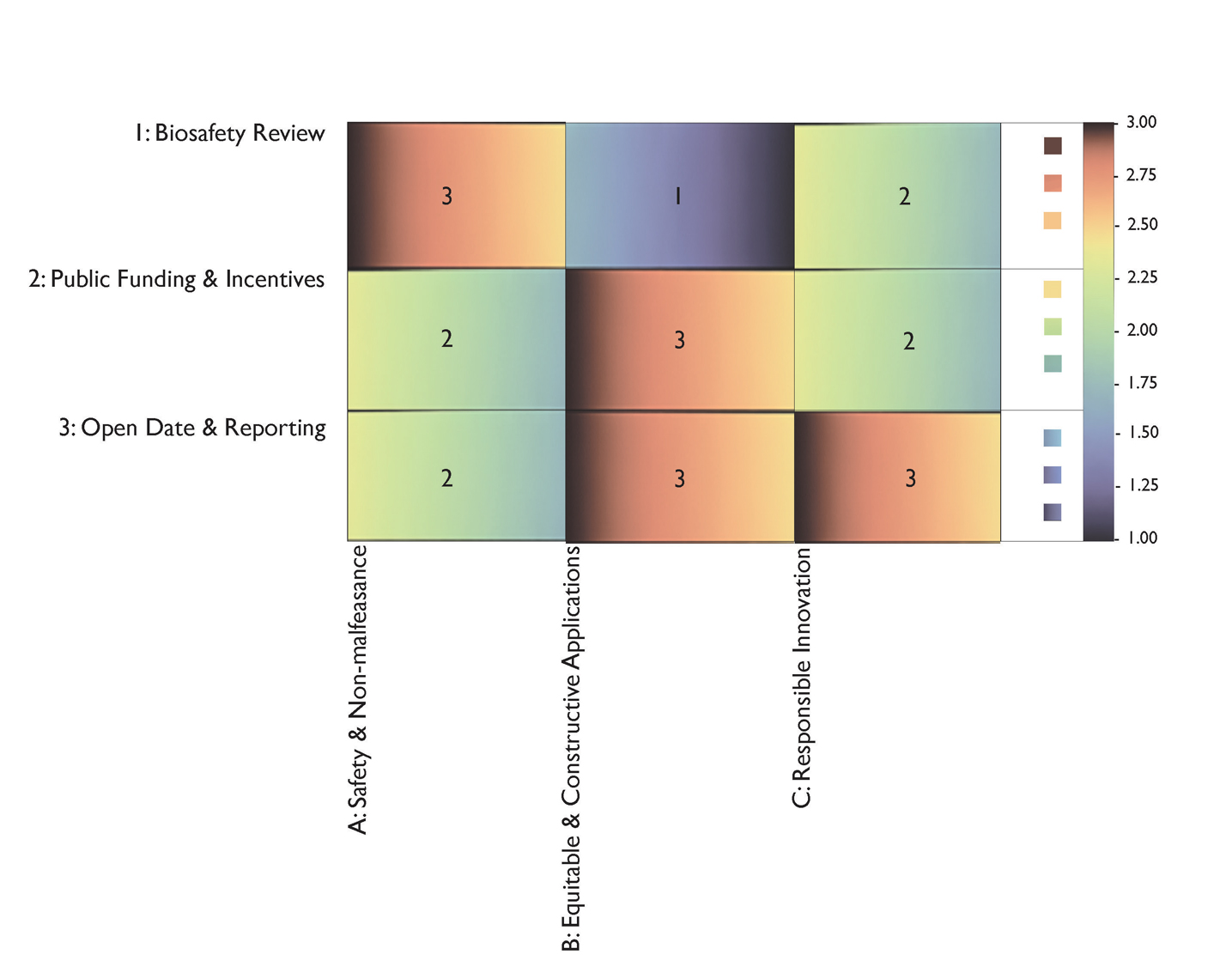
Governance actions x rubric of policy goals scores: 3 (most effective), 2 (moderately effective), 1 (least effective).
| Governance Action | A: Safety & Non-Malfeasance | B: Equitable & Constructive Applications | C: Responsible Innovation |
|---|
| 1: Biosafety & Bioelectrical Review Requirement | 3 (Directly addresses containment, electrical safety, and dual-use risk) | 1 (Focused on safety, not accessibility or environmental benefits) | 2 (Provides oversight but may limit experimental freedom) |
| 2: Public Funding & Incentives for Environmental Mycelium Applications | 2 (Indirectly supports safety by encouraging “low-risk” ecological uses) | 3 (Strongly encourages equitable, beneficial, and sustainable applications) | 2 (Encourages responsible innovation by guiding research direction) |
| 3: Open Data & Reporting Norms for Mycelial Behaviour | 2 (Improves safety indirectly by making results more reproducible and transparent) | 3 (Promotes accessibility and knowledge-sharing) | 3 (Encourages transparency, iterative experimentation, and interdisciplinary learning) |
Governance Action Effectiveness Across Policy Goals
(3 = most effective, 1 = least effective)
Last, drawing upon this scoring, describe which governance option, or combination of options, you would prioritize, and why. Outline any trade-offs you considered as well as assumptions and uncertainties. For this, you can choose one or more relevant audiences for your recommendation, which could range from the very local (e.g. to MIT leadership or Cambridge Mayoral Office) to the national (e.g. to President Biden or the head of a Federal Agency) to the international (e.g. to the United Nations Office of the Secretary-General, or the leadership of a multinational firm or industry consortia). These could also be one of the “actor” groups in your matrix.
Action 2 > Action 3 > Action 1
I would prioritise Public Funding & Incentives for Environmental Mycelium Applications (Action 2) and Open Data & Reporting Norms (Action 3), while keeping a lightweight Biosafety Review (Action 1) as a baseline. This combination encourages sustainable and equitable research, fosters transparency and reproducibility (of experiments despite natural variability in living mycelium), and supports responsible innovation without overburdening early experimental work.
Trade-offs include: potential “greenwashing” and access barriers for smaller labs
These can be mitigated through clear grant criteria and support for open participation.
Target audiences: National research councils, Universities, and Open-science platforms.
Reflecting on what you learned and did in class this week, outline any ethical concerns that arose, especially any that were new to you. Then propose any governance actions you think might be appropriate to address those issues. This should be included on your class page for this week.
One ethical issue that stood out to me this week was how human-centric much of my initial thinking was. Before starting the Biodesign course, most of my research and ideas were focused on solving human needs. However, as I began working with organisms and observing their growth and behaviour, I started to appreciate principles that extend beyond the human perspective. This shift made me realise that I don’t want my projects to treat non-human organisms merely as tools; I want the process to feel like a collaborative exchange between humans and non-humans. Because of this, even though I had multiple potential ideas for the HTGAA course, I struggled to settle on a final project, partly because I wanted it to reflect more-than-human principles rather than a purely human-centred goal.
Another concern that arose relates to the knowledge gap between designers and scientists when it comes to ethical governance. While I understand trust is central to ethical research, I realised that I don’t yet have a clear understanding of the specific rules, committees, and step-by-step processes that currently govern ethical work in biology and gene-editing. As a designer moving into the biological domain, I need to equip myself with this knowledge to ensure my practice aligns with existing regulations and ethical standards. To address this gap, I think there should be more accessible scientific communication and guidance targeted at interdisciplinary practitioners and this would help build trust and ensure ethics are not only a principle but a practical framework embedded in research.
To address these ethical concerns, one appropriate governance action would be to create interdisciplinary ethics resources specifically for designers and artists working with biological systems. These would clearly explain the relevant rules, committees, and step-by-step procedures that scientists follow, helping bridge the knowledge gap, build trust, and ensure that projects respect both human and more-than-human considerations.
References
- Adamatzky, A. (2016) Unconventional Computing: A Volume of the Handbook of Natural Computing. Cham: Springer.
- Adamatzky, A., Gandia, A., Chiolerio, A. and De Lacy Costello, B. (2018) ‘On spiking behaviour of oyster fungi pleurotus djamor’, Scientific Reports, 8, 7873.
- Robinson, J. M., Annells, A., Cando-Dumancela, C. & Breed, M. F. (2024) Sonic restoration: acoustic stimulation enhances soil fungal biomass and activity of plant growth-promoting fungi, Biology Letters, 20(10), 20240295.
- Smyth, S. J., et al. (2023). Governing biotechnology to provide safety and security and address ethical, legal, and social implications. Frontiers in Bioengineering and Biotechnology.
Subsections of Week 1 HW: Principles and Practices
Week 2 Lecture prep
Homework Questions from Professor Jacobson
1. Nature’s machinery for copying DNA is called polymerase. What is the error rate of polymerase? How does this compare to the length of the human genome. How does biology deal with that discrepancy?
According to Albertson & Preston (2006), it is estimated that replicative DNA polymerases make errors approximately once every 10⁴–10⁵ nucleotides polymerized; i.e. the error rate is 10⁻⁴ to 10⁻⁵, before proofreading and post‑replicative repair.
The human genome is roughly 3 billion base pairs (3 × 10⁹) (Cooper, 2000, The Human Genome).
If DNA polymerase worked alone with an error rate of 10⁻⁴ to 10⁻⁵, each time a cell divided it would introduce:
- At 10⁻⁵ error rate: ~30,000 errors per genome replication
- At 10⁻⁴ error rate: ~300,000 errors per genome replication
How biology solves this:
cells use a three-tier system that works sequentially:
- Nucleotide selectivity (~10⁻⁵ error rate): The polymerase active site favors correct base pairing through shape complementarity and hydrogen bonding (reference)
- Exonuclease proofreading (~100-1000× improvement): The 3’→5’ exonuclease activity catches errors immediately after incorporation, removing mismatched nucleotides before continuing (reference)
- Mismatch repair (~another 100-1000× improvement)
Together, these mechanisms reduce the effective error rate to roughly 10⁻⁹ – 10⁻¹⁰ per base (i.e 0.3 - 3 mutations per genome per replication), so only a few mutations are fixed per cell division despite the genome’s size. (Kunkel, 2009)
References:
Albertson, T. M. & Preston, B. D., 2006. DNA replication fidelity: proofreading in Trans. Current Biology, 16(6), pp.R209–R211. Available at: https://doi.org/10.1016/j.cub.2006.02.031.
Cooper, G.M. (2000) The Cell: A Molecular Approach. 2nd edn. Sunderland (MA): Sinauer Associates. Available at: National Center for Biotechnology Information – The Human Genome.
Kunkel, T.A. (2009). “Evolving views of DNA replication (in)fidelity.” Cold Spring Harbor Symposia on Quantitative Biology, 74, 91-101.
2. How many different ways are there to code (DNA nucleotide code) for an average human protein? In practice what are some of the reasons that all of these different codes don’t work to code for the protein of interest?
There are 61 codons that code for 20 amino acids. Most amino acids are degenerate, which means that multiple codons can code for one amino acid. The average human protein is around 400 amino acids (Milo et al., 2010). Since the average degeneracy per amino acid is approximately 3 codons, the number of possible DNA sequences is roughly 3⁴⁰⁰, which equals approximately 10¹⁹⁰ different ways to code for the same protein.
some of the reasons that all of these different codes don’t work to code for the protein of interest:
- Codon usage bias (Different organisms preferentially use certain codons over others)
- mRNA secondary structure (Different codon choices create different mRNA sequences that can form stable secondary structures (hairpins, loops) that block ribosome binding or prevent translation.)
- Translation speed and protein folding (Synonymous codons translate at different speeds, and incorrect translation timing can cause the protein to misfold co-translationally, even with the correct amino acid sequence.)
References:
Milo, R., Jorgensen, P., Moran, U., Weber, G., & Springer, M. (2010). BioNumbers—the database of key numbers in molecular and cell biology. Nucleic Acids Research, 38(suppl_1), D750-D753.
Quax, T. E., Claassens, N. J., Söll, D., & van der Oost, J. (2015). Codon bias as a means to fine-tune gene expression. Molecular Cell, 59(2), 149-161.
Homework Questions from Dr. LeProust:
1. What’s the most commonly used method for oligo synthesis currently?
solid-phase phosphoramidite chemistry
2. Why is it difficult to make oligos longer than 200nt via direct synthesis?
Each time a nucleotide is added during synthesis, the coupling efficiency is about 98-99%. This means 1-2% of molecules fail to add the nucleotide at each step. As the oligo gets longer, these errors accumulate, so fewer and fewer molecules are the correct full length. By 200 nucleotides, most of the product is incomplete (truncated sequences) rather than the desired full-length oligo.
3. Why can’t you make a 2000bp gene via direct oligo synthesis?
A 2000 bp gene is too long for direct synthesis because:
- the coupling efficiency errors accumulate so much that essentially no full-length product would be made (0.99^2000 ≈ zero)
- chemical damage accumulates on the already-synthesized nucleotides during the repeated chemical cycles (especially depurination)
- the growing chain becomes physically tangled and sterically hindered on the solid support, making it harder to add new nucleotides.
References:
Guzaev, A. P. (2013). Solid‐phase supports for oligonucleotide synthesis. Current Protocols in Nucleic Acid Chemistry, 53(1), 3-1.
Kosuri, S., & Church, G. M. (2014). Large-scale de novo DNA synthesis: technologies and applications. Nature Methods, 11(5), 499-507.
Homework Question from George Church:
Choose ONE of the following three questions to answer; and please cite AI prompts or paper citations used, if any.
1. [Using Google & Prof. Church’s slide #4] What are the 10 essential amino acids in all animals and how does this affect your view of the “Lysine Contingency”?
2. [Given slides #2 & 4 (AA:NA and NA:NA codes)] What code would you suggest for AA:AA interactions?
3. [(Advanced students)] Given the one paragraph abstracts for these real 2026 grant programs sketch a response to one of them or devise one of your own:
What are the 10 essential amino acids in all animals and how does this affect your view of the “Lysine Contingency”?
The 10 essential amino acids, according to Lopez et al. (2024):
- Histidine (His)
- Isoleucine (Ile)
- Leucine (Leu)
- Lysine (Lys)
- Methionine (Met)
- Phenylalanine (Phe)
- Threonine (Thr)
- Tryptophan (Trp)
- Valine (Val)
- Arginine (Arg)
Lysine, in particular, cannot be synthesised by vertebrates and must be obtained through dietary sources such as meat, dairy, eggs, and legumes (WebMD, n.d.).
The “Lysine Contingency” in Jurassic Park (both the book and the film) is presented as a genetic safety measure where the dinosaurs were engineered so they couldn’t produce the amino acid lysine, meaning they would die without supplements. But this is scientifically nonsensical, because Dinosaurs (vertibrates) already would not be capable of producing lysine on their own. Like modern animals, they would get it from their food. So there wouldn’t have been any need to genetically engineer this limitation, because it already exists in normal vertebrate biology.
References:
Jurassic Park Wiki (n.d.) Lysine contingency. Available at: https://jurassicpark.fandom.com/wiki/Lysine_contingency
Lopez, M. J., & Mohiuddin, S. S. (2024). Biochemistry, essential amino acids. In StatPearls [Internet]. StatPearls Publishing.
WebMD (n.d.) Foods High in Lysine. Available at: https://www.webmd.com/diet/foods-high-in-lysine
Week 2 HW: DNA Read Write and Edit
Part 1: Benchling & In-silico Gel Art
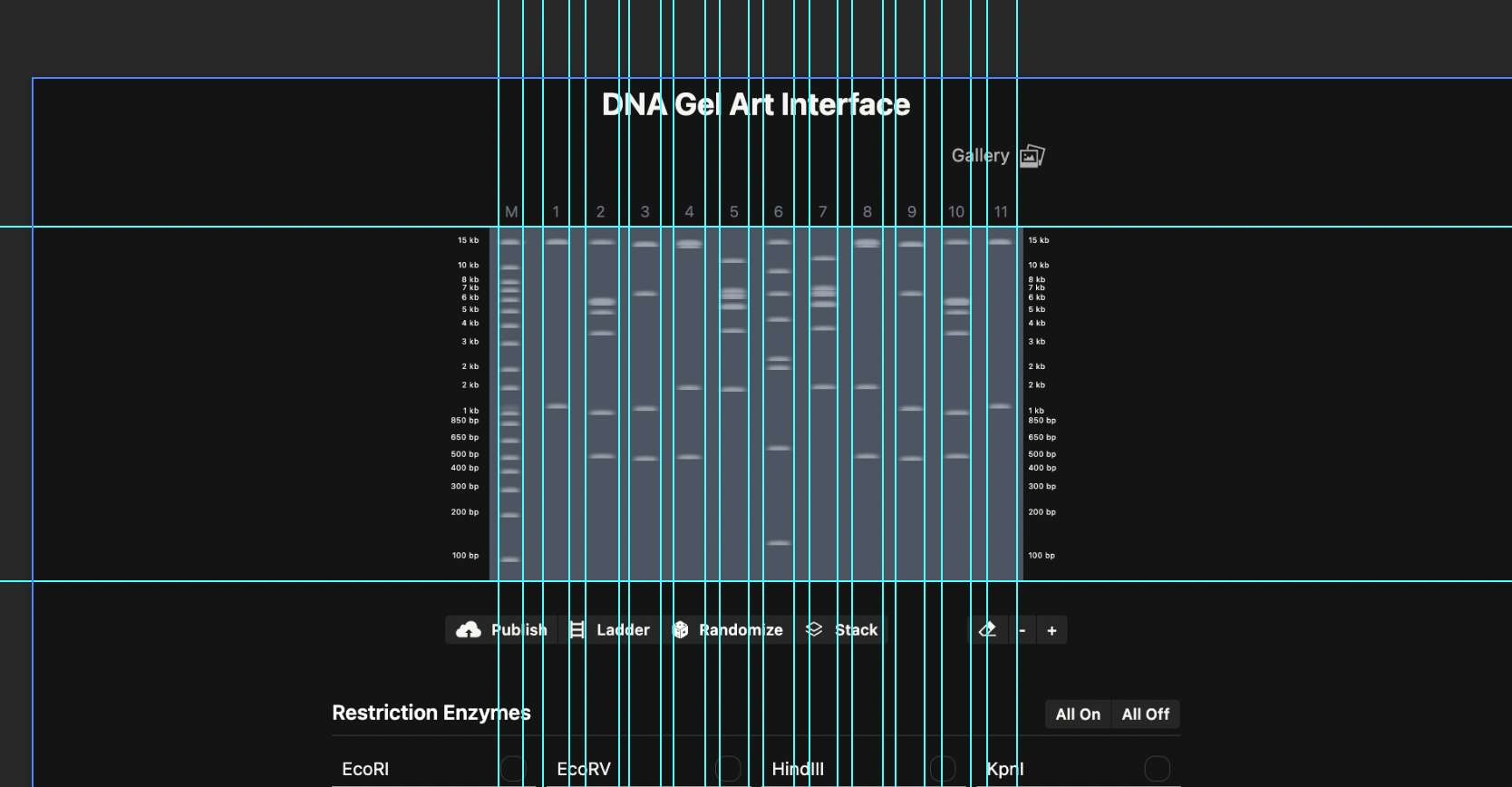
Image: modified in photoshop
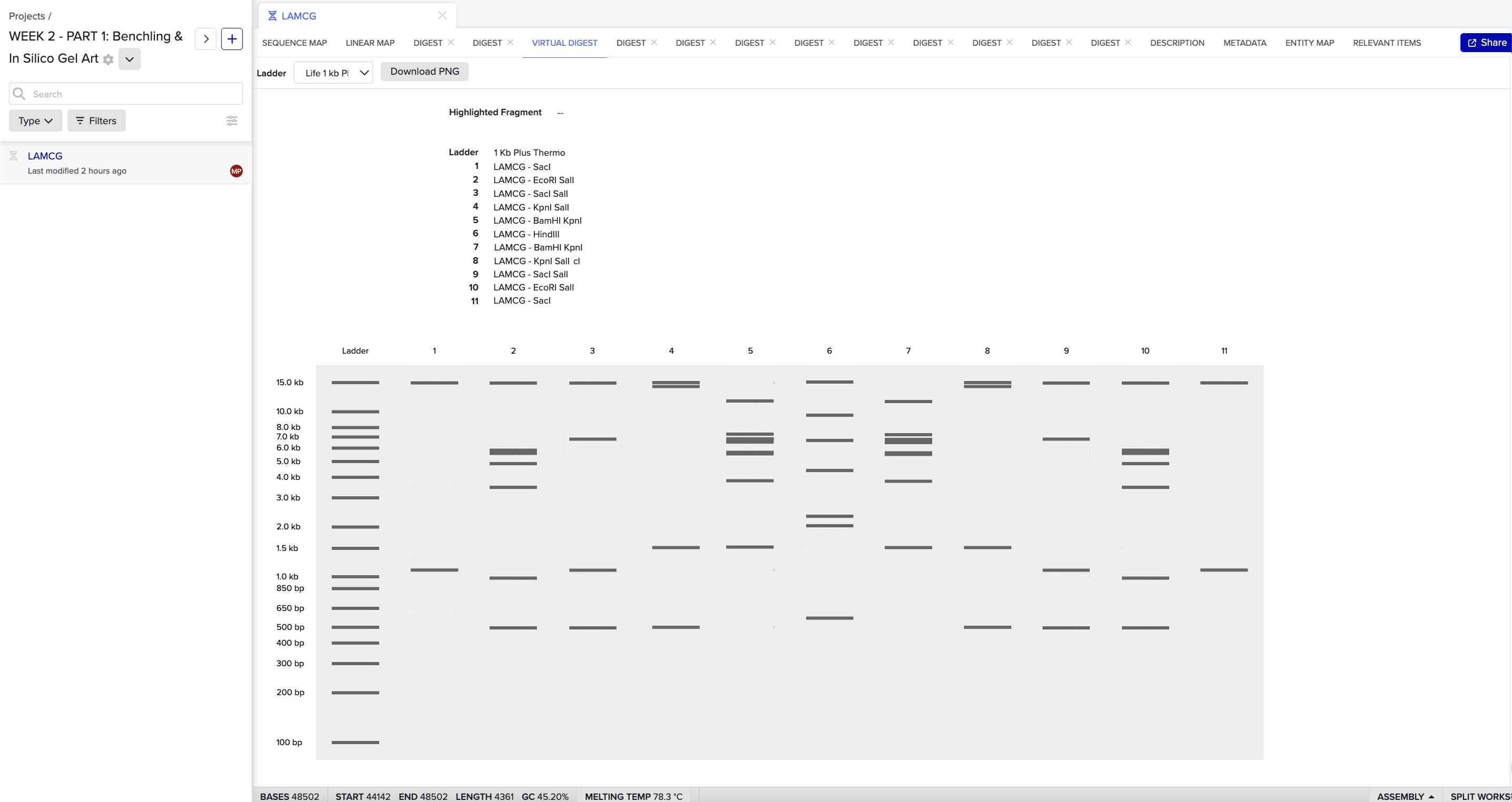
Image: modified in photoshop
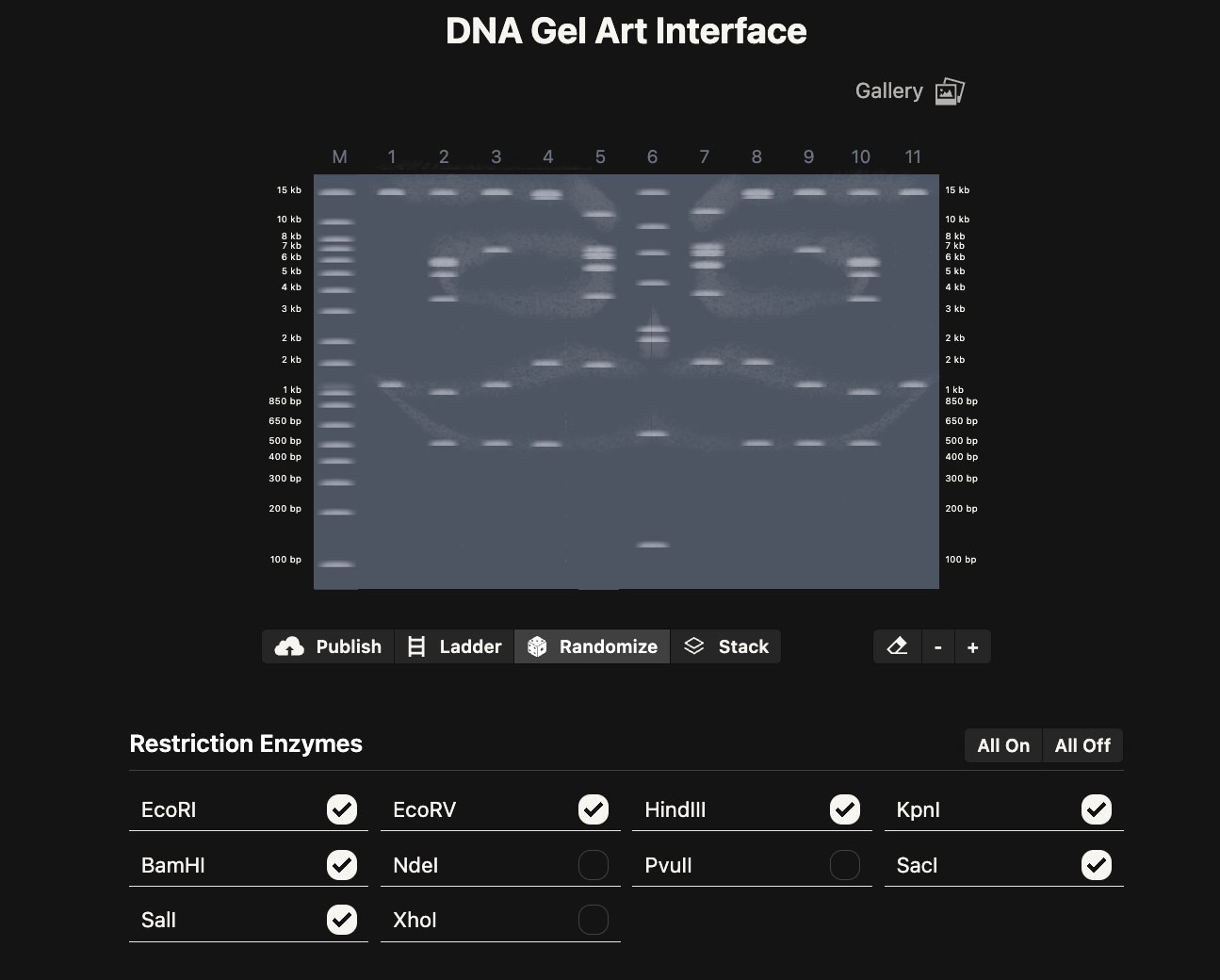
Image: modified in photoshop
| Component | M | 1 | 2 | 3 | 4 | 5 | 6 | 7 | 8 | 9 | 10 | 11 |
|---|
| Water | 19 µL | 14 µL | 13 µL | 13 µL | 13 µL | 13 µL | 14 µL | 13 µL | 13 µL | 13 µL | 13 µL | 14 µL |
| CutSmart Buffer | - | 2 µL | 2 µL | 2 µL | 2 µL | 2 µL | 2 µL | 2 µL | 2 µL | 2 µL | 2 µL | 2 µL |
| λ DNA | - | 3 µL | 3 µL | 3 µL | 3 µL | 3 µL | 3 µL | 3 µL | 3 µL | 3 µL | 3 µL | 3 µL |
| Enzyme(s) | 1 µL Ladder | 1 µL SacI | 1 µL EcoRI | 1 µL SacI | 1 µL KpnI, 1 µL SalI | 1 µL KpnI, 1 µL BamHI | 1 µL HindIII | 1 µL KpnI, 1 µL BamHI | 1 µL KpnI, 1 µL SalI | 1 µL SacI, 1 µL SalI | 1 µL EcoRI, 1 µL SalI | 1 µL SacI |
Part 3: DNA Design Challenge
3.1. Choose a protein that you find interesting. Which protein have you chosen and why? Using one of the tools described in recitation (NCBI, UniProt, google), obtain the protein sequence for the protein you chose.
[Example from our group homework, you may notice the particular format — The example below came from UniProt]
>sp|P03609|LYS_BPMS2 Lysis protein OS=Escherichia phage MS2 OX=12022 PE=2 SV=1 METRFPQQSQQTPASTNRRRPFKHEDYPCRRQQRSSTLYVLIFLAIFLSKFTNQLLLSLL EAVIRTVTTLQQLLT
Proteins research:
- Aquaporins - facilitates transport of water, glycerol, and other small solutes across biological membranes
- Hydrophobins - modulates hydrophobicity to aid aerial growth and environmental adaptation.
- GTPase - molecular switches
The protein I chose is VMH3-1, a Class I hydrophobin present in Pleurotus ostreatus strain PC15. This forms a hydrophobic coating on the cell walls allowing mycelium to grow in damp environments without sinking into them for example: soil
[tr|Q8WZI4|Q8WZI4_PLEOS Hydrophobin OS=Pleurotus ostreatus OX=5322 GN=vmh3-1 PE=3 SV=1
MFFQTTIVAALASLAVATPLALRTDSRCNTESVKCCNKSEDAETFKKSASAALIPIKIGD
ITGKVYSECSPIVGLIGGSSCSAQTVCCDNAKFNGLVNIGCTPINVAL]
https://www.uniprot.org/uniprotkb/Q8WZI4/entry
3.2. Reverse Translate: Protein (amino acid) sequence to DNA (nucleotide) sequence.
The Central Dogma discussed in class and recitation describes the process in which DNA sequence becomes transcribed and translated into protein. The Central Dogma gives us the framework to work backwards from a given protein sequence and infer the DNA sequence that the protein is derived from. Using one of the tools discussed in class, NCBI or online tools (google “reverse translation tools”), determine the nucleotide sequence that corresponds to the protein sequence you chose above.
[Example: Get to the original sequence of phage MS2 L-protein from its genome phage MS2 genome - Nucleotide - NCBI]
Lysis protein DNA sequence
atggaaacccgattccctcagcaatcgcagcaaactccggcatctactaatagacgccggccattcaaacatgaggattacccatgtcgaagacaacaaagaagttcaactctttatgtattgatcttcctcgcgatctttctctcgaaatttaccaatcaattgcttctgtcgctactggaagcggtgatccgcacagtgacgactttacagcaattgcttacttaa
VMH3-1 protein Nucleotide sequence
[>AJ420971.1 Pleurotus ostreatus vmh3-1 gene for hydrophobin 3 (allele 1), exons 1-3
ATGTTCTTCCAAACTACCATCGTCGCCGCCCTCGCTTCCCTTGCGGTCGCCACTCCTCTCGCACTTCGCA
CTGACAGTCGCTGCAACACCGAGTCCGTGAAGTGCTGCAACAAGTCTGAGGATGCAGAGACCTTCAAGAA
GAGCGCGTCGGCCGCCCTCATCCCGATTAAGATCGGTGATATTACCGGCAAGGTGTACTCGGAGTGTTCT
CCCATTGTCGGCCTCATTGGCGGGTCTAGCTGGTACGTGTCTTTGTGCGTCTCTGATGTCAAGTCTGTTC
TGACTCTTTTTTCAGCTCCGCGCAAACCGTTTGCTGCGATAACGCTAAATTCAGTAAGCAATCATTCTTG
GGCCTCTTCATTGACTTTCGGCGGAGAATTTGGTACTAATTCTTCCGCATGTTAGATGGTCTCGTCAACA
TTGGATGCACGCCCATCAACGTTGCCTTGTAA]
https://www.ncbi.nlm.nih.gov/nuccore/AJ420971.1?report=fasta
3.3. Codon optimization
Once a nucleotide sequence of your protein is determined, you need to codon optimize your sequence. You may, once again, utilize google for a “codon optimization tool”. In your own words, describe why you need to optimize codon usage. Which organism have you chosen to optimize the codon sequence for and why?
[Example from Codon Optimization Tool | Twist Bioscience while avoiding Type IIs enzyme recognition sites BsaI, BsmBI, and BbsI]
Lysis protein DNA sequence with Codon-Optimization
ATGGAAACCCGCTTTCCGCAGCAGAGCCAGCAGACCCCGGCGAGCACCAACCGCCGCCGCCCGTTCAAACATGAAGATTATCCGTGCCGTCGTCAGCAGCGCAGCAGCACCCTGTATGTGCTGATTTTTCTGGCGATTTTTCTGAGCAAATTCACCAACCAGCTGCTGCTGAGCCTGCTGGAAGCGGTGATTCGCACAGTGACGACCCTGCAGCAGCTGCTGACCTAA
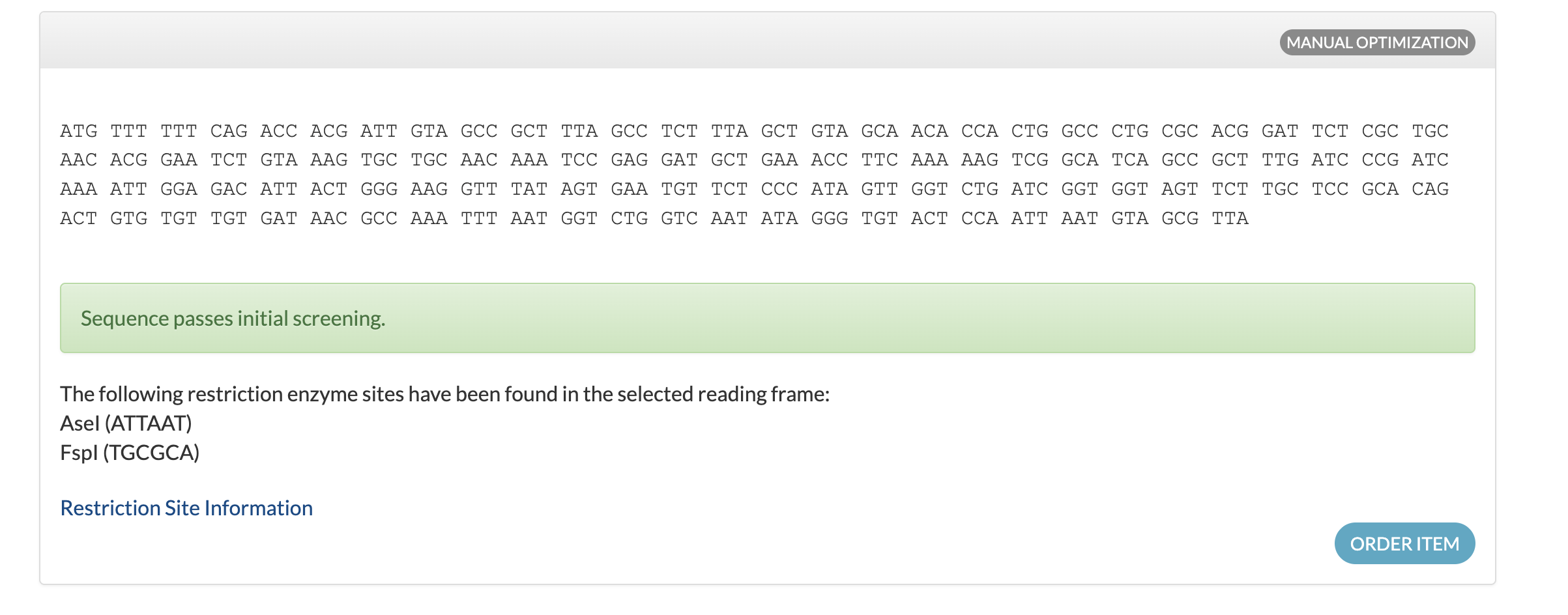
https://eu.idtdna.com/CodonOpt
I chose Escherichia coli or E.coli for codon optimisation sequence due to:
- Ease of replication: E. coli doubles every 20-30 min (fungi = days)
- High production: 100-500 mg/L vs 1-10 mg/L native PC15
- Proven system: Industry standard for recombinant hydrophobins
Optimising codon usage is important because not all codons are used equally in every organism. I learnt that even though multiple codons can code for the same amino acid, some are preferred over others depending on the species. (While I was using IDT Codon optimisation tool, I checked for different organims) Using codons that match the host organism’s preferred usage can improve translation efficiency and protein expression (Mäkelä et al., 2020).
If codons are rare in the host, the ribosome may stall during translation due to limited availability of the corresponding tRNAs, leading to slower protein synthesis, misfolded proteins, or low yield. Optimizing codons ensures smoother, faster translation and can enhance protein stability, functional folding, and overall biotechnological productivity (Mäkelä et al., 2020).
One detail I learnt (probably insignificant for science specialists): I initially tried optimising from the DNA sequence directly, but it did not give accurate results because the sequence could not be properly sorted into triplets. I attempted decoding it using perplexity, but that also failed to produce an answer. Through the chats, I learnt that the DNA sequence could be written differntly obstained from translation of the amino acid (AA) sequence. I recalled how Prof. George mentioned in class that different amino acids have different codons. I then tried optimising the sequence starting from the AA sequence from UniProt and was able to successfully generate an optimised codon sequence for E. coli.
Reference:
Mäkelä, M. et al. (2020) ‘Codon optimization with deep learning to enhance protein expression’, Scientific Reports, 10, p. 16968. Available at:
https://www.nature.com/articles/s41598-020-74091-z
3.4. You have a sequence! Now what?
What technologies could be used to produce this protein from your DNA? Describe in your words the DNA sequence can be transcribed and translated into your protein. You may describe either cell-dependent or cell-free methods, or both.
DNA READ
(i) What DNA would you want to sequence (e.g., read) and why? This could be DNA related to human health (e.g. genes related to disease research), environmental monitoring (e.g., sewage waste water, biodiversity analysis), and beyond (e.g. DNA data storage, biobank).
(ii) In lecture, a variety of sequencing technologies were mentioned. What technology or technologies would you use to perform sequencing on your DNA and why?
Also answer the following questions:
1. Is your method first-, second- or third-generation or other? How so?
2. What is your input? How do you prepare your input (e.g. fragmentation, adapter ligation, PCR)? List the essential steps.
3. What are the essential steps of your chosen sequencing technology, how does it decode the bases of your DNA sample (base calling)?
4. What is the output of your chosen sequencing technology?
DNA WRITE
(i) What DNA would you want to synthesize (e.g., write) and why?
These could be individual genes, clusters of genes or genetic circuits, whole genomes, and beyond. As described in class thus far, applications could range from therapeutics and drug discovery (e.g., mRNA vaccines and therapies) to novel biomaterials (e.g. structural proteins), to sensors (e.g., genetic circuits for sensing and responding to inflammation, environmental stimuli, etc.), to art (DNA origamis). If possible, include the specific genetic sequence(s) of what you would like to synthesize!
(ii) What technology or technologies would you use to perform this DNA synthesis and why?
Also answer the following questions:
1. What are the essential steps of your chosen sequencing methods?
2. What are the limitations of your sequencing method (if any) in terms of speed, accuracy, scalability?
DNA EDIT
(i) What DNA would you want to edit and why?
In class, George shared a variety of ways to edit the genes and genomes of humans and other organisms. Such DNA editing technologies have profound implications for human health, development, and even human longevity and human augmentation. DNA editing is also already commonly leveraged for flora and fauna, for example in nature conservation efforts, (animal/plant restoration, de-extinction), or in agriculture (e.g. plant breeding, nitrogen fixation). What kinds of edits might you want to make to DNA (e.g., human genomes and beyond) and why?
(ii) What technology or technologies would you use to perform these DNA edits and why?
Also answer the following questions:
1. How does your technology of choice edit DNA? What are the essential steps?
2. What preparation do you need to do (e.g. design steps) and what is the input (e.g. DNA template, enzymes, plasmids, primers, guides, cells) for the editing?
3. What are the limitations of your editing methods (if any) in terms of efficiency or precision?