“Flutter Developer. AI Researcher. Bio-Hacker in Training.”
I am the founder of SincereGen Technologies and a passionate software engineer specializing in Flutter, Dart, and Python. My background is deeply rooted in building scalable mobile applications and integrating complex AI models into user-friendly interfaces.
What fascinates me about biology is its resemblance to software. DNA is the ultimate legacy code, a 4-letter programming language that compiles into living matter.
I joined HTGAA 2026 to bridge these two worlds. I want to apply the principles of software engineering, modularity, abstraction, and debugging, to synthetic biology. My goal is to move beyond just writing code for screens and start writing code for cells, creating tools that make the “engineering” of biology as accessible as app development.
Project Proposal: Bio-IDE and Governance Architecture.
Subsections of Homework
Week 1 HW: Principles and Practices
Describe a biological engineering application or tool you want to develop and why.
The Problem:
Currently, designing a cloning experiment requires a fragmented, complex workflow. A researcher must search AddGene for vectors, use NEBcutter for enzyme selection, and switch to desktop software like SnapGene for visualization. This fragmentation leads to data compatibility errors and high barriers to entry for students, labbers, and hobbyists who cannot afford expensive software licenses.
The Solution:
Bio-IDE is a browser-based “Co-Pilot” that unifies these tools into one intelligent workflow:
Intent-Based Input: The user states a simple goal (e.g., “Express GFP in E. coli”).
Ranked Recommendations: Instead of a single “black box” answer, the system retrieves top plasmid candidates from public registries.
Top Pick: The algorithm highlights the most optimized vector (e.g., “Best for High Yield”).
Alternatives: It lists valid secondary options sorted by compatibility (e.g., “Best for Low Toxicity”).
Algorithmic Cloning: It automatically identifies compatible restriction sites and simulates the ligation.
Instant Visualization: It renders an interactive circular map of the final construct, ready for synthesis.
Why:
By shifting from fragmented desktop tools to a unified web app, we democratize access to high-level biological design. A student in a resource-constrained lab can design industrial-grade experiments on a simple laptop.
Describe one or more governance/policy goals related to ensuring that this application or tool contributes to an “ethical” future?
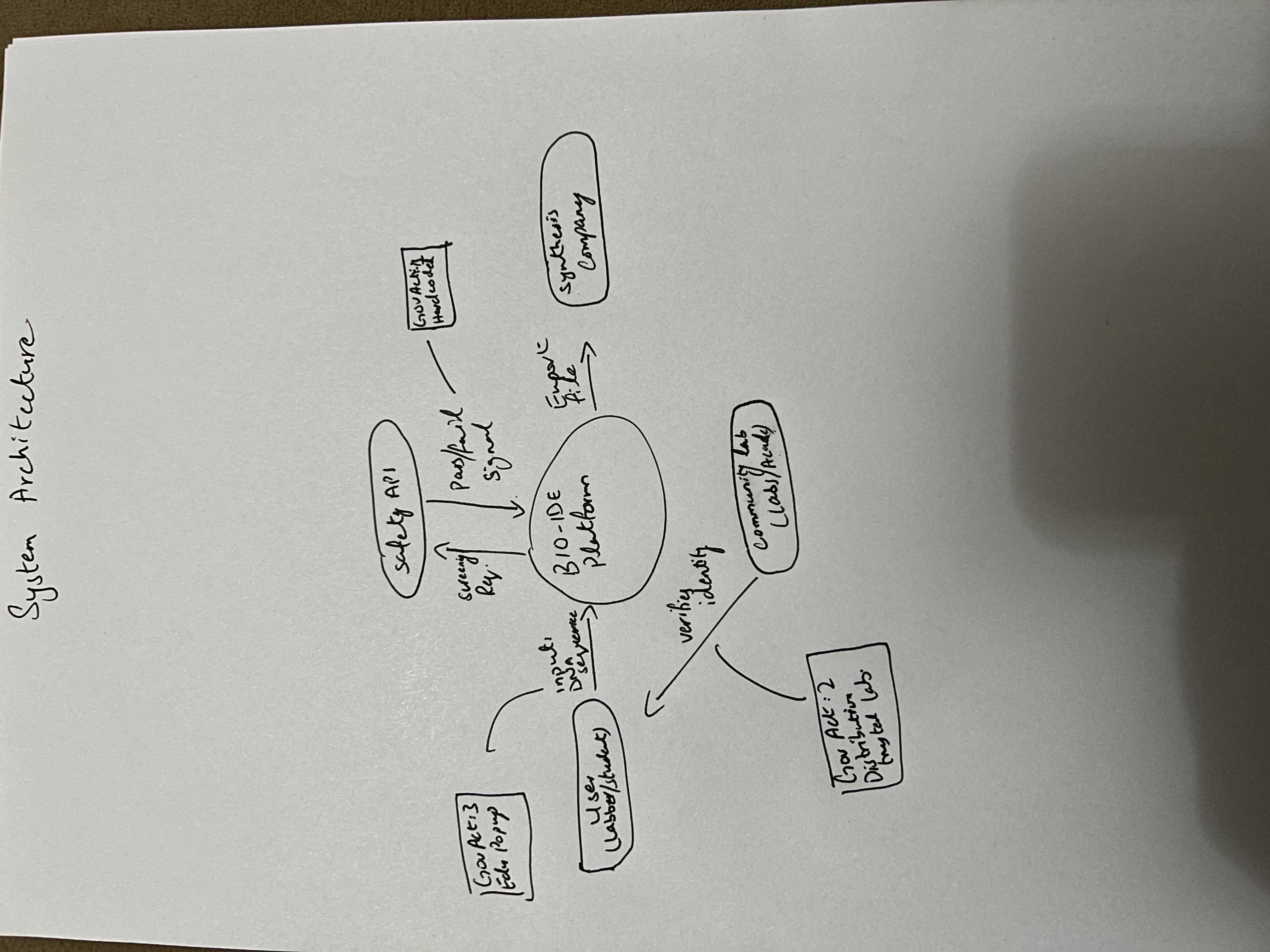
Figure 1: Governance Ecosystem Sketch
To ensure Bio-IDE contributes to an ethical future, I propose the following goals:
Goal A: “Safety by Default” (Non-Malfeasance): Ensure that the democratization of design tools does not lead to the democratization of danger. The platform must have embedded, non-bypassable safety checks that screen every design for known pathogens and toxins.
Goal B: Universal Accessibility (Equity): The primary goal is to lower the barrier to entry. The tool must remain accessible to researchers in developing nations and community labs, ensuring that “biological literacy” is not restricted by geography or institutional affiliation.
Describe at least three different potential governance “actions” by considering the four aspects below (Purpose, Design, Assumptions, Risks of Failure & “Success”)?
Option 1: The “Embedded Safety” API (Hard Control)
Design: Every design is silently sent to a screening API (e.g., Gryphon Scientific) before visualization. If a threat is detected, export is disabled.
Purpose: Makes safety invisible and automatic; removes the ability to “opt-out.”
Option 2: The “Community Verification” Web (Social Trust)
Design: A “Web of Trust” model where new users are verified by existing trusted nodes (e.g., Bio-Academy instructors) to unlock advanced features.
Purpose: Replaces centralized ID checks with a distributed social immune system.
Option 3: The “Educational Pop-Up” (Informed Consent)
Design: Before exporting a design with a “Risk Group 1” organism, users must answer a short quiz about safe handling.
Purpose: Ensures users understand the biological reality of what they are designing (preventing accidental misuse).
Describe which governance option, or combination of options, you would prioritize, and why?
I prioritize Option 1 (Embedded Safety) supported by Option 3 (Educational Quiz).
Reasoning:
As a solo developer, I need scalable solutions. Option 1 provides the “Hard Wall” against bioweapons, while Option 3 provides the “Soft Skills” to ensure students handle even safe organisms correctly. Both can be implemented in code without requiring a massive human support team (unlike Option 2, which requires managing a complex human trust network).
Ethical Reflection Over the last lecture:
New Concern: The “Black Box” Problem
Reflecting on this week’s lectures, I worry that automating the design process might lead to “Scientific Deskilling.” If the AI chooses the plasmid and the enzymes, the student might never learn why those choices were made.
Proposed Governance:
To counter this, Bio-IDE will implement an “Explainable AI” (XAI) interface. It will not just say “Use pUC19.” It will say: “I recommend pUC19 because your gene is small (500bp) and you requested high copy number for maximum yield.” This turns the tool into a mentor, not just a machine.
Week 2 Lecture Prep: DNA Read, Write, Edit
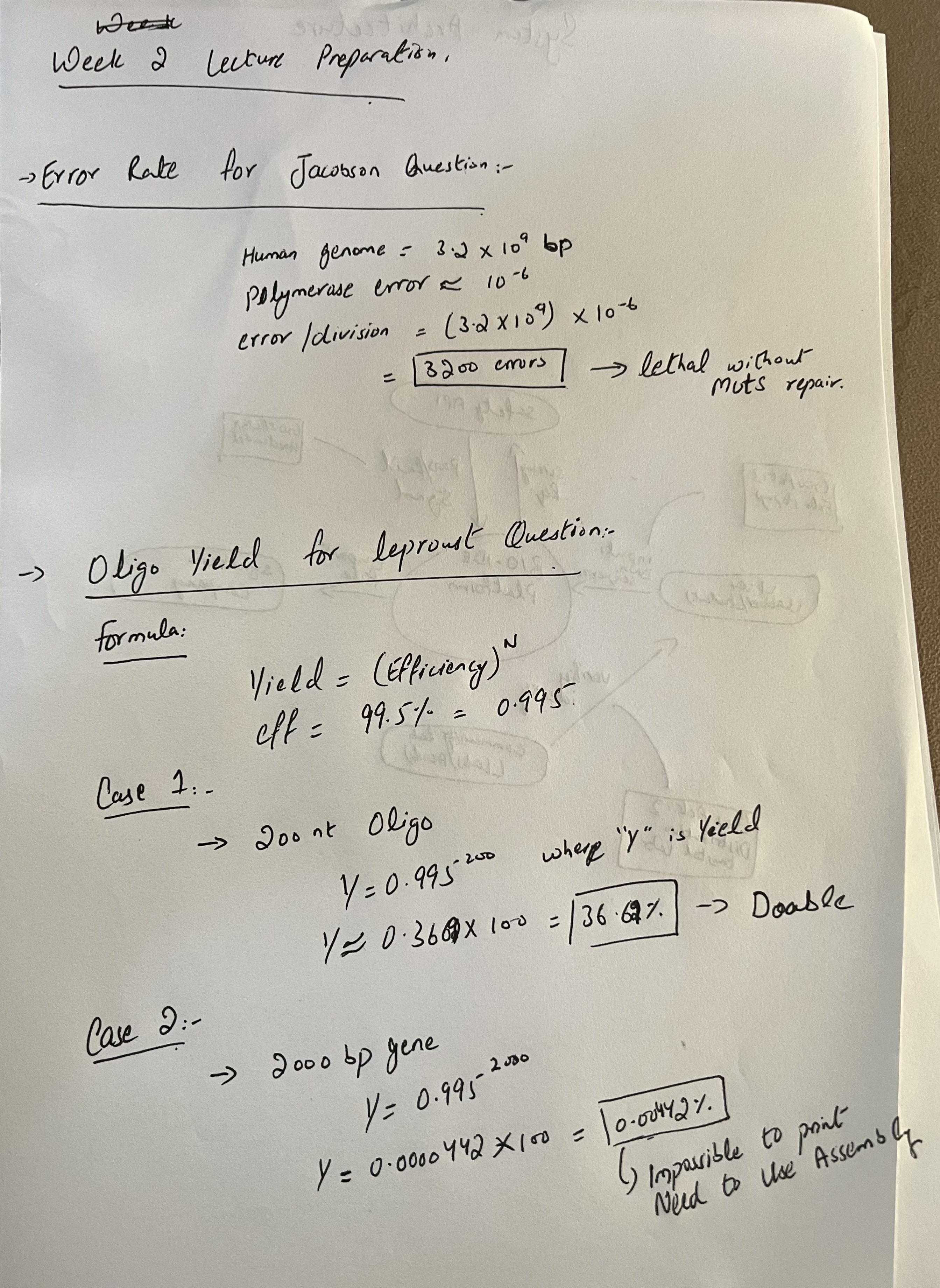
Figure 2: My calculations for Polymerase error rates and Oligo synthesis yields.
Part 1: Prof. Jacobson (Theory)
How biology deals with the error discrepancy:
As calculated above, 3,200 errors per division is too high. Biology solves this with a Mismatch Repair (MMR) system (MutS/MutL). This system scans the DNA after the polymerase passes, finding “bumps” (mismatches) and cutting them out. This improves accuracy by another 1000x, bringing the final error rate to ~10^-9 (less than 1 error per genome).
Why coding for proteins is difficult (Secondary Structure):
Even if a DNA sequence theoretically codes for the right amino acids, it might fail in practice due to Secondary Structure. If the mRNA folds into a tight hairpin loop (as seen in NUPACK simulations), the ribosome cannot bind to the “Start” signal, and translation never happens.
Part 2: Dr. LeProust (Theory)
Most Common Synthesis Method:
The industry standard is Phosphoramidite Chemistry. It is a 4-step cycle (De-blocking –> Coupling –> Capping –> Oxidation) performed on a solid support (like a silicon chip or glass beads).
Why we can’t print 2000bp genes:
As shown in my calculations (Figure 2), the yield for a 2000bp sequence drops to 0.004%. This means the test tube would contain almost entirely “trash” (truncated fragments). To build a 2000bp gene, we must synthesize short oligos (e.g., 60-100nt) and stitch them together using enzymes (Gene Assembly).
Part 3: George Church (The Lysine Contingency)
Question: What are the 10 essential amino acids, and how does this affect the “Lysine Contingency”?
The Flaw in Jurassic Park: The movie claimed that genetically engineering dinosaurs to be “Lysine Deficient” was a security fail-safe. However, Lysine is essential for ALL animals (including humans). None of us can produce it; we all get it from our diet.
Conclusion: If the dinosaurs escaped, they wouldn’t die. They would simply obtain Lysine by eating plants or other animals, just like they would in the wild. The “contingency” was scientifically meaningless.