Week 1 HW: Principles and Practices

Engineered Biosensors For the Detection of Illegal Mining Pollutants
Week One’s Principles and Practice class taught us the foundations of ethics, safety, and governance using biotechnology. While pondering ideas for the bioengineered tool or application, I was inspired by the battle against the ongoing menace of small-scale illegal mining in Ghana propularly known as “Galamsey”.
Illegal mining is the extraction of minerals, metals, or other resources without proper authorization, permits, or compliance with national laws or regulations. It leads to the destruction of forests, leading to the loss of biodiversity, land degradation, and water pollution of rivers and groundwater with pollutants such as mercury, cyanide, and arsenic. Water pollution from galamsey activities is causing chronic diseases as pollutants seep into the water supply undetected.

I wish to explore the development of a microbial testing kit that uses genetically engineered non-pathogenic microbes to detect metal pollutants such as mercury, cyanide, and arsenic associated with small-scale mining activities in Ghana. The bioengineered microbe should be housed in a sealed, single-use microfluidic cartridge that will generate a visible signal when pollutant concentrations exceed defined thresholds. This approach will be a low-cost, rapid, and field-deployable environmental monitoring tool that can support public health by preventing the use of contaminated water supply and aid remediation efforts by facilitating the tracking of pollutants without the direct release of bioengineered organisms in the environment.

Escherichia coli will serve as an ideal engineered biosensor for detecting mining pollutants because it can be genetically engineered to couple potent specific sensing elements with standardized reporter outputs. It has native regulatory systems responsive to mercury, cyanide, and arsenic that can be integrated with plug-and-play genetic circuits that convert toxin recognition into a visible or measurable signal, such as fluorescence or luminescence. Engineered E. coli biosensors have been successfully demonstrated for mercury using mer-regulated promoters, for arsenic using ars operon regulators, and for cyanide through redox- and respiration-linked sensing systems, highlighting their sensitivity, specificity, and applicability for environmental monitoring in contaminated water systems. Making it a practical platform for environmental monitoring in mining-impacted regions.
Governance & Policy Goals for Ethical Usage
I chose these policy goals due to the project being a contained diagnostic synthetic biology tool, not a system meant for environmental release. As such, the primary ethical risks center on contaiment, missue and social impact.
Policy Goals
- Biological Containment and Preventing Harm.
- Prevent environmental release
- Prevent horizontal gene transfer
- Ensure post-use inactivation
- Responsible Use and Misuse Prevention
- Restrict access to live biological material
- limit modification and replication
- Ensure appropriate interpretation of results
- Environmental and Social Protection
- Avoid stigmatization or punitive misuse of data
- Support remediation and public health responses
- Protect vulnerable communities
- Accessibility and Constructive Innovation
- Maintain affordability
- Avoid impeding legitimate research
- Encourage local adoption and trust
Governance Actions
Option 1. Build-In Dual Contatiment
Purpose
Currently, biosensors are often regulated based on organism release risk. This option shift goverance upsteam by embedding safety directly into design.
Design
- Physical containment (sealed cartridges, microfluidics)
- Genetic safeguards(auxtrophy, kill switches, chromosomal integration)
- Automation chemical inactivation after use.
Actors
- Academic researchers to aid in design.
- Biotechnology companies to facilitate manufacturing.
- Biosafety regulators such as the Environmental Protection Agency (EPA) and the National Biosafety Authority (NBA) for approval standards.
- Funders: biosafety enforcement through grants and investments.
Assumptions
- Containment systems remain reliable across conditions
- Kill switches remain evolutionarily stable.
Risks of Failure & Success
- Failure: Manufacturing defects or improper disposal
- Success risk: over-reliance on technical fixes leading to reduced oversight
Option 2. Device-Level Regulatory Certification
Purpose
More governance from organism-based oversight to diagnostic-device style regulation, similar to water quality strips or pregnancy kits.
Design
- Certification based on performance, containment, disposal, and shelf life.
- Independent validation studies
- Periodic recertification.
Actors
- National environmental agencies: defining acceptable detection thresholds
- Biosafety authorities: monitor post approval compliance and certify containment, inactivation, and disposal protocols.
- standards organizations: develop testing, labelling, and performance standards.
- Independent academic validators: conduct third-party performance and safety evaluations to provide credibility and transparency.
Assumptions
- Regulators have the capacity to evaluate synthetic biology devices.
- Certification increases public trust.
Risks of Failure & Success
- Failure: slow approval processes.
- Success risk: compliance cost excludes small innovators.
Option 3: Controlled Distribution and Stewardship
Purpose
Prevents misuse while ensuring ethical use.
Design
- Distribution through approved institutions such as the EPA, NGOs and Universities.
- Basic user training.
- Standardize results reporting templates.
- No access to cell or DNA.
Actors
- Local environmental agencies: distribute kits to approved users, aggregate and interpret monitoring data.
- NGOs and community organizations: act as community intermediaries, train users, and support ethical use.
- Universities and extension services: provide technical training and oversight, update protocols as science evolves, and support data quality and analysis.
- Local governments: coordinate response actions, ensure data is used for public health, not punishment, and set rules on who can deploy kits.
Assumptions
- Training reduces misuse
- Institutions act in the community’s interest.
Risk of Failure and Success
- Failure: informal redistribution
- Success risk: limited access in remote areas
Governance Scoring
Scores
- 1 = Most Effective
- 2 = Moderatly Effective
- 3 = Minimally Effective
| Does the option: | Option 1 | Option 2 | Option 3 |
|---|---|---|---|
| Enhance Biosecurity | |||
| • By preventing incidents | 1 | 1 | 2 |
| Foster Lab Safety | |||
| • By preventing incident | 1 | 1 | 2 |
| Protect the environment | |||
| • By preventing incidents | 1 | 1 | 2 |
| Other considerations | |||
| • Preventing misuse | 1 | 1 | 1 |
| • Minimizing costs and burdens to stakeholders | 2 | 2 | 3 |
| • Community Protection | 2 | 2 | 1 |
| • Feasibility? | 1 | 2 | 2 |
| • Not impede research | 1 | 2 | 2 |
| • Promote constructive applications | 1 | 1 | 2 |
Prioritization and Recommendation
I would prioritize a combined strategy of Option 1 (Dual containment) as a non-negotiable baseline, Option 2 (Device-level certification) for clarity and trust, and Option 3 (Controlled distribution) selectively in high-risk or sensitive contexts. This layered approach balances technical safety, regulatory clarity, and social responsibility. The primary trade-offs are increased development cost and reduced flexibility, but this is justified by a substantial reduction in ecological, ethical, and reputational risk.
Assignment Week 2 Lecture Prep
Homework Questions from Professor Jacobson
Question 1. Nature’s machinery for copying DNA is called polymerase. What is the error rate of polymerase? How does this compare to the length of the human genome. How does biology deal with that discrepancy?
Question 2. How many different ways are there to code (DNA nucleotide code) for an average human protein? In practice what are some of the reasons that all of these different codes don’t work to code for the protein of interest?
Answers
Question 1. The error rate of DNA polymerase is approximately 1 mistake for every 106 added during DNA replication. The intrinsic 3’ to 5’ exonucleolytic proofreading activity of DNA polymerase removes the mismatch bases and lowers the replication error rate to about 108 nucleotides. When this is combined with the post-replication mismatch repair mechanisms, the overall error rate is reduced to better than 1 in 109 nucleotides. The human genome consists of approximately 3.1 to 3.2 billion base pairs (3×10^10) due to the combined accuracy of DNA polymerase, 3’ to 5’ exonucleolytic proofreading activity, and post-replication repair. The error rate compared to the human genome is less than one mistake per genome per cell division cycle. Biology deals with the discrepancy through a multilayered correction system that consists of polymerase accuracy, 3’ to 5’ exonucleolytic proofreading activity, post-replicational mismatch, and redundancy in DNA sequences, which prevent the massive number of errors that would occur otherwise.
Question 2. The genetic code consists of 4 nucleotide bases that code for 20 amino acids. mRNA reads nucleotides in triplets called codons, resulting in 64 possible codon combinations. The average human protein is composed of approximately 300 to 500 amino acids, and most amino acids are encoded by two to six different codons. There is a huge number of possible DNA sequences for any given protein approximatly X450 combinations, where X is the average number of codons per amino acid. In practice, however not all codon combinations are equally effective code for expression due to codon usage bias. Most cells do not have equal amounts of tRNAs for every codon and prefer optimal codons, which enhance translation efficiency and protein production. Some other reasons are
The use of suboptimal codons slows tranlastion leading to protein misfolding and
Homework Questions from Dr. LeProus
Question 1. What’s the most commonly used method for oligo synthesis currently?
Question 2. Why is it difficult to make oligos longer than 200nt via direct synthesis?
Question 3. Why can’t you make a 2000bp gene via direct oligo synthesis?
Answers
Question 1. The most commonly used method for oligo synthesis currently is solid-phase phosphoramidite chemistry. It was developed by Caruthurs in 1981 and has become the industry standard because it allows for easy automation, rapid, and cost-effective production of custom oligonucleotides of 150-200 nucleotides in length.
Question 2. It is difficult to make oligonucleotides longer than 200 nucleotides via direct chemical synthesis due to the cumulative effect of inefficiencies such as depurination, loss of yield, and accumulation of truncated sequences in each coupling step. By the 200 nucleotide, the fraction of full-length correct oligonucleotides becomes very low while truncated sequences and error-containing sequences increase, making further synthesis and purification increasingly difficult.
Question 3. You cannot make a 2000bp gene via direct oligo synthesis because it is not feasible due to the cumulative effect of increasing low yields and errors in phosphoramidite chemistry as the chain length of nucleotide increases. Even at 200 nucleotide purification is difficult, much less at 2000 nucleosides, where the high number of truncated sequences and low yields would make the purification process impractical and the error rate unacceptably high.
Homework Questions from George Church
Choose ONE of the following three questions to answer; and please cite AI prompts or paper citations used, if any.
Question 1. [Using Google & Prof. Church’s slide #4] What are the 10 essential amino acids in all animals and how does this affect your view of the “Lysine Contingency”?
Question 2. [Given slides #2 & 4 (AA:NA and NA:NA codes)] What code would you suggest for AA:AA interactions?
Question 3. [(Advanced students)] Given the one paragraph abstracts for these real 2026 grant programs sketch a response to one of them or devise one of your own:
https://arpa-h.gov/explore-funding/programs/boss
https://www.darpa.mil/research/programs/smart-rbc
https://www.darpa.mil/research/programs/go
Answers
Question 1.
An amino acid is an organic molecule that consists of a basic amino group (-NH2), an acidic carboxyl group (-COOH), and an organic R group that is unique to each amino acid. They are organic compounds that serve as the fundamental building blocks of proteins, which are essential for repairing tissue, building muscle, and driving nearly all cellular functions.
Essential amino acids are amino acids that cannot be synthesized from scratch by organisms fast enough in sufficient quantities to supply their demands and must therefore be obtained from their diets. Essential amino acids are crucial for protein synthesis, tissue repair, and immune function. The 10 essential amino acids are Arginine, Histidine, Isoleucine, Leucine, Lysine, Methionine, Phenylalanine, Threonine, Tryptophan, and Valine. Nine of the essential amino acids are essential in humans, with the exception of Arginine, which is generally only essential in infants and many non-human species, particularly in strict carnivores such as felines, reptiles, avian, and some fish.
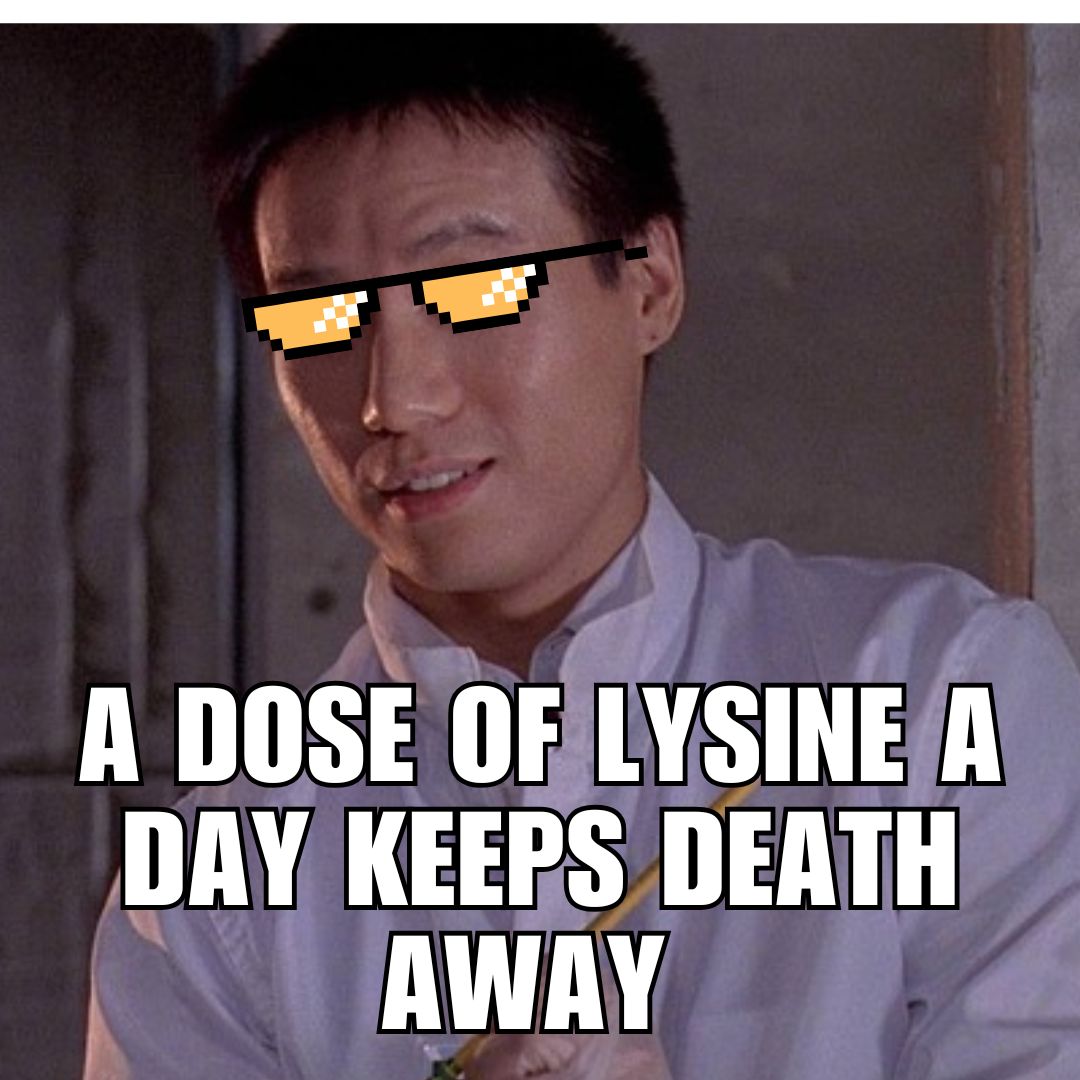
The lysine Contingency was a genetically engineered fail-safe performed by Dr. Henry Wu in Jurassic Park. The fail-safe was meant to knock out the ability of dinosaurs to produce the essential amino acid Lysine, forcing them to rely on synthetic supplements from the park’s staff. To ensure that, in the event of a dinosaur breakout, it would not survive long enough to damage global ecosystems. Based on my understanding of essential amino acids, using Lysine as a bioengineered fail-safe was not the right choice. Lysine is an integral part of the metabolic process; it is needed for collagen formation, calcium formation, and energy production, and might seem to be a good target for a failsafe mechanism. However, all known animals lack the ability to synthesize lysine in adequate amounts but derive it from their food sources, primarily plants. Thus, Dr. Wu and the other scientists at InGen (International Genetics Technologies) essentially broke a feature in the dinosaur genome that was already broken in nature, assuming dinosaurs could actually produce lysine in adequate amounts in the first place. In nature, herbivores obtain lysine from feeding on plants, and carnivores obtain it by feeding on other animals. The Lysine contingency essentially forced the dinosaurs into the food web; as such, any dinosaur that escaped the park could survive by just consuming their normal diet in the natural environment, which ironically is lysine-rich in nature.
Reference
Bechor, O., Smulski, D.R., Van Dyk, T.K., LaRossa, R.A. and Belkin, S., 2002. Recombinant microorganisms as environmental biosensors: pollutants detection by Escherichia coli bearing fabA′:: lux fusions. Journal of Biotechnology, 94(1), pp.125-132.
Beese, L.S., Derbyshire, V. and Steitz, T.A., 1993. Structure of DNA polymerase I Klenow fragment bound to duplex DNA. Science, 260(5106), pp.352-355.
Benserhir, Y., Salaün, A.C., Geneste, F., Pichon, L. and Jolivet-Gougeon, A., 2022. Recent Developments for the Detection of Escherichia Coli Biosensors Based on Nano-Objects—A Review. IEEE Sensors Journal, 22(10), pp.9177-9188.
Bilal, M. and Iqbal, H.M., 2019. Microbial-derived biosensors for monitoring environmental contaminants: Recent advances and future outlook. Process Safety and Environmental Protection, 124, pp.8-17.
Dieudonné, A., Prévéral, S. and Pignol, D., 2020. A sensitive magnetic arsenite-specific biosensor hosted in magnetotactic bacteria. Applied and Environmental Microbiology, 86(14), pp.e00803-20.
Cai, S., Shen, Y., Zou, Y., Sun, P., Wei, W., Zhao, J. and Zhang, C., 2018. Engineering highly sensitive whole-cell mercury biosensors based on positive feedback loops from quorum-sensing systems. Analyst, 143(3), pp.630-634.
Hou, Y. and Wu, G., 2018. Nutritionally essential amino acids. Advances in Nutrition, 9(6), pp.849-851.
Jurassic-Pedia (no date) Lysine Contingency (S/F). Available at: https://www.jurassic-pedia.com/lysine-contingency-sf/ (Accessed: 7 February 2026
Reddy, Michael K.. “amino acid”. Encyclopedia Britannica, 23 Jan. 2026, https://www.britannica.com/science/amino-acid. Accessed 8 February 2026.