Week 9 HW: Cell Free Systems
Part A: General and Lecturer-Specific Questions
General homework questions
- Explain the main advantages of cell-free protein synthesis over traditional in vivo methods, specifically in terms of flexibility and control over experimental variables. Name at least two cases where cell-free expression is more beneficial than cell production.
The main advantages of cell-free protein synthesis (CFPS) over traditional in vivo methods include
- Cell-free systems do not need time-consuming cloning steps
- Easy manipulation of reaction conditions
- High-throughput potential
- Synthesis of difficult to express proteins, such as toxic and transmembrane proteins. In addition, the absence of the cellular membrane allows the synthesis of modified proteins with statistically as well as site-specifically embedded non-canonical amino acids
- CFPS is easily adaptable to the translational requirements of a particular target protein, and the synthesis conditions can be adjusted for a desired subsequent analytical setup
- Novel automated high-throughput systems are being developed due to the simple handling of liquids and the easy scalability of cell-free reactions
- Via the removal of the cell membranes and redundant parts of cells, CFPS has provided flexibility in directly dissecting and manipulating the Central Dogma with rapid feedback. non-native chemicals can be introduced directly into the system, allowing greater flexibility in the selection of regulating reagents
- Such an open nature of the CFPS enables the first-ever programming of modular cellular mimicking processes with active transcription and translation support.
- ease of use, rapid protein production, and minimal requirements for lab space, equipment, and expertise compared to traditional methods
- Flexibility: The cell-free expression system can utilize various template DNAs, including PCR products, plasmid DNA, and synthetic DNA, making it suitable for expressing different types of proteins.
Two cases where cell-free expression is more beneficial than cell production.
- Cell-free protein expression lets researchers incorporate unnatural labels or amino acids into targets of interest, as well as express toxic proteins
- The accessibility of cell-free reactions enables optimization impossible in cells. Researchers can directly adjust pH, ionic strength, redox potential, metal ion concentrations, or temperature without considering cellular viability. Specific folding catalysts, chaperones, or cofactors can be added at precise concentrations. For disulfide-bonded proteins, the oxidation-reduction balance can be fine-tuned by adding specific ratios of reduced and oxidized glutathione. For metalloproteins, appropriate metal ions can be supplemented. This level of control over the biochemical environment enables optimization of yield and proper folding for challenging targets that fail in standard cellular environments.
- Describe the main components of a cell-free expression system and explain the role of each component. There are three fundamental components:
- Cell-Free Extract: This is the heart of the system, containing the essential cellular components for protein synthesis, such as ribosomes, tRNA, amino acids, and enzymes. The source of the extract can vary, with commonly used ones including E. coli, rabbit reticulocyte, and wheat germ extracts.
- DNA Template: Researchers provide the genetic information for the desired protein in the form of a DNA template. This template typically contains a promoter sequence to initiate transcription and a coding sequence for the target protein.
- Energy and Cofactors: Energy sources (e.g., ATP, GTP) and cofactors (e.g., magnesium ions) are supplied to facilitate transcription and translation processes.
- Why is energy provision regeneration critical in cell-free systems? Describe a method you could use to ensure continuous ATP supply in your cell-free experiment.
Energy regeneration is critical in cell-free systems because protein synthesis is ATP-intensive, and there is no living metabolism in the reaction mix to continuously replenish ATP as a cell would. Without regeneration, ATP is depleted quickly, protein synthesis slows or stops, and yield drops; stable energy supply is also a major determinant of reaction duration and cost.
Current energy module engineering solutions:
ATP regeneration systems for CFPS
- using phosphoenolpyruvate (PEP) with pyruvate kinase, creatine phosphate with creatine kinase, or acetyl phosphate with acetate kinase. These systems help maintain energy levels throughout the protein synthesis process, significantly improving yield and duration of the reaction.
- enzymes like creatine kinase or acetate kinase that regenerate ATP from ADP using high-energy phosphate donors.
- Secondary energy sources such as phosphoenolpyruvate, creatine phosphate, and acetyl phosphate can be incorporated into cell-free protein synthesis systems to enhance energy availability. These compounds serve as phosphate donors in enzymatic reactions that regenerate ATP.
- Continuous-exchange cell-free protein synthesis systems: Continuous-exchange cell-free protein synthesis systems involve the continuous supply of energy substrates and removal of inhibitory byproducts during the reaction. These systems utilize specialized reaction chambers with semi-permeable membranes that allow small molecules to diffuse while retaining larger components like ribosomes and enzymes. This approach significantly extends reaction lifetimes and increases protein yields by preventing energy depletion and byproduct accumulation that typically limit batch reactions.
Secondary energy sources and cofactors Beyond primary ATP regeneration, cell-free protein synthesis energy modules incorporate secondary energy sources and essential cofactors. These include NAD+/NADH, NADP+/NADPH, and GTP, which support various biochemical reactions during protein synthesis. Optimized ratios of these cofactors are critical for maintaining redox balance and ensuring efficient translation. Some systems also utilize glucose or maltose with appropriate enzymes to create a continuous energy supply pathway, enhancing the overall efficiency and productivity of the cell-free system.
Engineered extracts for improved energy efficiency Specially engineered cell extracts can significantly improve the energy efficiency of cell-free protein synthesis systems. These extracts are often derived from modified organisms with enhanced metabolic pathways or reduced energy-consuming side reactions. By eliminating competing pathways that deplete energy resources and optimizing the concentration of key enzymes involved in energy metabolism, these engineered extracts can sustain protein synthesis for longer periods with higher yields. Some approaches include genetic modifications to reduce phosphatase activity or enhance glycolytic flux.
- Compare prokaryotic versus eukaryotic cell-free expression systems. Choose a protein to produce in each system and explain why.
Prokaryotic cell-free expression systems
The E. coli based CFPS system has redefined the scale standard for protein synthesis. Its core advantage lies in the simplicity and metabolic robustness of the prokaryotic machinery, allowing for high concentration yields in batch and continuous-flow reactions. This platform is the undisputed leader in low-cost, high-throughput synthesis for projects where functional folding (e.g., disulfide bonds or glycosylation) is not a critical factor.
- Scale Advantage: Capable of producing up to 2 mg/mL of protein, dramatically reducing the cost per gram—similar to Twist’s $0.003/bp DNA synthesis advantage.
- Speed Metric: Protein production can be completed within 2–4 hours, allowing for parallel synthesis of hundreds of constructs in a single day.
- Modification Niche: Highly adaptable for specialized labeling, such as efficient incorporation of non-natural amino acids (CFPS for Non-Natural Amino Acid Incorporation Service), due to easy depletion of natural amino acids in the lysate.
- Limitation: Lacks the machinery (PDI, chaperones, microsomal membranes) for correct folding and processing of complex eukaryotic proteins, often resulting in inclusion bodies or inactive constructs.
Eukaryotic cell-free expression systems
Eukaryotic CFPS systems have specialized in overcoming the functional bottlenecks of prokaryotic expression. By retaining cell-specific endogenous elements—including ribosomes, tRNA pools, and PTM enzymes, they achieve functional integrity for complex targets, aligning with the “clinical-grade accuracy” of GenScript.
Systems based on mammalian cells (HEK293, CHO) are essential for therapeutic protein research.
- Fidelity Core: The presence of microsomal membranes allows for co-translational or post-translational translocation, critical for synthesizing Cell-Free Membrane Protein Expression and functional antibodies.
- Key PTM: Capable of performing initial N-glycosylation and forming correct disulfide bonds, reaching a functional correctness standard of 99% for single-chain variable fragments (scFv).
- Limitation: Production yields are generally 5–10 times lower than E. coli systems, and the lysate preparation process is costly.
How would you design a cell-free experiment to optimize the expression of a membrane protein? Discuss the challenges and how you would address them in your setup.
Imagine you observe a low yield of your target protein in a cell-free system. Describe three possible reasons for this and suggest a troubleshooting strategy for each.
References
- https://pubmed.ncbi.nlm.nih.gov/26478227/
- https://www.sciencedirect.com/science/article/pii/S200103702300185X
- https://www.cytion.com/us/About-Cytion/Knowledge-Hub/Articles-Updates/Cell-Free-Systems-for-Protein-Production-Advantages-Over-Living-Cells/
- https://www.idtdna.com/pages/applications/cell-free-protein-synthesis
- https://www.cusabio.com/cell-free-expression-system.html
- https://eureka.patsnap.com/report-energy-module-engineering-for-sustainable-cell-free-protein-synthesis
- https://www.biosynsis.com/a-comparative-guide-prokaryotic-vs-eukaryotic-cell-free-expression-systems-for-eukaryotic-proteins.html
Homework question from Kate Adamala
Design an example of a useful synthetic minimal cell as follows
According to S. Cao, L. C. da Silva, K. Landfester, Angew. Chem. Int. Ed.2022, 61, e202205266; Angew. Chem.2022, 134, e202205266.
- Pick a function and describe it.
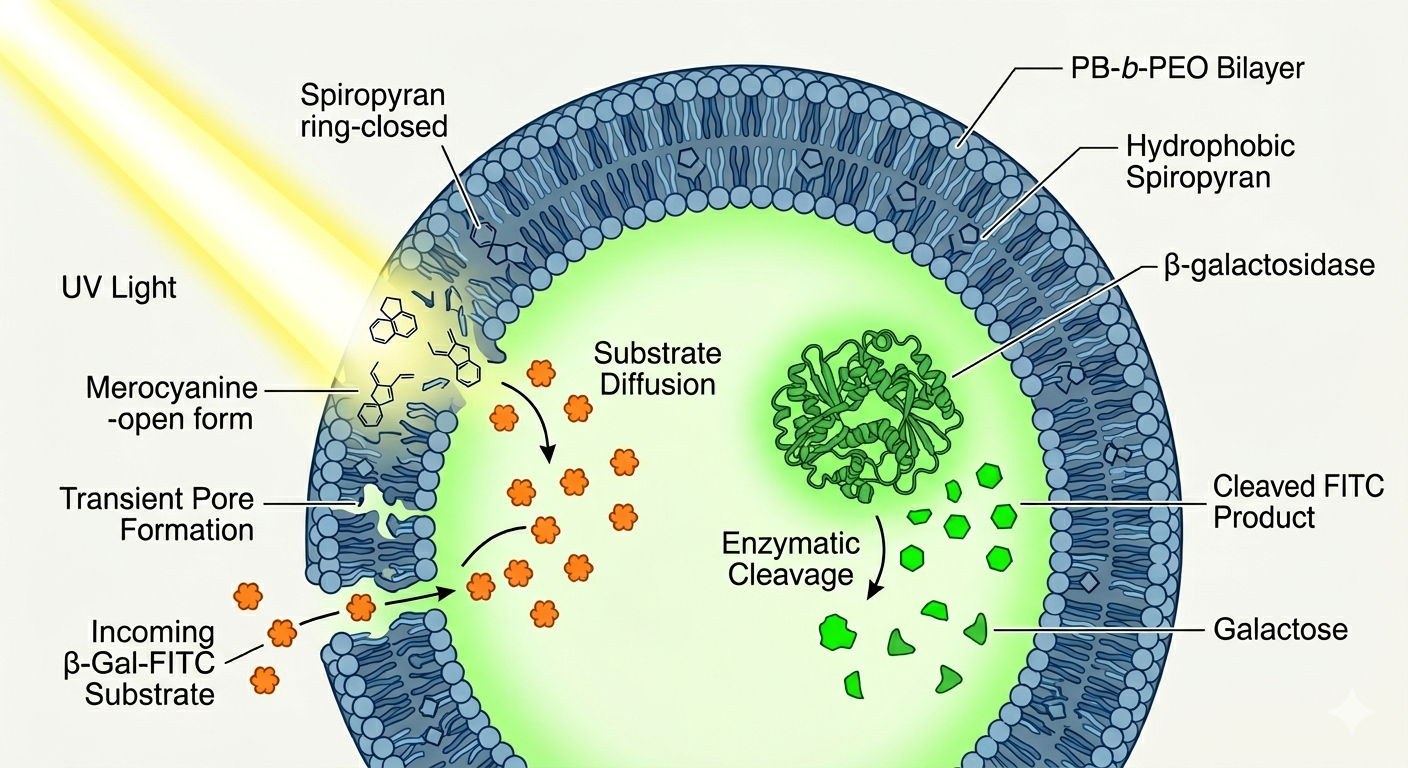
- The synthetic cell functions as a light-activated micro-reactor that controls internal enzymatic reactions on demand. Its input is dual: a UV light signal that opens membrane permeability, and an external substrate (β-Gal-FITC) that enters the vesicle as a result. Its output is the fluorescent molecule FITC, produced when the encapsulated enzyme β-galactosidase hydrolyzes the substrate inside the polymersome, providing a directly measurable chemical signal that confirms successful reaction activation.
- Controlling enzymatic reactions solely through cell-free transcription and translation without encapsulation is difficult because the system relies on compartmentalization and membrane-based regulation of substrate access. Encapsulation provides the spatial and temporal control needed for light-activated permeability, which would be challenging to replicate with free, unencapsulated systems.
- Yes, natural cells can be genetically modified to achieve light-controlled membrane transport and enzymatic activity, similar to the synthetic system, using light-sensitive proteins or channels
- The desired outcome of the synthetic cell operation is to achieve precise, light-controlled regulation of membrane permeability, enabling selective transport of small hydrophilic molecules into and out of the compartments, and to facilitate dynamic internal processes such as enzymatic reactions and biomolecular coacervation, mimicking natural cellular functions with controllable activation and deactivation triggered by light stimuli.
- Design all components that would need to be part of your synthetic cell
- The membrane of the giant polymersomes is made of a copolymer consisting of poly(butadiene)-block-poly(ethylene oxide) (PB-b-PEO). Additionally, it incorporates spiropyran-based photo-transducers, specifically SP-C16, which are hydrophobic molecules embedded within the polymer matrix to enable light-responsive behavior.
- Inside the giant polymersomes, various hydrophilic molecules and macromolecular cargoes are encapsulated. These include water-soluble molecules like FITC-labeled poly-L-lysine, fluorescent dyes, as well as larger biomolecules like bovine serum albumin and dextran. The system was also used to encapsulate enzymes like β-galactosidase and other active components for constructing light-controlled microreactors and dynamic cell-like systems
- The system described is synthetic and biomimetic; it does not originate from a natural organism. Instead, it is engineered using polymeric materials and designed to mimic cellular functions in a controlled, artificial environment.
- The synthetic cell communicates with the environment through light-controlled membrane permeability. By using spiropyran-based modulators, the membrane can be made permeable or impermeable to small molecules in response to light, allowing controlled exchange of signals and substrates, and enabling interactions with its surroundings.
- Experimental details
- To design a synthetic cell mimicking the functions described— such as light-activated membrane permeability, controlled molecular transport, and internal biochemical reactions, I will select lipids and genes that facilitate membrane stability, responsiveness to stimuli, and internal functionalities.
Lipids:
- Phospholipids: Since natural membranes are lipid-based, incorporating phospholipids like phosphatidylcholine (PC), phosphatidylethanolamine (PE), and phosphatidylserine (PS) can provide a biocompatible and flexible membrane.
- Cholesterol: To modulate membrane fluidity and stability.
- Light-responsive lipids: Incorporate lipids conjugated with photoresponsive groups (similar to spiropyran derivatives) that can undergo structural changes upon light irradiation, affecting membrane permeability.
- Synthetic amphiphiles: Custom-designed lipids with specific functional groups for stimulus-responsive behaviors.
Genes:
Enzymes for internal reactions: Genes encoding enzymes such as β-galactosidase (as used in the study) or other catalytic proteins to perform the desired biochemical transformations.
Transporter genes: For internal regulation, genes encoding for synthetic or natural transporter proteins can be introduced to enhance selectivity of transport.
Regulatory genes: To allow dynamic response or adaptation within the synthetic cell, synthetic regulatory gene circuits could be designed.
The function of the light-activated synthetic cell system can be assessed through several experimental approaches:
- Permeability Testing by using fluorescently labeled small molecules outside the system and monitoring their diffusion into the system upon light activation using fluorescence microscopy or spectroscopy.
- Internal Biochemical Reactions by incorporate a fluorescent substrate inside the system and then measuring the production of fluorescent products using confocal microscopy or fluorometry before and after light activation to verify enzyme activity and substrate access
- Substrate Conversion and Product Release by quantifing reaction products in the external medium using spectroscopic methods or HPLC
- Dynamic Response and Control by performing time-resolved studies applying light stimuli repeatedly to test the reversibility and responsiveness of permeability and internal reactions.
An overview image of the system
References
Homework question from Peter Nguyen
- I chose the Textiles/Fashion application
Write a one-sentence summary pitch sentence describing your concept.
- a freeze-dried embedded biosensor in fabric that detects cortisol levels in diabetic patients
How will the idea work, in more detail? Write 3-4 sentences or more.
- for the idea to work, first the sensor should be designed and synthetized, following that, it will be freeze-dried and embedded on a fabric that upon activation / hydration using sweat produce a detectable colorimetric output indicating the high level presence of the biomarker (cortisol)
What societal challenge or market need will this address?
- It will mainly address patients suffering from metabolic and endocrine dieases to mental health patients and healthy individuals seeking performance and wellness optimization
How do you envision addressing the limitation of cell-free reactions (e.g., activation with water, stability, one-time use)?
- activation is a big limitation since the sensor is acitvated by any liquid, so the specificity to be activated by sweat is a challenge that can be solved by the option of protecting the sensor from external liquids and activate it on-demand
- the second limitation is the usage time and this can be addressed through replacing something in the fabric not the whole system, therefore, increasing the usage time with affecting the system.
References
Homework question from Ally Huang
- Provide background information that describes the space biology question or challenge you propose to address. Explain why this topic is significant for humanity, relevant for space exploration, and scientifically interesting. (Maximum 100 words)
- Long-duration space missions expose astronauts to profound physiological and psychological stressors that significantly compromise health, cognitive performance, and behavioral integrity. Diagnostic health technologies during space missions pose many challenges, including limited availability of medical personnel, tools, and equipment. Cortisol, the primary stress hormone measurable non-invasively in sweat represents a scientifically compelling real-time biomarker for simultaneously tracking physiological and psychological deterioration. Dynamic monitoring of specific biomarkers is essential in the diagnosis of fluctuating conditions. Developing autonomous, wearable biosensing platforms capable of continuous, non-invasive biomarker detection is therefore both scientifically urgent and mission-critical for safe deep-space human exploration.
- Name the molecular or genetic target that you propose to study. Examples of molecular targets include individual genes and proteins, DNA and RNA sequences, or broader -omics approaches. (Maximum 30 words)
- The primary molecular targets proposed are cortisol (a steroid hormone), cell-free circulating RNA (cfRNA), and the HPA axis-responsive gene transcripts, specifically FKBP5 and NR3C1 (glucocorticoid receptor gene)
- Describe how your molecular or genetic target relates to the space biology question or challenge your proposal addresses. (Maximum 100 words)
- Long-duration spaceflight chronically activates the hypothalamic-pituitary-adrenal (HPA) axis through persistent psychological and physiological stressors, resulting in sustained cortisol elevation and downstream immune suppression. Elevated cortisol during spaceflight activates the HPA axis, suppressing cell-mediated immunity and triggering reactivation of latent herpesviruses. At the molecular level, variations in NR3C1 and FKBP5 alter glucocorticoid receptor sensitivity and HPA axis dynamics, while chronic stress induces persistent HPA activation and maladaptive physiological responses. Since cortisol is detectable non-invasively in saliva, and FKBP5/NR3C1 transcripts reflect real-time HPA axis status, these targets collectively enable continuous, non-invasive monitoring of both psychological stress and immune health, critical capabilities currently absent from deep-space mission medicine.
- Clearly state your hypothesis or research goal and explain the reasoning behind it. (Maximum 150 words)
- Hypothesis: freeze-dried, cell-free synthetic biology circuits embedded in a wearable fabric, activated by saliva, can simultaneously detect salivary cortisol protein and FKBP5/NR3C1 mRNA transcripts, providing a non-invasive, real-time dual-layer readout of HPA axis status in astronauts during deep-space missions. This reasoning converges on three evidence pillars: first, freeze-dried cell-free synthetic circuits embedded in textiles are activated upon rehydration from liquids and can detect metabolites and nucleic acid signatures, with detection limits rivalling quantitative PCR. Second, significant correlations exist between free cortisol levels in saliva and blood, attributed to cortisol’s small molecular weight and lipophilicity enabling diffusion through glandular epithelial membranes. Third, since FKBP5 and NR3C1 transcripts are present in salivary cells and reflect real-time HPA axis regulatory status, their co-detection alongside cortisol protein would distinguish acute stress from chronic HPA breakdown, enabling autonomous, physician-independent health surveillance.
- Outline your experimental plan - identify the sample(s) you will test in your experiment, including any necessary controls, the type of data or measurements that will be collected, etc. (Maximum 100 words)
- The experiment proceeds in three phases. First, freeze-dried cell-free toehold switch biosensors targeting FKBP5 and NR3C1 mRNA transcripts and a cortisol-specific aptamer module will be validated in vitro using synthetic RNA and recombinant cortisol in artificial saliva, with nuclease-free buffer and non-target RNA as controls. Second, human saliva collected before and after the Trier Social Stress Test from healthy volunteers will validate biosensor performance against gold-standard ELISA and qRT-PCR. The cortisol sensor reliability will be confirmed by comparison to ELISA immunoassay across stressed and non-stressed conditions. Third, biosensors will be integrated into textile substrates and tested for colorimetric output, storage stability, and reproducibility upon deliberate saliva application, simulating operational astronaut use.
Part B: Individual Final Project
- Put your chosen final project slide in the appropriate slide deck following the instructions on slide 1
- Submit this Final Project selection form if you have not already.
- Begin planning how you will write your final project documentation based on the guidelines
- Prepare your first DNA order and put it in the “Twist (MIT)” or “Twist (Nodes)” tab of the 2026 HTGAA Ordering: DNA, Reagents, Consumables spreadsheet, as appropriate.