Week 11 HW: Building Genomes
Part A: The 1,536 Pixel Artwork Canvas | Collective Artwork
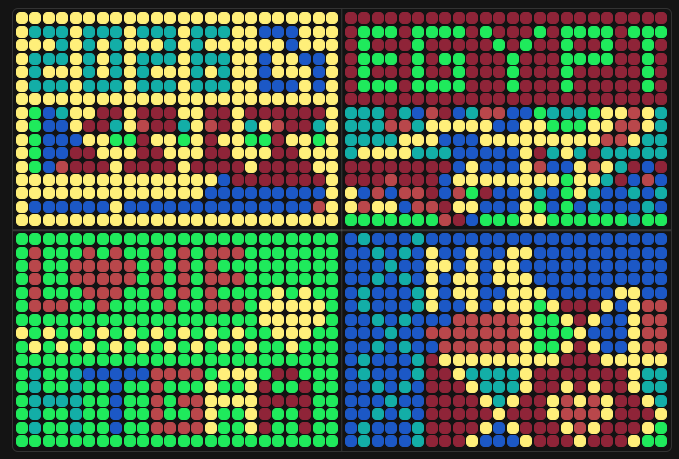
I contributed 123 pixels to the global artwork experiment by making HTGAA letters at the bottom left. I liked the collaborative work and that it represents all of us. I think it can be better by including more colors.
Part B: Cell-Free Protein Synthesis | Cell-Free Reagents
- Referencing the cell-free protein synthesis reaction composition, provide a 1-2 sentence description of what each component’s role is in the cell-free reaction.
| Component | Role |
|---|---|
| E. coli Lysate | |
| • BL21 (DE3) Star Lysate (includes T7 RNA Polymerase) | As a whole-cell lysate, it provides the complete “hardware” needed for protein synthesis that was harvested during the exponential growth phase of the bacteria. It serves as the core transcription-translation machinery in cell-free protein synthesis (CFPS) systems. The lysate contains endogenous metabolic enzymes that work in tandem with added secondary energy substrates. T7 RNA Polymerase (from DE3 lysogen): Specifically transcribes T7 promoter-driven genes. BL21 Star mutation (mutation in the rne131 gene): Reduces RNase E activity, stabilizing mRNA longer for higher protein yields. |
| Salts/Buffer | |
| • Potassium Glutamate | act as the primary salt to maintain the chemical and osmotic environment necessary for the molecular machinery to function. |
| • HEPES-KOH pH 7.5 | serves as the primary buffering agent, maintaining the precise chemical environment required for delicate enzymatic reactions to occur outside the cell. It maintains pH homeostasis, in addition it does not readily cross biological membranes and has limited interaction with metal ions. |
| • Magnesium Glutamate | It serves as the primary source of magnesium cations. Mg ions are needed to drive the association of the 30S and 50S ribosomal subunits into the active 70S complex and it neutralize the strong negative charges of the ribosomal RNA (rRNA) phosphate backbone, allowing the complex to fold into the precise 3D shape required for translation. Glutamate anion is naturally dominant in the E. coli cytoplasm, allowing for high magnesium concentrations without the enzymatic inhibition typically caused by chloride ions. |
| • Potassium phosphate monobasic | It provides the essential inorganic phosphate required for metabolic pathways within the lysate to recycle ADP and GDP back into ATP and GTP. It also acts as a buffer to maintain a steady pH, preventing the metabolic byproducts of the reaction from becoming too acidic and denaturing the ribosomes or RNA polymerase. It supplies potassium cations |
| • Potassium phosphate dibasic | stabilize the pH of the reaction mixture by acting as a proton acceptor to prevent the pH from dropping into a range that would denature the ribosomes. Dibasic phosphate provides a ready source of inorganic phosphate required by endogenous enzymes in the E. coli lysate to re-phosphorylate ADP and GDP |
| Energy / Nucleotide System | |
| • Ribose | It is needed for Nucleotide Synthesis (ATP, GTP, CTP, UTP). It is needed also for RNA Stability by providing the structural backbone for the mRNA being transcribed and the tRNA used during the translation process. Ribose can enter the Pentose Phosphate Pathway to generate NADPH, which provides reducing power and further metabolic intermediates that support the overall “health” of the lysate during prolonged incubation. |
| • Glucose | It is the Primary energy source via glycolysis. It is needed also for ATP Regeneration: Through the glycolytic pathway, glucose helps regenerate ATP and GTP from ADP and GDP, providing the chemical energy necessary for peptide bond formation. |
| • AMP, CMP, GMP, UMP | precursors that are phosphorylated to NTPs (Nucleoside Triphosphates): ATP, CTP, GTP, UTP respectively that are needed during transcription for mRNA synthesis. ATP is the main energy, it is used for Aminoacylation, which is the process of “charging” or loading each tRNA with its specific amino acid. GTP is the specific energy source for the Ribosome. It powers “translocation,” which is the physical movement of the ribosome as it slides down the mRNA and “clicks” the next amino acid into place. CTP & UTP are primarily used as building blocks for the mRNA instructions, they also help maintain the metabolic balance |
| • Guanine | It is the base component of GMP and GTP. During transcription, the T7 RNA polymerase incorporates guanine into the growing mRNA strand whenever it encounters a cytosine on the DNA template. it acts as a key part of the genetic code (codons), and the core of the GTP energy molecule that powers the physical movement of the protein-building machinery. |
| Translation Mix (Amino Acids) | |
| • 17 Amino Acid Mix | The 17 Amino Acid Mix provides direct substrates for protein synthesis. The mixture excludes Cys, Ile, Met, Trp that are added separately as radioactive or fluorescently tagged to track or visualize the protein later. |
| • Tyrosine | It acts as a structural building block for the protein chain, a critical component for protein folding, and a primary tool for quantifying and labeling the synthesized product due to its unique chemical and optical properties (is responsible for the natural UV light absorbance of proteins). |
| • Cysteine | It is a sulfur-containing amino acid that serves as a critical structural stabilizer and a specific target for biochemical labeling. It is the only amino acid capable of forming covalent disulfide bonds (S-S) between different parts of a protein chain. |
| Additives | |
| • Nicotinamide | It is a precursor for NAD+/NADH. NAD is required to facilitate the flow of electrons during the breakdown of energy sources like glucose or glutamate. It drives energy regeneration by maintaining the pool of NAD+, the system can continue the process of oxidative or substrate-level phosphorylation. This ensures a steady supply of ATP and GTP. It can act as a stabilizing agent for certain enzymes |
| Backfill | |
| • Nuclease Free Water | It serves as the primary solvent to dissolve and dilute all other components. It ensures that no microbial or chemical contaminants are introduced and prevents DNA/RNA degradation by trace DNase/RNase contamination |
- Describe the main differences between the 1-hour optimized PEP-NTP master mix and the 20-hour NMP-Ribose-Glucose master mix. (2-3 sentences)
The 20-hr protocol was optimized by LLMs and autonomous labs with minimal human intervention, primarily limited to preparation, loading and unloading of reagents and consumables. Additionally, the 20-hr incubation protocol over six iterative steps produced sfGFP at a specific cost of $422/g, reducing CFPS specific cost by 40% and increasing protein titers by 27% relative to SOTA, while the 1-hr protocol optimized a reagent formulation that can produce 2.4 ± 0.3 g/L of protein product at the 15-µL scale ~$55/gprotein and 3.7 ± 0.2 g/L ~$36/gprotein at the 4-mL scale with oxygen supplementation. The 1-hr protocol screened 58 cell-free reagent components and their concentrations in 1,231 different reaction combinations, while the 20-hr protocol executed 480 384-well plate experimental designs comprising 29,527 unique reaction compositions.The knowledge acquisition also needs to be addressed. In the 20-hr protocol, GPT-5 was provided with access to the internet, a computer, data analysis packages, and the SOTA preprint.
- Bonus question: How can transcription occur if GMP is not included but Guanine is?
Guanine is the base component of GMP and GTP. During transcription, the T7 RNA polymerase incorporates guanine into the growing mRNA strand whenever it encounters a cytosine on the DNA template.
References:
- https://www.biorxiv.org/content/10.64898/2026.02.05.703998v1.full.pdf
- https://www.biorxiv.org/content/10.1101/2025.08.01.668204v1.full.pdf
Part C: Planning the Global Experiment | Cell-Free Master Mix Design
- Given the 6 fluorescent proteins we used for our collaborative painting, identify and explain at least one biophysical or functional property of each protein that affects expression or readout in cell-free systems.
sfGFP (Superfolder GFP) is a basic (constitutively fluorescent) green fluorescent protein published in 2005, derived from Aequorea victoria. It is reported to be a very rapidly-maturing weak dimer.
| Maturation Time (min) | 13.6 |
|---|---|
| Lifetime (ns) | 3.1 |
mRFP1 is a basic (constitutively fluorescent) red fluorescent protein published in 2002, derived from Discosoma sp.. It is reported to be a somewhat slowly-maturing monomer with low acid sensitivity.
| Maturation (min) | 60.0 |
|---|---|
| pKa | 4.5 |
mKO2 is a basic (constitutively fluorescent) orange fluorescent protein published in 2008, derived from Verrillofungia concinna. It has moderate acid sensitivity.
| Maturation (min) | 108.0 |
|---|---|
| pKa | 5.5 |
mTurquoise2 is a basic (constitutively fluorescent) cyan fluorescent protein published in 2012, derived from Aequorea victoria. It is reported to be a rapidly-maturing monomer with very low acid sensitivity.
| Maturation (min) | 33.5 |
|---|---|
| pKa | 3.1 |
| Lifetime (ns) | 4.0 |
mScarlet is a basic (constitutively fluorescent) red fluorescent protein published in 2016, derived from synthetic construct. It has moderate acid sensitivity.
| Maturation (min) | 174 |
|---|---|
| pKa | 5.3 |
| Lifetime (ns) | 3.9 |
Electra2 is a basic (constitutively fluorescent) blue fluorescent protein published in 2022, derived from Entacmaea quadricolor.
| Lifetime (ns) | 3.4 |
|---|
Glossary of Terms
- Maturation time: Time from translation to active form. Maturation is the time (in minutes) required (due to protein folding and chromophore maturation) for fluorescence to obtain a half-maximal value.
- pKa is a measure of the acid sensitivity of a fluorescent protein. It is the pH at which fluorescence intensity drops to 50% of its maximum value.
- Fluorescence Lifetime: The amount of time (in nanoseconds) after photon absorption that it takes the fluorophore to relax to the ground state is referred to as the fluorescence lifetime. When a population of fluorophores is excited, the lifetime is the time it takes for the number of excited molecules to decay to 1/e or 36.8% of the original population.
- Create a hypothesis for how adjusting one or more reagents in the cell-free mastermix could improve a specific biophysical or functional property you identified above, in order to maximize fluorescence over a 36-hour incubation. Clearly state the protein, the reagent(s), and the expected effect.
- protein: mScarlet
- reagents: by increasing Magnesium Glutamate, the stability of the ribosomes and tRNA, which is optimal for translation, therefore, the expected effect is increase in fluorescence.
- The second phase of this lab will be to define the precise reagent concentrations for your cell-free experiment.

References