Week 3 HW: Lab Automation

𓃠 Week 3 Homework 𓃠
Assignment: Python Script for Opentrons Artwork
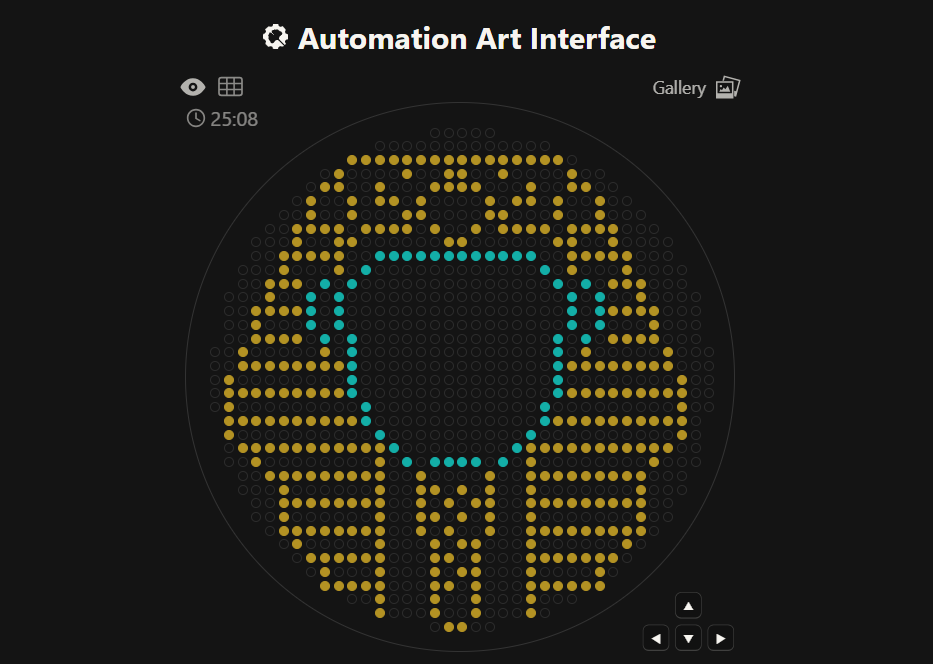
This is an Ancient Egyptian Pharaoh Figure, this was made using this GUI Also here is the live link to check it out! :D
So i started out with this image which i generated using Gemini a long while ago.

- I wanted to draw it using the Opentrons OT-2 but i had no idea how + i am not a very good pixel artist.
- So i decided to use AI to help me with this, first i went to Ronan’s GUI (Thanks Again Ronan! :D) and i roughly counted there was (on default settings) 36x36 pixels (i was off by a little number btw XD)
- So i went back to Gemini and prompted it to draw my the image on a 36x36 pixel grid and this was the output

- It was pretty good to me, but i need coordinates for the Opentrons API, i tried to roughly copy it on Ronan’s GUI but i failed misreably and wasn’t accurate
- So when i was searching online for tools to like give some sort of coordinates to this (and i didn’t find XD), i stumbled on this website called pixilart, I went in and generated a 36x36 pixel grid and guess what? I drew it from scratch using Gemini’s image as the reference and i added some tweaks myself to it too :D
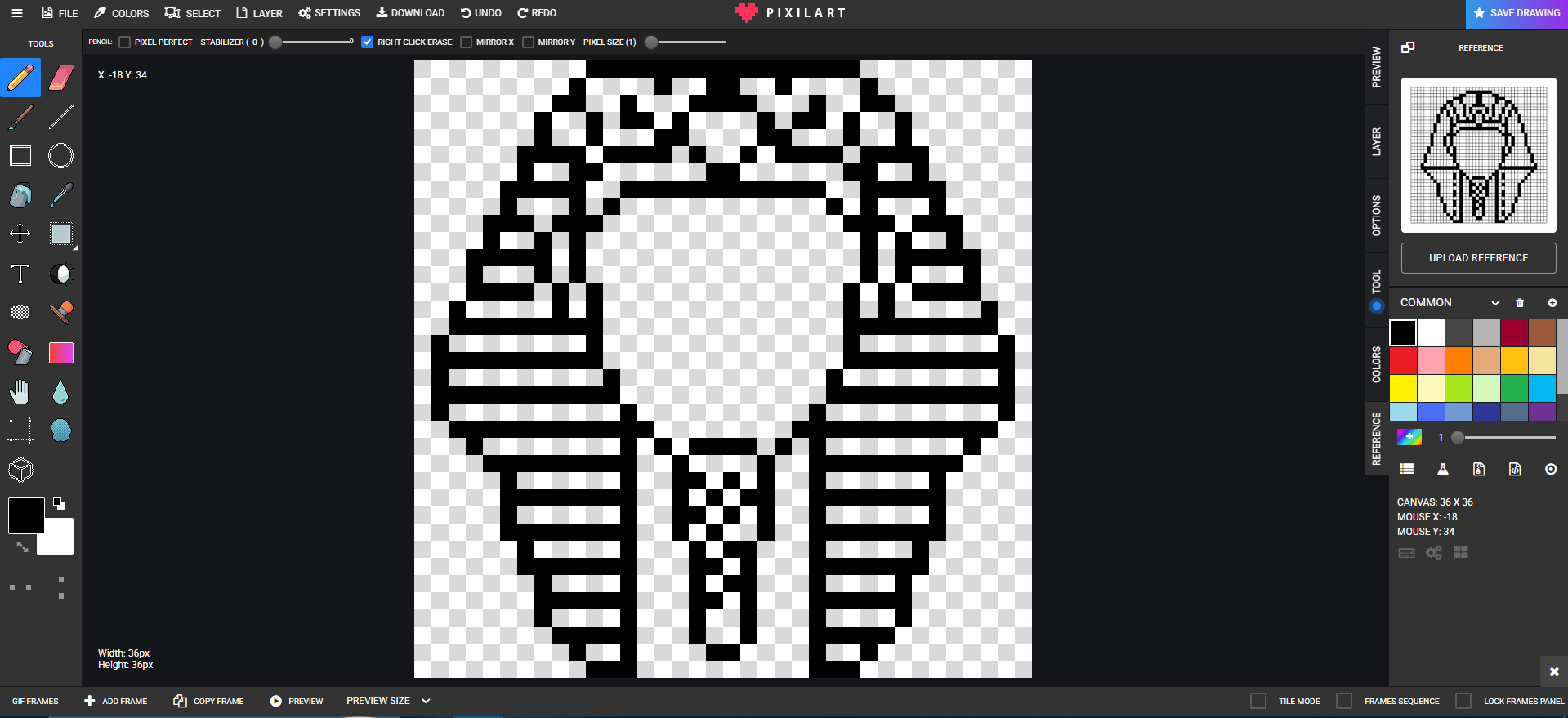
- It took alot of effort trying to focus on those pixels to get a picture perfect copy of it, but in the end the mission was a success :D
- Now that i could somehow get x/y coordinates, i wanted to redo this on Ronan’s GUI so that the coordinates i give to Opentrons are accurate, so now i had to take my new reference and map it there.
- I tried to upload the image but it didn’t map it well at all, maybe because of the pixel grids, so i had to do it manually XD
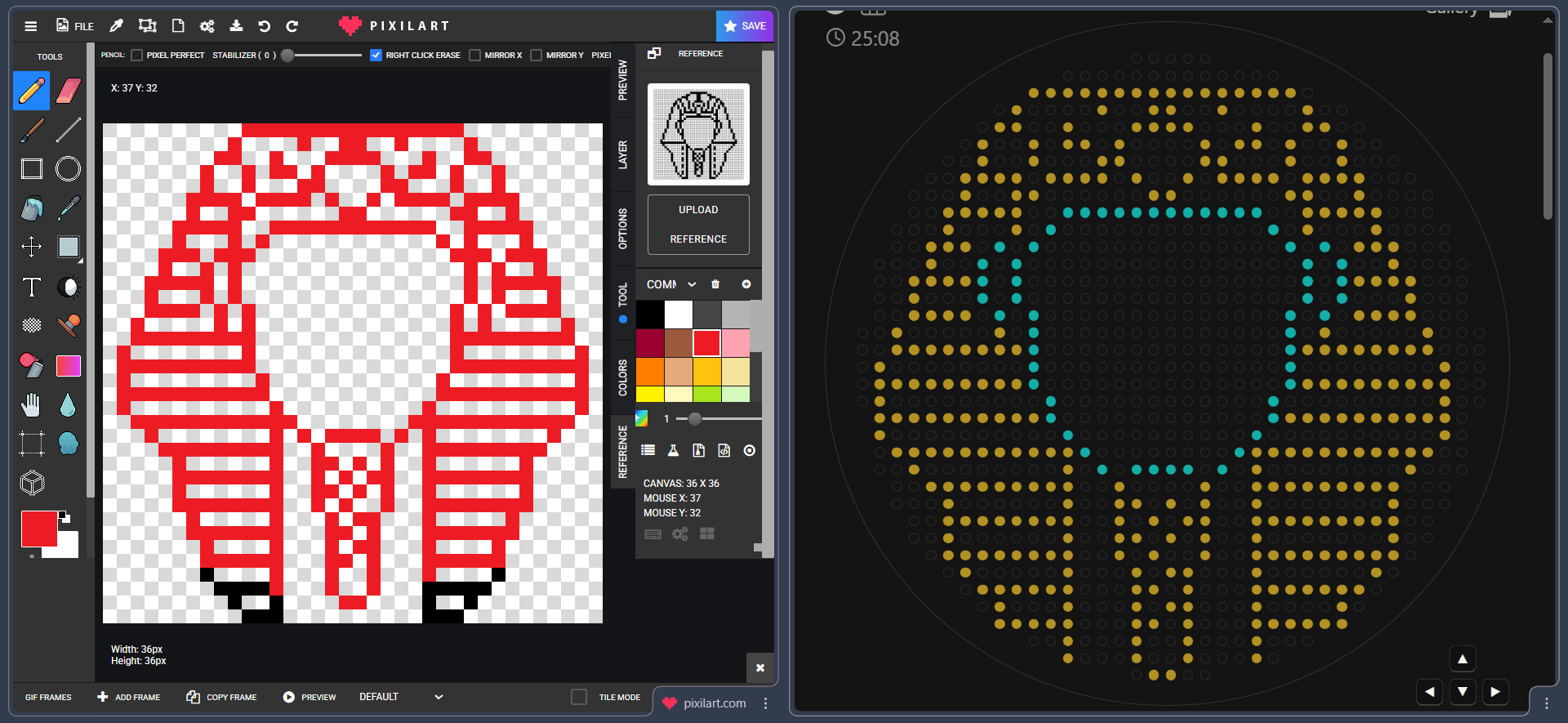
- Here is a screenshot of me mapping every single pixel on Ronan’s GUI and marking it in red on pixilart so i don’t mix something up :D
- It took sometime but the results were totally worth it :D
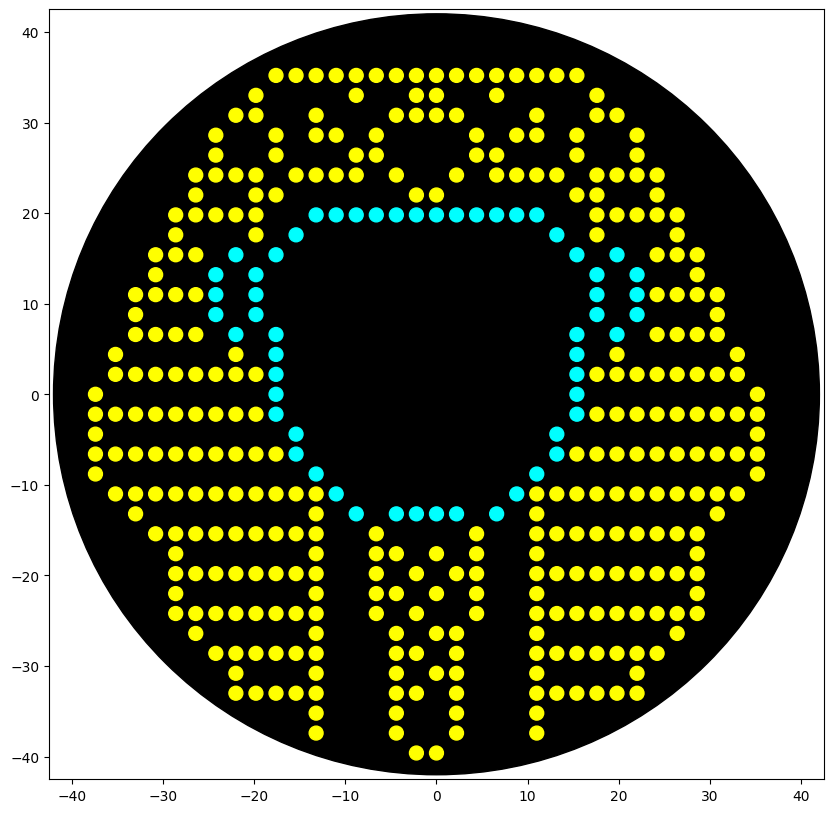
- This way i took the generated coordinates and went the Opentrons Google Colab Notebook and used Gemini to write the actual function because i was too tired after all the drawing XD, and this was the result! :D
Here is some other designs that i did too while in the Autonomous Cloud Lab Stream where we were printing Fluorescent Artwork designs
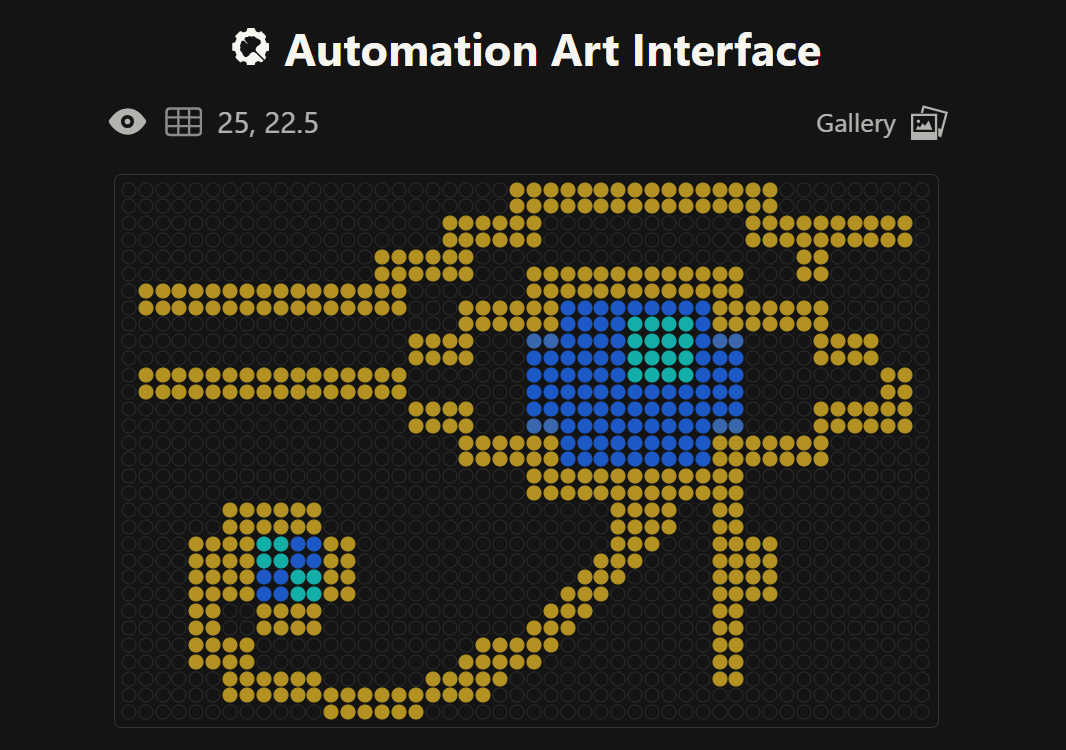
This is the Eye of Ra, a very common and famous Ancient Egyptian Symbol
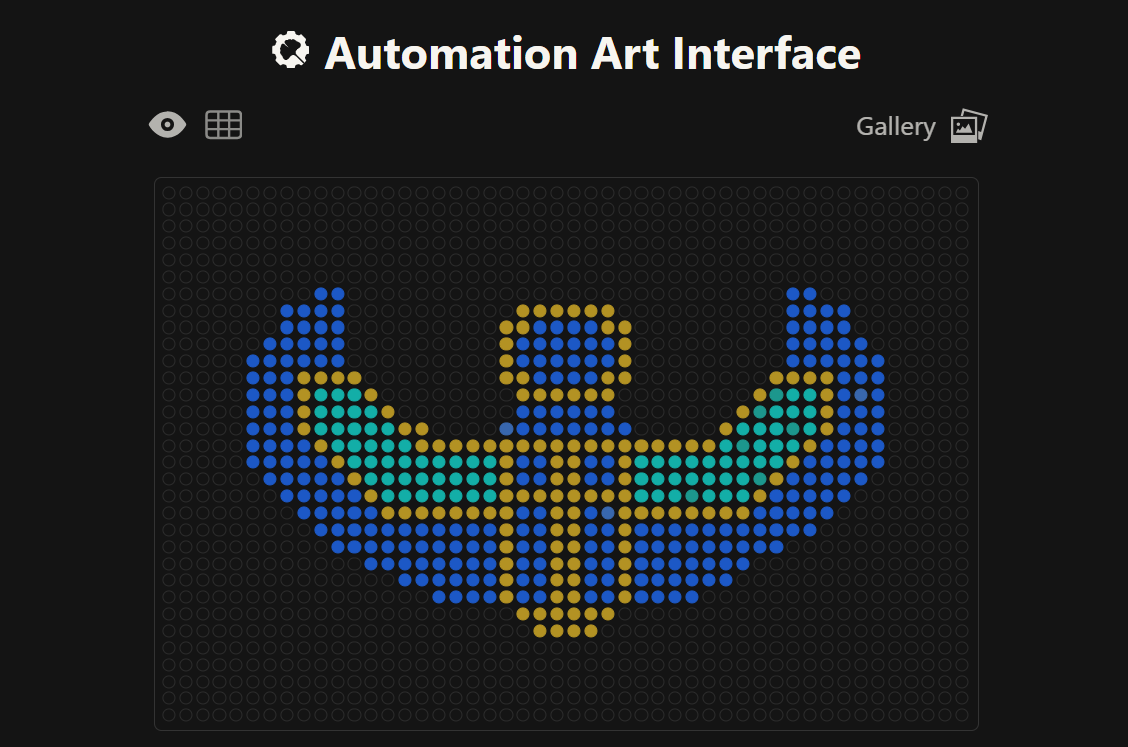
This is a Winged Scarab, which is also a very well known Ancient Egyptian Symbol
Post-Lab Questions — DUE BY START OF FEB 24 LECTURE
Find and describe a published paper that utilizes the Opentrons or an automation tool to achieve novel biological applications.
Paper: Development of a Modular Lab Automation System with Applications to Animal and Bacteria Cell Culture(1)
This paper is a perfect example of why automation is critical for modern synthetic biology. They identify the key challenges of manual lab work which includes that complex protocols are tedious, prone to human error, and suffers from a lack of reproducibility. and To solve this, so they developed a modular lab automation system. They validated their system through automating cell culture, for both simple bacteria (prokaryotic) and complex animal cells (eukaryotic).
The most important part of their project isn’t just the robot, it’s their focus on transparency, quality control, and community reuse. They created a system that automatically generates Jupyter Notebooks as a “full protocol execution report,” which makes the experiments perfectly documented and reusable. They also described how this modular system is the first step toward “self-driving labs,” where AI and machine learning models can design and run their own experiments, possibly creating a fully automated DBTL cycle.
Write a description about what you intend to do with automation tools for your final project. You may include example pseudocode, Python scripts, 3D printed holders, a plan for how to use Ginkgo Nebula, and more.
Automation Tools can help me quickly and efficiently do many tasks and test different scenarios with minimal errors, for example in Idea 1 i can use Automation Tools to test out different circuits with different promotors to test them and check out which on is the most optimal and which ones burden the cell too much, same with Idea 2 where i can test different Inducer Ratios and measure production titers in a quick way
Final Project Ideas
The presentation slides can be found at the Slides Deck
Idea 1: The Malaria Machine: Computational Optimization of Artemisinic Acid Biosynthesis
The Problem: Artemisinin, the frontline treatment for malaria which still kills ~600,000 people annually, relies on plant extraction from Artemisia annua — an inherently slow, geographically limited, and climate-vulnerable supply chain that cannot meet global demand consistently.
The Mechanism: This project computationally engineers a microbial factory (E. coli or yeast) to overproduce artemisinic acid, the direct biosynthetic precursor to artemisinin, by modeling the mevalonate pathway using flux balance analysis, systematically evaluating knockout and overexpression strategies, and designing optimized genetic circuits for the winning candidate.
The Impact: By delivering a fully documented, wet-lab-ready computational blueprint for high-yield artemisinic acid biosynthesis, this project contributes toward a scalable, plant-independent, and globally accessible supply of the world’s most critical antimalarial compound.
Idea 2: The Bio-Propulsion Model: Engineering Off-World Propellant
The Problem: High-density aerospace propellants (like JP-10) are entirely petroleum-derived, making them unsustainable on Earth and physically impossible to drill for during deep space missions.
The Mechanism: This project computationally optimizes a microbial factory, utilizing Metabolic pathway, to metabolically convert raw carbon into alpha-pinene.
The Impact: Because alpha-pinene can be chemically dimerized into a direct, high-energy biological equivalent of JP-10 rocket fuel, this creates a scalable, closed-loop propulsion supply for advanced aerospace applications.
Idea 3: The Coral Distress Beacon: Early-Warning Marine Biosensors
The Problem: Corals release specific chemical stress markers, such as Reactive Oxygen Species (ROS), immediately before undergoing heat-induced bleaching.
The Mechanism: This project proposes engineering a marine microbe biosensor with a targeted genetic logic circuit designed to detect these exact ROS molecules and output a highly visible fluorescent signal.
The Impact: By deploying this living “distress beacon,” marine biologists gain a realtime, colorful early warning system, allowing them to intervene and protect the reef before the ecological damage becomes irreversible.
Extra Ideas
Idea 4: BioDesalination: Engineering a Living Portable Freshwater System
The Problem: Existing desalination technologies are energy-hungry, expensive and dependent on infrastructure which sometimes makes it inaccessible to coastal communities, small vessels and off-grid environments that need them the most
The Mechanism: This project aims to engineer a microorganism with optimized ion transport and osmoregulation pathways to actively convert saltwater into freshwater through biological membrane processes. It begins computationally, modeling genetic modifications and pathway optimization, with a clear roadmap toward experimental validation.
The Impact: A living, self-sustaining, portable biodesalination system that requires no external energy infrastructure, deployable anywhere there is saltwater and sunlight
References
- Development of a Modular Lab Automation System with Applications to Animal and Bacteria Cell Culture