Week 7 HW: Genetic Circuits Part ii

𓃠 Week 7 Homework 𓃠
Assignment Part 1: Intracellular Artificial Neural Networks (IANNs)
1. What advantages do IANNs have over traditional genetic circuits, whose input/output behaviors are Boolean functions?
IANNs are more suited for biology since they are not constrained with the digital “0 and 1” appraoch, but can follow an Analog appraoch that is more realistic and suited for biology, because biology is not in an On/Off stage but it varies with different values and expression levels and they are more flexible in that they help in designing more Decision Boundaries without having to create new parts from the scratch and as we have seen with the Neuromorphic wizard, it can also tap and work in Advanced areas like “Dual Region” zones where a cell activates if inputs are strictly below a threshold Or strictly above a threshold, but remains totally inactive in the intermediate zone
2. Describe a useful application for an IANN; include a detailed description of input/output behavior, as well as any limitations an IANN might face to achieve your goal.
Useful Applications for IANNs include that it can detect multiple inputs with varying ranging differencies, allowing it to sense and act on subtle expression differences and The network’s decision boundaries can be uniquely tuned to trigger only when the inputs fall into a highly specific area or threshold matching the random, analog nature of biology and on the other hand the network would make no action or keep the outputs at 0 when outside the decision boundaries
Limitations include that using endoribonucleases (ERNs) that bound to the RNA to prevent translation can be biologically expensive since it doesn’t destroy the RNA, it just holds on to it for a long while until it degrades, another one is that the bigger the circuits and the logic gets, probably the more unique ERNs you will need, and this can be tough but it is very important to prevent different branches of the network from accidentally destroying the wrong RNA targets
3. Draw a diagram for an intracellular multilayer perceptron where layer 1 outputs an endoribonuclease that regulates a fluorescent protein output in layer 2.
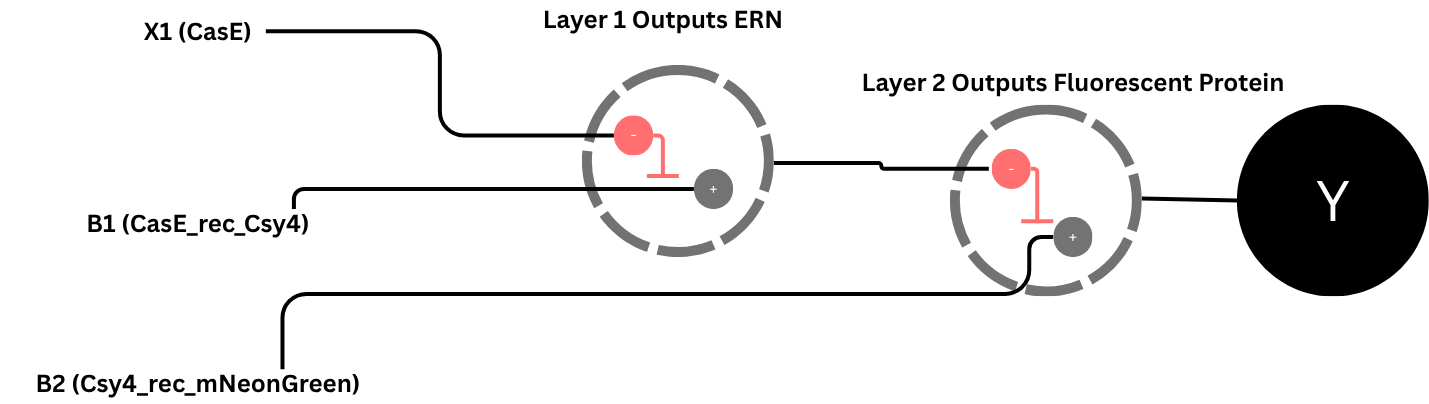
Lab (Week 7) — Neuromorphic Circuits
For the Lab, After spending countless hours trying to understand how these work and the different components and how to interpret them on the graph, I created this summary to explain what i understood exactly.
Our two main building blocks are colors (positive weights) and Endoribonucleases or ERNs (negative weights). An ERN’s main job is to degrade whatever RNA has a motif/tag that is specific to it. So in the Part Names excel file, you will see parts named like CasE_rec_mNeonGreen. This means that this is an RNA instruction to produce the mNeonGreen protein, but it has a target tag for CasE. If CasE is present, it sticks to that tag and cleaves the RNA, preventing the translation of mNeonGreen. The same concept follows for the other parts as well!
Then comes the prediction/graph part. You can split the graph into 4 quadrants to make it easier to understand. The Upper Left is where our X2 circuit is highly expressed and X1 circuit is not. The Upper Right is where both X2 and X1 are highly expressed. The Lower Right is where X1 is expressed and X2 is not, and the Lower Left is where neither are expressed.
Here is a simple example to clarify everything:
- In X1, we put CasE_rec_mNeonGreen: This is supposed to produce the mNeonGreen protein whenever CasE is not available.
- In X2, we put CasE: This means in areas where X2 is available, the CasE will destroy the green RNA, so we won’t see the mNeonGreen protein.
If you plot this, because X1 brings the color and X2 brings the ERNs, the cells will only glow in the Lower Right quadrant (where X1 is high and X2 is low)!
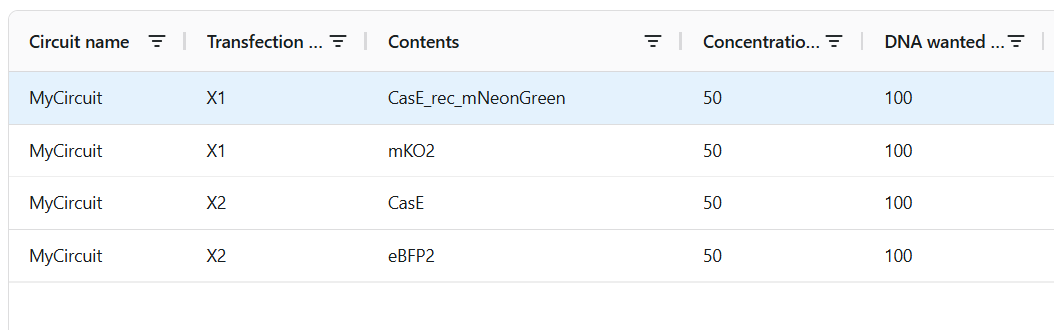
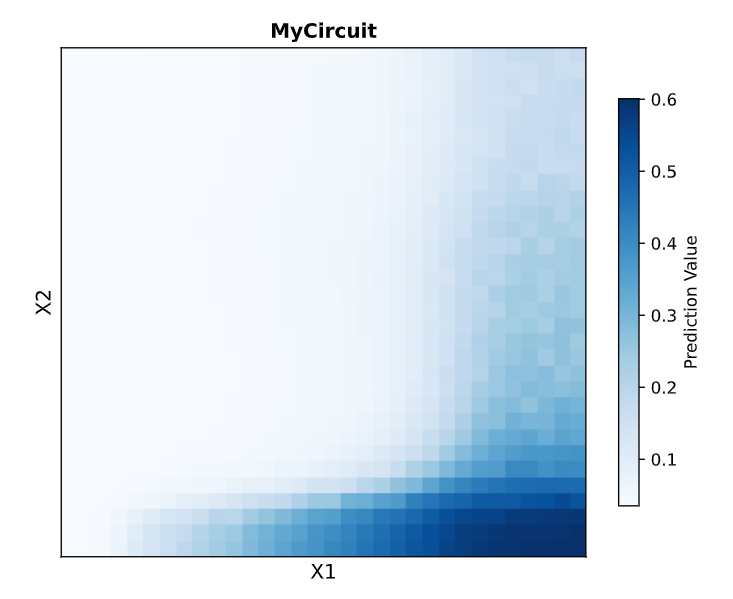
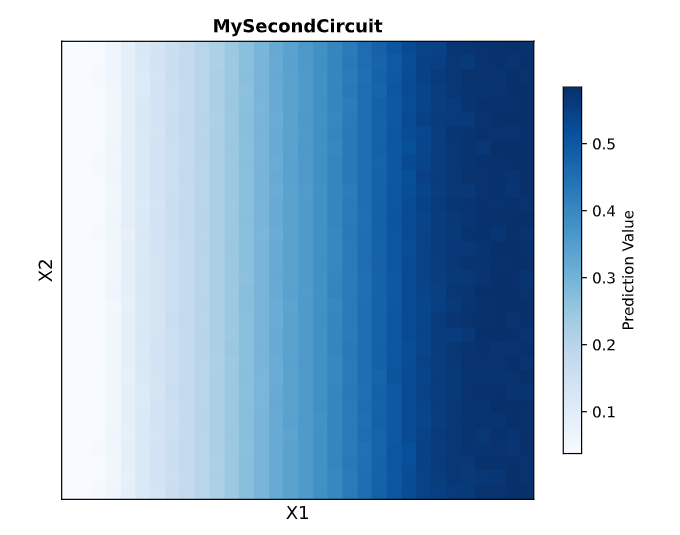
After That I tried to create this Circuit, my aim was to produce a graph that is totally blue on the right and fades to white on the left
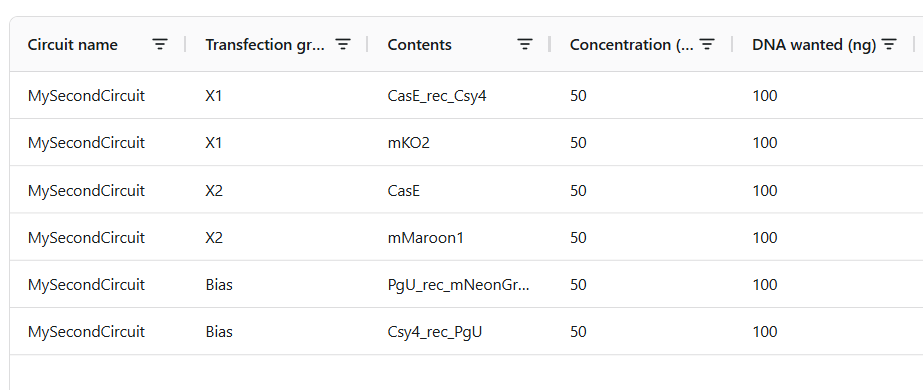
This is my Setup, let me explain it It relies on two main biases:
- PgU_rec_mNeonGreen which produces the Green color all over the graph and has the PgU tag
- Csy4_rec_PgU which cleaves the Green color RNA that has the PgU tag
so far we are supposed to have nothing produced since our second bias Csy4_rec_PgU sequesters our first bias PgU_rec_mNeonGreen, then comes in our X1 and X2.
Remember X1 controls the right half of the graph, which is the part we want filled with color, so X1 should probably break our second bias Csy4_rec_PgU to let our first bias PgU_rec_mNeonGreen produce the color
- X1: CasE_rec_Csy4 this sequesters our second bias Csy4_rec_PgU so now the color is available on the right side
This effectively produces our desired graph, nothing else is needed but since we need to have an X2, we can make it so that it stops X1 letting the second bias be alive again Csy4_rec_PgU to stop the coloring, but we need to do it in an equal way so that X2 doesn’t overpower X1 and removes the color from the upper right quadrant
- X2: CasE this effecitevly sequesters X1 on the left side and is as equal to it on the right side so it doesn’t whiten that part
I hope i still remember how to explain this when the next BioClub Tokyo homework review comes lol XD
Assignment Part 2: Fungal Materials
1. What are some examples of existing fungal materials and what are they used for? What are their advantages and disadvantages over traditional counterparts?
Fungal materials, such as mycelium, are currently used to create alternative leathers for fashion, luxury packaging, and household thermal insulation, Because they take the shape of the molds they grow in, they are also used to fabricate solid objects like planters, furniture, and building bricks for structures and remote habitats
Advantages include that they are incredibly lightweight and deeply insulating as Ren mentioned a thin sheet of mycelium can block the heat of a blowtorch and they are also sustainable and can be grown entirely on agricultural waste like wood chips, grain, or hay
Disadvantages include Vulnerability and Contamination during growth and deformation which is to make the final material safe to handle (inert), it must be baked, which can cause the material to dehydrate and shrink which might break the desired shape
2. What might you want to genetically engineer fungi to do and why? What are the advantages of doing synthetic biology in fungi as opposed to bacteria?
We Engineer Fungi for many reasons including Biomanufacturing therapeutics and enzymes, Grow sustainable materials and foods or building bricks and tools Advantages of fungi over bacteria includes fungi having secretion capacities 10 to 1,000 times higher than bacterial hosts, also they are able to survive harsh and extreme environmental conditions that would destroy bacterial cultures, including highly acidic pH levels, severe dryness, and toxic pollutant surges, also while bacteria typically require a continuous water phase to grow, filamentous fungi build intricate 3D networks of branching hyphae (mycelium) which in huge industrial bioreactors are more efficient to capture and degrade hydrophobic molecules that wet bacterial biofilms struggle to absorb