Week 1 HW: Principles + Practices

1.1 A Neighborly Bio-literacy Learning System for Non-Scientists, Living in a Disaster-Prone World
Full disclosure: My house burned down in the Palisades, California fire last year with 5,000 other homes and it inspired me to see neighborhood disaster as a rich opportunity for study.
Rather than treating bio-literacy as isolated content mastery, this project frames bio-literacy as ethical sense-making within one’s own community and around community-based problems. Bio-literacy is understood as the ability to know ourselves and our world by asking questions, interpreting uncertainty, engaging responsibly, and building trust with biological systems. These capacities become more meaningful—and more powerful—when grounded in local concerns and lived experience. There is no shortage of biology-based shared community challenges: food security, extreme weather and fire, infectious disease, and environmental instability.
The project draws on local, embodied, and experimental pedagogies—such as role play, physical modeling, dialogue, and narrative—to make biological systems felt rather than merely understood abstractly. Participants develop bio-literacy in their “own backyard,” investigating biological questions that matter to them, their families, and their neighbors. In this way, Neighbor Gap Bridge (neighborgapbridge.com) reframes bio-literacy as a situated, relational practice rather than a distant technical competence.
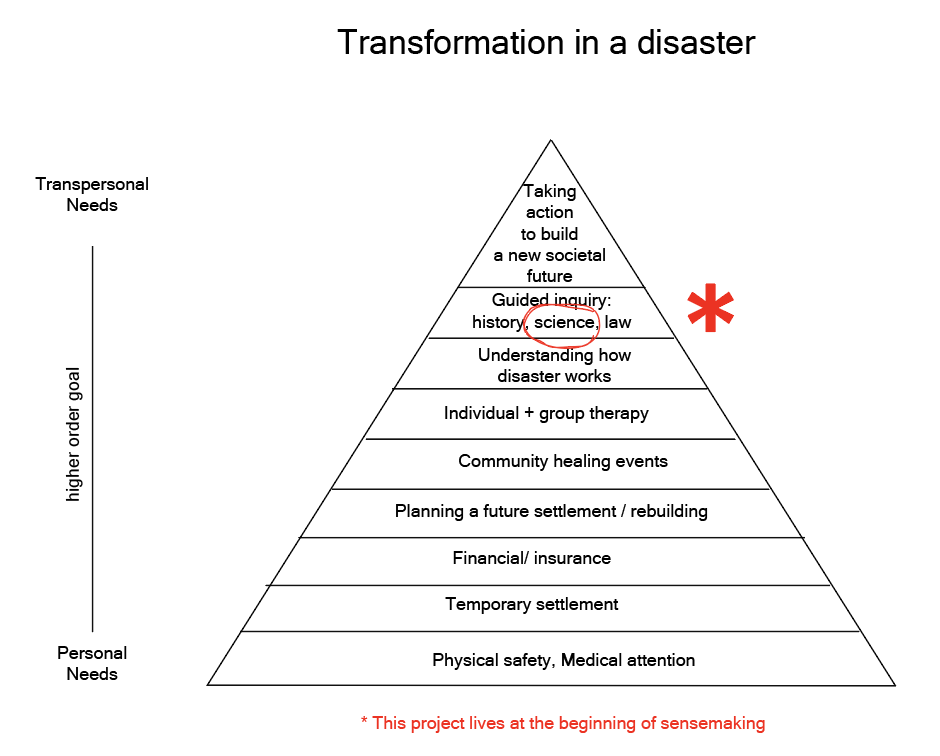
Why this matters We are living in a world of disaster uncertainty in which consequential biological decisions—about health, environment, food systems, and governance—are increasingly made by non-biologists. Bio-literacy’s closest historical parallel is computer literacy: a decades-long project that succeeded in widespread participation, but not widespread understanding. This project reimagines the starting point of bio-literacy as the learner’s own backyard, privileging local problems as invitations into biological understanding, community participation, and compassion. This project is situated in the overall transformative experience of a disaster victim, creating opportunity for high level sensemaking and ability to know ourselves and our world by asking questions, and building trust with multiple systems including biological systems.
Existing bio- and AI-literacy efforts often optimize for scale, rigor, or engagement in isolation. This project instead optimizes for connection and meaning—situating learning within relationships, shared stakes, and ethical reflection.
Visionary (Infrastructure Design) What is missing is a governance-aligned learning infrastructure that treats ethical sense-making, uncertainty, pluralism, and participation as core learning outcomes rather than peripheral concerns. This project explores what such an infrastructure might look like, and what forms of governance, partnership, and institutional support would be required to sustain it.
Near-Future (Programmatic Pilot) Local, problem-based, intergenerational synthetic biology learning—using scaffolded play and embodied curriculum in partnership with LAUSD—focused on community-relevant biological questions.
Close-In (Rapid Prototyping / Extreme Events) Mobile syn-bio workshops and learning labs responding to “extreme events,” such as wildfire. For example, intergenerational workshops with residents affected by the Palisades fire to explore the biology of fire-resistant mycelium-based materials, alongside the design and fabrication of protective artifacts for future resilience.
1.2 Governance/Policy Goals for a Neighborly Bio-Literate Future
Governance Goal 1: Equitable Access Without Dilution
- Open access (low or no cost)
- Universal Design for Learning
- Multi-generational participation
- Not restricted to credentialed elites
- Engage Creative athletics
- Engages local biological problems
Governance Goal 2: Epistemic Pluralism
- Interdisciplinary sources
- Diverse instructors and perspectives
- Recognition that different perspectives change what becomes knowable
- Embodies Learning
- Learning is felt
Governance Goal 3: Trustworthy Sense-Making
- Transparency of sources
- Open and updatable materials
- Clear articulation of uncertainty
- Avoidance of false certainty or hype
- Care and Compassion based Learning
- Feminine Technology of learning
- Treat Error as opportunity
Governance Goal 4: Ethics as Infrastructure (Not Add-On)
- Ethics embedded in delivery, not add-ons
- Democratic dialogue and controversy included
- Anticipation of ethical roadblocks
- Delayed closure where appropriate
1.3 Potential Governance Actors + Actions
NSF-funded experimental bio literacy learning labs
Purpose Bio-education funding prioritizes content mastery and workforce development. This action proposes NSF funding streams specifically for experimental, embodied bio literacy learning environments aimed at non-specialists.
Design
- Competitive grants for interdisciplinary teams (science + education + design0
- Competitive Grants for Neighorhood non scientists
- Emphasis on process documentation, not standardized outcomes
- Publicly available learning artifacts and reflections
- Ethics embedded throughout the learning experience
- Robust digital share community spaces
Assumptions
- Embodied and experimental pedagogy improves ethical sense-making
- Non-specialists can meaningfully engage without technical mastery
- NSF will value exploratory education research
- People actually want to work when they have been affected by trauma
Risks of Failure
- Failure: Projects become performative or symbolic rather than substantive
- Failure: Difficulty evaluating progress without traditional metrics
- Say to day survival becomes more important
Department of Education Guidance on Bio-literacy + Trust
Purpose Currently, bio education standards focus on factual knowledge. This action proposes non-binding federal guidance recognizing bio literacy as an ethical and civic competency.
Design
- Advisory frameworks (not mandates)
- Alignment with Universal Design for Learning
- Encouragement of dialogue-based and participatory approaches
- Recognition of uncertainty and ethical debate as learning outcomes
Assumptions
- Federal guidance can shape discourse without enforcement
- Educators want permission to teach uncertainty and ethics
- Bio literacy can be framed as civic preparation
- Bio Literacy can be framed astrauma informed
Risks of Failure
- Failure: Guidance is ignored or politicized
- Failure: Oversimplification for scale
- Risk of “success”: Bio literacy reduced to compliance checklists
MIT Life-long Kindergarten as Model
Purpose Traditional science education often prioritizes correctness, abstraction, and expert authority. This governance action supports play-based, experimental science literacy models that cultivate curiosity, agency, and ethical orientation before formal expertise. Rather than teaching biology directly, the approach develops habits of inquiry—iteration, questioning, and reflection—that are transferable to bio literacy contexts.
Design
- Learning environments structured around play, making, and experimentation
- Tools that lower barriers to participation (no prerequisite mastery)
- Emphasis on remixing, peer learning, and public sharing
- Ethics embedded implicitly through collaboration, attribution, and care
- These workshops are part of a holistic plan for discovery and recovery
Assumptions
- Play supports deeper engagement and long-term learning
- Ethical orientation can emerge through participation, not instruction alone
- Habits of inquiry transfer across domains (e.g., from computation to biology)
- Framing can be sensitive enough to support engagement during or after a crisis
- these Workshops are optional
Risks of Failure
- Failure: Play is dismissed as insufficiently rigorous
- Failure: Ethical dimensions remain implicit and unarticulated
- Play becomes instrumentalized or gamified, losing its exploratory power and sensitivity
- This becomes very Kumbaya and does not move our collective inderstanding forward
1.4 Scoring Table
–> (1= lowest)
| Does the option: | ED | NSF | MIT |
|---|---|---|---|
| Build Trust | |||
| • Uncertainty Embraced | 3 | 2 | 1 |
| • Care/ Compassion | 3 | 2 | 1 |
| Embed Ethics | |||
| • Democratic Dialog | 3 | 2 | 1 |
| • Delay closure | 3 | 2 | 1 |
| Interdis | |||
| • Perspectives | 2 | 2 | 1 |
| • Feminine Technology | 3 | 3 | 1 |
| Equitable | |||
| • Not just Elites | 2 | 3 | |
| • Free/ low cost | 1 | 3 | 2 |
| - |