Week 7 HW: Genetic Circuits
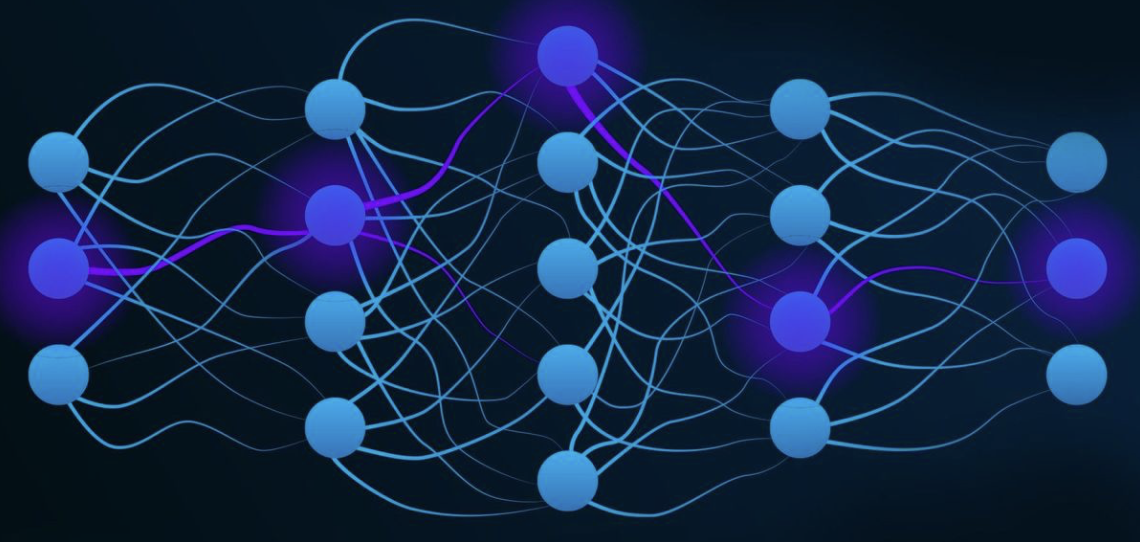
Assignment Part 1: Intracellular Artificial Neural Networks (IANNs)
What advantages do IANNs have over traditional genetic circuits, whose input/output behaviors are Boolean functions?
Traditional genetic circuits behave like Boolean logic gates (ON/OFF, 0/1), meaning they produce discrete outputs based on fixed thresholds. In contrast, Intracellular Artificial Neural Networks (IANNs) offer several advantages:
- Continuous (analog) responses rather than binary outputs
- Ability to integrate multiple inputs simultaneously with weighted influence
- Support for more complex decision-making within cells
- Greater flexibility in representing graded biological signals (e.g., concentration levels)
- Potential to approximate nonlinear relationships, similar to machine learning models
- In short, while Boolean circuits are rigid and rule-based, IANNs allow cells to behave more like adaptive information-processing systems.
Describe a useful application for an IANN; include a detailed description of input/output behavior, as well as any limitations an IANN might face to achieve your goal. Example: Smart cellular sensor for inflammation An IANN could be engineered to detect and respond to complex inflammatory environments in the body. Inputs: X₁: concentration of inflammatory cytokine A X₂: concentration of inflammatory cytokine B X₃: oxidative stress signal Each input would be encoded as DNA constructs producing regulatory molecules (e.g., endoribonucleases or transcription factors).
Processing: The IANN integrates these inputs using weighted interactions, allowing the cell to evaluate: “Is this a mild, moderate, or severe inflammatory state?” Instead of a simple ON/OFF response.
Output: Low inflammation → no response Moderate inflammation → mild reporter signal High inflammation → strong expression of a therapeutic protein (or fluorescent output) Why this is powerful This allows context-sensitive decision-making, rather than triggering responses based on a single threshold.
Limitations: Biological noise (gene expression variability) Difficulty in precisely tuning weights and thresholds Slow response times compared to electronic systems Metabolic burden on the cell Limited number of orthogonal (non-interfering) biological components
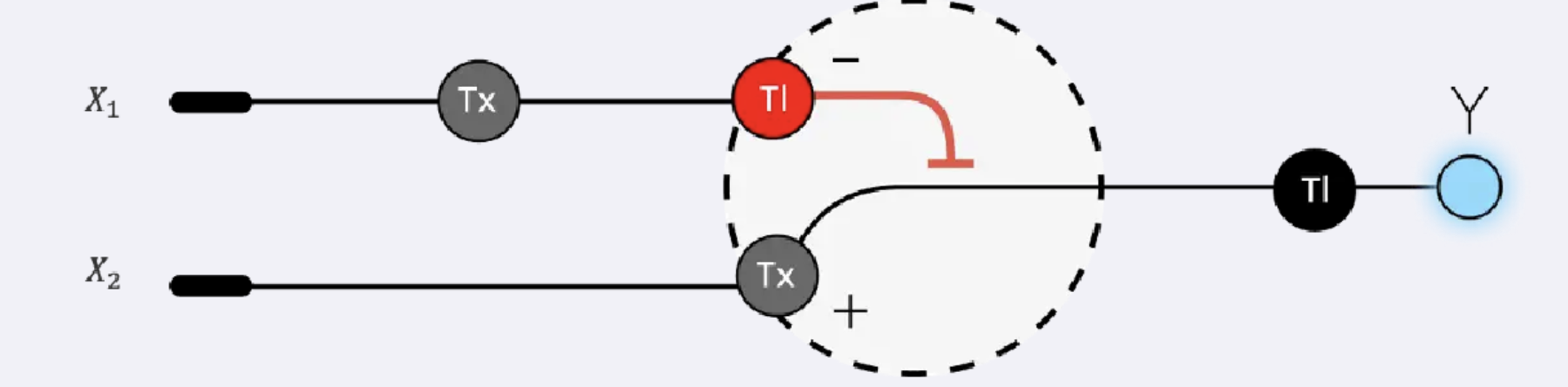
Below is a diagram depicting an intracellular single-layer perceptron where the X1 input is DNA encoding for the Csy4 endoribonuclease and the X2 input is DNA encoding for a fluorescent protein output whose mRNA is regulated by Csy4. Tx: transcription; Tl: translation.
 Draw a diagram for an intracellular multilayer perceptron where layer 1 outputs an endoribonuclease that regulates a fluorescent protein output in layer 2.
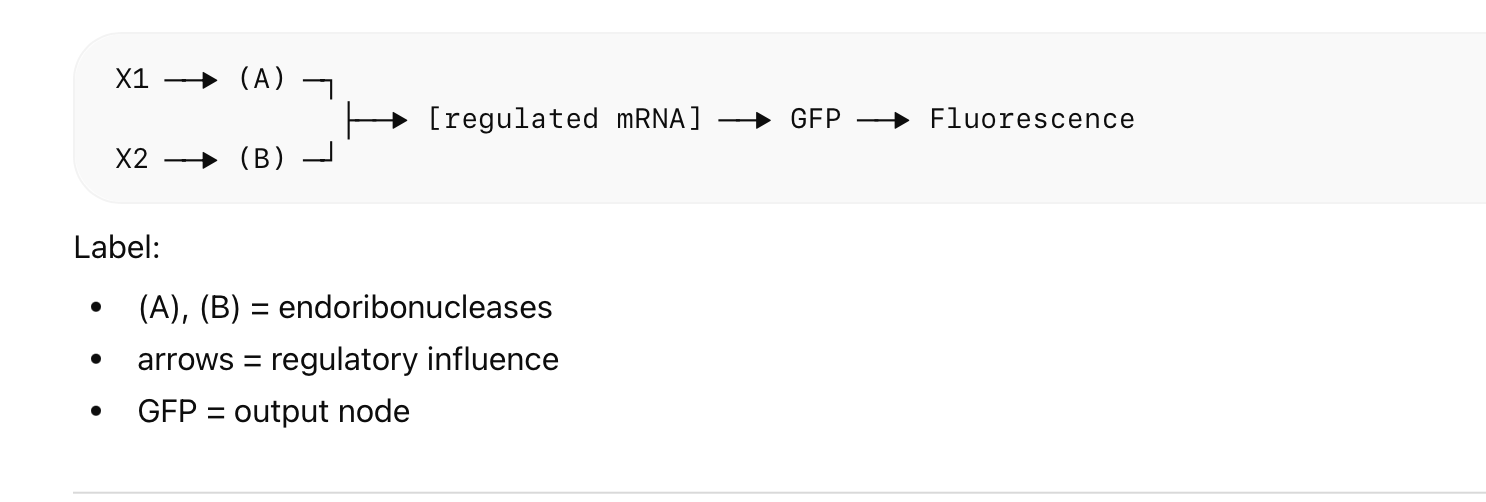 This intracellular multilayer perceptron uses input DNA sequences to produce endoribonucleases in the first layer, which regulate mRNA stability in the second layer to produce a graded fluorescent output. This architecture enables analog signal integration rather than binary responses.
Assignment Part 1A ## Connecting This to MY Project
My emerging theme: Fire loss → soil → memory → sensing → regeneration
Concept: “Post-Fire Soil Intelligence Circuit”
Instead of abstract cytokines, my inputs become: Inputs (Layer 0) X₁ = heavy metal concentration (post-fire contamination) X₂ = microbial recovery signal (soil health indicator) X₃ = moisture / environmental recovery
These are real ecological signals. Layer 1 (Processing layer)
Each input drives expression of: different regulatory proteins (or endoribonucleases)
These act like weights in a neural network.
Layer 2 (Output)
Instead of just GFP, you could have: fluorescence (for lab demonstration) OR scent molecule (👀 geosmin/petrichor tie-in!) OR pigment production
Conceptual diagram of MY system
POST-FIRE ENVIRONMENT
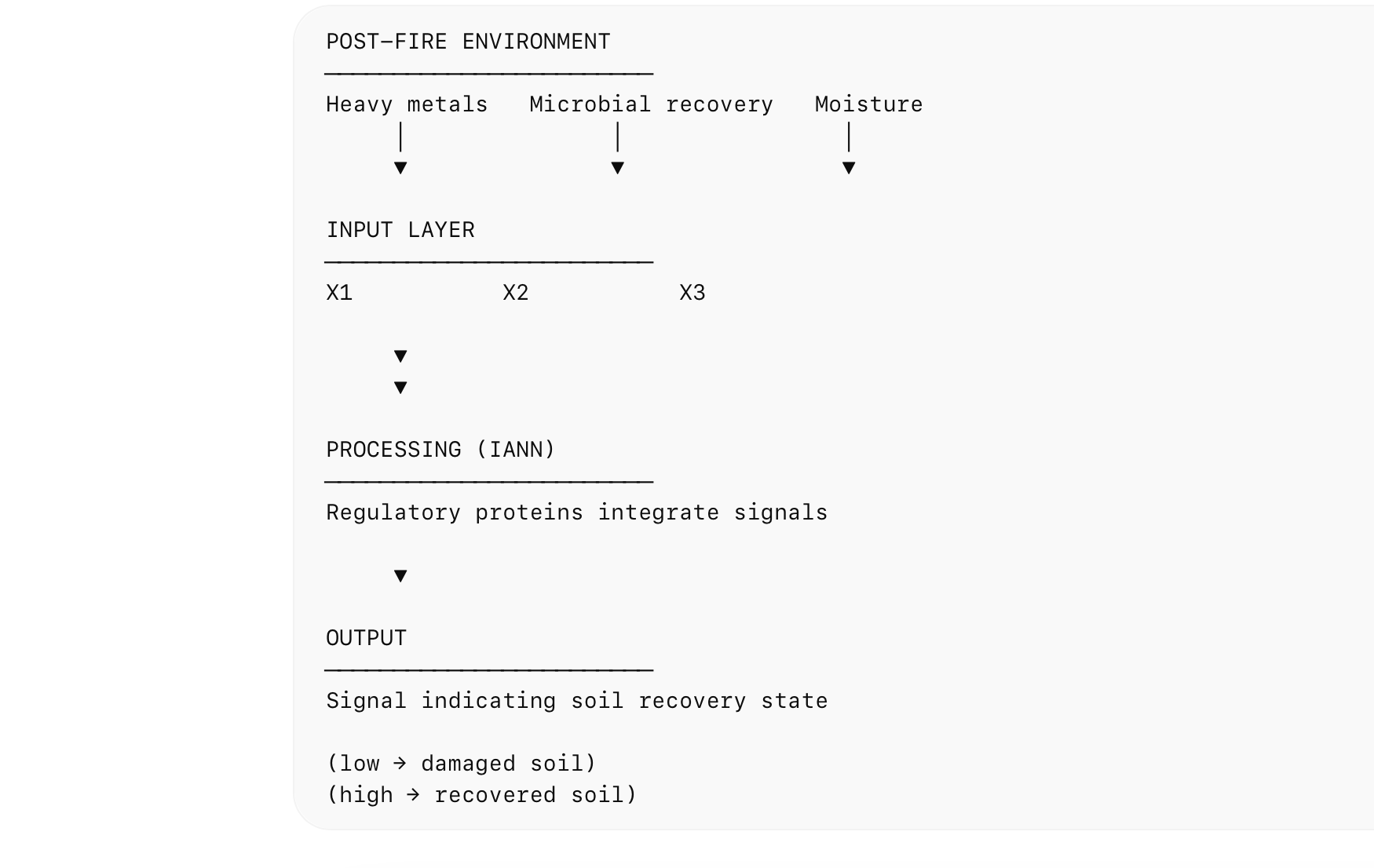 (low → damaged soil)
(high → recovered soil)
(low → damaged soil)
(high → recovered soil)
Project Reframe:
A living system that interprets ecological recovery as a continuous signal, rather than a binary “healthy/unhealthy” classification.
Just as human memory after fire is not binary but layered, partial, and evolving, an intracellular neural network allows biological systems to interpret environmental recovery as a gradient rather than a fixed state.
I’m interested in designing a system that brings together several biological sensing pathways that don’t عادة interact — like soil chemistry, microbial recovery, and environmental conditions — and integrating them using an intracellular neural network so the system can produce a graded signal of post-fire recovery rather than a simple on/off response.##
Optional poetic layer (if you want to go there) You could even imagine: low recovery → no scent mid recovery → faint petrichor high recovery → strong petrichor signal
So the system literally becomes: soil health → smell of rain → memory of renewal
Assignment Part 2: Fungal Materials
What are some examples of existing fungal materials and what are they used for? What are their advantages and disadvantages over traditional counterparts? What might you want to genetically engineer fungi to do and why? What are the advantages of doing synthetic biology in fungi as opposed to bacteria? Assignment Part 3: First DNA Twist Order
Assignment Part 3
- Review the Individual Final Project documentation guidelines.
- Submit this Google Form with your draft Aim 1, final project summary, HTGAA industry council selections, and shared folder for DNA designs.
- Review Part 3: DNA Design Challenge of the week 2 homework.
- Design at least 1 insert sequence and place it into the Benchling/Kernel/Other folder you shared in the Google Form above. Document the backbone vector it will be synthesized in on your website.nv