ABSTRACT This project investigates whether post-fire soil contains detectable molecular and chemical signatures of ecological disturbance that can be translated into perceptible sensory signals. The project addresses the growing need for accessible, community-centered approaches to environmental remediation and post-fire recovery in increasingly climate-affected regions. The overall objective is to explore how engineered microbial systems might simultaneously support soil remediation while making otherwise invisible recovery processes perceptible through olfactory, visual, and auditory outputs. The hypothesis is that post-fire contaminants and altered soil conditions can activate engineered biological pathways linked to sensory signaling and remediation functions. Specific aims include collecting and comparing post-fire soil samples, identifying microbial and chemical indicators of disturbance, and designing speculative bio-responsive signaling systems. Methods include soil culturing, pH and contamination analysis, microbial comparison studies, and conceptual synthetic biology workflows involving biosensing, biomineralization, and geosmin-associated signaling pathways.
Post Wildfire Soil Restoration, Emotional Ecology and Repair Signaling
ABSTRACT
This project investigates whether post-fire soil contains detectable molecular and chemical signatures of ecological disturbance that can be translated into perceptible sensory signals. The project addresses the growing need for accessible, community-centered approaches to environmental remediation and post-fire recovery in increasingly climate-affected regions. The overall objective is to explore how engineered microbial systems might simultaneously support soil remediation while making otherwise invisible recovery processes perceptible through olfactory, visual, and auditory outputs. The hypothesis is that post-fire contaminants and altered soil conditions can activate engineered biological pathways linked to sensory signaling and remediation functions. Specific aims include collecting and comparing post-fire soil samples, identifying microbial and chemical indicators of disturbance, and designing speculative bio-responsive signaling systems. Methods include soil culturing, pH and contamination analysis, microbial comparison studies, and conceptual synthetic biology workflows involving biosensing, biomineralization, and geosmin-associated signaling pathways.
PROJECT AIMS
Aim 1: Experimental Aim :
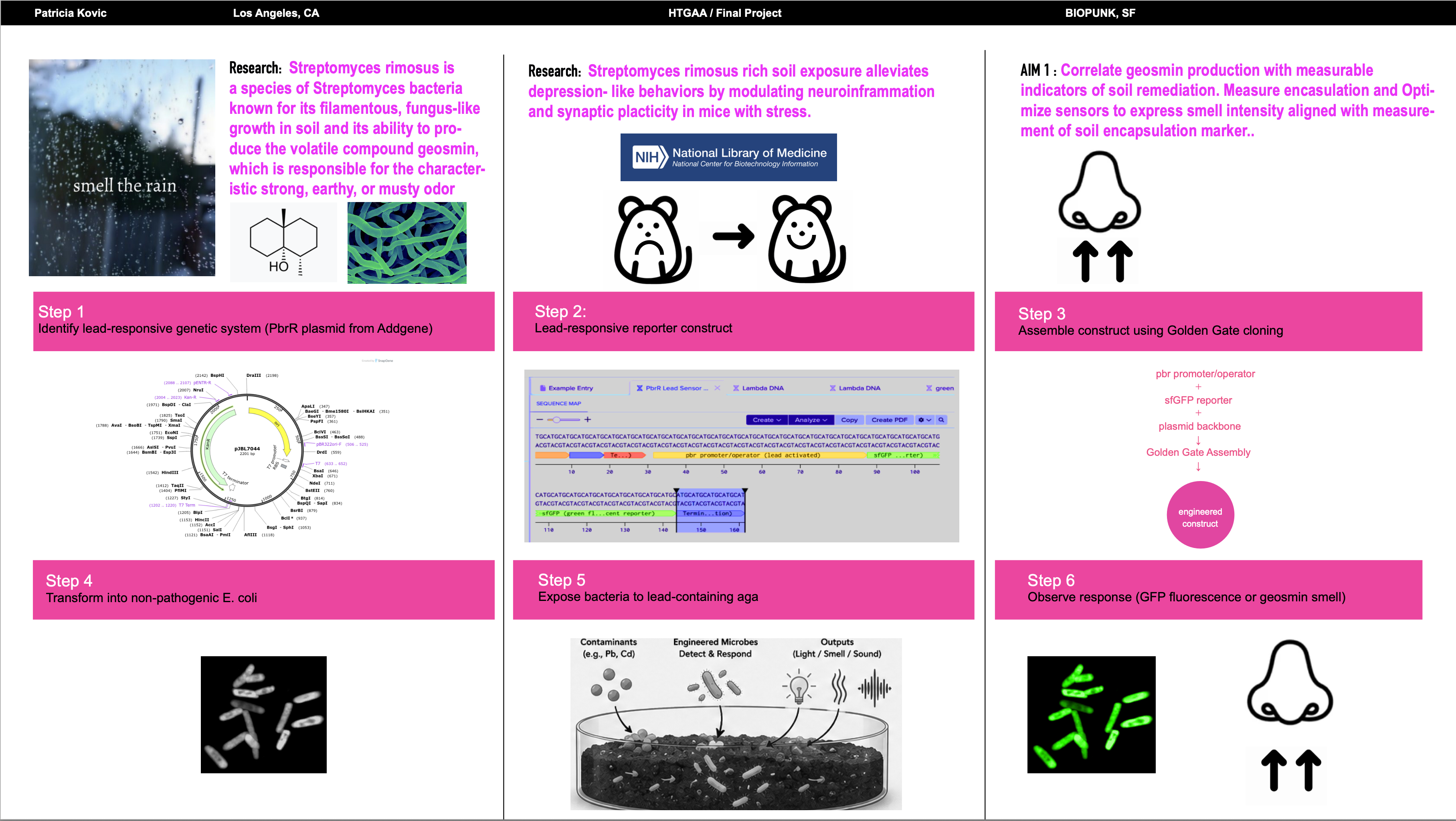
The first aim of my final project is to correlate geosmin production with measurable indicators of soil remediation. Step one was to PROVE the LEAD-SENSING LOGIC by designing a modular genetic cassette in which a heavy-metal sensing element, likely pbrR/pbr, controls either a GFP or a geosmin output module.
Aim 2: Development Aim:
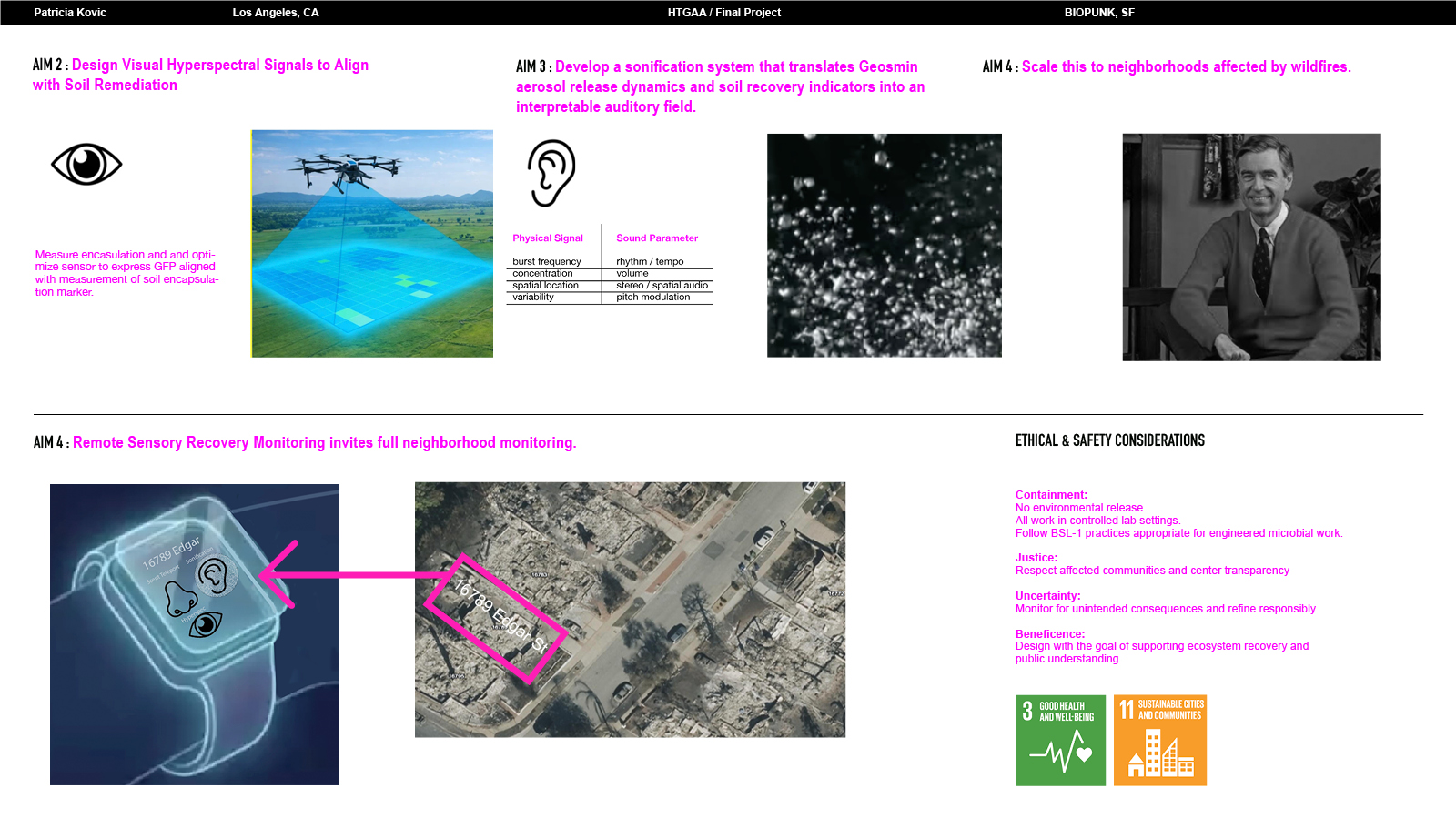
Design Visual Hyperspectral Signals to Align with Soil Encapsulation
Aim 3: Visionary Aim:
Develop a sonification system that translates Geosmin aerosol release dynamics and soil recovery indicators into an interpretable auditory field.
BACKGROUND
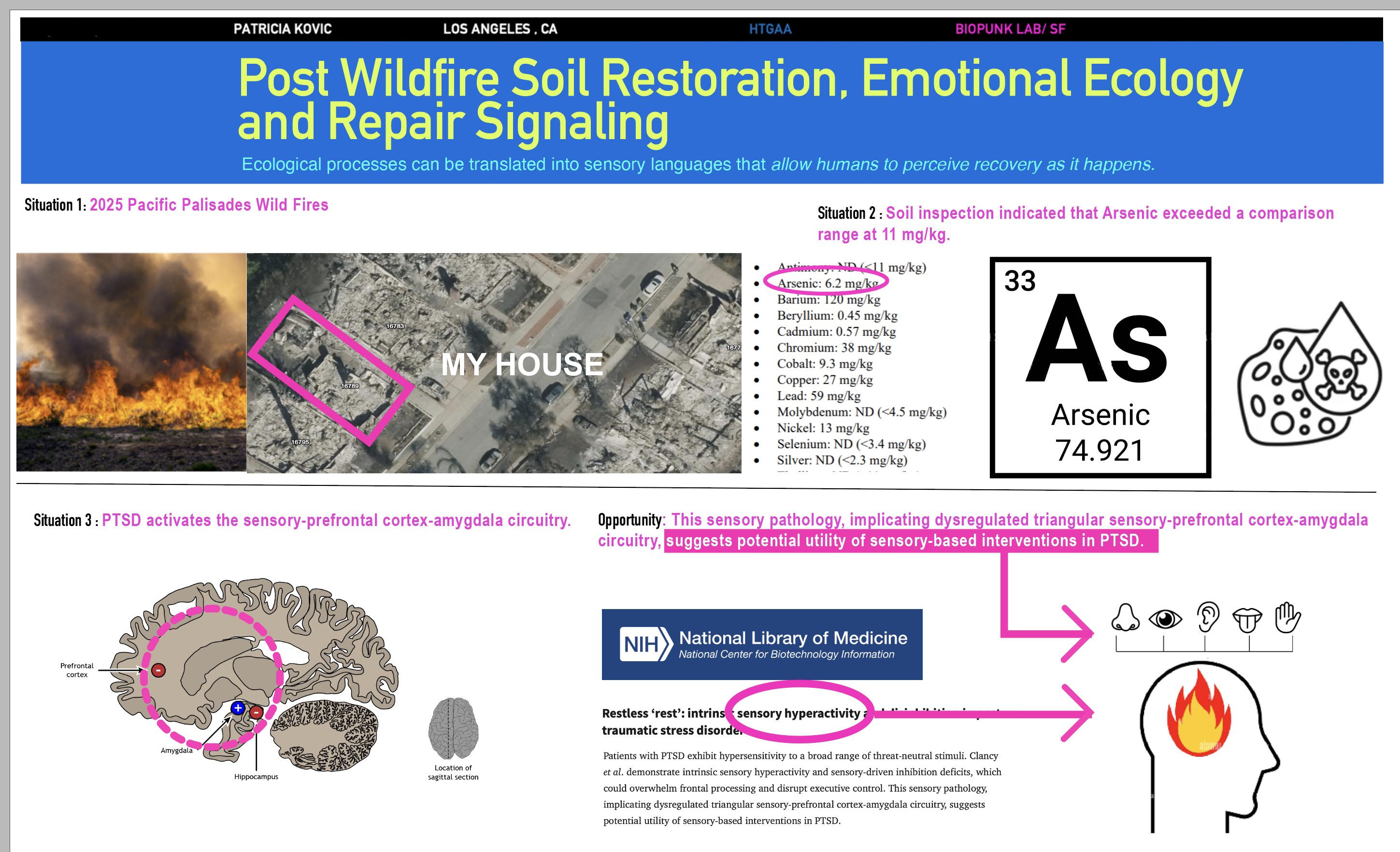
In January 2025, the Palisades fire moved through my home and landscape. What remained looked quiet. But the ground was no longer what it seemed. Post-fire conditions produce states that exceed human perception. The soil may be toxic without visible signs. The body may be affected without clear markers. There is a gap… between condition and perception. After the fire, two forms of damage remain. One is visible—the destruction of the landscape. The other is less visible—chemical residues in the soil, and psychological previously designed circuits in a new way that begins to address the gap between condition and perception.
Novelty
This project is only novel in that it proposes connecting previously un-related circuits into a new system that begins to address two post fire conditions: Material contamination and Experiential and psychological residue. “Post Wildfire Soil Restoration, Emotional Ecology and Repair Signaling” is situated in Beneficence, the ethical principle of promoting the well-being of others. It involves taking positive actions to help survivors of wildfires recover in a broad holistic way, in a time when climate-induced hotter, drier conditions have produced extreme wildfire activity.
Literature Context
I read the following texts for this project:
1/ Twice-engineered bacteria scavenge heavy-metal pollutants and hold them for recycling, Cornell biotechnologists report
By Roger Segelken March 23, 1999
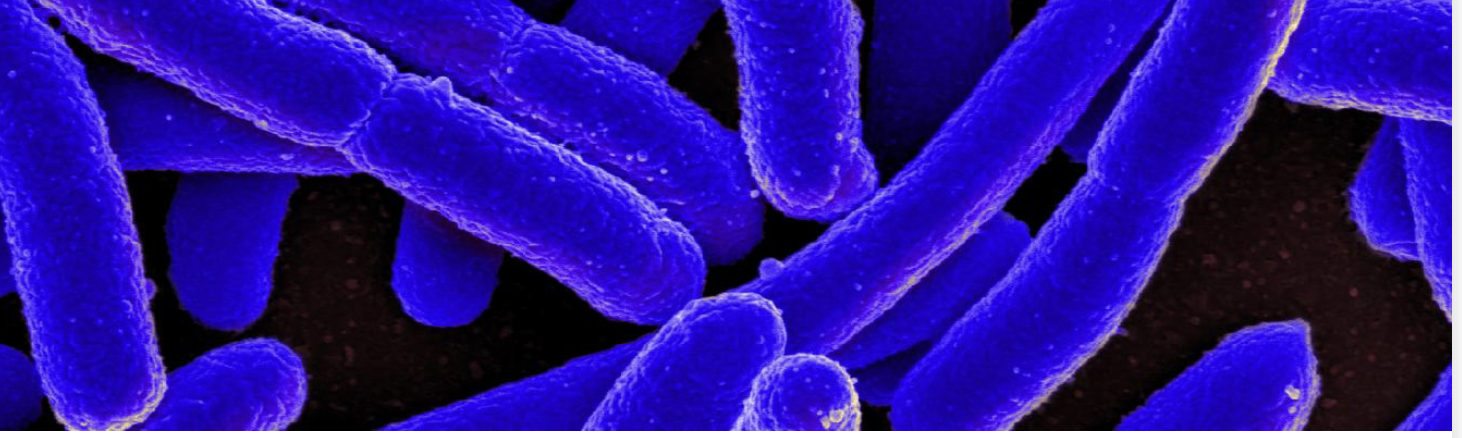
In a 1999 study from Cornell University, researchers engineered E. coli bacteria to help remove toxic heavy metals from contaminated environments. The team modified the bacteria to produce proteins on the cell surface that strongly bind metals such as cadmium, nickel, and lead. Instead of storing the metals inside the cell, the engineered bacteria acted more like microscopic sponges, capturing contaminants externally and making them easier to collect and remove.
The research demonstrated that genetically engineered microbes could potentially offer a cheaper and more environmentally responsive alternative to conventional heavy-metal cleanup methods, which are often expensive and disruptive. The study also suggested possible applications in mining waste, industrial runoff, and polluted soil remediation.
For my project, the article is especially relevant because it establishes an early precedent for using engineered bacteria as environmental sensing and remediation systems. My work extends this idea further by coupling remediation with sensory signaling — making ecological recovery perceptible through smell, sound, or visual outputs rather than remediation remaining chemically invisible. https://news.cornell.edu/stories/1999/03/engineered-bacteria-scavenge-heavy-metals#:~:text=By%20Roger%20Segelken,coli%20cell.
2/Engineered bacteria emit signals that can be spotted from a distance | MIT News | Massachusetts Institute of Technologyhttps://dronelaunchacademy.com/resources/aerial-photogrammetry-surveying/
The article explains how aerial photogrammetry surveying uses drones and overlapping photographs to create highly accurate maps, terrain models, and 3D reconstructions of landscapes. Specialized software analyzes the overlap between hundreds of aerial images to calculate depth, elevation, and spatial measurements, transforming photographs into usable geospatial data.
The article highlights applications in construction, environmental monitoring, land surveying, infrastructure analysis, agriculture, and disaster assessment. Key advantages include speed, safety, cost efficiency, and the ability to survey hazardous or inaccessible terrain remotely with centimeter-level accuracy.
For my HTGAA work, this is particularly relevant because drone photogrammetry could become part of my Aim 2:Design Visual Hyperspectral Signals to Align with Soil Encapsulation helping to make ecological recovery perceptible, since aerial imaging can reveal landscape-scale changes invisible from the ground.
This project raises ethical questions about the use of engineered biological systems in damaged ecological environments. Because the project explores speculative microbial sensing and remediation systems for post-fire soil, principles of non-maleficence, beneficence, environmental responsibility, and justice are especially relevant. The research is motivated by increasing wildfire damage and the unequal environmental and public health burdens often experienced by affected communities. While the project imagines beneficial applications for remediation and ecological communication, it also recognizes that introducing engineered organisms into complex ecosystems could create unintended ecological consequences. The project therefore approaches synthetic biology cautiously, treating biological intervention not as a technological “solution,” but as a form of experimental inquiry into how remediation processes might become more perceptible and publicly understandable.
To ensure ethical responsibility, the project proposes that all experimental work remain contained within laboratory or highly controlled environments and avoid environmental release of engineered organisms. Soil sampling and microbial analysis should follow biosafety and environmental handling protocols appropriate for educational research settings. Potential unintended consequences include inaccurate assumptions about ecological recovery, oversimplification of complex environmental systems, or the possibility that speculative sensory outputs could be misinterpreted as precise scientific measurements rather than exploratory signals. Alternatives to engineered systems include non-genetic environmental sensing methods, conventional remediation strategies, or purely observational ecological monitoring. The project acknowledges uncertainty in both the scientific and social dimensions of the work and emphasizes transparency, caution, and public accountability in how biological technologies are imagined and communicated.
EXPERIMENTAL DESIGN, TECHNIQUES, TOOLS, AND TECHNOLOGY
PROVE LEAD-SENSING LOGIC
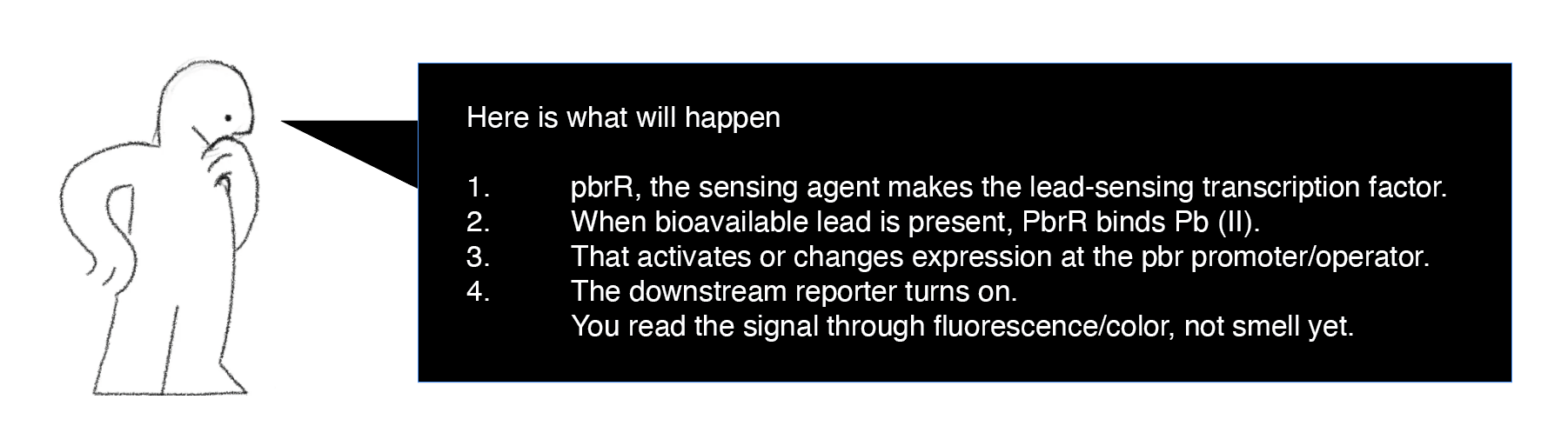
I am designing a modular genetic cassette in which a heavy-metal sensing element, likely pbrR/pbr, controls either a standard reporter or a geosmin output module, with HSR considered as an auxiliary stress-sensitive element rather than the primary detector. My design intent is to detect bioavailable Pb(II) using a PbrR/pbr lead-responsive sensing module. Initial output will be a fluorescent reporter to validate sensing behavior. A later version may replace the reporter with a geosmin-associated output module for sensory repair signaling.
Cassette v1 should respond to bioavailable Pb(II) PbrR + pbr promoter/operator → reporter
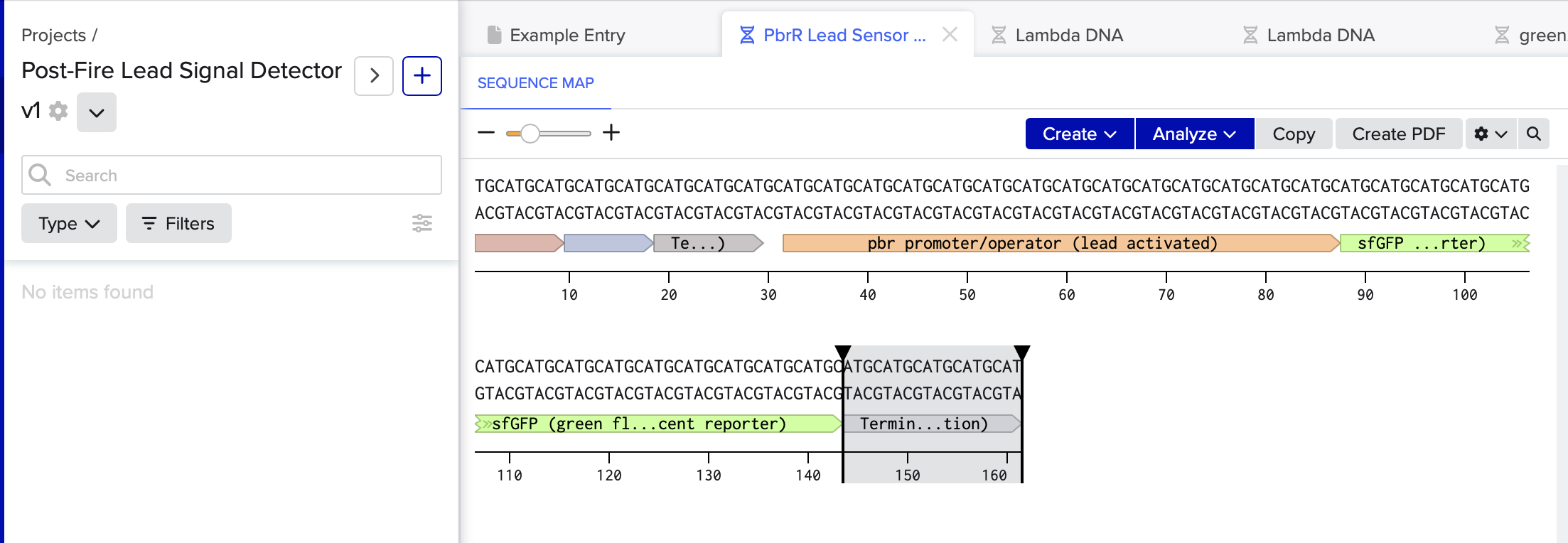
Building aa Benching Circuit Template Promoter → pbrR → Terminator → pbr promoter → sfGFP → Terminator benchling benchling
Assuming E. coli as initial chassis for circuit implementation
2. MAKE THIS BIOLOGICALLY PLAUSIBLE + LAB-READY
I updated the annotiations
ann_up
Design uses J23100 to constitutively express pbrR (from C. metallidurans). Lead-bound PbrR activates the pbr promoter controlling sfGFP.
Terminators used to isolate transcriptional units. Designed for E. coli chassis. ##
e
VALIDATE THAT WHEN LEAD IS PRESENT, GFP IS EXPRESSED
QUESTIONS FOR ELLIOT
I designed a lead-specific PbrR system. I’m wondering if you’d like me to instead—or additionally—explore an HSR-based stress-responsive promoter. Is PbrR/pbr a good system in your lab’s E. coli setup?
Would you recommend validating with GFP before attempting a geosmin output?
What are my next steps?
ANWERS FROM ELIOT
To validate put a small amoont of Lead nitrate ((\text{Pb(NO}{3}\text{)}{2})) or Lead acetate in an agar plate and grow ecoli in the presence of lead. Go to addgene. search PbrR and get the plasmid pjl74y. Regarding petrachor/ geosmin you need to add a that oroduces a similar smell. Use Goldergate to design DNA that emits geosmin smell.List all the supplies i need to conduct the basic experiment and email Elliot.
Results & Quantitative Expectations
You are required to validate at least one aspect of your final project aims. This is to ensure that you are able to successfully apply a relevant synthetic biology technique to your project. Include figures if you have them—accuracy is critical in figures, tables, and graphs
Here is a non-exhaustive list of acceptable validations:
Designing DNA relevant to your final project
Performing a PCR reaction using primers relevant to your final project
Performing a Gibson assembly relevant to your final project
Creating and performing a cell-free assay related to your final project
Creating and running code to validate an aspect of your final project
Developing a model or completing a computational analysis relevant to your project
Designing DNA construct(s) that can express at least one gene of interest, ordering it (via Twist), and testing of the expression of the construct(s) (potentially using an Opentrons robot)
What aspect of your final project did you choose to validate? (min. 2 sentences)
Write down a detailed protocol of how you validated this aspect of your final project. (Numbered list or paragraph is fine)
What synthetic biology techniques did you utilize in validating this aspect of your final project? You can refer to the list of techniques in question 8. (min. 4 sentences)
You must present data as part of your final project and include some analysis of that data. The data may be collected experimentally in the lab or generated as simulated data (e.g., using the Asimov Kernel or another simulation method). (min. 2 sentences)
Did you encounter any unexpected challenge(s) when performing your validation? If so, describe the challenge(s) and strategies to overcome it. If not, discuss potential problems, difficulties, limitations, and/or alternative strategies to overcome challenges in your final project. (min. 4 sentences).
ADDITIONAL INFORMATION
References
Supply list
Biological Materials
Non-pathogenic E. coli strain
Addgene plasmid pJL74Y (PbrR system)
DNA assembly reagents for Golden Gate cloning
Competent cells
Agar plates and bacterial media
Antibiotic selection plates
DNA Design + Assembly
Benchling account
Restriction enzymes compatible with Golden Gate assembly
Ligase
Primers
DNA fragments or synthesized gBlocks
DNA purification materials
Analysis + Documentation
Blue light or fluorescence viewer (if using GFP)
Pipettes and sterile tips
Petri dishes
Incubator access
Lab notebook/documentation setup
Camera or smartphone for recording results
Biosafety + Handling
Gloves
Eye protection
Proper hazardous waste disposal procedures
Institutional biosafety guidance
Biosafety Notes
This project should remain fully contained within an educational or community laboratory environment. Any work involving heavy metals or engineered organisms should follow appropriate biosafety and hazardous materials procedures. The project is intended as a speculative educational demonstration and not for environmental deployment.
PRESENTATION SLIDES
PRESENTATION SCRIPT:
Thank You, Joel
In January 2025, the Palisades, California fire moved through my home and landscape. What remained looked quiet. But the ground was no longer what it seemed. Post-fire conditions produce states that exceed human perception. The soil may be toxic without visible signs. The body may be affected without clear markers. There is a gap between condition and perception. After the fire, two forms of damage remain. One is visible and measurable—the destruction of the landscape and the chemical residues in the soil. The other is less visible—psychological traces in those who experienced it.
Next slide
Perhaps you have noticed a strong, earthy, and invigorating smell of healthy soil after a rain fall. That’s Geosmin. AIM 1 explores how engineered microbes might detect post-fire contaminants, translating hidden ongoing environmental conditions into a sensory signal. The healthier the soil, the stronger the geosmin production. Geosmin production is used as a genetic circuit trigger linked to increased heavy metal soil encapsulation. The measurable recovery of the soil conditions, express as an increasing olfactory signal.
I began working with synthetic biology tools not as ends in themselves, but as ways of thinking. How might engineered microbes detect post-fire contaminants and translate hidden environmental conditions into sensory signals? I translated this statement into a genetic circuit— A sensor. A promoter. A reporter.
Next Slide
The first experiment is intentionally simple and visual. A Boolean test: If lead is present, the circuit produces a fluorescent signal. If not, it remains off. A binary response—but one that makes an otherwise invisible condition perceptible. Using modular DNA assembly approaches, the output of this system can be reconfigured—translating the same signal into different sensory forms. A hyperspectral image. A sonification system. In this context, repair is not singular. The soil may undergo chemical remediation, while human experience moves through a different, slower process. This work does not attempt to resolve that difference—but to make it perceptible. This project operates in the space—between appearance and condition, between recovery and perception.
COURSE EVALUATION
Before HTGAA, synthetic biology felt like a distant world—highly technical, specialized, and somewhat inaccessible from my position as a design educator and educational researcher. What surprised me most about the course was not simply the extraordinary level of scientific knowledge, but the culture of generosity surrounding it. HTGAA welcomed curiosity before expertise. The course gave me permission to enter synbio experimentally: to ask questions, make conceptual connections, fail publicly, and slowly build understanding alongside artists, scientists, designers, engineers, and researchers from around the world. Rather than narrowing my perspective into a single technical pathway, it expanded my sense of what biological literacy, collaboration, and future-making might become. As someone working at the intersection of AI, pedagogy, culture, and systems thinking, HTGAA helped me see synthetic biology not only as a scientific field, but as a profound cultural and philosophical space—one that will increasingly shape how humans understand agency, ecology, responsibility, and especially design itself.