Week 3 LAB AUTOMATION

Week # 3 Lab Automation
LAB AUTOMATION
To get hands-on (or at least code-on) with pipetting robots.
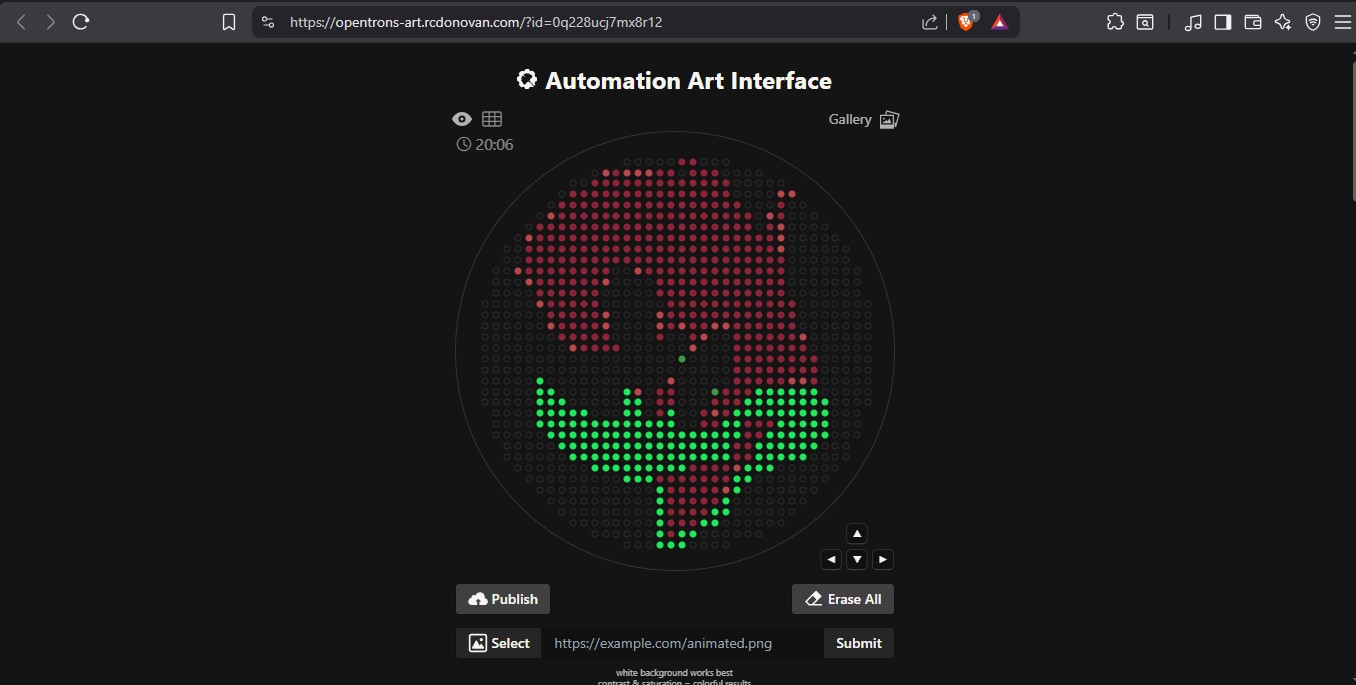
Your task this week is to Create a Python file to run on an Opentrons liquid handling robot. 0. Review this week’s recitation and this week’s lab for details on the Opentrons and programming it. 1. Generate an artistic design using the GUI at opentrons-art.rcdonovan.com. 2. Using the coordinates from the GUI, follow the instructions in the HTGAA26 Opentrons Colab to write your own Python script which draws your design using the Opentrons. ◦ You may use AI assistance for this coding — Google Gemini is integrated into Colab (see the stylized star bottom center); it will do a good job writing functional Python, while you probably need to take charge of the art concept. ◦ If you’re a proficient programmer and you’d rather code something mathematical or algorithmic instead of using your GUI coordinates, you may do that instead. Ask for help early! 3. If the Python component is proving too problematic even with AI and human assistance, download the full Python script from the GUI website and submit that: Use the download icon pointed to by the red arrow in this diagram. The Python component was problematic and I sent the the python script (1 OTDesign_02-26-26_22-49-52.py)
One of the great parts about having an automated robot is being able to precisely mix, deposit, and run reactions without much intervention, and design and deploy experiments remotely. For this week, we’d like for you to do the following:
1. Find and describe a published paper that utilizes the Opentrons or an automation tool to achieve novel biological applications.
The research papers are referenced below and using cancer research using opentron as described in sections below:
Automating Cancer Research Through Robotic Laboratory Systems Laboratory automation transforms manual pipetting and sample handling into standardized, repeatable robotic processes that enhance throughput and consistency in cancer research. Common platforms such as the Opentrons OT-2 and OT-3 are increasingly deployed to automate large-scale drug screening experiments, three-dimensional organoid cultivation, and protein analysis from clinical samples.
Hardware and Software Architecture Effective automation requires integrating a robotic arm with specialized modules designed to replicate the conditions and functions of a traditional laboratory workbench.
The Robotic Platform The Opentrons OT-2 serves as the central automation unit, featuring a motorized arm that moves along three axes (X, Y, and Z coordinates) and can accommodate up to two electronic pipetting heads—either single-channel or eight-channel configurations—to transfer liquids between containers.
Supporting Hardware Modules Cancer research protocols typically require specialized add-on modules to perform specific tasks: Temperature Modules: These maintain biological reagents and cell culture plates at precise temperatures, such as 4°C for refrigerated storage or 37°C for maintaining cells at body temperature. Magnetic Modules: These devices use magnetic fields to capture and manipulate magnetic beads, which are essential for isolating DNA and RNA or enriching specific proteins from samples. Thermocyclers: Integrated PCR machines mounted directly on the robotic platform allow for on-deck amplification of genetic material during library preparation without removing samples.
Software Control and Customization Researchers can program the Opentrons system using the Python programming language through the Opentrons Python API, which permits conditional instructions and calculations that adjust volumes dynamically. For simpler applications, user-friendly no-code platforms like OT2-CherryPick provide accessible interfaces that require no programming expertise, making the system suitable for straightforward tasks such as transferring samples between plates or mapping sample locations.
Converting Manual Protocols into Automated Workflows Translating a published cancer research method into an automated robotic protocol requires careful deconstruction into standardized components.
Liquid Class Calibration Different biological liquids behave uniquely during pipetting. Viscous solutions like basement membrane extract or volatile substances like ethanol require customized pipetting speeds and discharge volumes to guarantee accuracy and prevent errors.
Deck Mapping and Coordinate Assignment Every location on a 96-well or 384-well plate must be precisely mapped to exact spatial coordinates (x, y, z positions) so the robotic arm can access each well with precision. Converting Manual Steps into Computational Logic Manual instructions such as “perform three washes with phosphate-buffered saline (PBS)” are transformed into Python programming loops that automatically repeat the washing sequence across all plate positions.
Real-World Cancer Research Applications 3D Organoid and Microtissue Development Expanding three-dimensional cell models is essential for capturing the complexity and variation seen in actual tumors. The Scaffold-supported Platform for Organoid-based Tissues (SPOT) uses the Opentrons OT-2 to automate the creation and maintenance of organoids grown from patient tumor samples. This automated method produces results comparable to manual methods while streamlining multiple steps—including tissue generation, adding test drugs, and breaking down the gel matrix for downstream analysis of individual cells. This integration reduces labor and improves consistency.
High-Throughput Protein Analysis in Cancer Immunotherapy Identifying disease-associated proteins in blood plasma from cancer patients requires processing large numbers of samples rapidly. Automated workflows on the OT-2 have successfully streamlined the entire analysis pipeline—from preparing samples through to loading them onto specialized mass spectrometry instruments—enabling analysis of up to 192 patient samples within a 6-hour window. This capability was applied to examine how immune checkpoint inhibitors alter the protein composition of blood plasma in patients with advanced melanoma.
Automated Management of Cancer Cell Lines Maintaining living cancer cells in culture—whether they grow attached to surfaces or suspended in liquid—presents a significant operational challenge. The Automated Cell Culture Splitter (ACCS), developed using the Opentrons OT-2, incorporates an integrated imaging system that counts living cells in real-time, allowing the robot to automatically seed new plates at precisely controlled cell densities. This approach reduces hands-on labor by more than 61% while achieving remarkably consistent seeding across wells, with variation remaining below 11%.
Testing and Quality Assurance Before Running Experiments Before executing a protocol with valuable or limited patient samples, researchers must validate the automated workflow through multiple verification steps: Virtual Simulation: Software tools like opentrons_simulate perform a computer-based “dry run” of the protocol to identify potential coordinate errors or physical collisions between the robotic arm and laboratory equipment before the robot actually moves. Water Runs: The complete protocol is executed using water colored with dyes, allowing researchers to visually confirm that the correct volumes are being transferred and that solutions are mixing properly throughout the process. Real-Time Observation: Imaging modules integrated into the system monitor the status of cells or organoids during automated runs, ensuring that cultures are progressing normally and providing immediate feedback if adjustments are needed.
References
Avci, M. B. (2026). An integrated platform for liquid handling and cell imaging in life science applications. PMC.
Cao, R., Li, N. T., Latour, S., Cadavid, J. L., Tan, C. M., Forman, A., Jackson, H. W., & McGuigan, A. P. (2023). An automation workflow for high‐throughput manufacturing and analysis of scaffold‐supported 3D tissue arrays. Advanced Healthcare Materials, 12. https://doi.org/10.1002/adhm.202202422
Courville, G., Vaid, S., Toruño, A., Lebel, P., Cabrera, J. P., Raghavan, P., Jacobsen, A., Bell, G., Leonetti, M. D., & Gómez-Sjöberg, R. (2024). Open-source cell culture automation system with integrated cell counting for passaging microplate cultures. PNAS Nexus. https://doi.org/10.1101/2024.12.27.629034
Fusco, R. (2026). OT2-CherryPick: A zero-install web platform for orchestrating complex liquid handling on the Opentrons OT-2. ChemRxiv. https://doi.org/10.26434/chemrxiv.15000637
Kverneland, A. H., Harking, F., Vej-Nielsen, J. M., Huusfeldt, M., Bekker-Jensen, D. B., Svane, I. M., Bache, N., & Olsen, J. V. (2023). Fully automated workflow for integrated sample digestion and Evotip loading enabling high-throughput clinical proteomics. PubMed. https://doi.org/10.1101/2023.12.22.573056
2. Write a description about what you intend to do with automation tools for your final project. You may include example pseudocode, Python scripts,
 3D printed holders, a plan for how to use Ginkgo Nebula, and more. You may reference this week’s recitation slide deck for lab automation details.
While your description/project idea doesn’t need to be set in stone, we would like to see core details of what you would automate. This is due at
the start of lecture and does not need to be tested on the Opentrons yet.
Automating Pancreatic Cancer Research with Opentrons Converting a manual cancer assay into an automated liquid-handling system involves standardizing sample preparation, distributing reagents, mixing samples, managing incubation periods, and preparing materials for final analysis. The Opentrons platform facilitates this transformation by offering a collection of pre-built protocols, user-friendly workflow design tools without requiring programming, and a Python-based application programming interface for custom development. The system is specifically designed to support the types of experiments common in cancer research, including genomic analysis, cell biology studies, and assays using cultured cells.
Essential Components for Automation Successfully automating a pancreatic cancer research workflow depends on establishing a clear scientific objective, breaking the experimental procedure into discrete robotic steps, and assigning appropriate equipment to each stage.
Starting with a Clear Research Goal The first step is identifying the specific biological question driving the research. Pancreatic cancer investigations typically focus on one of three main approaches: analyzing individual cells to understand their molecular characteristics, testing patient-derived tumor models to see how they respond to drugs, or preparing genetic material for next-generation sequencing analysis. The Opentrons system excels in situations where you need to perform the same pipetting task reliably across numerous wells, multiple patient samples, or many different experimental conditions.
Converting the Assay into Discrete Robotic Operations Breaking down the experiment into individual automation steps is essential. A typical automated pancreatic cancer assay includes setting up plates, equalizing reagent concentrations, moving cells or tissue samples between containers, creating series of decreasing concentrations for dose-response studies, breaking open cells or preserving cell structures, isolating target molecules using magnetic bead separation, amplifying DNA segments, and constructing libraries for sequencing. The Opentrons protocol library contains established workflows for nucleic acid isolation, sequencing library preparation, protein detection assays (ELISA), and cell-based experiments—all fundamental building blocks for pancreatic cancer research.
Connecting Assay Steps to Hardware Resources Each step of the assay must be matched to the appropriate robotic tools and accessories. Specify which liquid-dispensing devices (pipettes), storage containers for pipette tips, temperature-control modules, or magnetic separation tools the protocol requires, then input the exact locations and volumes within the robotic workspace. Both the Flex platform and Opentrons’ Python API support automation ranging from straightforward liquid transfers to highly customized workflows, including connection to external instruments or software systems.
Research Applications for Pancreatic Cancer Single-Cell Analysis and Sequencing Library Preparation The most promising automation opportunity for pancreatic cancer research centers on single-cell multiomics—techniques that reveal multiple molecular characteristics (genomics, proteomics, etc.) from individual cells—and automating the capture and library-preparation steps required for sequencing. This focus is particularly valuable because understanding tumor heterogeneity (the differences between cancer cells within a single tumor) and moving discoveries from research to clinical practice both depend on these methods. A notable example is the partnership between BD and Opentrons to automate cell isolation and sequencing library construction on the Opentrons Flex platform, targeting both fundamental disease research and pharmaceutical development.
Three-Dimensional Tumor Models and Drug Testing Another significant application is automating the creation and screening of 3D tumor models—including spheroids grown under conditions mimicking the oxygen-poor, fibrotic tumor microenvironment. Published research on pancreatic cancer has demonstrated that high-throughput automation of spheroid platforms improves the reliability and scalability of tumor biology studies. Although these studies may not exclusively use Opentrons, the same core automation principles apply: standardized dispensing of liquids, precisely timed incubations, and controlled sample movement all reduce experimental inconsistency and strengthen the robustness of drug screening results.
Building a Practical Automated Workflow A realistic Opentrons-based workflow for pancreatic cancer research follows this sequence:
- Sample intake and standardization: Receive and prepare patient samples so they are comparable across the experiment.
- Automated reagent distribution: Dispense solutions into 96- or 384-well plates with precision.
- Cell or tissue model setup: Seed cells or organize 3D spheroids if modeling tumor structure.
- Controlled waiting periods: Allow reactions to proceed off the robot or using integrated heating modules.
- Magnetic bead-based purification: Isolate target molecules using magnetic separation.
- Genetic amplification or sequencing preparation: Set up DNA amplification or library construction for sequencing.
- Sample finalization and export: Seal plates and prepare them for downstream analysis. This structured approach is particularly valuable for pancreatic cancer research because patient samples are frequently scarce and genetically diverse, so automation conserves sample material, eliminates human pipetting errors, and ensures that replicate samples are processed identically.
Implementing Automation Choosing a Starting Point Begin by checking whether the Opentrons protocol library contains a workflow similar to the assay, because using an existing protocol is the fastest way to access a validated and tested starting point. For custom or modified assays, a Python protocol that specifies the containers, pipettes, liquid properties, transfer volumes, mixing instructions, and module operations, then test it thoroughly with small-scale trials before expanding to larger experiments.
Development Strategy A proven approach to establishing a reliable automated assay follows these stages:
- Start with a single plate and one type of sample to confirm basic functionality.
- Test how much liquid remains unusable, verify transfer precision, and confirm timing is appropriate.
- Incorporate positive and negative control samples and replicate wells.
- Confirm that the automated method produces biological results identical to hand-performed pipetting.
- Only after verifying the assay’s stability should you increase the scale to more samples or plates.
Why Opentrons Works for Pancreatic Cancer Research The Opentrons system is particularly well-suited for pancreatic cancer workflows that require many repetitive liquid-handling steps—such as single-cell genetic analysis, sample preparation, protein measurement assays, or testing how patient tumor organoids respond to drug treatments. The advantage extends beyond simply completing work faster; consistency across wells and between experimental runs is equally important, especially in pancreatic cancer research where tumor microenvironment variations and limited patient material mean that experimental errors are costly and difficult to replicate. A practical example illustrates this value: an automated pipeline could receive patient-derived pancreatic cancer cells, apply chemicals to dissociate them into single cells, adjust cell numbers so they are consistent across samples, distribute cells into test wells, set up a series of drug concentrations to evaluate treatment responses, and prepare sequencing libraries from surviving cells. This type of integrated workflow aligns with Opentrons’ flexible automation framework and reflects the emerging focus on fully automated, multiomics analysis in cancer research.
References
- Opentrons Unveils New Protocol Library and Generative AI Tools to … https://opentrons.com/archives/news/opentrons-unveils-new-protocol-library-and-generative-ai-tools-to-accelerate-lab-automation-and-scale-scientific-research
- Protocol Library - Opentrons https://opentrons.com/intro-to-protocol-library
- BD, Opentrons Partner to Automate Single-Cell Multiomics Workflows https://clpmag.com/lab-essentials/lab-automation/bd-opentrons-partner-automate-single-cell-multiomics-workflows/
- AI in lab automation: Opentrons Flex boosts experimental protocols https://www.drugdiscoverytrends.com/ai-in-lab-automation-opentrons-flex/
- BD and Opentrons Collaborate to Accelerate Single-Cell Multiomics Discoveries with Robotic Automation https://www.morningstar.com/news/pr-newswire/20251008ny92700/bd-and-opentrons-collaborate-to-accelerate-single-cell-multiomics-discoveries-with-robotic-automation
- Evaluating the biological effectiveness of boron neutron capture … https://pubs.rsc.org/en/content/articlelanding/2023/an/d2an01812h
- Opentrons unveils new protocol library and generative AI tools https://www.selectscience.net/article/opentrons-unveils-new-protocol-library-and-generative-ai-tools
- Using Patient-Derived Organoids to Predict Treatment Response in … https://www.genengnews.com/topics/cancer/using-patient-derived-organoids-to-predict-treatment-response-in-pancreatic-cancer/
- BD and Opentrons collaborate to accelerate single-cell multiomics … https://www.news-medical.net/news/20251009/BD-and-Opentrons-collaborate-to-accelerate-single-cell-multiomics-discoveries-with-robotic-automation.aspx
- BD and Opentrons Collaborate to Accelerate Single-Cell Multiomics … https://news.bd.com/2025-10-08-BD-and-Opentrons-Collaborate-to-Accelerate-Single-Cell-Multiomics-Discoveries-with-Robotic-Automation
- Biological Approaches to Therapy of Pancreatic Cancer - PMC https://pmc.ncbi.nlm.nih.gov/articles/PMC2882228/
- Accelerating Drug Discovery with Automation and A.I. with UTMB https://opentrons.com/utmb
- FDA Approves First-of-Its-Kind Device to Treat Pancreatic Cancer https://www.fda.gov/news-events/press-announcements/fda-approves-first-its-kind-device-treat-pancreatic-cancer
- What Does Opentrons Do? | Directory - PromptLoop https://www.promptloop.com/directory/what-does-opentrons-do
- An Automation Workflow for High‐Throughput Manufacturing … - PMC https://pmc.ncbi.nlm.nih.gov/articles/PMC11468893/
- Detection of pancreatic cancer using serum protein profiling https://www.sciencedirect.com/science/article/pii/S1365182X15314453
- Proton Therapy in the Management of Pancreatic Cancer - PMC https://pmc.ncbi.nlm.nih.gov/articles/PMC9179382/
- Artificial intelligence in pancreatic cancer - PMC - NIH https://pmc.ncbi.nlm.nih.gov/articles/PMC9576619/
- CAP Cancer Protocol Pancreas Exocrine https://documents.cap.org/protocols/cp-pancreas-exocrine-17protocol-4001.pdf
- The use of LLM to help with finding information and reporting