Week 7: GENETIC CIRCUITS PART II
Week # 7 Genetic Circuits Part II
GENETIC CIRCUITS PART II
To learn neuromorphic genetic circuits, showing how engineered gene networks can implement neural-network “perceptron”-like computation and learning
Assignment Part 1: Intracellular Artificial Neural Networks (IANNs)
- What advantages do IANNs have over traditional genetic circuits, whose input/output behaviors are Boolean functions?
To understand the advantages of IANNs (In silico Artificial Neural Networks / Integrated Artificial Neural Networks in synthetic biology) over traditional Boolean genetic circuits, it helps to look at how biological computing is evolving. Traditional genetic circuits act like classic computer chips: they take inputs (like the presence of a specific molecule) and use logic gates (AND, OR, NOT) to produce a definitive, binary ON/OFF response. IANNs, however, mimic the brain’s neural networks using biological components. Here is why IANNs are a massive step up from traditional Boolean genetic circuits:
Continuous (Analog) vs. Binary Processing • Traditional Circuits: They are strictly binary. They require sharp thresholds to determine if a signal is a 1 or a 0. This is highly inefficient in biological systems because nature rarely operates in pure black and white. • IANNs: They process analog signals. They can take continuous, graded inputs (e.g., varying concentrations of a toxin or biomarker) and produce a scaled, proportional output. This allows for much more nuanced decision-making, akin to how our own cells actually sense the environment.
Scalability and Resource Economy • Traditional Circuits: Scaling up a Boolean circuit requires stacking more and more physical logic gates. In synthetic biology, every new gate requires distinct promoters, repressors, and plasmids. Cells quickly run out of metabolic energy (the “retroactivity” and “resource burden” problem), causing the circuit to crash. • IANNs: They achieve complex computational depth using far fewer biological parts. By adjusting the “weights” of connections (e.g., tuning the binding affinities of a few regulatory proteins), a small network can perform tasks that would require dozens of traditional logic gates.
High-Dimensional Pattern Recognition • Traditional Circuits: They struggle with complex pattern recognition. If you want a cell to detect a disease based on a combination of 5 different biomarkers, a Boolean circuit requires a massive, fragile web of nested AND gates. • IANNs: Neural networks excel at fuzzy logic and multi-variate pattern recognition. They can integrate multiple noisy, weak inputs simultaneously, weigh their relative importance, and accurately classify a state (e.g., “Healthy” vs. “Cancerous”) even if one of the biomarkers is slightly off.
Robustness to Noise • Traditional Circuits: Biological environments are incredibly noisy. Molecular fluctuations can easily cause a Boolean gate to misfire, flipping a 0 to a 1 and ruining the entire computational chain. • IANNs: Because they are distributed networks, they possess inherent noise-filtering capabilities. The weights and non-linear activation functions average out random biological noise, making the overall system far more robust and less prone to catastrophic failure.
Trainability and Reconfigurability • Traditional Circuits: If you want to change the function of a Boolean circuit (e.g., changing it from an AND gate to an OR gate), you usually have to physically re-engineer the DNA sequence, swap out promoters, and rebuild the cell line from scratch. • IANNs: They can theoretically be “trained” or tuned. By subtly adjusting chemical inducers, light exposure (in optogenetic networks), or minor mutation rates, the same basic network structure can be repurposed to map entirely different input/output relationships without a complete structural overhaul.
Describe a useful application for an IANN; include a detailed description of input/output behavior, as well as any limitations an IANN might face to achieve your goal. One of the most promising and impactful applications for an Integrated Artificial Neural Network (IANN) in synthetic biology is autonomous, multi-biomarker cancer diagnostics and targeted drug delivery. In cancer therapy, a major hurdle is that tumor cells are highly adaptive and rarely defined by a single unique marker. Traditional Boolean logic gates require an exact combination of absolute ON/OFF signals (e.g., “Antigen A AND Antigen B must be present”). If a tumor cell downregulates just one antigen, a Boolean circuit fails to detect it. An IANN solves this by acting as an intelligent, cell-based classifier that can process a “fuzzy” spectrum of environmental cues to accurately target tumor microenvironments while sparing healthy tissue. The Application: Smart Living Therapeutics Imagine engineering a patient’s T-cells or a non-pathogenic probiotic bacteria with a genetic IANN. This living therapeutic circulates through the body, constantly sampling the local environment to decide whether it is sitting next to a healthy cell or a malignant tumor. Detailed Input/Output Behavior An IANN mimics a computational neuron mathematically, where the output y is determined by the weighted sum of inputs passed through a non-linear activation function (like a sigmoidal Hill function):
The Inputs (Continuous Analog Signals) Instead of binary 1s and 0s, the cell senses a continuous range of concentrations (x_i) via synthetic surface receptors and promoters: • Input 1 (x_1): Hypoxia (Oxygen levels). Tumors are notoriously oxygen-deprived. The input is high when oxygen is low. • Input 2 (x_2): Extracellular Lactate/Acidity. Tumor metabolism generates high levels of lactic acid, lowering local pH. • Input 3 (x_3): Tumor-Associated Antigen (TAA). A surface protein commonly found on the specific cancer, but occasionally present on healthy cells in low amounts.
The Internal Processing (Biological Weights) Inside the cell, these inputs trigger the production of specific regulatory proteins. The “weights” (w_i) are physically engineered into the DNA by adjusting the binding affinities of promoters or changing plasmid copy numbers. For instance, if Antigen presence (x_3) is the most reliable indicator, its promoter is engineered to have a high weight, meaning it drives transcription much more aggressively than the hypoxia signal.
The Output (Proportional Therapeutic Payload) The final output (y) is the transcription and secretion of a localized therapeutic agent, such as an anti-tumor cytokine (e.g., IL-12) or a targeted toxin. • Traditional Boolean Output: Either 100% drug release or 0% drug release. • IANN Output: Graded and contextual. If the cell detects mild hypoxia and medium acidity, but zero tumor antigen, the network computes a low probability of cancer and releases no drug. If it detects high antigen, high acidity, and high hypoxia, it releases a maximum payload. If it encounters a complex intermediate profile, it secretes a proportional, moderate dose to safely address the threat without causing systemic toxicity. Limitations Faced by Biological IANNs While computationally elegant, implementing an IANN inside a living cell faces severe physical and biological constraints: • The “Static Weight” Problem (No Real-Time Training): In computer software, a neural network learns by adjusting its weights via backpropagation over millions of iterations. In a living cell, you cannot easily “train” the network on the fly. Weights must be meticulously pre-calculated and hardcoded into the DNA architecture via genetic engineering before the cell enters the body. • Metabolic Burden and Resource Competition: Every “node” and “weight” in a genetic neural network requires the host cell to transcribe RNA and translate proteins. If the IANN is too large, it will monopolize the cell’s ribosomes and ATP. The cell will either grow sluggishly, die, or evolutionarily mutate to eject the synthetic circuit entirely. • Biological Crosstalk and Environmental Interference: Unlike clean code, a cell’s interior is packed with native signaling pathways. The synthetic transcription factors used to calculate the IANN’s weights might inadvertently bind to the cell’s native DNA, or native proteins might interfere with the circuit, wildly distorting the pre-calibrated math. • Genetic Instability over Time: Living cells replicate and mutate. Because the IANN provides no survival advantage to the cell itself (only to the patient), natural selection incentivizes the cell to accumulate mutations that break the circuit to save energy.
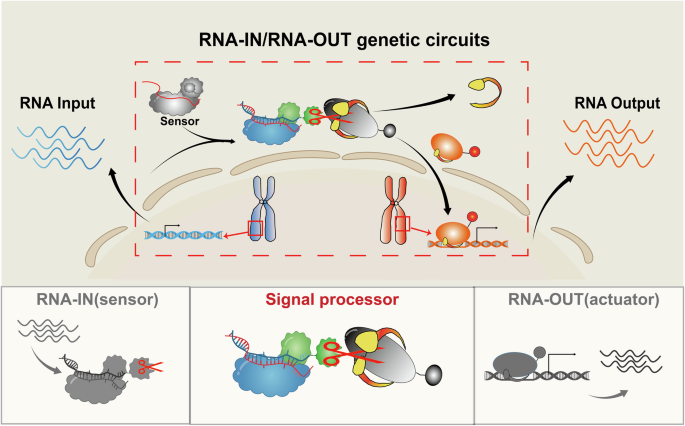
- Below is a diagram depicting an intracellular single-layer perceptron where the X1 input is DNA encoding for the Csy4 endoribonuclease and the X2 input is DNA encoding for a fluorescent protein output whose mRNA is regulated by Csy4. Tx: transcription; Tl: translation.
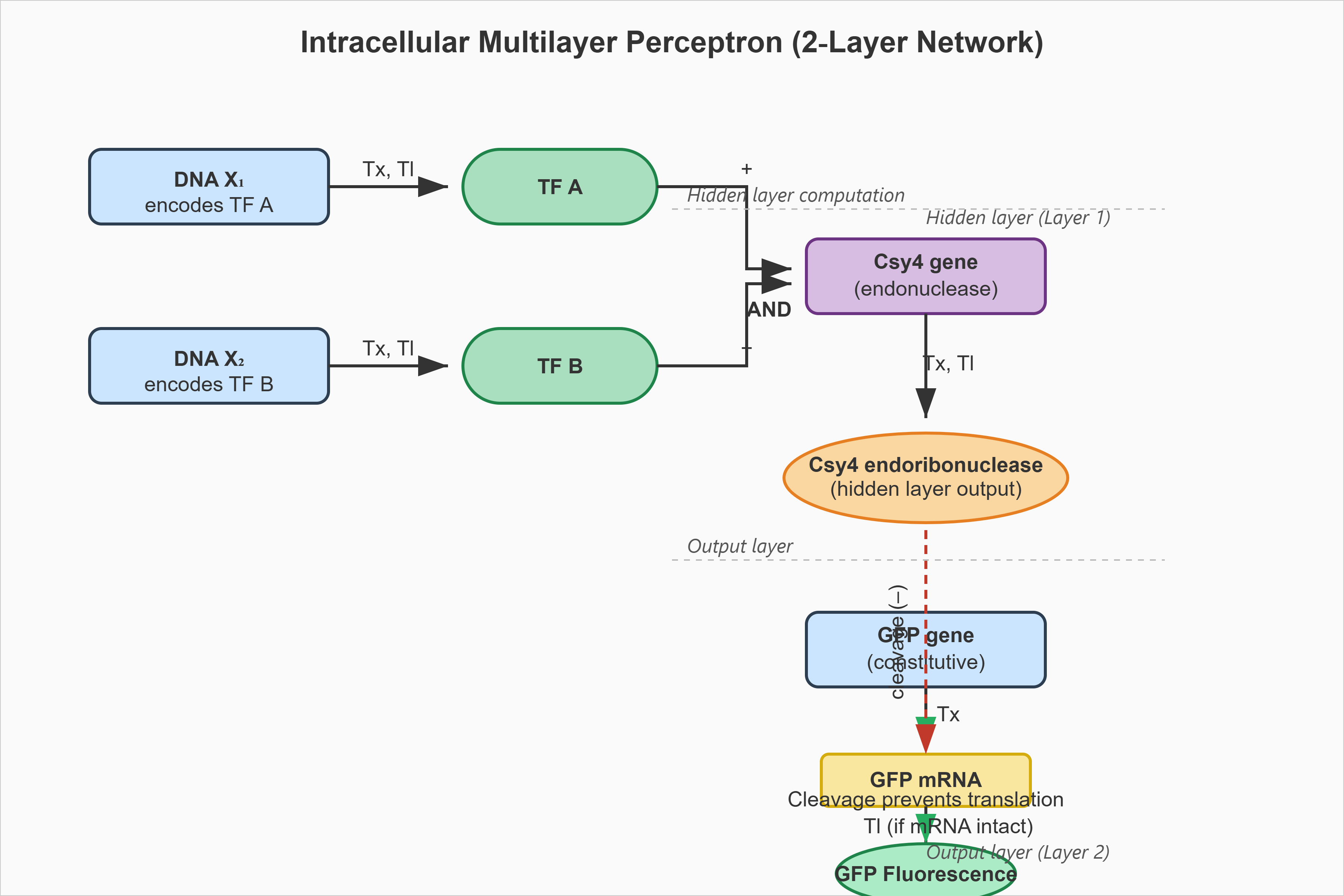
Draw a diagram for an intracellular multilayer perceptron where layer 1 outputs an endoribonuclease that regulates a fluorescent protein output in layer 2
Assignment Part 2: Fungal Materials
- What are some examples of existing fungal materials and what are they used for? What are their advantages and disadvantages over traditional counterparts?
Several fungal‑based materials are already being produced or prototyped, mainly using mycelium (the “root” network) or fungal biomass. They are used as biodegradable substitutes for plastics, foams, leather, paper, insulation, and even some construction elements.
Below are concrete examples, their uses, and how they compare to traditional counterparts.
- Mycelium foam / packaging
Ecovative Design’s MycoFoam and MycoComposite packaging grown on agricultural waste (e.g., corn husks, hemp).
Mycelium “bricks” and cushioning blocks for protective packaging, replacing polystyrene (Styrofoam).
Uses:
Protective packaging for electronics, fragile goods, and shipping inserts.
Lightweight insulation or filler in construction panels.
Advantages vs. polystyrene / plastics:
Biodegradable and compostable; decomposes in weeks–months instead of centuries.
Grown at ambient temperature on low‑value waste (sawdust, straw), with low energy and carbon footprint.
Naturally fire‑resistant and termite‑resistant in some formulations, with good thermal and acoustic insulation.
Disadvantages:
More sensitive to moisture and humidity; can lose strength or compress if wet.
Lower mechanical strength and density than dense plastics; better for cushioning than load‑bearing structures.
Batch‑to‑batch variability in growth and density can complicate quality control.
- Mycelium leather alternatives (“myco‑leather”) Examples:
- MycoWorks’ Reishi mycelium leather for bags, shoes, and upholstery.
- Other “myco‑leather” textiles grown as fungal mats on trays (often from species such as Fomes fomentarius or Phellinus spp.).
Uses:
- Fashion (bags, shoes, jackets), furniture upholstery, and interior design.
Advantages vs. animal leather or synthetic leather:
- No livestock rearing; lower land use, methane emissions, and water pollution than bovine leather.
- Often biodegradable or compostable, unlike most synthetic (PU/PVC) leather.
- Can be grown to precise shapes and textures, reducing mechanical cutting waste.
Disadvantages:
- Limited durability and abrasion resistance compared with high‑grade bovine leather at present.
- Cost and scale still higher than bulk synthetic leather; production is not yet at mass‑market polyester‑PU volumes.
- May require coatings or treatments (e.g., for water resistance) that can reduce biodegradability.
- Fungal‑derived paper‑like materials Examples:
- Fungal “paper” made from liquid fermentation of filamentous fungi (often Trametes or related polypores) into chitin–β‑glucan sheets.
- Early stage materials for printing, filters, and coatings instead of wood‑pulp paper.
Uses:
- Specialty printing surfaces, filtration membranes, and coatings.
Advantages vs. wood‑pulp paper:
- Can be grown from waste streams (e.g., agricultural byproducts) instead of virgin trees.
- Some fungal papers have higher toughness or porosity tailored for specific filtering or biomedical uses.
Disadvantages:
Not yet cost‑competitive for bulk printing or packaging paper.
Limited industrial supply chains and standardized processing compared with paper mills.
- Mycelium “bricks” and construction panels Examples:
Mycelium‑bound insulation panels and bricks grown on agricultural residues (hemp, straw, sawdust).
Acoustic panels from companies such as MOGU using mycelium‑based composites for interior sound‑absorbing surfaces.
Uses:
- Thermal and acoustic insulation in walls, ceilings, and partitioning.
- Interior cladding, acoustic panels, and non‑structural architectural elements.
Advantages vs. mineral wool / expanded polystyrene / concrete:
- Very low embodied energy and carbon‑negative potential when grown on waste biomass.
- Good thermal and acoustic performance per unit weight; lightweight and easy to handle.
- Naturally biodegradable at end‑of‑life, unlike foam or mineral‑wool insulation.
Disadvantages:
Compressive strength far below concrete (mycelium bricks ~30 psi vs. concrete ~4000 psi).
Susceptible to moisture and long‑term fungal degradation if not properly sealed.
Limited load‑bearing capacity restricts use to non‑structural or low‑stress applications.
- Other fungal “soft” materials Examples:
Historical “felt‑like” textiles from polypore fruit bodies (e.g., Fomes fomentarius “amadou” or German Amou), now being revisited for niche textiles and fashion.
Fungal biomass for food and feed (e.g., Fusarium venenatum “Quorn” mycoprotein), which is a protein material but not usually classed as “structural.”
Uses:
- Specialized textiles, cultural crafts, and decorative materials.
- High‑protein foods and feedstocks.
Advantages vs. cotton / synthetic fibers:
- Can be grown on waste streams with small land and water footprints.
- Natural biodegradability and relatively low chemical input.
Disadvantages:
- Limited mechanical strength and durability compared with conventional textiles.
- Niche supply chains and limited industrial‑scale processing.
References
Flexible Fungal Materials: Shaping the Future https://www.sciencedirect.com/science/article/abs/pii/S0167779921000603
How Fungi Can Transform Waste Into Useful Materials https://joyfulmicrobe.com/how-fungi-can-transform-waste-into-useful-materials/
Will Buildings in the Future Be Built From Mushrooms? - RESET.ORG https://en.reset.org/mycelium-construction-material-benefit/
Current Insights in Fungal Importance—A Comprehensive … https://pmc.ncbi.nlm.nih.gov/articles/PMC10304223/
Benefits of Fungi for the Environment and Humans https://www.decadeonrestoration.org/stories/benefits-fungi-environment-and-humans
Fungi-based materials | Notion https://pbdvc-research.notion.site/Fungi-based-materials-3b088667784f416e90169be831fb6105
Growing sustainable materials from filamentous fungi | The Biochemist https://portlandpress.com/biochemist/article/45/3/8/233178/Growing-sustainable-materials-from-filamentous
Mycelium-Based Composites - Using Fungi as Building Materials https://www.youtube.com/watch?v=vWkGpbOXZj8
Fungus - Wikipedia https://en.wikipedia.org/wiki/Fungus
- What might you want to genetically engineer fungi to do and why? What are the advantages of doing synthetic biology in fungi as opposed to bacteria?
One would genetically engineer fungi to enhance or redirect their natural biology for industrial, medical, agricultural, or environmental applications. At the same time, fungi offer several unique advantages over bacteria for synthetic biology, especially for complex molecules and eukaryotic‑style processes.
Below I is an outline on using fungi then contrast fungal synthetic biology with bacterial systems.
What to engineer fungi to do
- Hyper‑produce natural products and drugs
- Fungi are already rich sources of antibiotics (e.g., penicillin), statins (lovastatin), immunosuppressants (cyclosporine), and anticancer scaffolds.
- Engineer them to:
- Overexpress or “wake up” silent biosynthetic gene clusters that do not normally make detectable compounds.
- Combine pathways from different fungi or other organisms to create hybrid natural products with new bioactivities.
Why: 50% of approved clinical drugs are natural products or derivatives; engineered fungi can accelerate drug discovery and lower production costs.
- Produce high‑value enzymes and acids
- Filamentous fungi such as Aspergillus niger naturally secrete large amounts of industrial enzymes (amylases, cellulases, proteases) and organic acids (citric, aconitic, itaconic).
- Engineering goals include:
- Overexpressing enzymes for biomass deconstruction (e.g., in biorefineries).
- Redirecting metabolism to increase titers of organic acids used as food additives or chemical‑building blocks.
Why: This enables cheaper, more sustainable routes to bulk chemicals and biocatalysts compared with chemical synthesis.
- Build advanced materials and mycelium composites
- Mycelium can be engineered to:
- Modify chitin, β‑glucans, or hydrophobic surface proteins to tune water resistance, mechanical strength, and fire retardancy of mycelium bricks, foams, or textiles.
- Express functional proteins (e.g., adhesion peptides, enzymes) to improve integration with other biomaterials or substrates.
Why:Fungal materials are low‑carbon, biodegradable alternatives to plastics and synthetics; genetic control can make them more robust and standardized.
- Improve biocontrol and plant‑symbiosis traits
- Entomopathogenic fungi (e.g., Beauveria, Metarhizium) can be engineered to:
- Carry insecticidal toxins or plant‑defence elicitors to target pests more selectively.
- Increase UV tolerance or persistence under field conditions.
- Mycorrhizal or endophytic fungi can be tuned to:
- Enhance phosphate/nitrogen uptake, stress tolerance, or pathogen resistance in crops.
Why:This reduces reliance on synthetic pesticides and fertilizers while keeping the system biologically specific.
- Add “smart” metabolic or sensing functions
- Fungi can be engineered with synthetic circuits for:
- Biosensors that change color or emit light when they detect pollutants, plant pathogens, or soil nutrients.
- Metabolic switches that turn on biodegradation pathways only in the presence of specific contaminants.
Why:Eukaryotic regulation (e.g., chromatin, promoters, secretion) allows more complex, context‑dependent behaviors than simple bacterial toggle switches.
References
- Gene-editing gets fungi to spill secrets to new drugs - Futurity https://www.futurity.org/gene-editing-fungi-2854282-2/
- Genetic engineering of fungi now simplified – acib https://www.acib.at/genetic-engineering-fungi-now-simplified/
- Nature Index Genomic Engineering of Filamentous Fungi for … https://www.nature.com/nature-index/topics/l4/genomic-engineering-of-filamentous-fungi-for-biotechnological-applications
- Filamentous fungal synthetic biology: Current applications … https://www.sciencedirect.com/science/article/abs/pii/S0734975026001187
- Systems and Synthetic Biology Approaches to Engineer Fungi … https://pmc.ncbi.nlm.nih.gov/articles/PMC6178918/
- Genetically Engineering Entomopathogenic Fungi https://pubmed.ncbi.nlm.nih.gov/27131325/
- Advancing microbial engineering through synthetic biology https://www.jmicrobiol.or.kr/journal/view.php?number=2971
- Pros and Cons of Synthetic Biology: An Overview https://hudsonlabautomation.com/pros-and-cons-of-synthetic-biology/
- Fungi in Synthetic Biology Applications | PDF | Fungus https://www.scribd.com/document/511854147/Fungai-Metabolites
- Application of fungi in genetics | PPTX - Slideshare https://www.slideshare.net/slideshow/application-of-fungi-in-genetics/51498153
- The use of LLM to help with finding information and reporting