Week 05 HW: Protein Design part II
Part A: SOD1 Binder Peptide Design (From Pranam)
Superoxide dismutase 1 (SOD1) is a cytosolic antioxidant enzyme that converts superoxide radicals into hydrogen peroxide and oxygen. In its native state, it forms a stable homodimer and binds copper and zinc.
Mutations in SOD1 cause familial Amyotrophic Lateral Sclerosis (ALS). Among them, the A4V mutation (Alanine → Valine at residue 4) leads to one of the most aggressive forms of the disease. The mutation subtly destabilizes the N-terminus, perturbs folding energetics, and promotes toxic aggregation.
Your challenge:
- Design short peptides that bind mutant SOD1.
- Then decide which ones are worth advancing toward therapy.
You will use three models developed in our lab:
PepMLM: target sequence-conditioned peptide generation via masked language modeling
PeptiVerse: therapeutic property prediction
moPPIt: motif-specific multi-objective peptide design using Multi-Objective Guided Discrete Flow Matching (MOG-DFM)
Part 1: Generate Binders with PepMLM
1. Begin by retrieving the human SOD1 sequence from UniProt (P00441) and introducing the A4V mutation.
Original sequence: sp|P00441|SODC_HUMAN Superoxide dismutase [Cu-Zn] OS=Homo sapiens OX=9606 GN=SOD1 PE=1 SV=2 MATKAVCVLKGDGPVQGIINFEQKESNGPVKVWGSIKGLTEGLHGFHVHEFGDNTAGCTS AGPHFNPLSRKHGGPKDEERHVGDLGNVTADKDGVADVSIEDSVISLSGDHCIIGRTLVV HEKADDLGKGGNEESTKTGNAGSRLACGVIGIAQ
Introducing A4V mutation: MATKVVCVLKGDGPVQGIINFEQKESNGPVKVWGSIKGLTEGLHGFHVHEFGDNTAGCTSAGPHFNPLSRKHGGPKDEERHVGDLGNVTADKDGVADVSIEDSVISLSGDHCIIGRTLVVHEKADDLGKGGNEESTKTGNAGSRLACGVIGIAQ
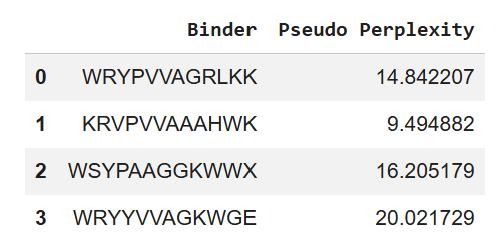
2. Using the PepMLM Colab linked from the HuggingFace PepMLM-650M model card generate four peptides of length 12 amino acids conditioned on the mutant SOD1 sequence.
3. To your generated list, add the known SOD1-binding peptide FLYRWLPSRRGG for comparison.
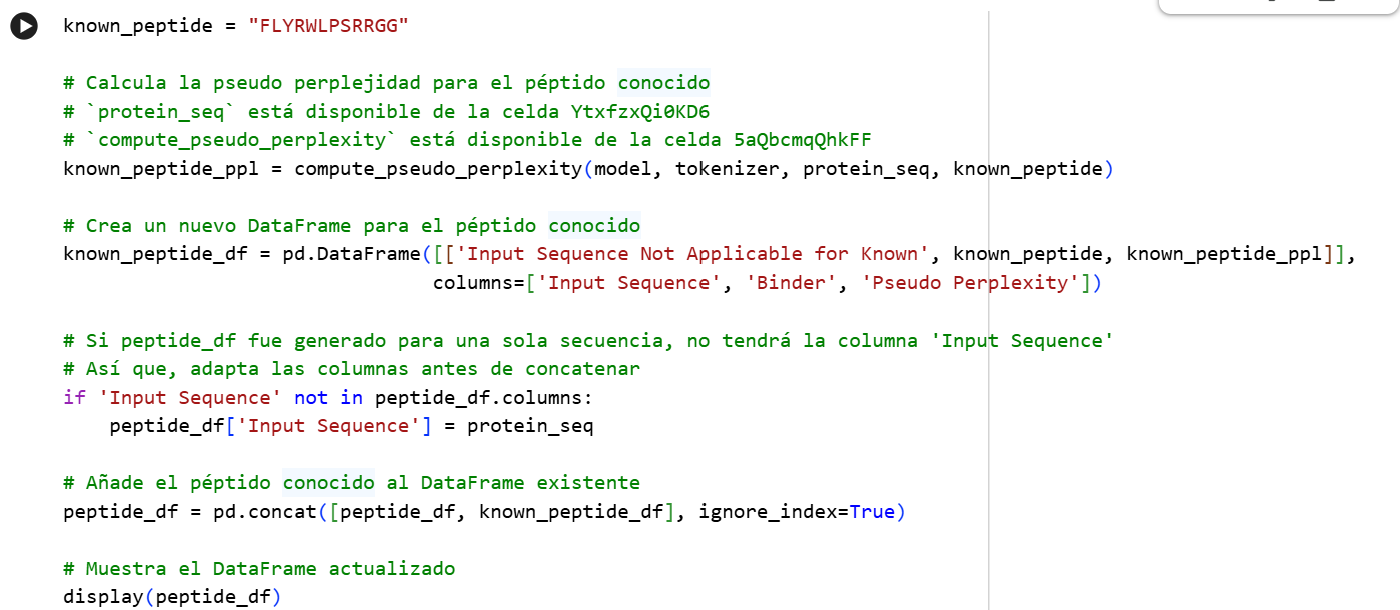
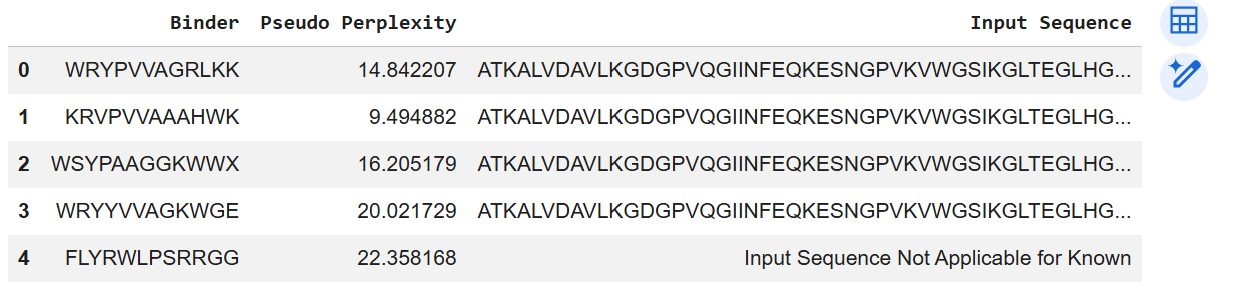
4. Record the perplexity scores that indicate PepMLM’s confidence in the binders.
Part 2: Evaluate Binders with AlphaFold3
2. Navigate to the AlphaFold Server and for each peptide, submit the mutant SOD1 sequence followed by the peptide sequence as separate chains to model the protein-peptide complex.
One of the generated peptide contained an “X” residue representing an unspecified amino acid. For AlphaFold modeling, I replaced this position with alanine to allow structure prediction.
3. Record the ipTM score and briefly describe where the peptide appears to bind. Does it localize near the N-terminus where A4V sits? Does it engage the β-barrel region or approach the dimer interface? Does it appear surface-bound or partially buried?
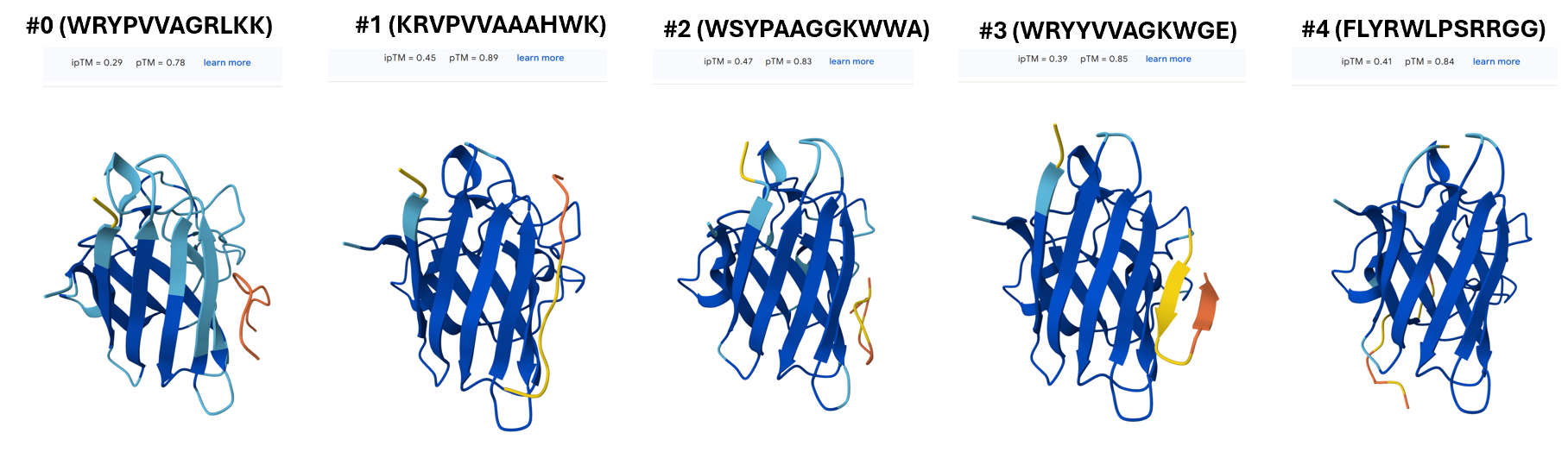
N-terminus/A4V site: The peptide is binding far from the N-terminus where A4V sits, almost at the oposite side.
β-barrel/dimer interface: The peptide localizes to the face opposite the dimerization surface, away from the free loop termini that would normally contact the second monomer.
Surface-bound or buried: It appears surface-bound, not inside the β-barrel or the loops.
4. In a short paragraph, describe the ipTM values you observe and whether any PepMLM-generated peptide matches or exceeds the known binder
| # | Peptide | Pseudo-Perplexity | ipTM |
|---|---|---|---|
| 0 | WRYPVVAGRLKK | 14.84 | 0.29 |
| 1 | KRVPVVAAAHWK | 9.49 | 0.45 |
| 2 | WSYPAAGGKWWA | 16.20 | 0.47 |
| 3 | WRYYVVAGKWGE | 20.02 | 0.39 |
| 4 | FLYRWLPSRRGG | 22.36 | 0.41 |
ipTM measures the accuracy of the predicted relative positions of the subunits within the complex. Values higher than 0.8 represent confident high-quality predictions, while values below 0.6 suggest likely a failed prediction.
All the ipTM score values are below 0.6, ranging from 0.29 to 0.47, suggesting that the predicted complexes may not represent a reliable interaction. Nevertheless, if the ipTM results are compared to the known SOD1-binding peptide FLYRWLPSRRGG, we can see that peptide #2 (ipTM = 0.47) and peptide #1 (ipTM = 0.45), slightly exceeded the ipTM value of the known binder. These results suggest that while the predicted interactions are weak, some generated peptides show comparable or slightly improved interface scores relative to the known binder.
Part 3: Evaluate Properties of Generated Peptides in the PeptiVerse
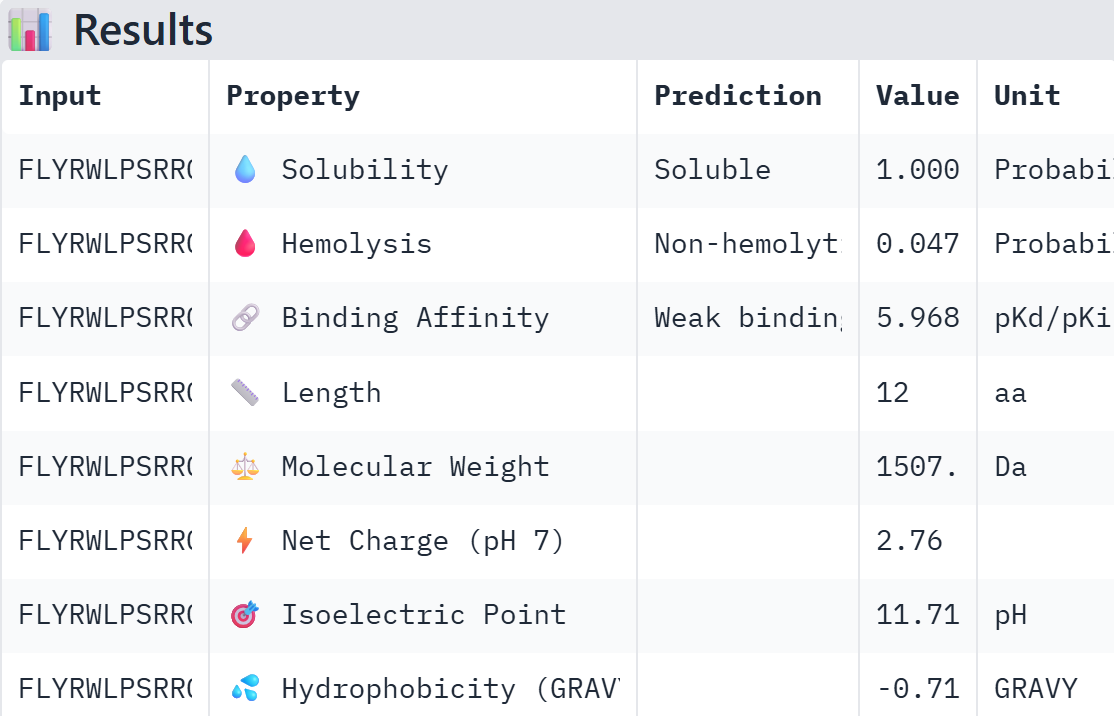
Structural confidence alone is insufficient for therapeutic development. Using PeptiVerse, let’s evaluate the therapeutic properties of your peptide! For each PepMLM-generated peptide:
- Paste the peptide sequence.
- Paste the A4V mutant SOD1 sequence in the target field.
- Check the boxes
- Predicted binding affinity
- Solubility
- Hemolysis probability
- Net charge (pH 7)
- Molecular weight
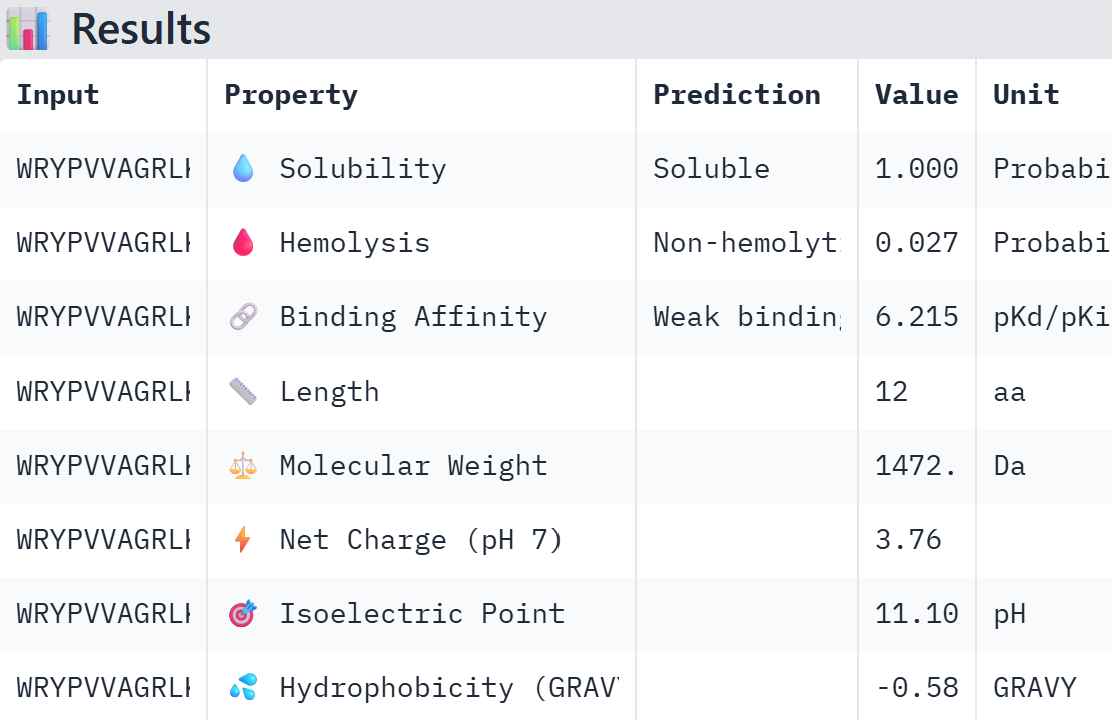
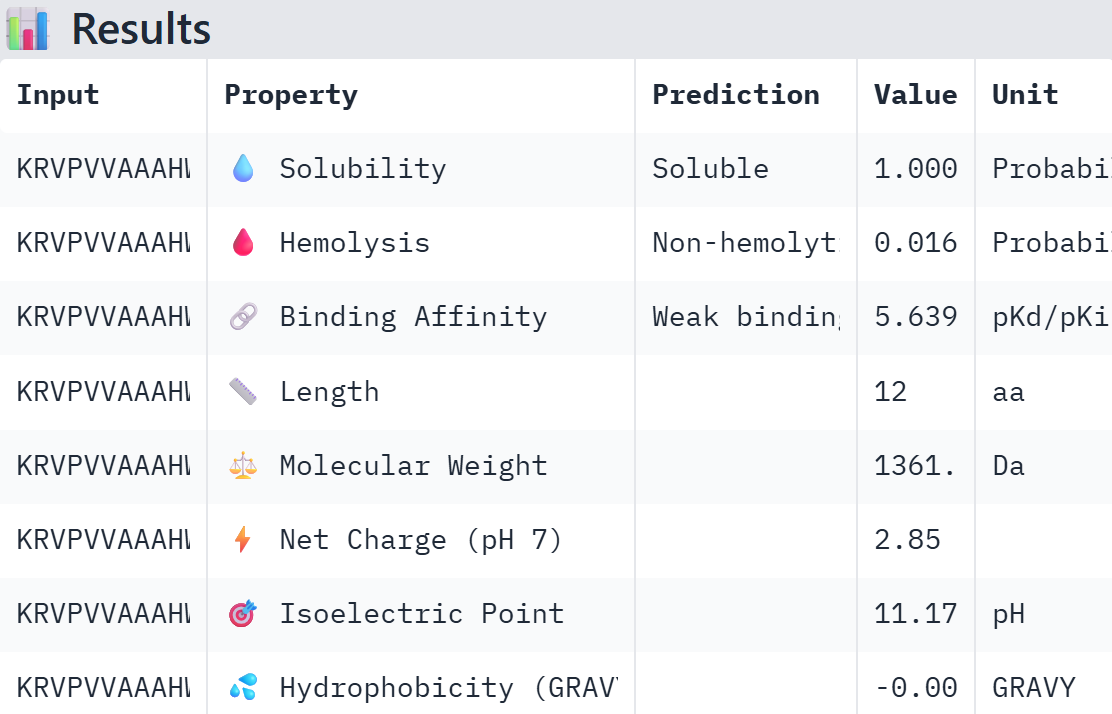
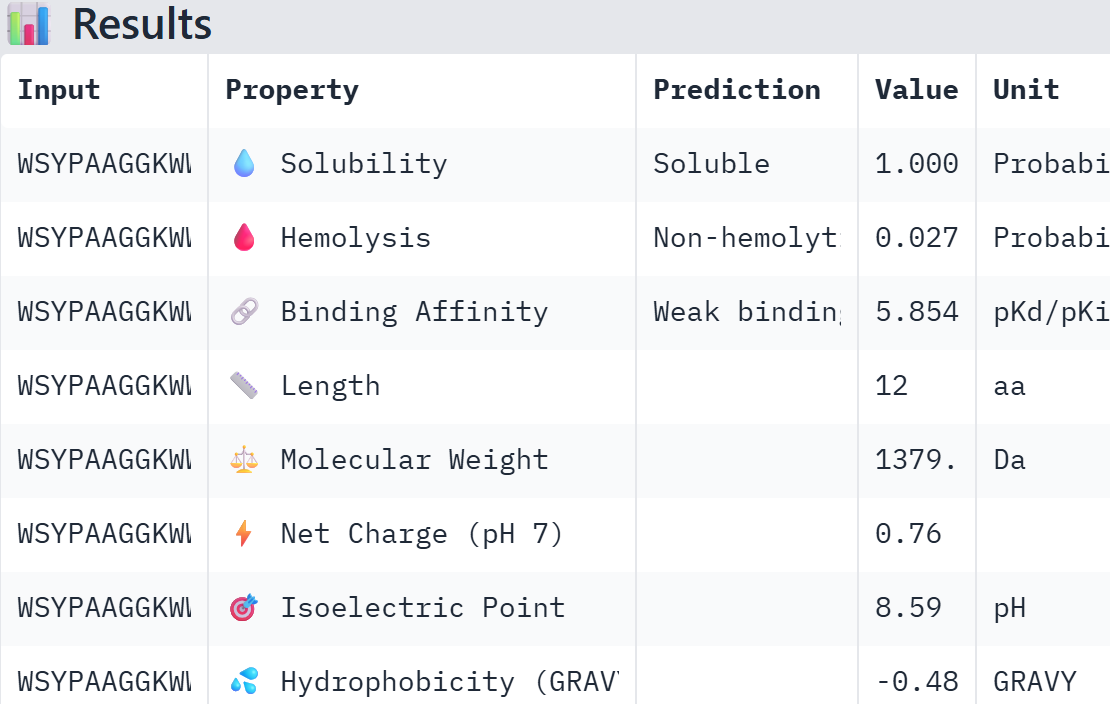
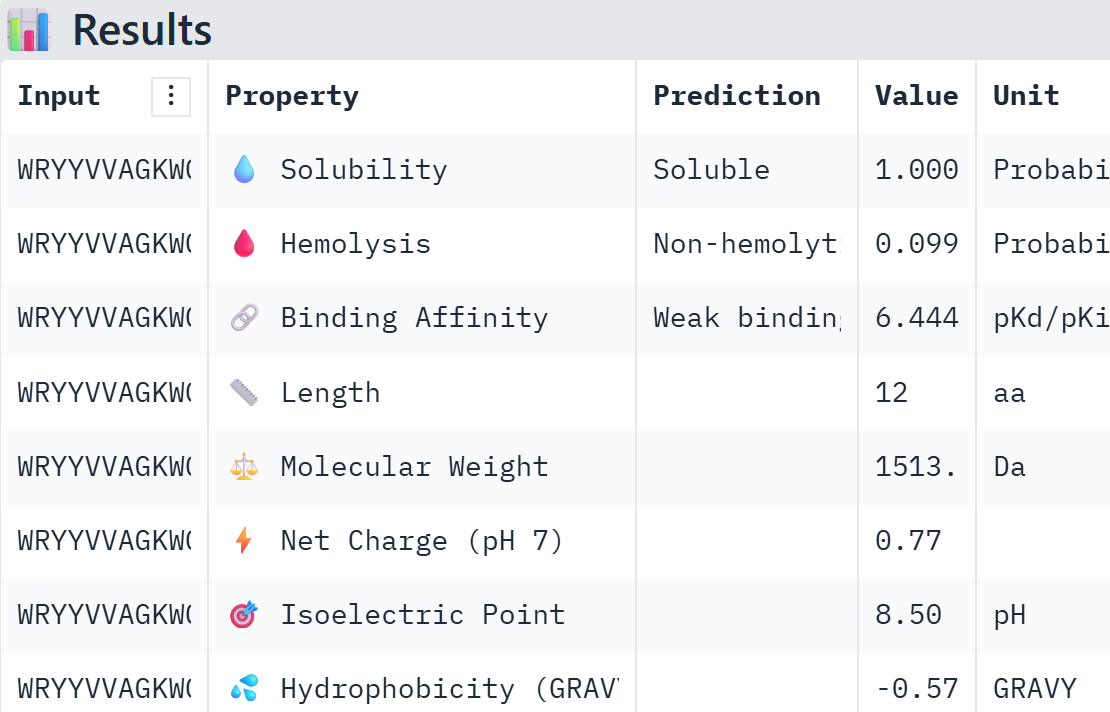
Compare these predictions to what you observed structurally with AlphaFold3. In a short paragraph, describe what you see. Do peptides with higher ipTM also show stronger predicted affinity? Are any strong binders predicted to be hemolytic or poorly soluble? Which peptide best balances predicted binding and therapeutic properties?
Choose one peptide you would advance and justify your decision briefly.