Week 06 HW: Genetic Circuits Part I
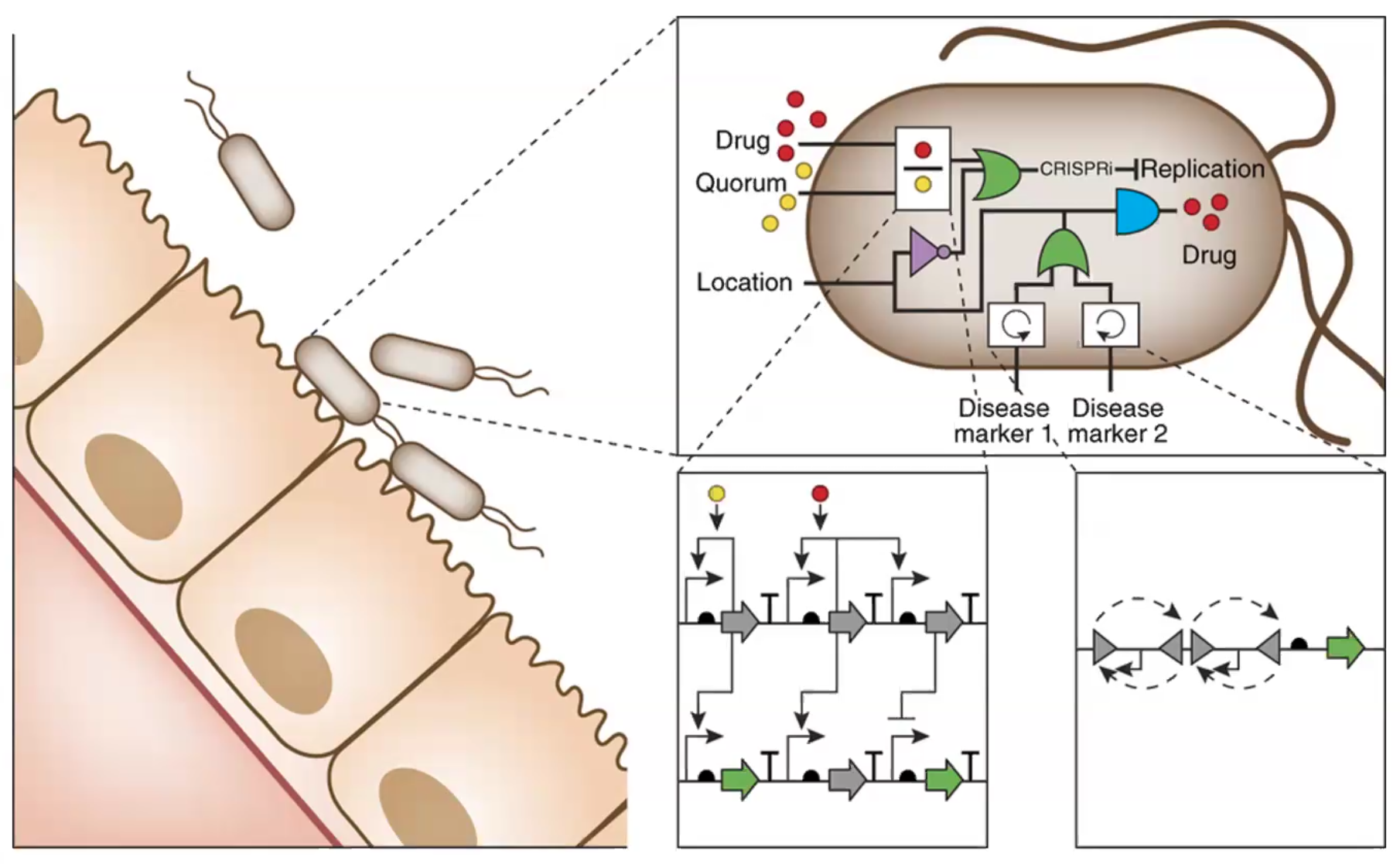
Assignment: DNA Assembly
1. What are some components in the Phusion High-Fidelity PCR Master Mix and what is their purpose?
According to New England Biolabs [1]:
Phusion DNA polymerase: a DNA polymerase (enzymes that catalyze the synthesis of DNA molecules from dNTPs) that offers high fidelity and speed, with a lower error rate than Taq DNA polymerase.
Deoxynucleotides (dNTPs): building blocks of DNA, allow synthesis of new DNAstrands.
Reaction Buffer: a solution that maintains optimal conditions for the PCR reaction.
MgCl2: provides Mg2+ a required co-factor for the DNA polymerase.
2. What are some factors that determine primer annealing temperature during PCR?
According to New England Biolabs [2]:
The optimal annealing temperature (Ta) is determined by the melting temperature (Tm) of the PCR primer which is the temperature at which half of the primer-template duplex dissociates to become single-stranded.
Factors that influence Tm of the primers and thus impact on Ta of the PCR:
Length: Longer primers → higher Tm values
Sequence: higher GC content → higher Tm → higher Ta
Concentration of the primers: higher primer concentration → higher likelihood of binding
3. There are two methods from this class that create linear fragments of DNA: PCR, and restriction enzyme digests. Compare and contrast these two methods, both in terms of protocol as well as when one may be preferable to use over the other.
PCR uses primers that anneal to a template at specific temperatures, then a polymerase extends them. What we get is a copy of the designed region, so we could say that the result is determined by where the primers bind.
Restriction enzymes are proteins that recognize a specific short DNA sequence, called a restriction site, and then cut both strands of the double helix at or near that site. The result is a defined DNA fragment with either blunt ends or sticky ends.
Restriction enzymes only cut at their recognition sequence. What if I want to cut DNA at a boundary that has no natural restriction site nearby? There are hundreds of known restriction enzymes, but it’s still limited, and engineering proteins to cut any sequence I want is still hard. On the other hand, the primers needed for PCR are just short DNA nucleotides, it’s easier to just synthesize a sequence in silico and order it. In this case, PCR is preferable over restriction enzymes.
4. How can you ensure that the DNA sequences that you have digested and PCR-ed will be appropriate for Gibson cloning?
Gibson cloning is a method to join DNA fragments in a single tube. This method requires overlapping complementary sequences at their ends. Therefore, I would make sure that the DNA sequences will be appropriate for Gibson Assembly by designing the primers with 5’ tails matching the ends of the backbone at the cut site. Only the 3’ end of a primer needs to anneal to the template, so the tail just gets carried into the product as the polymerase extends forward.
5. How does the plasmid DNA enter the E. coli cells during transformation?
There are two main physical methods, both of them share the same objective: transiently stress the membrane so plasmid DNA can diffuse in it.
Heat shock: a sudden drastic change in temperature, from ice 0°C to 42°C for 30 seconds, which briefly opens the cell wall.
Electroporation: an electroporator applies a brief pulse of a high-voltage electric field that temporally induces pores in cell membranes, which permits plasmid entry into the cells.
6. Describe another assembly method in detail (such as Golden Gate Assembly)
- Explain the other method in 5 - 7 sentences plus diagrams (either handmade or online).
Golden Gate assembly is a one-pot, one-step cloning procedure. The method takes advantage of Type IIS restriction enzymes, which cleave DNA outside their recognition sequences. The result is an ordered assembly of a vector and one or more DNA fragments [3].
Golden Gate works in two simultaneous steps: digestion by a Type IIS enzyme that cuts outside its recognition site, and ligation by T4 ligase in the same tube. Because the recognition sites sit on the outside of each fragment pointing inward, the enzyme removes itself when it cuts and leaves a 4 bp overhang whose sequence is chosen during design. Once the destination vector and DNA insert(s) are digested, their complementary overhangs are joined together by DNA ligase to create an ordered assembly [3].
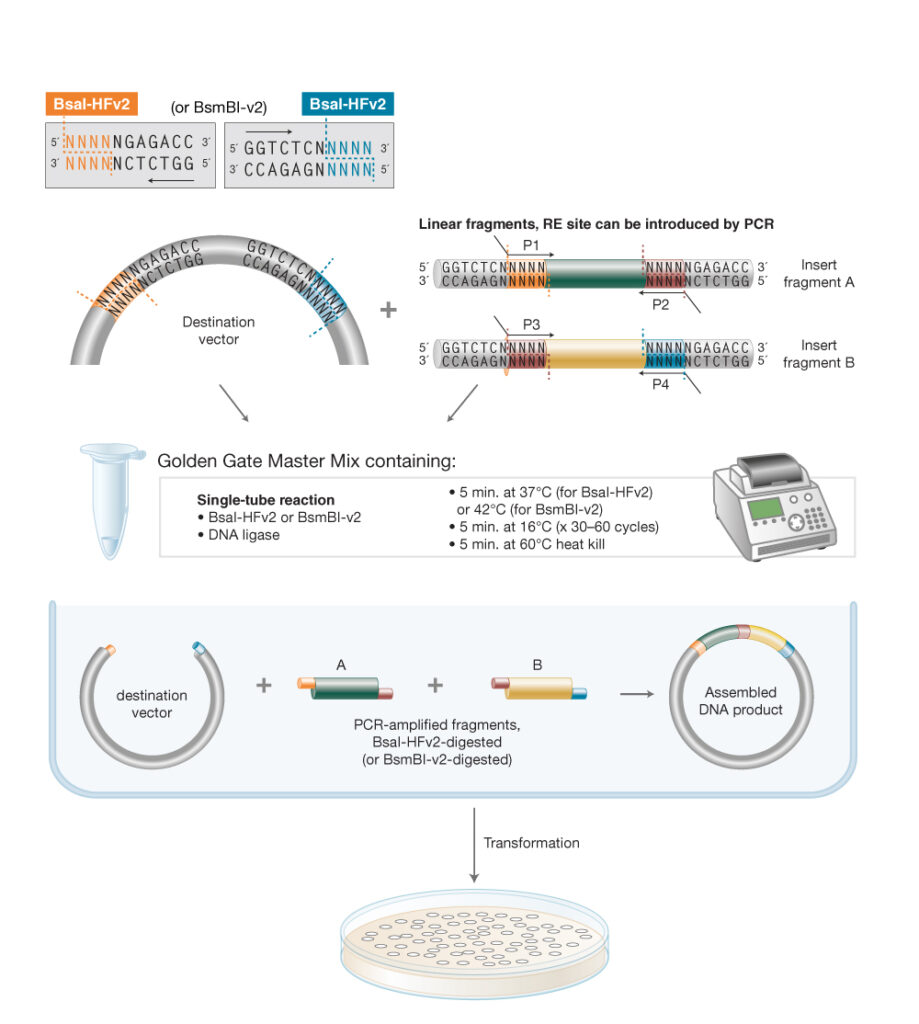 Figure extracted from New England Biolab’s web page
Assignment: Asimov Kernel
Create a blank Construct and save it to your Repository
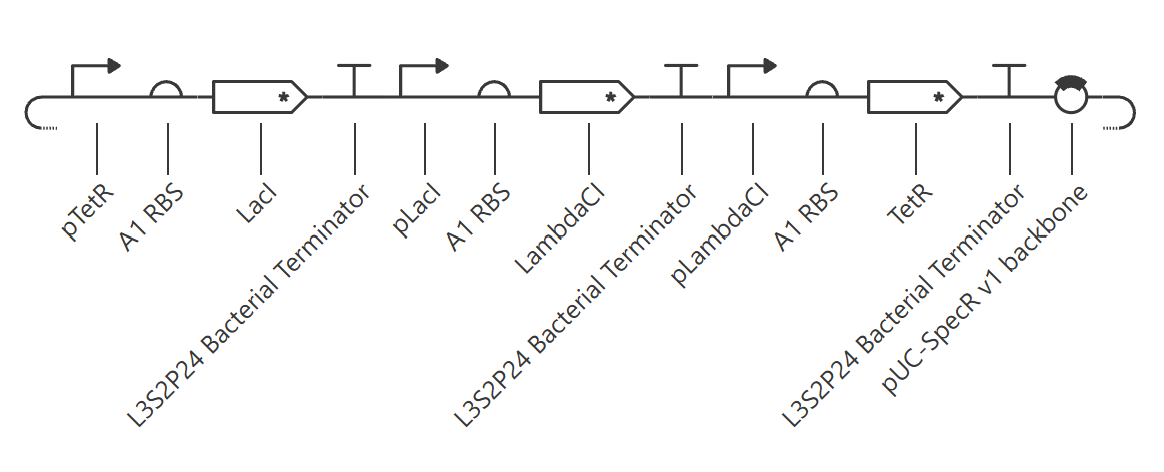
- Recreate the Repressilator in an empty Construct by using parts from the Characterized Bacterial Parts repository
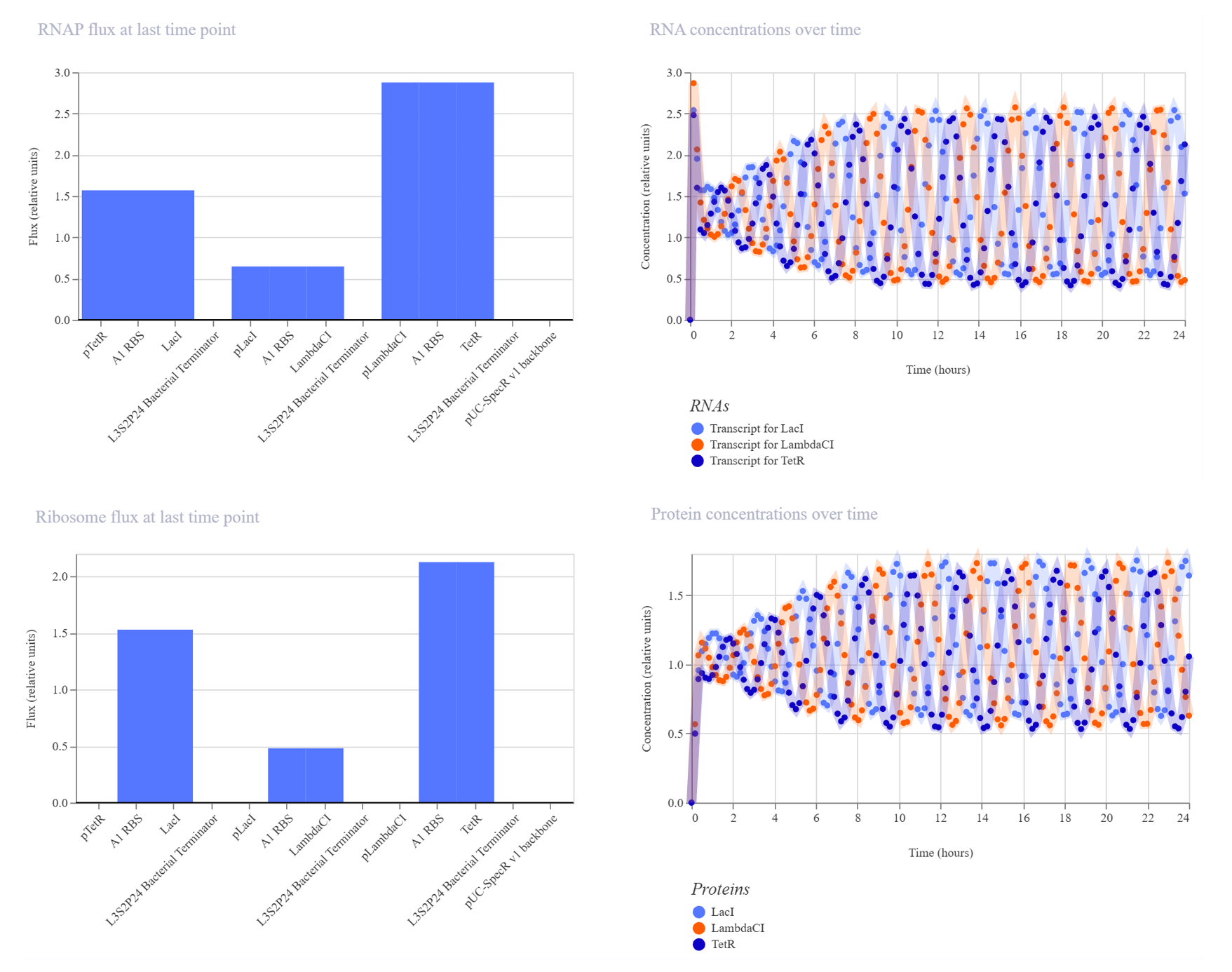
- Confirm it works as expected by running the Simulator and compare your results with the Repressilator Construct found in the Bacterial Demos repository
- pTetR represses TetR
- pLacI represses LacI
- pLambdaCI represses LambdaCI
pTetR drives LacI → pLacI drives LambdaCI → pLambdaCI drives TetR
The simulation works as expected, showing clear oscillation. When one repressor is high, the next promoter in the cycle is shut off, so the next protein falls; once that protein is low, the promoter after it becomes free, and so on around the loop.
Build three of your own Constructs using the parts in the Characterized Bacterials Parts Repo
Construct 1 - OR gate:
Design:
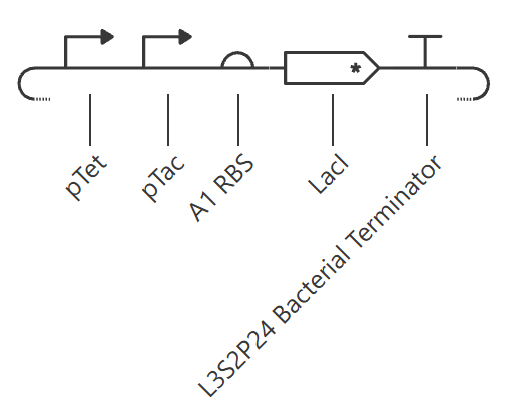
- pTet and pTac drive a shared transcription unit (A1 RBS → LacI → L3S2P24).
- pTet is induced by aTc, pTac by IPTG.
- LacI is the output.
Truth table:
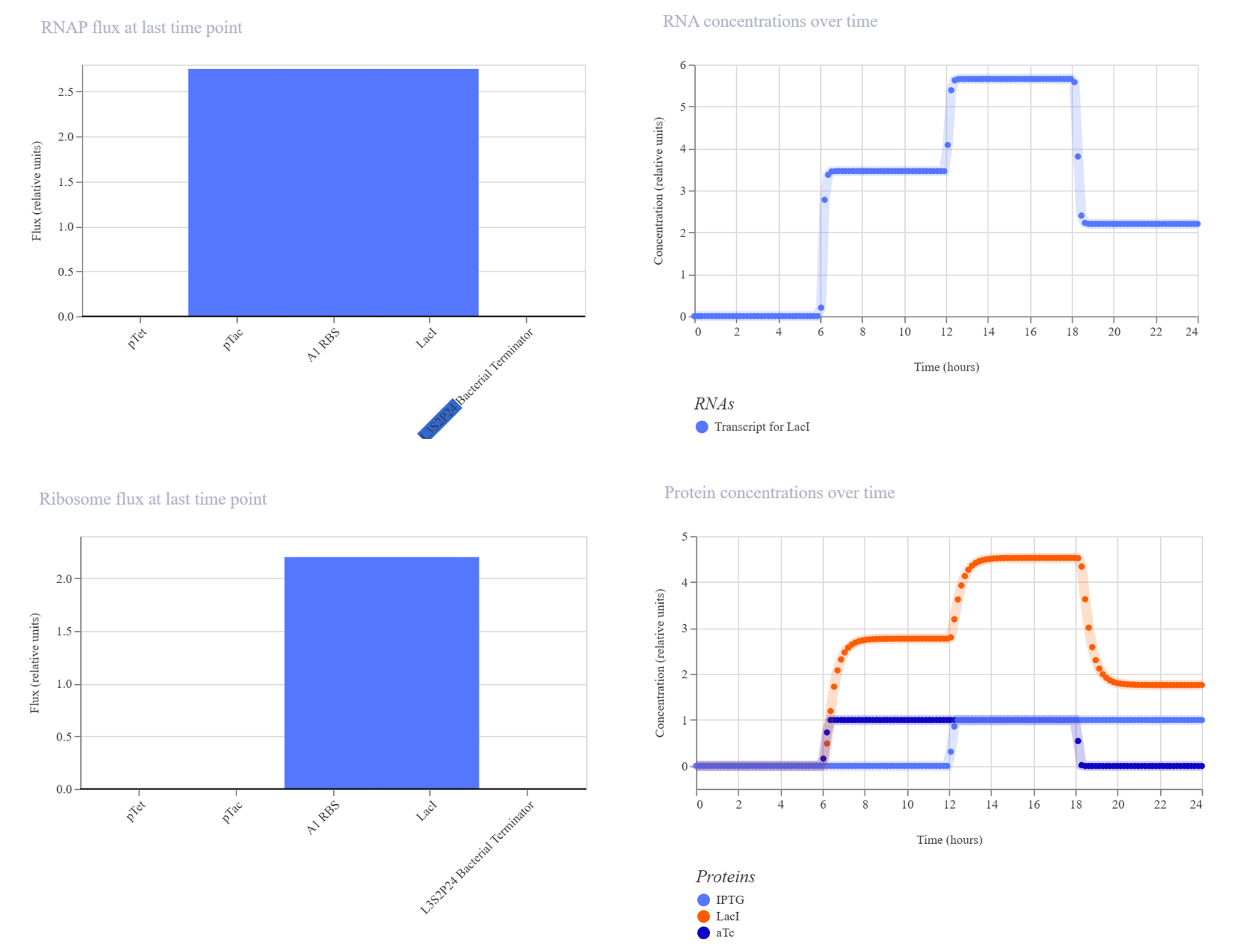
Simulation: E. coli, 24 h, 10-min timestep, transient transfection. Ligand schedule:
- aTc → max at h 6
- IPTG → max at h 12
- aTc → 0 at h 18
| Phase | Time (h) | aTc | IPTG | Output |
|---|---|---|---|---|
| 1 | 0–6 | 0 | 0 | 0 |
| 2 | 6–12 | 1 | 0 | 1 |
| 3 | 12–18 | 1 | 1 | 1 |
| 4 | 18–24 | 0 | 1 | 1 |
Circuit behaves as OR, all four truth-table states are reproduced. (1,1) gives the highest output, as expected from additive promoter activity.
Construct 2 - NOR gate:
Design:
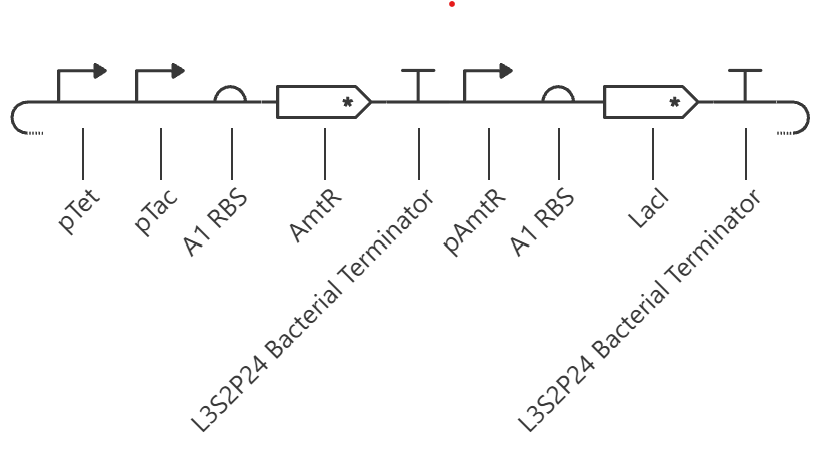
- Two cassettes: pTet + pTac → A1 RBS → AmtR → L3S2P24, then pAmtR → A1 RBS → LacI → L3S2P24.
- aTc induces pTet, IPTG induces pTac, both produce AmtR which represses pAmtR.
- LacI is the output.
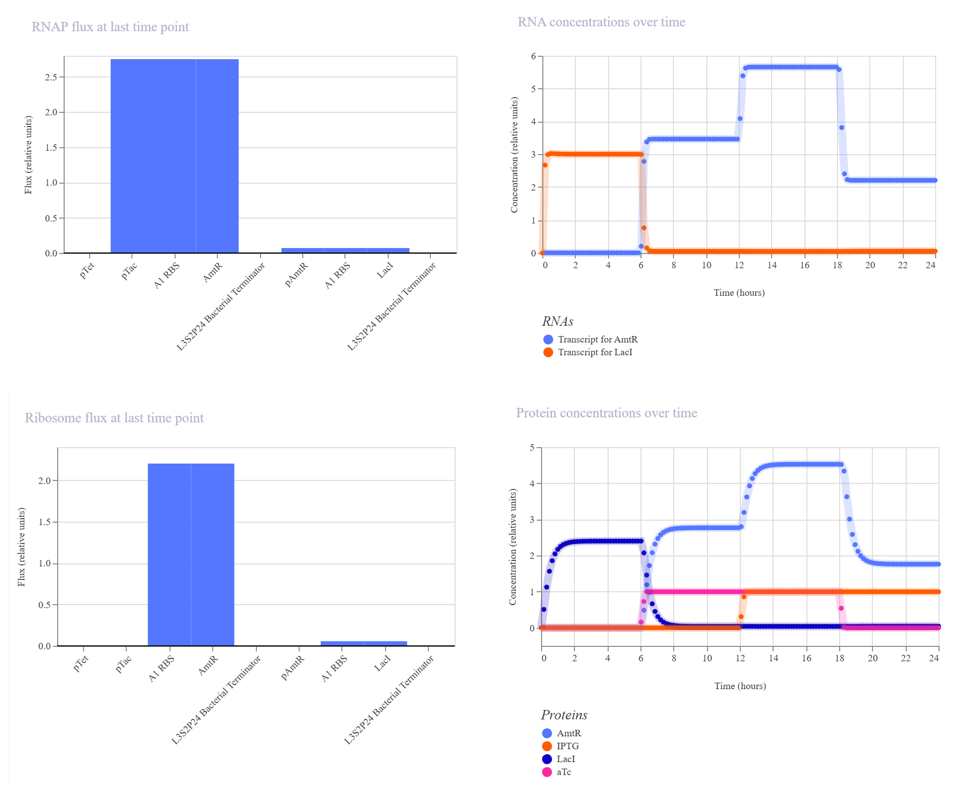
Simulation: E. coli, 24 h, 10-min timestep, transient transfection. Ligand schedule:
- aTc → max at h 6
- IPTG → max at h 12
- aTc → 0 at h 18
| Phase | Time (h) | aTc | IPTG | Output |
|---|---|---|---|---|
| 1 | 0–6 | 0 | 0 | 1 |
| 2 | 6–12 | 1 | 0 | 0 |
| 3 | 12–18 | 1 | 1 | 0 |
| 4 | 18–24 | 0 | 1 | 0 |
Circuit behaves as NOR, all four truth-table states are reproduced. LacI only accumulates in the (0,0) state when no AmtR is being produced; any inducer drives LacI to near zero through AmtR repression of pAmtR.
Construct 3 - Double repression cascade (NOT-NOT):
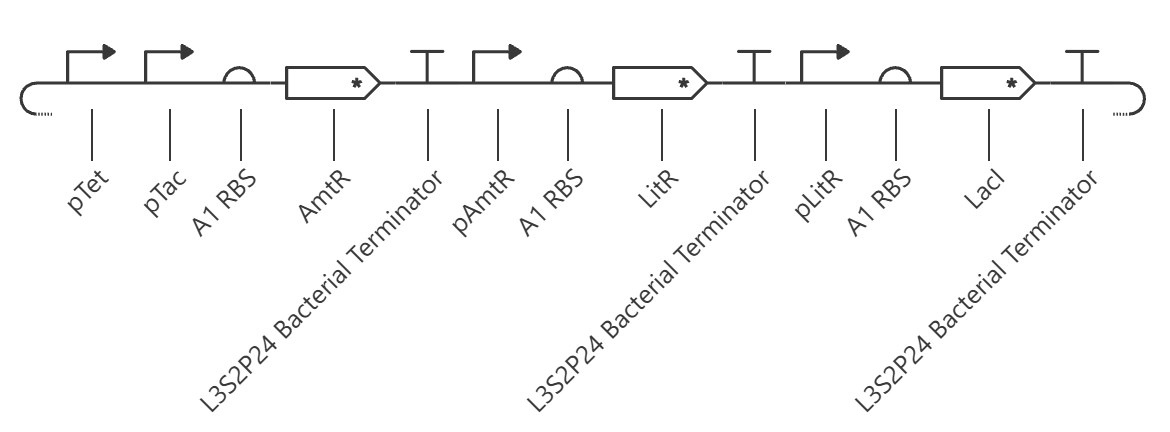
Design:
- Three cassettes: pTet + pTac → A1 RBS → AmtR → L3S2P24, then pAmtR → A1 RBS → LitR → L3S2P24, then pLitR → A1 RBS → LacI → L3S2P24.
- aTc/IPTG → AmtR → represses LitR → de-represses LacI. Two inversions in series.
- LacI is the output.
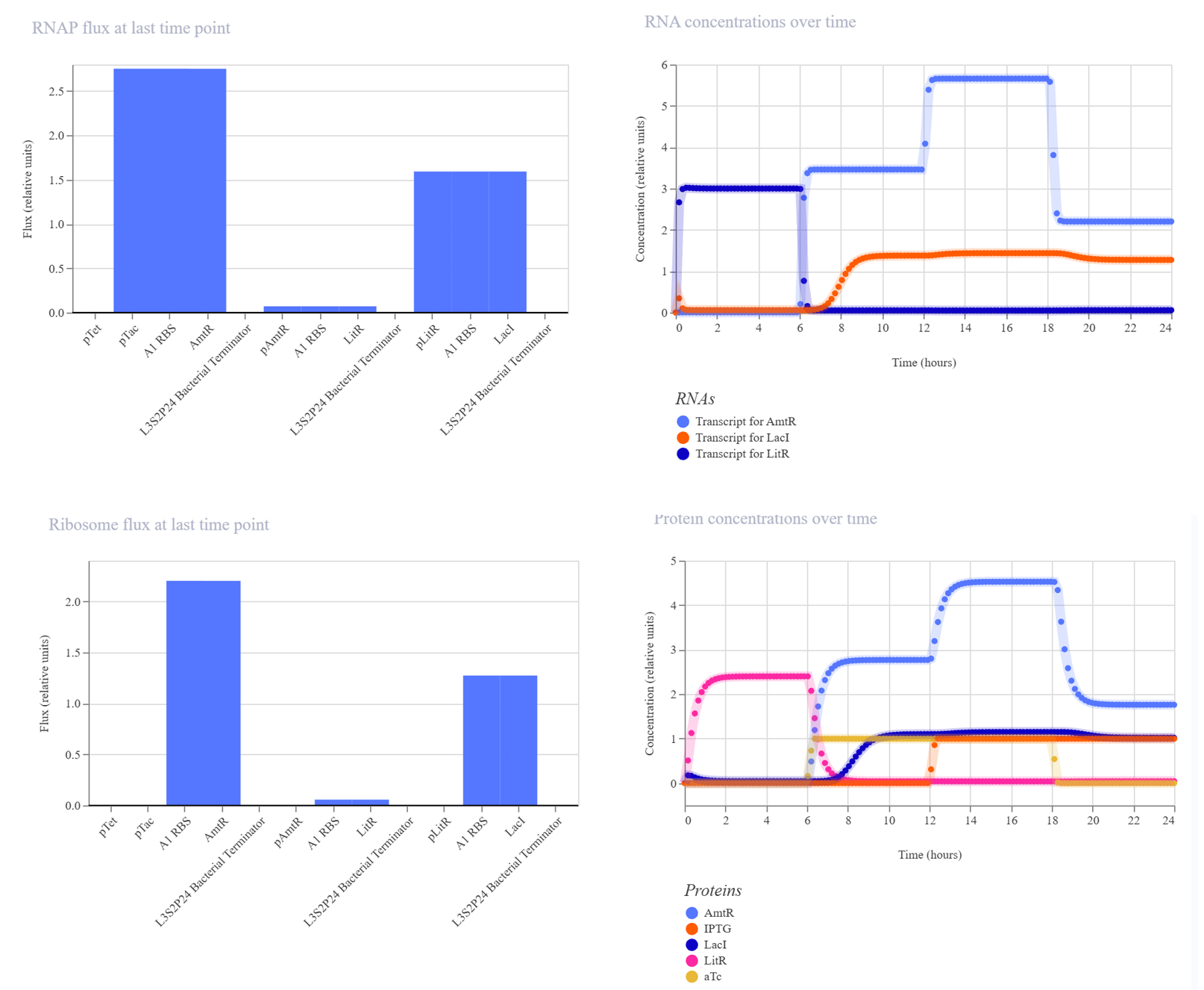
Simulation: E. coli, 24 h, 10-min timestep, transient transfection. Ligand schedule:
- aTc → max at h 6
- IPTG → max at h 12
- aTc → 0 at h 18
| Phase | Time (h) | aTc | IPTG | LitR | Output (LacI) |
|---|---|---|---|---|---|
| 1 | 0–6 | 0 | 0 | high | 0 |
| 2 | 6–12 | 1 | 0 | low | 1 |
| 3 | 12–18 | 1 | 1 | low | 1 |
| 4 | 18–24 | 0 | 1 | low | 1 |
The construct behaves like an OR gate (same truth table as C1), but with propagation delay and signal attenuation due to the extra repression layers. LitR protein falls before LacI rises, confirming that the repression signal propagates through the cascade in the expected order.
References
[1] “Phusion® High-Fidelity PCR Master Mix with HF Buffer | NEB.” Accessed: Apr. 22, 2026. [Online]. Available: https://www.neb.com/en/products/m0531-phusion-high-fidelity-pcr-master-mix-with-hf-buffer?srsltid=AfmBOorM6I4NLehgZdJrP18X-RzKB2X2U5oq3v8pfXh-kiMF-Tdxn5LL
[2] S. M. Klee, S. Lund, and G. C. Patton, “Universal annealing temperature in PCR and its impact on amplification results,” New England Biolabs, Ipswich, MA, USA, Application Note, Apr. 2026.
[3] “Golden Gate Assembly - Snapgene.” Accessed: May 25, 2026. [Online]. Available: https://www.snapgene.com/guides/golden-gate-assembly