Week 07 HW: Genetic circuits part II
Assignment Part 1: Intracellular Artificial Neural Networks (IANNs)
1. What advantages do IANNs have over traditional genetic circuits, whose input/output behaviors are Boolean functions?
Boolean functions are limited to discrete on/off states while IANNs are capable of processing analogue signals and, because of that, carry more information. Real world phenomena are analog, inside a cell there is inherent molecular noise, and Boolean circuits are fragile to this, especially at low signal concentrations.
Boolean functions can only handle simple logical relationships (AND/OR/etc..) between inputs. IANNs, through weighted connections and nonlinear activation functions are capable of solving problems that are not linearly separable. [1]
IANNs have potential for Adaptability and unsupervised learning. There´s a principle known as neurons that fire together, wire together:
“This means that the strength of the connection between neurons changes based on how often they are activated. When a connection between two neurons is activated frequently, its weight increases and vice-versa: when the activation is less frequent, the weight weakens.” [1]
2. Describe a useful application for an IANN; include a detailed description of input/output behavior, as well as any limitations an IANN might face to achieve your goal.
Endometriosis has a multi-signal inflammatory signature, no single biomarker has sufficient sensitivity to diagnose or treat endometriosis.
Dual Region IANN: Two Sequestrons running in parallel, each sensing a different axis of the disease:
Sequestron A — inflammatory axis
- X1: NF-κB
- X2: IL-17A mRNA
If NF-κB is high but IL-17A is low → generic inflammation (PID) → Output_A ≈ 0
If IL-17A is high AND exceeds NF-κB → endometriosis signature → Output_A > 0
Sequestron B — angiogenic axis
- X1: NF-κB
- X2: VEGF/IL-8
Pelvic Inflammatory Disease elevates NF-κB but not the angiogenic markers. Endometriosis elevates both. By requiring both Sequestrons to fire, the circuit filters out false positives.
Output: anti-IL17A nanobody, released only when both axes are active simultaneously.
Assignment Part 2: Fungal Materials
1. What are some examples of existing fungal materials and what are they used for? What are their advantages and disadvantages over traditional counterparts?
Adaptive fungal architectures: The FUNGAR project is working on a “living monolith”, a large-scale structure made of interconnected fungal threads. Designed to be sentient, using its natural “internet-like” properties to sense the environment and respond to touch, light, or electrical stimuli. The goal is to move toward intelligent bio-buildings that can monitor themselves and communicate information through their own biological network.
Advantages:
- Sustainable materials since they are completely biodegradable, requiere minimal energy, and they are grown from industrial waste.
- Fungal based materials are capable of detecting light, chemicals and pressure, they can react to their surrounding.
Disadvantages:
- It is still difficult to achieve long-distance structures while maintaining the integrity and functionality of the fungus
- Its chemical and mechanical properties change constantly according to its metabolism
Fungi into biological computers: By inserting electrodes into the mycelium, they’ve discovered they can record spikes of electrical activity and use them to implement Boolean logic gates (like ‘AND’, ‘OR’, and ‘XOR’). This means the fungus itself acts as a computing substrate, potentially leading to architecture that can process data without traditional electronic hardware.
Advantages:
- It reduces the need for cables and batteries
- It uses its own bioelectricity to function and communicate over long distances within its own biological body.
Disadvantages:
- If the material dries out, its electrical resistance increases dramatically and it stops working as a sensor or computer.
Biological Information Valves (Fungal Automata): Hyphaes are divide in compartments by septa. The septal pores, called Woronin bodies, act as informational flow valve opening or closing to control the flow of cytoplasm. Researchers are using these valves as a way to control the flow of information through a fungal filament. This turns the fungus into a series of binary switches, similar to how transistors work in a computer chip.
Advantages:
- They can process information and act as binary switches.
Disadvantages:
- The internal valves that move information can close due to stress or simply the age of the fungus, affecting the system’s logic.
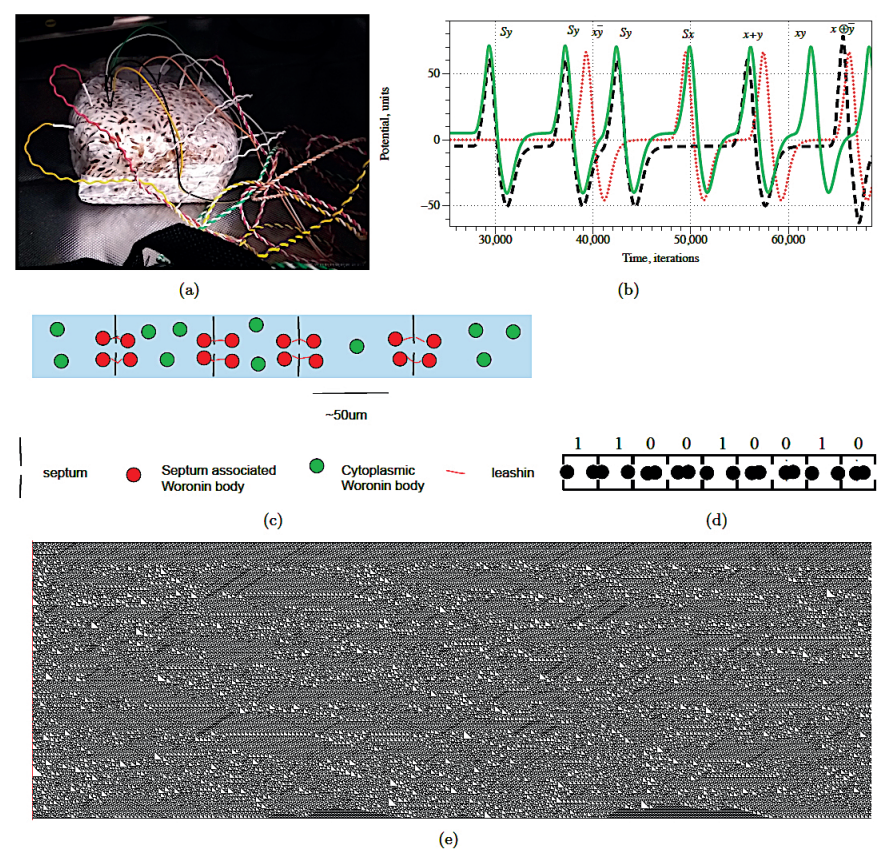
Towards fungal computing. (a) Exemplar setup of recording electrical activity of mycelium of Pleurotus ostreatus. (b) Example of Boolean gates implementation with computer model of spikes travelling in a fungal colony. Fragment of electrical potential record in response to inputs (01), black dashed line, (10), red dotted line, (11), solid green line, entered as impulses.28 (c) A biological scheme of a fragment of a fungal hypha of an ascomycete, where we can see septa and associated Woronin bodies.29 (d) A scheme representing states of Woronin bodies: ‘0’ open, ‘1’ closed.30 (e) Examplar evolution of a one-dimensional fungal automaton: the arrays of nite state machines is vertical and time increases from the left to the right.
References
[1] A. Halužan Vasle and M. Moškon, “Synthetic biological neural networks: From current implementations to future perspectives,” BioSystems, vol. 237, p. 105164, Feb. 2024, doi: 10.1016/j.biosystems.2024.105164.