Week 09 HW: Cell Free Systems
Homework Part A: General and Lecturer-Specific Questions
General homework questions
1. Explain the main advantages of cell-free protein synthesis over traditional in vivo methods, specifically in terms of flexibility and control over experimental variables. Name at least two cases where cell-free expression is more beneficial than cell production.
| Aspect | In vivo | Cell free |
|---|---|---|
| Production speed | Hours to days (requires growth) | Minutes to hours (immediate synthesis) |
| Cell membrane | Cell membranes impede scientists from interacting with the components of the reaction or manipulate cellular processes. | No cell membranes to get in the way of directly manipulating the reaction components. |
| Toxic proteins | If the target protein is toxic to the host cell, the cell may die before it can produce a significant amount of the protein. | No living cells to keep alive so it bypasses toxicity issues. |
| Manipulation of Reaction Conditions | Cell viability needs to be considerate. | Enables optimization (adjust pH, ionic strength, redox potential, metal ion concentrations, or temperature). |
| Interference & purity | Host cells need to produce their own proteins to stay alive, interfering with or delaying the production of the target protein. Difficult to separate the target protein from all the other proteins and cellular components. | Since CFPS contain the minimal cellular components necessary for protein synthesis it simplifies the extraction and purification process. |
| Non-natural amino acids | Restricted to the use of the 20 naturally occurring amino acids. | Enable the use of non natural amino acids to produce proteins with novel properties. |
| Storage & Shipping | Produced in large batches and shipped cold on ice, which is expensive | Can be freeze-dry to make them last longer at room temperature. |
When is cell-free expression more beneficial than cell production?
Prototyping: Cell-free systems serve as excellent platforms for prototyping synthetic genetic circuits before implementation in living cells. Researchers can test promoters, ribosome binding sites, regulatory elements, and genetic circuit designs in hours rather than days, dramatically accelerating the design-build-test cycle [1].
Antibody discovery: Cell-free systems accelerate antibody engineering by enabling rapid production and screening of large antibody libraries [1].
Diagnostics and Point-of-Care Testing: Cell-free systems enable decentralized protein production for diagnostics, particularly valuable in resource-limited settings. Freeze-dried cell-free reactions can be stored at room temperature for months, then reconstituted with template DNA to produce protein sensors, antibodies, or enzymes on-demand [1].
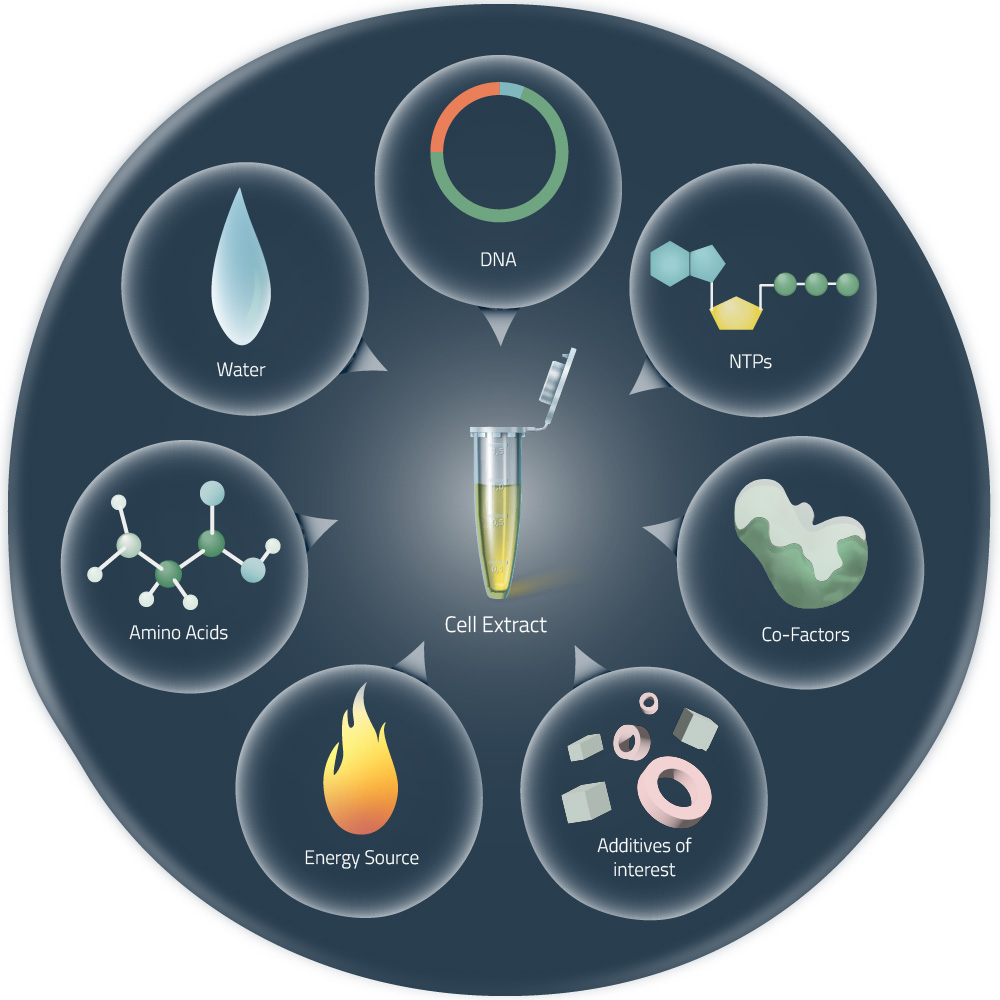
2. Describe the main components of a cell-free expression system and explain the role of each component.
DNA: specific gene sequence of the target protein we wish to transcribe and translate
RNA polymerase: enzyme that transcribes the DNA instructions into mRNA.
Ribosomes: reads the mRNA instructions. tRNAs: transport the correct amino acids to the ribosome to build the protein.
Amino acids: building blocks for the construction of the actual proteins
Energy sources: provide the necessary power to drive both the transcription and translation reactions.
Translation factors: helper proteins that assist the ribosome during the initiation, elongation, and termination phases of building the protein chain.
Aminoacyl-tRNA synthetases: specific enzymes responsible for attaching the correct amino acid to its corresponding tRNA molecule.
Energy regeneration system: it is added to continuously recycle consumed ADP and GDP back into functional ATP and GTP, ensuring the reaction does not stop prematurely.
3. Why is energy provision regeneration critical in cell-free systems? Describe a method you could use to ensure continuous ATP supply in your cell-free experiment.
Protein synthesis requires power in the form of ATP, living cells are able to constantly regenerate these necessary cellular components. However, cell-free reactions cannot naturally regenerate these components on their own limiting reaction duration.
Because I want to validate a toehold switch I would prioritize signal clarity and the PURE system eliminates background noise. I found a paper (Yadav et al., 2025) that extends PURE by integrating an ATP regeneration system based on pyruvate oxidase, acetate kinase, and catalase. The new pathway generates acetyl phosphate from pyruvate, phosphate, and oxygen, which is used to rephosphorylate ATP in situ.This can function independently or in combination with the existing creatine-based system in PURE; the combined system produced an enhancement of 78% compared to using the creatine system alone [2].
4. Compare prokaryotic versus eukaryotic cell-free expression systems. Choose a protein to produce in each system and explain why.
| Aspect | Prokaryotic | Eukaryotic |
|---|---|---|
| Yield | High | Low |
| Cost-efficiency | Cheap and fast | Expensive and laborious |
| Modifications (PTMs) | Severely limited | Multiple (glycosylation, lipidation, and disulfide-bridge formation) |
| Folding | Relies on native prokaryotic chaperones (may cause incorrect folding of complex eukaryotic proteins) | Optimal environment for complex/human proteins |
| Membranes | No natural membranes | Possess endogenous microsomes for direct insertion |
For a Prokaryotic System: this is a suitable option for small and soluble proteins that don’t need post-translational modifications to function and high yield is a priority. This system is specially good for genetic circuits validation. For this system I would produce sfGFP, since it only needs to fold correctly to fluoresce and has no PTM requirements, making E. coli cell-free the most straightforward and cost-effective choice.
For a Eukaryotic System: this is the right choice when the protein is human-derived, requires Post-translational modifications (PTMs) like glycosylation or disulfide bonds or has complex folding that depends on eukaryotic chaperones. For this system I would produce IL-6, since it requires N-linked glycosylation for proper receptor binding.
References
[1] “Cell-Free Systems for Protein Production: Advantages Over Living Cells,” Cytion. Accessed: Apr. 06, 2026. [Online]. Available: https://www.cytion.com/ca/About-Cytion/Knowledge-Hub/Blog/Cell-Free-Systems-for-Protein-Production-Advantages-Over-Living-Cells/ [2] S. Yadav, A. J. P. Perkins, S. B. W. Liyanagedera, A. Bougas, and N. Laohakunakorn, “ATP Regeneration from Pyruvate in the PURE System,” ACS Synth. Biol., vol. 14, no. 1, p. 247, Jan. 2025, doi: 10.1021/acssynbio.4c00697.