Week 10 HW: Imaging and Measurement
For your final project:
- Please identify at least one (ideally many) aspect(s) of your project that you will measure. It could be the mass or sequence of a protein, the presence, absence, or quantity of a biomarker, etc.
- Please describe all of the elements you would like to measure, and furthermore describe how you will perform these measurements.
- What are the technologies you will use (e.g., gel electrophoresis, DNA sequencing, mass spectrometry, etc.)? Describe in detail.
----------------------------------------------------------------------------------------------------------------------------------------------------
- Toehold switch activation:
- Does the switch open specifically in response to LncRNA H19? I would order the toehold switch construct from Twist and it will be expressed at Ginkgo using a PURExpress cell-free reaction with and without the H19 trigger, using sfGFP as reporter.
Technology: fluorescence spectroscopy with a plate reader.
----------------------------------------------------------------------------------------------------------------------------------------------------
- Fusion protein identity:
- Was the anti-STAT3 monobody fused to the E3 ligase recruitment domain expressed at the right size and correct sequence?
Technology:
- SDS-PAGE: approximate size (first check)
- Intact LC-MS: confirm molecular weight
- Peptide mapping for LC-MS/MS: confirm the correct order of amino acids (primary structure)
----------------------------------------------------------------------------------------------------------------------------------------------------
- Ternary complex formation:
- Does the bioPROTAC bridge STAT3 to the cell´s degradation machinery?
Technology: native mass spectrometry I would look for three peaks:
- STAT3 (alone)
- E3 recruitment domain alone
- Assembled ternary complex (If the third peak appears, the mechanism is functional)
----------------------------------------------------------------------------------------------------------------------------------------------------
- LNP formulation integrity:
- Are the lipid nanoparticles used for intraperitoneal delivery correctly assembled and homogeneous?
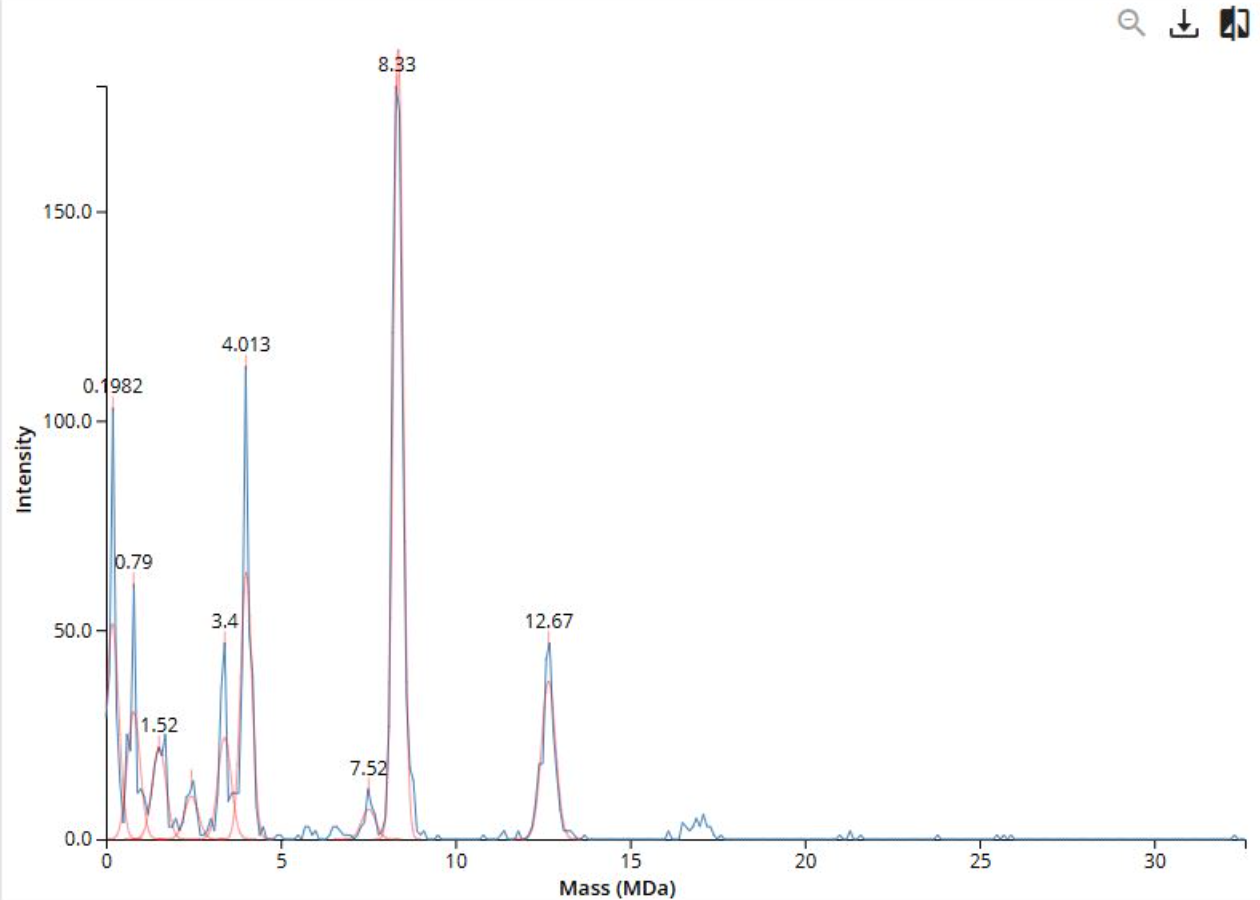
Technology: CDMS
----------------------------------------------------------------------------------------------------------------------------------------------------
- STAT3 degradation:
- Do STAT3 protein levels decrease?
Technology: Western Blot in endometriosis cells treated vs. untreated.
----------------------------------------------------------------------------------------------------------------------------------------------------
- IL-6 and IL-8:
- Do downstream inflammatory markers (IL-6 & IL-8) drop as functional output?
Technology: ELISA
Homework: Waters Part I — Molecular Weight
We will analyze an eGFP standard on a Waters Xevo G3 QTof MS system to determine the molecular weight of intact eGFP and observe its charge state distribution in the native and denatured (unfolded) states. The conditions for LC-MS analysis of intact protein cause it to unfold and be detected in its denatured form (due to the solvents and pH used for analysis).
1. What is the calculated molecular weight?
eGFP Sequence: MVSKGEELFTG VVPILVELDG DVNGHKFSVS GEGEGDATYG KLTLKFICTT GKLPVPWPTL VTTLTYGVQC FSRYPDHMKQ HDFFKSAMPE GYVQERTIFF KDDGNYKTRA EVKFEGDTLV NRIELKGIDF KEDGNILGHK LEYNYNSHNV YIMADKQKNG IKVNFKIRHN IEDGSVQLAD HYQQNTPIGD GPVLLPDNHY LSTQSALSKD PNEKRDHMVL LEFVTAAGIT LGMDELYKLE HHHHHH
Values obtained from Expasy’s molecular weight calculator when entering eGFP sequence that contains a His-purification tag (HHHHHH) and a linker:
| Property | Result |
|---|---|
| Number of aminoacids | 247 |
| Average molecular weight | 28006.60 Da |
| Monoisotopic molecular weight | 27988.96 Da |
| Theorical pI | 5.90 |
I will be using the average $MW=28006.60 Da$
However, according to this week’s lab “This self-cyclization is observed as a nominal loss of 20 Da, through dehydration and loss of two hydrogen atoms.”
So a prior modification is needed because the mature chromophore formation causes a mass loss of approximately $H2O + H2 ≈ 20.03 Da$.
$$ Theorical MW = 28006.60 - 20.03 $$ $$ Theorical MW = 27986.57 Da $$2. Calculate the molecular weight of the eGFP using the adjacent charge state approach described in the recitation. Select two charge states from the intact LC-MS data (Figure 1) and:
I selected the following charge state peaks:
$m/z_n=1000.4302$
$m/z_{n+1}=965.9684$
Determine z for each adjacent pair of peaks $(n, n + 1)$ using:
- Determine the MW of the protein using the relationship between $\frac{m}{z_n}$, $MW$ and $z$
$$\frac{m}{z_n} = \frac{MW + n \cdot H}{n}$$
$H \approx 1.0073$ Da (mass of a proton). Solving for $MW$:
$$MW = n \cdot \left(\frac{m}{z_n}\right) - n \cdot H$$
Using $n = 28$ (from part 2.1) and $m/z_n = 1000.4302$:
$$MW = 28 \cdot (1000.4302) - 28 \cdot (1.0073)$$
$$MW = 27983.8412 \text{ Da}$$
As a check, applying the same formula to the adjacent peak with $n+1 = 29$ and $m/z_{n+1} = 965.9684$:
$$MW = 29 \cdot (965.9684) - 29 \cdot (1.0073)$$
$$MW = 27983.87 \text{ Da}$$
Now I’ll take the average experimental MW:
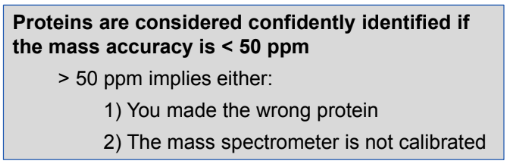
$$ MW_exp = \frac{27983.8412 + 27983.87}{2} $$ $$ MW_exp = 27983.86 Da $$- Calculate the accuracy of the measurement using the deconvoluted MW from 2.2 and the predicted weight of the protein from 2.1 using:
- Can you observe the charge state for the zoomed-in peak in the mass spectrum for the intact eGFP? If yes, what is it? If no, why not?
Yes, the charge state can be determined from the zoomed-in peak at $m/z \approx 1473$. The isotope peaks within the envelope are separated by approximately $\Delta(m/z) \approx 0.052$ m/z (between 1473.7428 and 1473.7950). Since the isotopic spacing equals $1/z$, this gives:
$$z = \frac{1}{0.052} \approx 19$$