Week 11 HW: Building Genomes
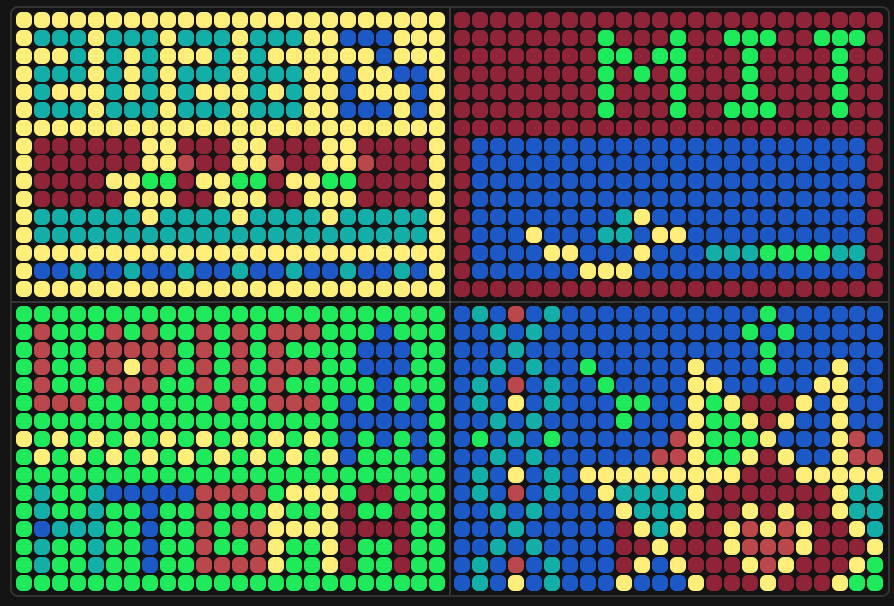
Part C: Planning the Global Experiment | Cell-Free Master Mix Design
1. Given the 6 fluorescent proteins we used for our collaborative painting, identify and explain at least one biophysical or functional property of each protein that affects expression or readout in cell-free systems. (Hint: options include maturation time, acid sensitivity, folding, oxygen dependence, etc) (1-2 sentences each)
1. sfGFP
2. mRFP1
3. mKO2
4. mTurquoise2
5. mScarlet_I
6. Electra2
| Fluorescent protein | Maturation (min) | pKa | Brightness | Description |
|---|---|---|---|---|
| sfGFP | 13.6 | 54.15 | Rapidly-maturing weak dimer | |
| mRFP1 | 60.0 | 4.5 | 12.5 | Slowly-maturing monomer with low acid sensitivity |
| mKO2 | 108.0 | 5.5 | 39.56 | Moderate acid sensitivity |
| mTurquoise2 | 33.5 | 3.1 | 27.9 | Rapidly-maturing monomer with very low acid sensitivity |
| mScarlet_I | 174.0 | 5.3 | 70 | Moderate acid sensitivity |
| Electra2 | 61.48 |
3. Create a hypothesis for how adjusting one or more reagents in the cell-free mastermix could improve a specific biophysical or functional property you identified above, in order to maximize fluorescence over a 36-hour incubation. Clearly state the protein, the reagent(s), and the expected effect.
I choose mKO2 because it is acid sensitive and has a slow maturation time.. My hypothesis is that increasing the HEPES-KOH concentration in the 36-hour master mix would help maintain the pH closer to 7.5 throughout the reaction. Which is important because in cell free reactions pH decreases over long incubations due to the accumulation of acidic metabolic byproducts and mKO2 slow maturation time means most of the signal is generated in the later hours when pH tends to drop.