Week 9 HW: Cell Free Systems
Part A: General and Lecturer-Specific Questions
General homework questions
1. Explain the main advantages of cell-free protein synthesis over traditional in vivo methods, specifically in terms of flexibility and control over experimental variables. Name at least two cases where cell-free expression is more beneficial than cell production.
- Cell-free protein synthesis: is a protein expression approach that enables the production of a target protein without the use of living cells.
- In vivo methods: it is also a protein expression approach that uses living cells such as bacteria (e. coli, most common), yeast, insect cells, and mammalian cells.
Here is a chart that makes a summary about differences between both methods:
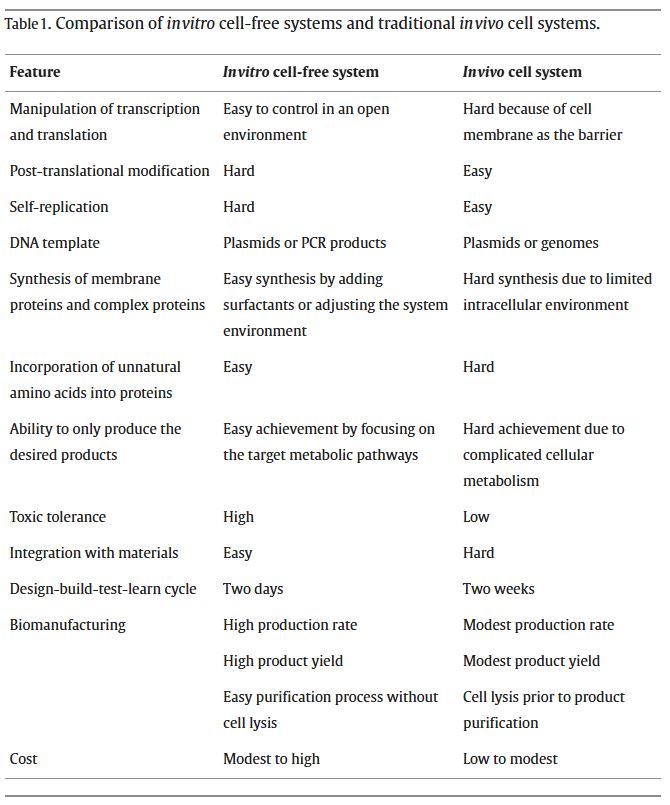
As it is shown, cell-free protein synthesis has several advantages compared to traditional in vivo methods, mainly because everything happens outside of a living cell. This makes the system much more flexible, since you can directly control things like the amount of DNA, enzymes, and other components without worrying about how the cell will react. In contrast to cell-dependent methods, in which limitations are high due to metabolism, regulation, and survival.
Another important advantage is that cell-free systems allow the production of proteins that might be toxic to cells, while in in vivo methods, these types of proteins can kill or damage the host organism, making them difficult or impossible to produce. In cell-free expression, this is not a problem because there are no living cells involved.
In terms of speed, it is faster (cell-free), since it does not need to spend time growing cells or transforming them. This makes it easier to quickly test different DNA sequences or protein variants.
There are several situations where the cell-free method is more useful. For example: when producing toxic proteins that cannot be expressed in cells, or for rapid prototyping applications, such as synthetic biology circuits or screening multiple protein variants in a short time. It is important to add that while cell-free methods are better with rapid process and protein expression in a controled-medium size, in vivo methods can handle massive production and low-cost protein production
2. Describe the main components of a cell-free expression system and explain the role of each component.
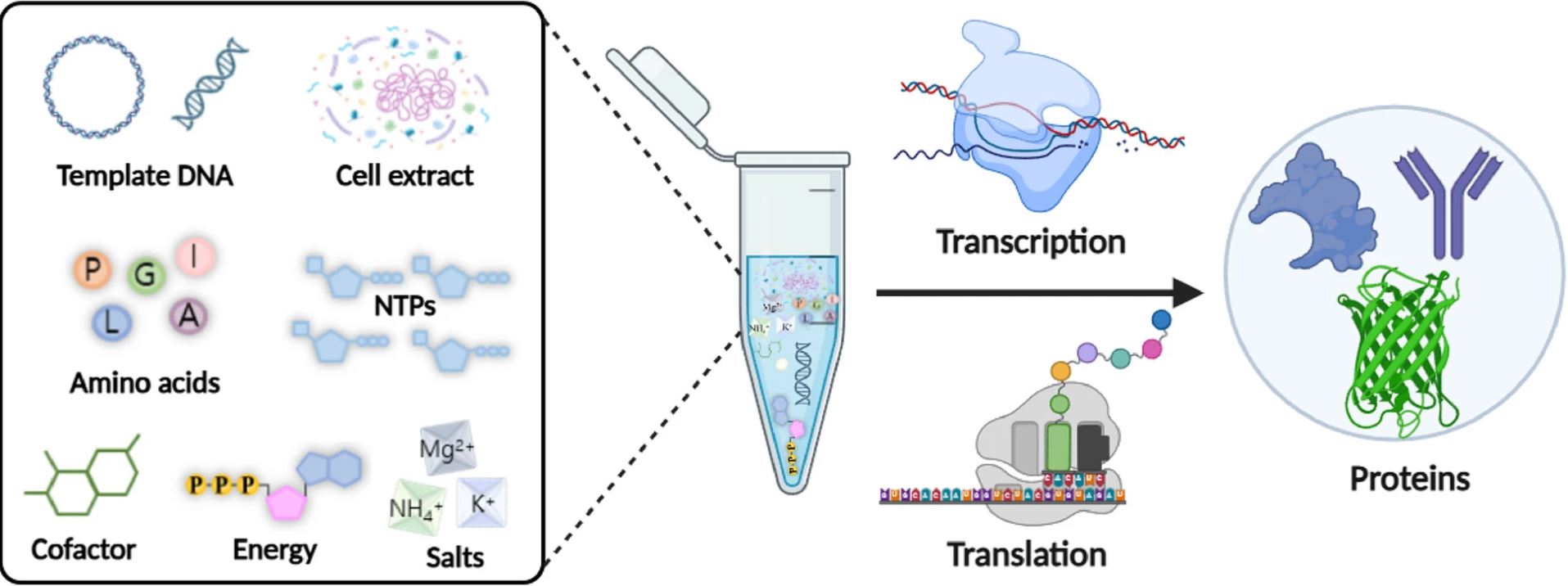
Cell-free expression systems are made up of several components that work together to produce proteins outside living cells:
- Cell extract: contains the molecular machinery needed for protein synthesis. This extract usually comes from broken cells (like bacteria) and provides ribosomes, tRNAs, enzymes, and other factors required for transcription and translation.
- DNA template: this is the gene that encodes the protein of interest. The system uses this DNA to produce mRNA and then translates it into the desired protein.
- Amino acids: they are the building blocks of proteins. These are added to the system so that ribosomes can assemble them into a protein based on the sequence of the mRNA.
- NTPs (nucleoside triphosphates): such as ATP, GTP, CTP, and UTP. These molecules are essential both for building the mRNA during transcription and for providing energy during translation.
- Energy source: protein synthesis requires a lot of energy, so the system needs molecules like ATP and other energy-regenerating compounds to keep the reaction running.
- Cofactors and salts: this helps the stability of the chemical environment and helps enzymes to function correctly. Cofactors and salts ensure that the system remains stable and efficient.
3. Why is energy provision regeneration critical in cell-free systems? Describe a method you could use to ensure continuous ATP supply in your cell-free experiment.
Energy provision regeneration is critical in cell-free systems because protein synthesis is a highly energy-demanding process. Both transcription and translation require large amounts of ATP and GTP. Without the continuous energy supply, the reaction stops. Because of the absence of a cellular metabolism to naturally generate energy, the cell-free system would run out of ATP very fast. Without it, protein yields would be very low, and the reaction would only last a short period.
There are some interesting pathways to produce continuous energy in cell-free systems, some of which are:
- Glucose and sugar metabolism: systems that are frequently derived from E.coli or yeast, enable high-yield, in vitro protein production by utilizing metabolic pathways to break down glucose, which can improve cost-efficiency.
- Maltodextrin metabolism: it is a low-cost secondary energy compound for CFPS. It produces higher levels of protein than PEP, glucose, and glucose-6 phosphate. The enhancement of protein synthesis was largely attributed to be better-controlled phosphate levels ( recycling of inorganic phosphate) and a more homeostatic reaction environment.
- Electric-generated power: in cells, ATP is synthethized through a rather complicated process involving several membrane-bound redox protein complexes. Electrons are transferred along different redox centers, creating a proton motive force across the membrane, which is subsequently harvested for ATP synthesis.
| System | How it generates ATP | Advantages | Disadvantages | When to use it |
|---|---|---|---|---|
| Glucose and sugar metabolism | Uses glucose or other sugars (e.g., glycolysis) to produce ATP | Low cost; biologically natural; supports longer reactions | Can produce acidic byproducts; less control over conditions | When a cost-effective and stable system is needed |
| Maltodextrin metabolism | Uses maltodextrin, slowly broken down to generate ATP | More stable energy release; fewer inhibitory byproducts | Requires optimization; depends on enzymatic activity | When higher stability and consistency are required |
| Electricity-powered generation | Uses electrical energy to drive redox reactions | Precise control; real-time adjustment; reduced byproducts | Technically complex; requires specialized equipment | Advanced research or tight energy control systems |
4. Compare prokaryotic versus eukaryotic cell-free expression systems. Choose a protein to produce in each system and explain why.
First, we need to understand both terms:
- Prokaryotic is a unicellular organism that is characterized by not having a defined nucleus. Its DNA is located in the cytoplasm.
- Eukaryotic is a cell or an organism that has a defined nucleus, protected by a membrane in which the DNA is stored.
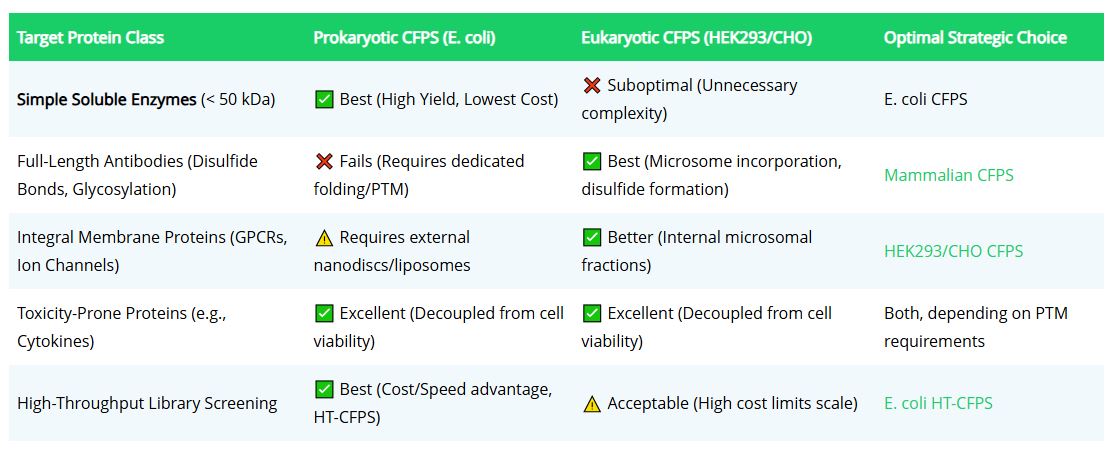
When comparing them within the cell-free expression, we can outline some important differences due to the complexity of each intracellular machinery:
Prokaryotic CFPS:
- Yield higher quantities of protein
- Are cost-effective
- Production of simple proteins
- Production of toxic proteins that would kill a living host.
- Example: E.coli
Eukaryotic CFPS:
- Crucial for properly folding complex
- Functional proteins that require post-translational modifications.
- Disulfide bond formation
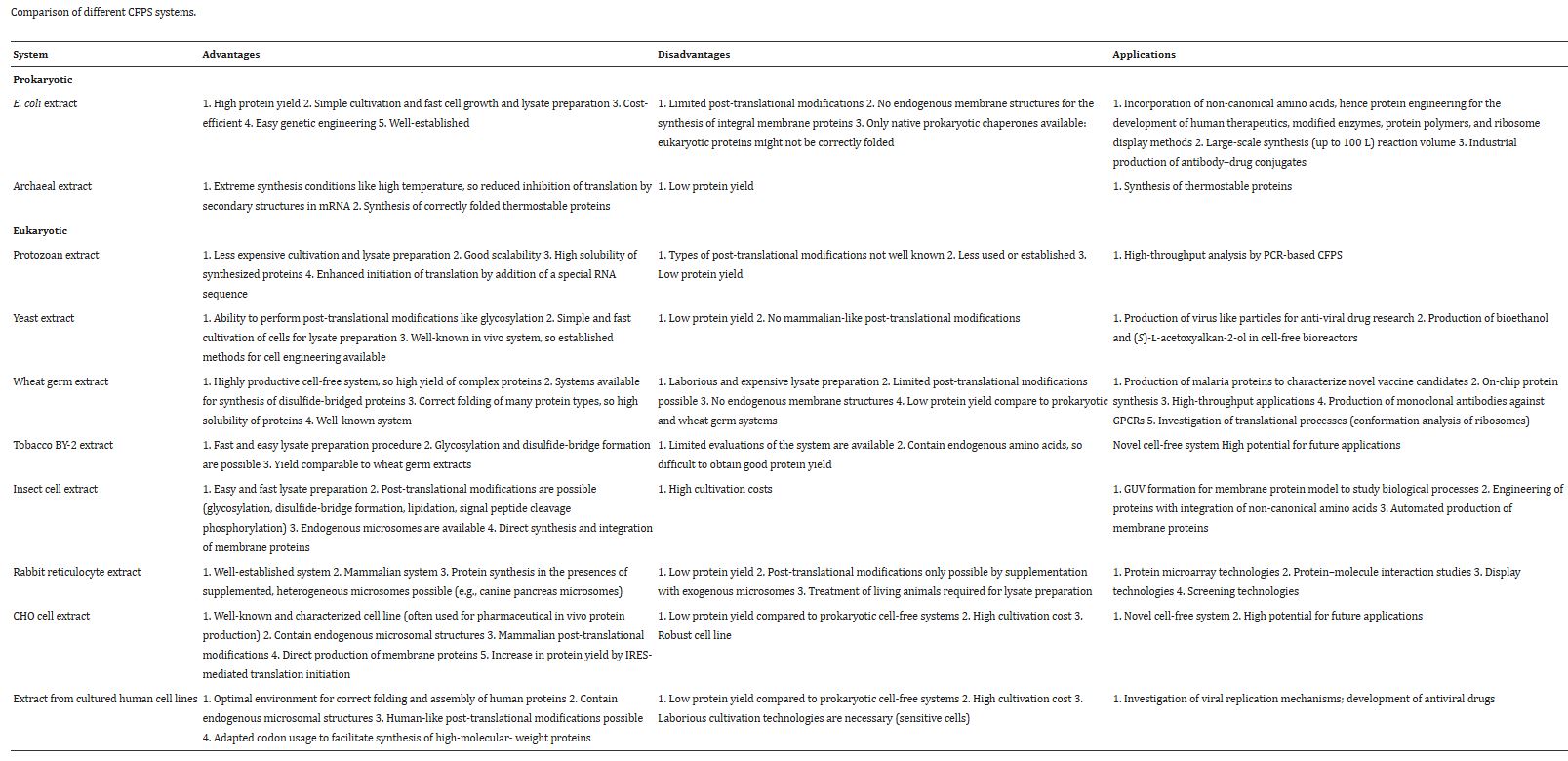
- Example: Wheat germ, rabbit reticulocyte lysate, insect cell lysate.
In the image below, we can analyze a comparative chart between Prokaryotic vs. Eukaryotic CFPS:
And a useful comparison between CFPS systems classified by eukaryotic and prokaryotic cells:
5. How would you design a cell-free experiment to optimize the expression of a membrane protein? Discuss the challenges and how you would address them in your setup.
To optimize membrane protein expression in a cell-free system, I would use an eukaryotic extract such as CHO or an Insect extract, since both systems are more suitable for producing complex membrane proteins with proper folding and co-translational processes.
These extracts contain microsomal vesicles that provide a hydrophobic membrane-like environment, helping membrane proteins maintain their structure and preventing aggregation. This is especially important because membrane proteins are naturally adapted to lipid environments.
To monitor protein expression, I would use a GFP tag on the protein construct. GFP fluorescence would serve as an indicator of successful protein expression and would also help visualize where expression occurs within the system.
For energy regeneration, I would include a creatine phosphate/creatine kinase system to maintain ATP levels. Additionally, I would implement a Continuous Exchange Cell-Free (CEFC) system. This setup would extend the reaction time from only a few hours up to 24 hours, allowing higher protein yield.
Finally, in comparison with E.coli extracts, these eukaryotic systems usually produce a lower amount of protein. However, the main benefit is the higher-fidelity membrane protein expression, since protein folding and membrane expression are difficult to achieve in E.coli.
6. Imagine you observe a low yield of your target protein in a cell-free system. Describe three possible reasons for this and suggest a troubleshooting strategy for each.
Inappropriate extract system: Using the wrong extract system may reduce protein yield because some proteins require specific folding machinery, chaperons, or membrane environments that are not present in all extracts. For example, a complex membrane protein may not express properly in E.coli-based systems (like in the question above). For example, E.coli extracts can produce proteins very quickly, but they are not always a good fit for complex membrane proteins. To troubleshoot this, it would be necessary to understand exactly what the best extract and supplementary structures are for each protein.
Low energy supply: Cell-free protein synthesis requires a constant supply to maintain transcription and translation. If ATP regeneration is insufficient, the reaction may stop prematurely, resulting in a low protein yield. To address this, it is necessary to ensure a constant regeneration of energy, which could be achieved by using alternatives that provide a more stable and continuous energy source, such as glucose metabolism, maltodextrin metabolism, the creatine phosphate/creatine kinase system, or electricity-powered ATP regeneration.
Incorrect hydrophobic mimetics: Some proteins need to have hydrophobic environments to remain stable and folded. If the wrong detergents, nanodiscs, or liposomes are used, then the protein would aggregate or lose its functionality, therefore reducing protein yield. To solve this problem, different membrane mimetics and concentrations could be tested to mimic the natural membrane environment and stabilize the protein during expression.
Homework question from Kate Adamala
Design an example of a useful synthetic minimal cell as follows:
- Pick a function and describe it.
- What would your synthetic cell do? What is the input and what is the output?
I would like to design a synthetic cell that identifies flea saliva inside a dog´s body and then sends a signal to a common bacterial skin.
The input would be the protein that corresponds to the flea´s saliva: ctenocephalides felis. specifically the major allergen Cte f1, a chymotrypsin-like enzyme responsible for triggering histamine-mediated allergic responses. The output would be IPTG, which would activate the engineered bacteria living in the dog´s hair follicles.
The general output would be the expression of an anti-allergenic protein that blocks the saliva protein’s activity.
- Could this function be realized by cell-free Tx/Tl alone, without encapsulation?
No, it could not be done by a cell-free Tx/Tl alone, because the skin of the dog contains substances such as sweat that could degrade the different components of the cell-free system, as well as the DNA, or the transcription and translation enzymes.
- Could this function be realized by genetically modified natural cell?
It would be damaging for the dog and the bacteria of the skin because when a mutation is inserted in an organism, it can generate a very complex chain of reactions that could damage the health of the living being. In this case, bacterial metabolism would be compromised by the environment, which could cause mutations. This event would shut down the receptor mechanism, and the sensor would not work.7
- Describe the desired outcome of your synthetic cell operation.
In the presence of flea´s salivary protein (Cte f1), the SMDC produces and liberates IPTG. IPTG would wake up the modified Staphylococcus epidermis that lives in the hair follicles. Once activated, the enzyme Histaminase will be produced.
- Design all components that would need to be part of your synthetic cell.
What would be the membrane made of?
- 70% POPC: as a structural fluid base.
- 20% Cholesterol: to reduce permeability and give rigidity against physical force.
- 10% DSPE-PEG2000: to prevent aggregation of vesicles in shampoo or gel products and to improve adherence to the dog´s fur.
What would you encapsulate inside? Enzymes, small molecules.
- Macromolecules and enzymes: Tx/Tl machinery, e.coli chasis, ARN polymerase, tRNAs, and elongation factors.
- Small molecules: IPTG, ATP, GTP, amino acids, and a regenerative system of energy.
- Genetic material: DNA plasmid containing the allergen-responsive riboswitch circuit.
Which organism your Tx/Tl system will come from? Is bacterial OK, or do you need a mammalian system for some reason? (hint: for example, if you want to use small molecule modulated promotors, like Tet-ON, you need mammalian)
It will come from E.coli that is perfect for a bacterial match. This bacterial system is fully adequeate because the synthetic circuit uses a modified bacterial RNA aptamer/riboswitch that interacts directly with prokarytic 70S ribosomes.
How will your synthetic cell communicate with the environment? (hint: are substrates permeable? or do you need to express the membrane channel?)
Input communication: since the flea allergen protein Cte f1 is too large to cross the membrane through passive diffusion, the SMC membrane will constitutively contain modified alfa-hemolysin pores. These pores would allow the passage of peptides or small allergen fragments. Alternatively, a membrane-bound scFv receptor (single-chain variable fragment antibody) could be coupled to the pore system to induce conformational signaling upon allergen binding.
Output communication: IPTG is a relatively small molecule and would diffuse through activated αHL pores once the molecular circuit is triggered.
- Experimental details
List all lipids and genes. (bonus: find the specific genes; for example, instead of just saying “small molecule membrane channel” pick the actual gene.)
LIPIDS:
- POPC (1-palmitoyl-2-oleoyl-sn-glycero-3-phosphocholine)
- Cholesterol
- DSPE-PEG2000 (1.2-distearoyl-sn-glycero-3-phosphoethanolamine-N-[amino(polyethylene glycol)-2000)])
GENES:
- Constitutive T7 promoter (pT7)
- Cte f1-specific riboswitch/aptamer An engineered RNA aptamer that specifically binds the flea allergen Cte f1. In the absence of the allergen, the ribosome binding site remains blocked. Once the allergen binds, the RNA changes conformation and allows translation.
- Holin S105 gene: After activation, the system expresses the Lambda phage Holin S105 protein, which forms membrane pores and triggers the rapid release of encapsulated IPTG.
How will you measure the function of your system?
IPTG Release assay: A fluorescent dye such as calcein would be co-encapsulated inside the SMCs. When the flea allergen is added, pore formation would release the dye, and fluorescence increase would be measured over time.
Bacterial Activation Assay: The SMCs would be co-cultured with engineered Staphylococcus epidermidis containing an IPTG-inducible mCherry reporter. Successful activation would produce red fluorescence.
Histamine Degradation Assay: After system activation, histamine concentration would be measured using ELISA or HPLC to confirm DAO-mediated histamine degradation.
Homework question from Peter Nguyen
Freeze-dried cell-free systems can be incorporated into all kinds of materials as biological sensors or as inducible enzymes to modify the material itself or the surrounding environment. Choose one application field — Architecture, Textiles/Fashion, or Robotics — and propose an application using cell-free systems that are functionally integrated into the material. Answer each of these key questions for your proposal pitch:
- Write a one-sentence summary pitch sentence describing your concept.
A freeze-dried cell-free bioleather capable of sensing environmental temperature changes and responding by producing visible aeBlue chromoprotein coloration within the material.
- How will the idea work, in more detail? Write 3-4 sentences or more.
The project consists of a bacterial cellulose-based bioleather embedded with freeze-dried cell-free protein synthesis systems containing the genetic circuit for aeBlue chromoprotein expression. The CFPS components would remain inactive while dry, allowing the material to be stored and used safely without living engineered bacteria.
When the material is exposed to moisture, humidity, sweat, or environmental rehydration, the freeze-dried CFPS becomes active. Temperature-responsive genetic elements or the natural thermosensitive behaviour of ae-Blue would trigger different levels of blue pigmentation depending on environmental conditions.
The bacterial cellulose matrix acts both as a structural biomaterial and a carrier for the embedded CFPS microcapsules. As temperature changes occur, the material dynamically changes color, creating an environmentally responsive biofabricated leather.
- What societal challenge or market need will this address?
This project addresses the growing demand for sustainable and responsive biomaterials within the fashion and textile industries. Traditional leather production has major environmental impacts, while synthetic plastics contribute to pollution and microplastic accumulation.
Also, a major challenge would be the variety of bioleather materials that already exist and are already available in the market, and their variations.
- How do you envision addressing the limitation of cell-free reactions (e.g., activation with water, stability, one-time use)?
The CFPS system would be freeze-dried and encapsulated within the protective hydrogel or polymer microcapsules distributed throughout the cellulose matrix. This approach increases long-term stability and protects the biological machinery from premature degradation.
The material would only activate after exposure to moisture or humidity, extending shelf life during storage and transport. To address the one-time-use limitation, the bioleather could incorporate a replaceable or rechargeable CFPS layer that can be rehydrated multiple times or periodically replenished with fresh freeze-dried reaction components.
Homework question from Ally Huang
Freeze-dried cell-free reactions have great potential in space, where resources are constrained. As described in my talk, the Genes in Space competition challenges students to consider how biotechnology, including cell-free reactions, can be used to solve biological problems encountered in space. While the competition is limited to only high school students, your assignment will be to develop your own mock Genes in Space proposal to practice thinking about biotech applications in space!
For this particular assignment, your proposal is required to incorporate the BioBits® cell-free protein expression system, but you may also use the other tools in the Genes in Space toolkit (the miniPCR® thermal cycler and the P51 Molecular Fluorescence Viewer). For more inspiration, check out https://www.genesinspace.org/ .
- Provide background information that describes the space biology question or challenge you propose to address. Explain why this topic is significant for humanity, relevant for space exploration, and scientifically interesting. (Maximum 100 words)
Long-duration space missions expose astronauts to enclosed environments where oxygen imbalance or toxic gas accumulation may become life-threatening. Current oxygen monitoring systems depend heavily on electronic infrastructure, which can fail during emergencies. This proposal explores a freeze-dried cell-free biosensor capable of detecting low oxygen levels and harmful gas accumulation while activating an emergency biological response system. Such a platform could support astronaut survival spacecraft, planetary habitats, or exploration missions with limited resources. Developing lightweight, portable, and biologically programmable gas-response systems is significant for future lunar, Martian, and deep-space exploration, where autonomous emergency technologies will become increasingly necessary.
- Name the molecular or genetic target that you propose to study. Examples of molecular targets include individual genes and proteins, DNA and RNA sequences, or broader -omics approaches. (Maximum 30 words)
Oxygen-sensitive regulatory system (Fnr system), hypoxya response promoters, and gas-responsive reporter proteins integrated into BioBits cell-free protein expression platform.
- Describe how your molecular or genetic target relates to the space biology question or challenge your proposal addresses. (Maximum 100 words)
The selected molecular targets allow the CFPS to biologically detect oxygen depletion and potentially dangerous atmospheric conditions. The Fnr oxygen-sensing regulatory system naturally responds to hypoxic environments in bacteria, making it suitable for engineering emergency biosensors. By integrating the regulatory elements into the BioBits platform, the system could activate visible reporter signals or trigger gas-response mehcanisms when ocygen concentration drops below safe thresholds. This directly addresses one of the major biological and engineering challenges in space exploration: maintaining safe atmospheric conditions in isolated environments where equipment malfunction or delayed rescue may threaten astronaut survival.
- Clearly state your hypothesis or research goal and explain the reasoning behind it. (Maximum 150 words)
This project hypothesizes that a freeze-dried BioBits cell-free system can function as a portable oxygen deficiency biosensor capable of activating a detectable biological response under hypoxic conditions. The goal is to engineer a lightweight and stable emergency platform that can detect dangerous atmospheric changes without relying entirely on electronic systems.
The proposed system would use oxygen-sensitive regulatory components to activate reporter protein expression when oxygen levels decrease. This response could generate visible colorimetric or fluorescent signals that warn astronauts about unsafe environments. In future applications, the platform could potentially be expanded to activate oxygen-generating or gas -neutralizing bilogical pathways.
This research is important because future space habitats will require autonomous, low-resource emergency technologies that remain functional even during equipment failures or power limitations.
- Outline your experimental plan - identify the sample(s) you will test in your experiment, including any necessary controls, the type of data or measurements that will be collected, etc. (Maximum 100 words)
Freeze-dried BioBits reactions containing oxygen-sensitive genetic circuits will be prepared and exposed to controlled atmospheric conditions with varying oxygen concentrations. Normoxic samples will serve as controls, while hypoxic chambers will simulate oxygen-deficient environments.
Reporter protein expression will be measured using visible chromoproteins or fluorescence detected with the P51 Molecular Fluorescence Viewer. The miniPCR thermal cycler may be used to amplify and verify DNA constructs before freeze-drying.
Collected data will include fluorescence intensity, response time, activation thresholds, and system stability after rehydration. These measurements will evaluate whether the biosensor can reliably detect dangerous atmospheric conditions in space-like environments.
Homework Part B: Individual Final Project
We’d like students to start exploring their final project in depth this week! Of your three Aims, for this week you should have at least Aim 1 decided and written down.
Put your chosen final project slide in the appropriate slide deck following the instructions on slide 1:
- MIT/Harvard/Wellesley ONE FINAL PROJECT IDEA
- Committed Listener ONE FINAL PROJECT IDEA
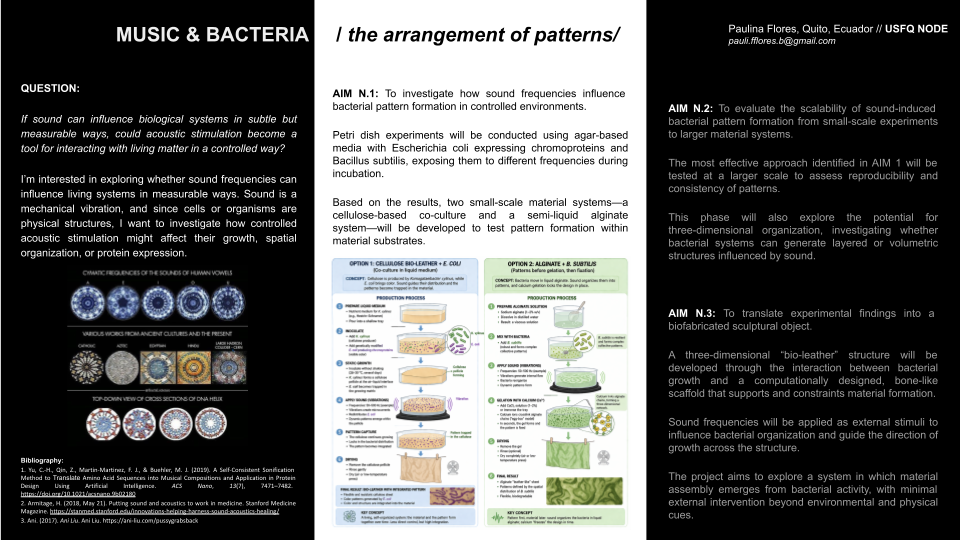
This is my final project idea, it is still on work but the slide makes an emphazyse about the idea of the experiment:
Submit this Final Project selection form if you have not already.
I already made it but forgot to take a screenshot of the form
Begin planning how you will write your final project documentation based on these guidelines
Prepare your first DNA order and put it in the “Twist (MIT)” or “Twist (Nodes)” tab of the 2026 HTGAA Ordering: DNA, Reagents, Consumables spreadsheet, as appropriate.
First Twist order deadline for MIT/Harvard/Wellesley students is Friday, April 3 at 11PM ET
First Twist order deadline for Committed Listeners is Friday, April 10 at 11PM ET. (Your Node Lead will place the Twist order, so please work with them to finalize your constructs and ordering decisions.)
For the USFQ node, the Twist orders were cancelled fue to administrative procedures.