Week 11 HW: Bioproduction & Cloud Labs
Part A: The 1,536 Pixel Artwork Canvas | Collective Artwork
1. Contribute at least one pixel to this global artwork experiment before the editing ends on Sunday 4/19 at 11:59 PM EST.
- A personalized URL was sent to the email address associated with your Discourse account, and you can discuss the artwork on the Discourse.
- If you did not have a chance to contribute, it’s okay, just make sure you become a TA this fall! 😉
2. Make a note on your HTGAA webpages including:
What you contributed to the community bioart project (e.g., “I made part of the DNA on the bottom right plate”)
For this part I contributed with a sinuous line that has the idea to connect the plates of the bottom. It was made with sfGFP protein (green fluorescent protein). I think I made some pixels with red, but I could not identified them when the artwork was complete.
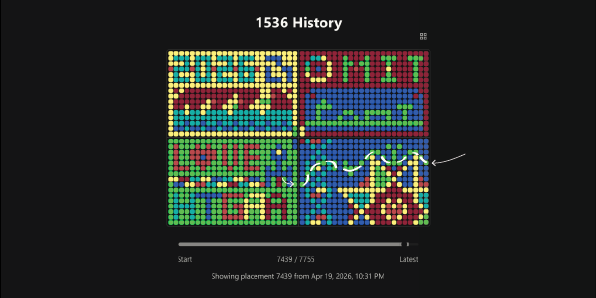
What you liked about the project, and
I think it woke up my curiosity and excitement about what was going to be the final output. Everyone was making some changes in it, and sometimes the drawing was pretty clear, but other times it mutated. It is nice to see how everyone contributes, without having anything in mind or with a very specific idea. I like the idea of having a collaborative artwork without knowing how it is going to be at the end. Also, it is an extensive process for the cloud lab to process.
What about this collaborative art experiment could be made better for next year?
I would like to see more colors in it. Also, it would be nice to use some coding to let everyone make a complete drawing, and then have an artificial analysis that has a final output. I would like to understand what the AI is reading and what patterns it selects and keeps. It would be nice to just have that curiosity resolved.
Part B: Cell-Free Protein Synthesis | Cell-Free Reagents
1. Referencing the cell-free protein synthesis reaction composition (the middle box outlined in yellow on the image above, also listed below), provide a 1-2 sentence description of what each component’s role is in the cell-free reaction.
E. coli Lysate
- BL21 (DE3) Star Lysate (includes T7 RNA Polymerase): It is the machinery of the E.coli cell that makes possible the expression of the proteins inserted in the plasmid. In the specific case of BL21 (DE3), the machinery has been modified so that the mRNA would not be degraded, resulting in a higher yield of protein expression and stability.
Salts/Buffer
- Potassium Glutamate: It is used to maintain osmotic balance and support enzyme function in the bacterial lysate process. It is an alternative to KCl and a highly efficient reaction. It simulates ionic strength.
- HEPES-KOH pH 7.5: It is a common high-quality buffer suited for cell culture, protein purification, and enzyme studies. It maintains a pH stable in the range of 6.8-8.2.
- Magnesium Glutamate: Mg²⁺ ions are essential for ribosome function and enzymatic activity, while glutamate counterion acts as a biocompatible high-capacity buffer that stabilizes pH and mimics intracellular conditions. Therefore, magnesium glutamate offers a superior buffering capacity across a broader pH range, enhancing protein stability and activity.
- Potassium phosphate monobasic: it is a highly soluble inorganic salt used as a foundational buffering agent. It acts as a weak acid in the preparation of phosphate buffer systems to maintain a stable pH (between 5.8 and 8.0), critical for enzyme stability and cell culture viability.
- Potassium phosphate dibasic: generally, it is combined with potassium phosphate monobasic for creating biological buffers. It’s used in CFPS when needing high-purity and low-background buffering.
Energy / Nucleotide System
- Ribose: It is crucial for rebuilding nucleotides in the reaction mixture and regeneration of energy molecules such as ATP (adenosine triphosphate) and adenine nucleotide. Ribose is a carbon-5 sugar used to build scaffolding for nucleobase salvage, turning them back into active nucleotides (important during energy stress)
- Glucose: it offers an ATP regeneration via glycolysis. It offers a higher energy yield per molecule compared to traditional high-energy phosphate. Glucose fuels CFPS by initiating glycolysis. Glucose drive systems present a lag in protein synthesis because ATP is consumed for priming glycolysis before net regeneration begins.
- AMP: Adenosine monophosphate acts as a signal of energy depletion in CFPS. It is recycled back to ADP/ATP to prolong protein synthesis, often via endogenous kinases such as adenylate kinase.
- CMP: Cytidine 5-monophosphate is a nucleotide component in CFPS. It serves as a precursor for the production of CTP, which is essential for RNA synthesis and transcription. It is utilized in energy regeneration pathways and as a building block fr nucleic acids.
- GMP: Guanosine monophosphate. Is a critical nucleotide precursor that serves as a building block for RNA synthesis (transcription) and as a substrate for energy regeneration (translation).
- UMP: Uridine monophosphate. Acts as a critical precursor for pyrimidine nucleotide metabolism, supplying UTP required for RNA synthesis and energy-dependent processes. While UTP is used for transcription, UMP phosphorylation depends on the energy regeneration systems, that replanishes the ATP required by UMP kinases.
- Guanine: It is crucial for powering translation machinery, with 2 molecules of GTP typically consumed for each amino acid incorporated into a growing polypeptide. It is required for: amino acid activation, initiation, elongation, and termination during translation.
Translation Mix (Amino Acids)
- 17 Amino Acid Mix: Provides the majority of amino acids required for protein synthesis, enabling ribosomes to assemble the target protein. While 20 amino acids are the standard, in specific mixes, 17 also works, and is used for enhancing solubility, balancing metabolism, or allowing the incorporation of unnatural amino acids to the mix.
- Tyrosine: It is supplied separately due to its low solubility. Typically added when needing high-yield protein production (1-4 mM).
- Cysteine: Also supplied separately due to its stability, reactivity, and oxidation issues. Is important to ensure its availability for having proper protein folding and disulfide bond formation
Additives
- Nicotinamide: commonly utilized in the context of metabolic engineering for the production of nicotinamide mononucleotide (NMN), a vital intermediate in NAD+/NADH, supporting redox reactions and metabolic processes that help sustain energy regeneration.
Backfill
- Nuclease Free Water: It is used to adjust the final reaction volume while preventing degradation of nucleic acids by nucleases.
2. Describe the main differences between the 1-hour optimized PEP-NTP master mix and the 20-hour NMP-Ribose-Glucose master mix shown in the Google Slide above. (2-3 sentences)
The main difference lies in the energy regeneration strategy used in each system: the 1hour PEP-NTP master mix relies on phosphoenolpyruvate (PEP) as a high-energy phosphate donor, enabling rapid and efficient ATP regeneration for short-term, high-yield protein synthesis. In contrast, the 20-hour NMP uses a slower, metabolism-based pathway that recycles nucleotides and generates ATP through glycolytic processes, allowing sustainable protein production over longer periods but with lower instantaneous energy output.
3. Bonus question: How can transcription occur if GMP is not included but Guanine is?
Transcription can occur because guanine can be converted into GMP through nucleotide salvage pathways present in the lysate. GMP is then phosphorylated to GDP and GTP, which are required for RNA synthesis. Therefore, even in the absence of externally supplied GMP, the system can regenerate the necessary nucleotides for guanine.
Part C: Planning the Global Experiment | Cell-Free Master Mix Design
1. Given the 6 fluorescent proteins we used for our collaborative painting, identify and explain at least one biophysical or functional property of each protein that affects expression or readout in cell-free systems. (Hint: options include maturation time, acid sensitivity, folding, oxygen dependence, etc) (1-2 sentences each)
sfGFP: has a ratio of 2.2 ± 0.1 (74 cells) (2.2 is the average of OSER parameters; 0.1 is the variability; 74 is the number of cells in which it has been analyzed). Therefore, sfGFP is an almost stable protein that tends to aggregate at a low rate, which means that it might not fold correctly or be less fluorescent.
- OSER ratio (Organized smooth endoplasmic reticulum) evaluates if a protein tends to oligomerize or aggregate in cells. In the case of CFPS, it indicates a tendency to do so. In general, values around 1-2 indicate a tendency to monomerize and therefore be more stable, while values around 3-4 indicate a tendency to oligomerize and therefore to aggregate.
mRFP1: this protein has 4.5 pKa. Normally, in CFPS, the pH is around 7-7.5 in order to obtain a higher efficiency in translation and transcription. In this case, a pH of 4.5 means that it is negatively charged, which favors its solubility. The only thing is that if the pH changes slightly, the protein will become positively charged and change its conformation. (altering its 3d structure and losing its functions).
- PKA: It is the measure of the acid sensitivity of FP. It is the pH at which fluorescence intensity drops at 50% of its maximum value. It is the physiological pH that the protein needs.
mKO2: has a 5.5 pKa, and a maturation time of 108 min. This means that the maturation time is long, and it delays fluorescence detection in CFPS, affecting the early readout. On the other hand, the low pKa indicates that it is sensitive to pH changes, making the fluorescence readout decrease when the pH gets more acidic.
- Maturation time (min): is the ideal time in which a protein is properly folded and expressed. The rates vary between 10-30 (min) as fast maturation, 30-60 (min) medium, and more than 90 (min) slow.
mTurquoise2: this protein has a maturation time of 33.5 min, which is a moderate rate, and a 3.3pKa, which is a little low; it is stable in physiological pH. In the case of oxygen dependence, as mTurquoise2 is derived from GFP, oxygen is required for chromophore maturation, making fluorescence dependent on oxygen availability.
mScarlet_I: we have a 3.9 (ns) of lifetime. This means each molecule will remain in an excited state for 3.9 ns before emitting a photon. This improves readout reliability by enabling discrimination from background fluorescence.
- Lifetime (ns): it is the time a fluorophore remains excited before returning to the ground state by emitting a photon. It is influenced by the local environment, such as pH and molecular interactions.
Electra2: this protein has a high photostability, with a half-life of 1466 seconds, allowing it to maintain fluorescence under continuous illumination.
- Photostability: ability of a fluorescent protein to maintain its fluorescence under continuous illumination. High photostability improves CFPS readout by reducing photobleaching because it produces a reliable signal.
2. Create a hypothesis for how adjusting one or more reagents in the cell-free mastermix could improve a specific biophysical or functional property you identified above, in order to maximize fluorescence over a 36-hour incubation. Clearly state the protein, the reagent(s), and the expected effect.
I chose the mKO2 protein, because it presents a relatively long maturation time (108 min), delaying fluorescence detection. I think it can be improved by combining two elements: first, by applying more agitation, oxygen levels would increase in the reaction, and to accelerate the chromophore formation. Second, would be by adding a chaperon protein so that it can improve folding efficiency, the chaperon selected could be GroEl/GroEs, also, it would increase the yield of properly folded protein over a 36-hour incubation.
3. The second phase of this lab will be to define the precise reagent concentrations for your cell-free experiment. You will be assigned artwork wells with specific fluorescent proteins and receive an email with instructions this week (by April 24). You can begin composing master mix compositions here.
4. The final phase of this lab will be analyzing the fluorescence data we collect to determine whether we can draw any conclusions about favorable reagent compositions for our fluorescent proteins. This will be due a week after the data is returned (date TBD!). The reaction composition for each well will be as follows:
- 6 μL of Lysate
- 10 μL of 2X Optimized Master Mix from above
- 2 μL of assigned fluorescent protein DNA template
- 2 μL of your custom reagent supplements Total: 20 μL reaction
Part D: Build-A-Cloud-Lab | (optional) Bonus Assignment