Week 7 HW: Genettic Circuits: Part II
Assignment Part 1: Intracellular Artificial Neural Networks (IANNs)
1. What advantages do IANNs have over traditional genetic circuits?
In my research, I found that IANNs offer a much more flexible way to handle biological data compared to standard Boolean (ON/OFF) circuits. Here are the main benefits:
- Graded vs. Binary Responses: While Boolean gates force a sharp decision, IANNs treat molecules as continuous inputs. This allows the cell to compute a proportional response (like partial induction) rather than just being fully “on” or “off.”
- Multivariate Integration: IANNs can sum up multiple weighted inputs at once. This lets them perform pattern recognition and complex classification that simple logic gates can’t handle.
- Noise & Fault Tolerance: IANNs are much more robust. In a Boolean gate, a single signal crossing a threshold can flip the whole output (brittleness). In an IANN, since it’s an analog sum, noise in one specific regulator has a limited effect on the final result.
- Adaptability: The “weights” and thresholds of these networks can be tuned or trained through directed evolution, making them easier to optimize than rigid digital circuits.
2. Application: Sentinel Implant Probiotic
I propose using an IANN to create a “Guardian” probiotic (using Lactobacillus reuteri) designed to prevent infections around dental implants.
- Input Behavior: The bacteria would monitor two specific analog cues:
- AHL concentration (pathogen quorum-sensing molecules).
- Local pH levels (which drop when acid-producing pathogens are present).
- Output Behavior: These inputs are weighted within the cell. If the weighted sum of “AHL + Low pH” hits a certain threshold, the probiotic expresses an antimicrobial peptide at a proportional level.
- The Goal: This creates a “soft AND” gate, ensuring the antimicrobial is only produced during actual dysbiosis, which protects the healthy oral flora.
- Limitations: Setting precise biological weights is difficult. We also have to worry about signal leakage (AHL diffusing away) and the long-term stability of the engineered strain in a competitive biofilm.
3. Multilayer Perceptron Diagram
Below is a conceptual layout for a two-layer IANN:
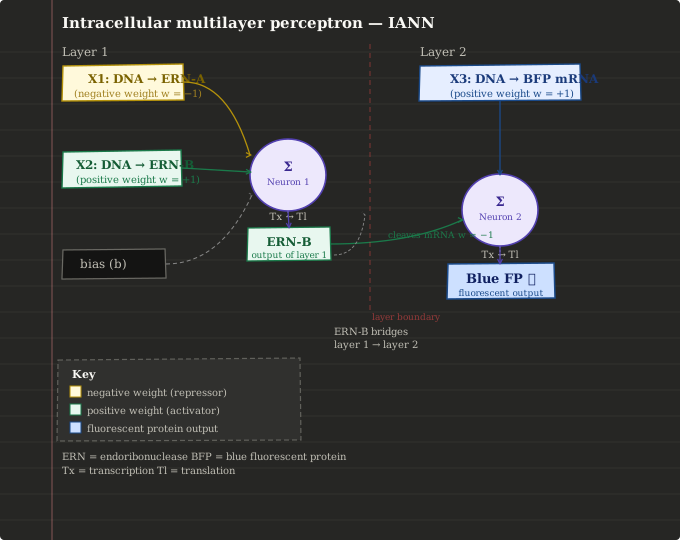
- Layer 1: Takes inputs $X_1$ and $X_2$ (DNA-encoded regulators) and a bias. Their weighted sum drives the production of an endoribonuclease (ERN-A).
- Layer 2: Uses the ERN-A from Layer 1 as a negative weight (it cleaves the mRNA of the output) and integrates it with a third input, $X_3$.
- Output: The final fluorescent protein reflects a cascaded computation, allowing for a more complex “decision boundary” than a single-layer model.
Assignment Part 2: Fungal Materials
1. Existing Fungal Materials: Use Cases, Pros, and Cons
Fungi provide a versatile range of materials that can replace traditional plastics and leathers.
| Material | Use Case | Advantages | Disadvantages |
|---|---|---|---|
| Mycelium Composites (MBCs) | Packaging foam, insulation, acoustic panels. | Low carbon footprint, fully compostable, fire-resistant. | Low mechanical strength; absorbs water/moisture. |
| Myco-leather | Sustainable fashion (e.g., Mylo™). | 50% lower $CO_2$ footprint than animal leather; high toughness. | High production consistency is hard to maintain. |
| Fungal Chitosan | Medical wound dressings. | Biocompatible, biodegradable, and shellfish-allergen free. | Requires strict regulatory approval; high cost at small scales. |
2. Genetic Engineering in Fungi
What I would engineer: I’d want to engineer filamentous fungi (like Aspergillus) to secrete human growth factors (e.g., BMP-2) for bone and dental tissue regeneration.
Why Fungi over Bacteria?
- Eukaryotic Processing: Fungi have the Golgi and ER needed to perform post-translational modifications (like glycosylation and disulfide bonding). Bacteria like E. coli often fail at this, leaving proteins unfolded or inactive.
- High Secretion Capacity: Industrial fungi are powerhouses; they can secrete up to 100 g/L of protein, which is far beyond what most bacterial systems can do.
- Safety: Fungi don’t produce endotoxins, making the purification process for medical-grade human proteins much simpler and safer.
Final Project: DNA Design & Backbone Documentation
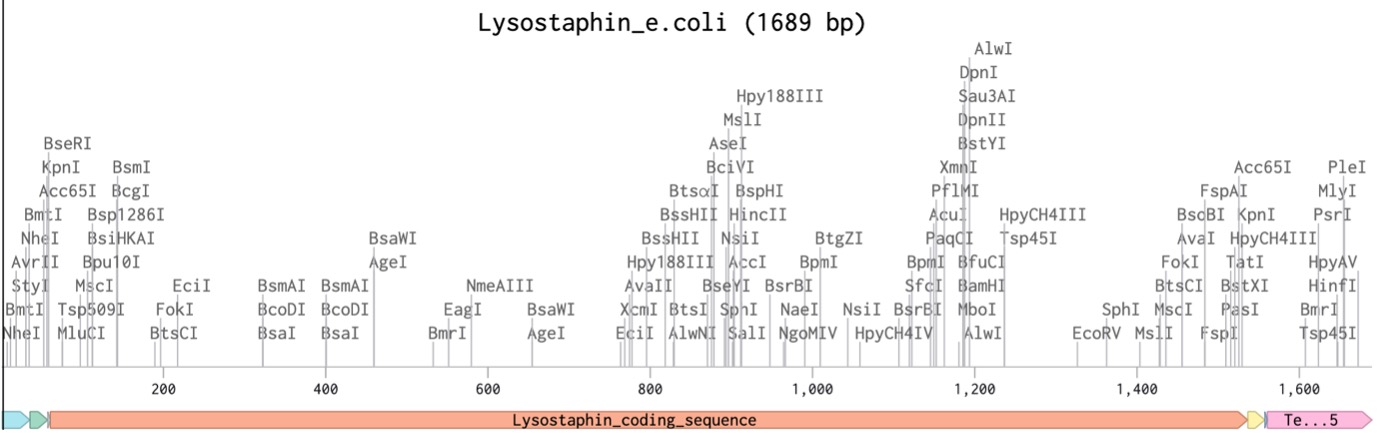
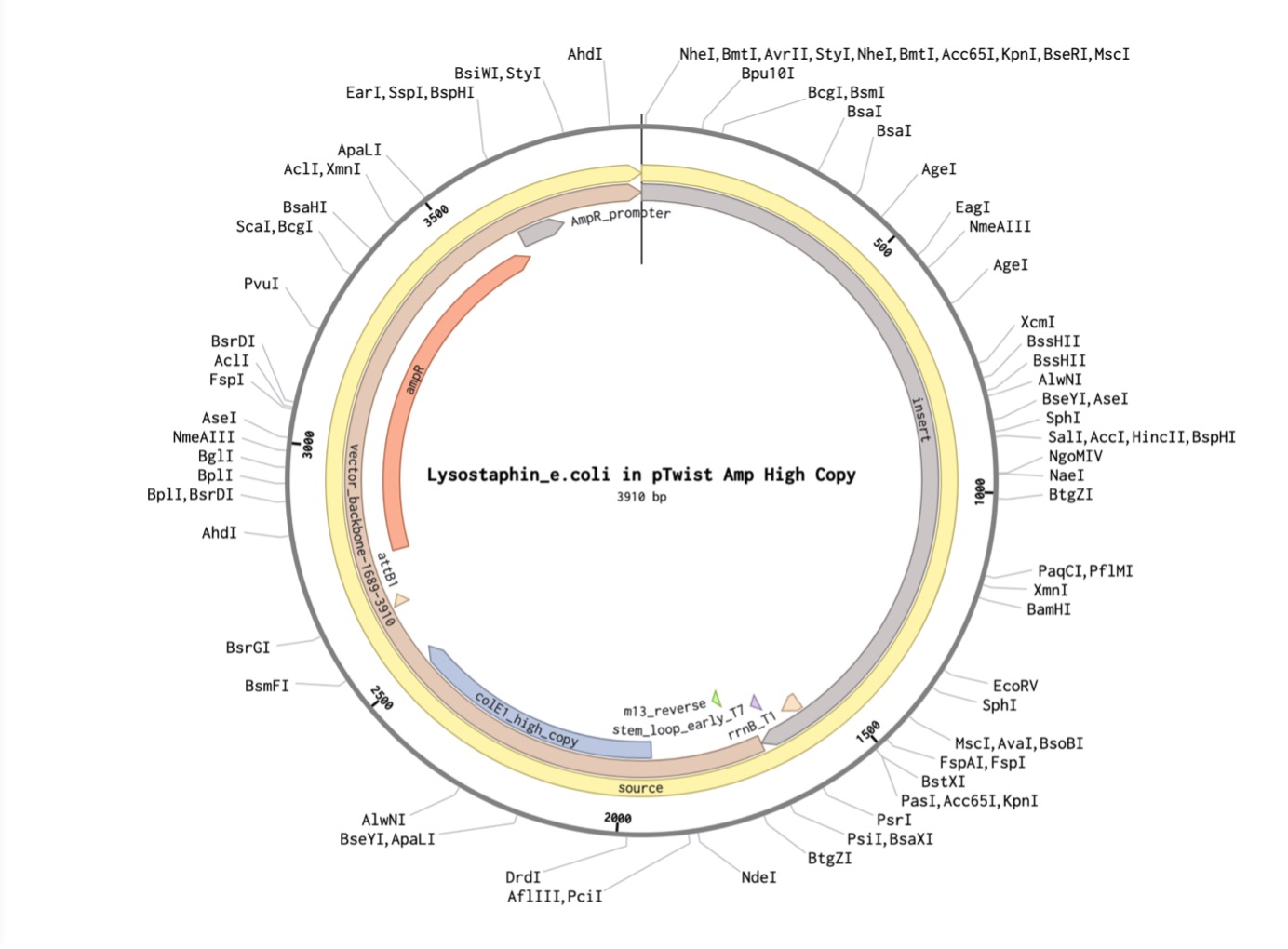
Backbone Vector Details
The insert sequence will be synthesized and cloned into the pET28a expression vector, obtained from Addgene.
Key Features of pET28a:
- Promoter: Carries a T7 promoter for high-level, IPTG-inducible expression.
- Selection Marker: Includes a kanamycin resistance cassette for reliable bacterial selection.
- Purification Tag: Features an N-terminal His-tag, allowing for efficient protein purification via IMAC (Immobilized Metal Affinity Chromatography).
Experimental Context:
This backbone is widely validated for recombinant protein production in E. coli BL21(DE3) and is directly compatible with the final project’s experimental aim. By using this standardized vector, I ensure that the synthesized DNA can be expressed and verified using established laboratory protocols.
Progress Checklist for March 20 Deadline:
- Draft Aim 1 and Project Summary.
- Select HTGAA Industry Council members.
- Shared Benchling/Kernel folder created.
- Insert sequence designed and uploaded to shared folder.
- Backbone vector documented (above).