Week 3 HW: Lab Automation
Assignment: Python Script for Opentrons Artwork:
For this assignment I wanted to draw something that’s representative of me, I really like chemistry, so I wanted to draw a test tube at first :)I thought to myself that it would be so lame to if it was just straight up a test tube, I tried to tilt it a little bit and to add some bubbles using different shades, I realized quickly however that I don’t know how to draw a curve nor a tilted line :(

This was the image I tried to use
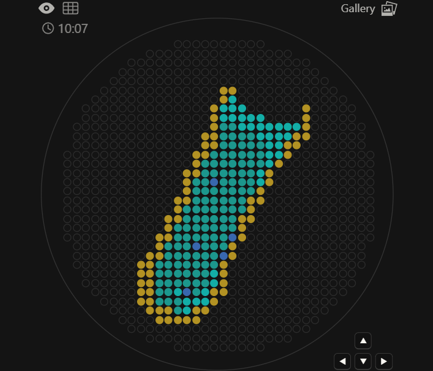
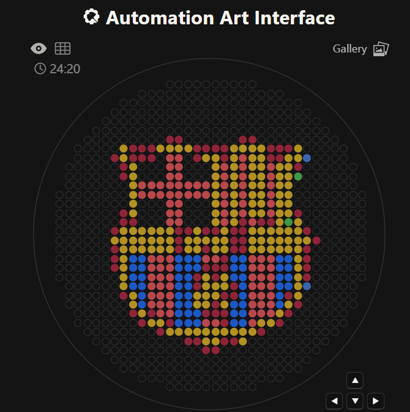
And this was the closest that I’ve got to what was on my mind, I decided to move on to try another design (rip test tube), but I still wanted something that’s colorful, So, I decided to draw the FC Barcelona logo, and it was wonderful, the art resembled the logo pretty much from the first attempt, but there was room for improvement
And after some tweaks, this was the final result
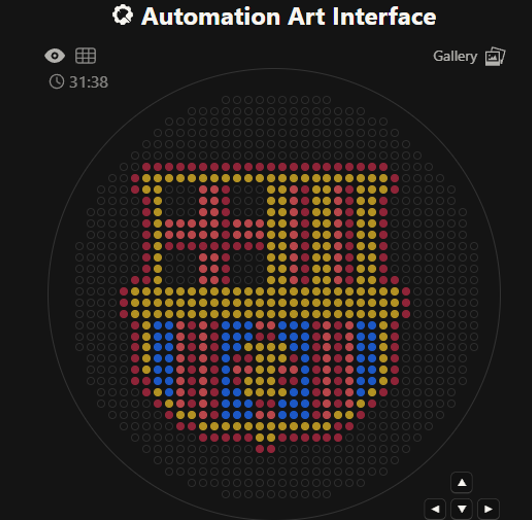
I was satisfied with the result, but I still want to smoothen the curves, and honestly, I was just spamming different shades with no reason, If I were to redo this task, I would look up first how to do proper shadowing, this was really fun which I didn’t think I would enjoy this much!
Now, to the not very fun part, the coding, I tried to use Gemini to help with the code, but it wasn’t very easy, and I started this task late unfortunately, so I had to settle with the script downloaded from the website
Post-Lab Questions:
Find and describe a published paper that utilizes the Opentrons or an automation tool to achieve novel biological applications.
Write a description about what you intend to do with automation tools for your final project.
For my 2nd and 3rd ideas, I would like to use the automation tools to iterate on my designs, as they allow for the testing of many versions at once
Final project ideas:
Daptomycin is one of the important drugs for multi-drug-resistant bacteria, its tedious manufacturing process makes it quite expensive, one of these factors is that one of the substrates fed to the bacteria to synthesize daptomycin is toxic, which is its lipid tail, I propose editing the genetics of S. roseporous, the organism used to synthesize daptomycin, to synthesize it without its lipid tail, and to design a new enzyme responsible for the lipidation process of daptomycin in a cell-free system
Diabetes mellitus is one of the most common diseases in Egypt, there are basically two types, DM1 & DM2, where in the first the liver almost doesn’t synthesize insulin anymore, and in the latter, the insulin receptors are not functioning as they should, the second type can be treated with non-insulin medications, which can be taken orally. However, this is not the case for type 1, which requires insulin, a protein that’s broken down in gastric juices, thus, the most common of administration is through injection, I want to create DNA origami, that has an aptamer that attaches it to the FcRn receptors, allowing it to get into systemic circulation despite its big size, another aptamer would be engineered to allow the release of insulin only in case of hyperglycemia. Major problems facing this project are the DNA origami stability in GIT juices, aptamers design, and insulin loss until it reaches the systemic circulation, which could render it a non-viable product due to economic burden.
Carbon monoxide poisoning is called the silent killer, it has no color, no odor, no warning signs, and it can bind to hemoglobin with 200 times the affinity of that of oxygen, I want to design a genetic circuit to detect carbon monoxide