Week 1 HW: Principles and Practices
Synthetically Grown Natural Indigo: An Inquiry
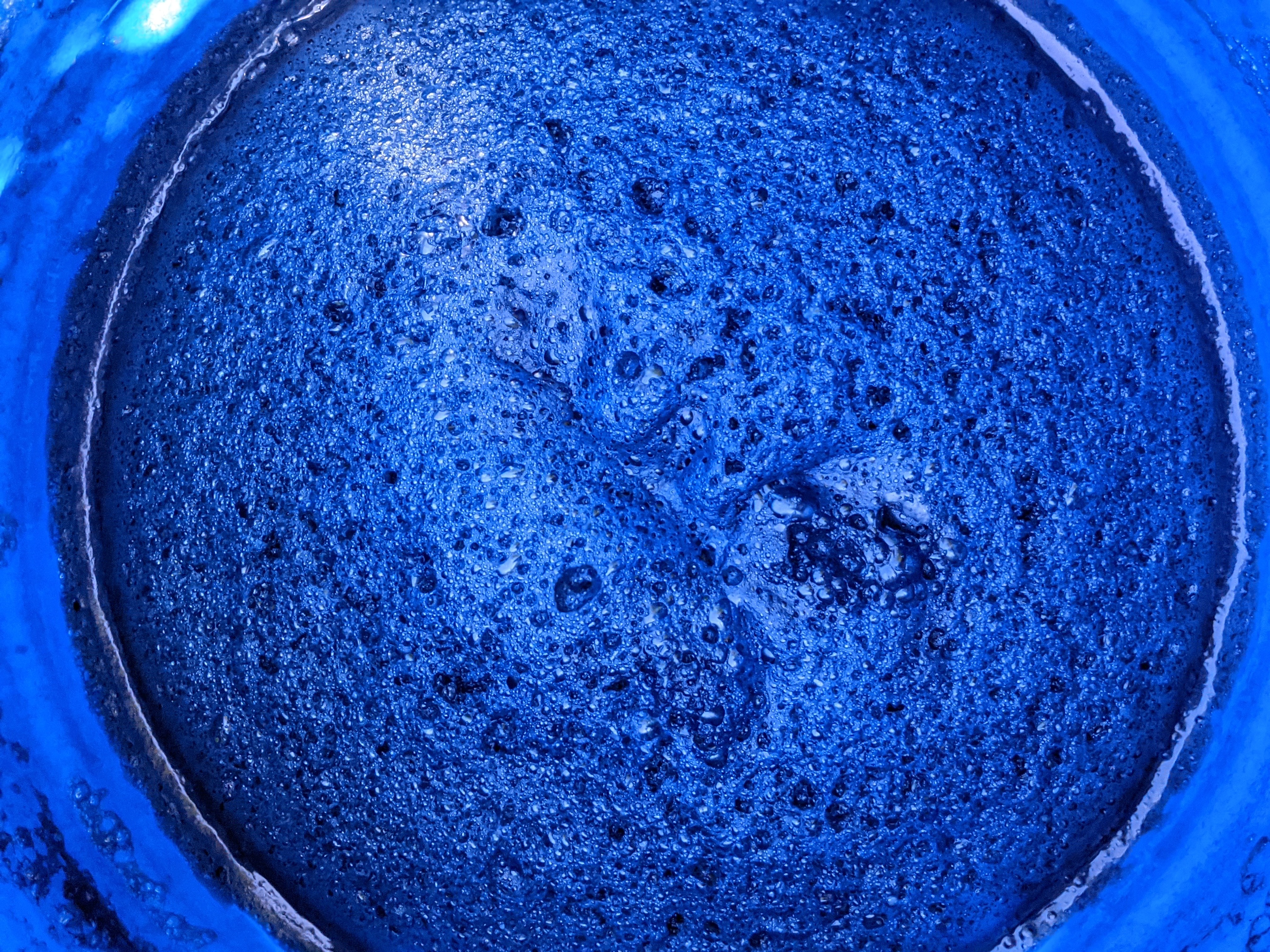
I would like to engineer a bacterium like yeast or E. coli to produce indigo pigment. If this could be achieved, I infer that the scalability of natural indigo production would increase exponentially. This could cut down on water, labor, and space needed for natural indigo production. This process would not be beholden to environmental factors like rain fall, frost prediction, and pest management. Pigment could be produced on an accelerated timeline, as the growth rate for bacteria is much faster than that of bushes or trees; especially when taking into account many indican producing plants need to be started from seed every growing season. Typically natural indigo production yields only two to three harvests per year, and requires labor intensive post processing to return about half of the weight of harvest in usable pigment from aqueous extraction, and slightly less from dried(though it is more shelf stable), (japanese sukomo, west african talaki balls) fermented, then cured indigo this process typically takes three months. These changes could eliminate a pain point that prevents commercial dying endeavours from adopting natural indigo, it’s possible it could decrease the cost of this process significantly.
Goal 1
Produce Indigotin or Indigotin precursors(indican or indoxyl) through the culturing of a genetically modified bacterium in such a way that the pigment can be processed to safely leave the lab, and have skin contact.
Sub-goal 1A:
Investigate the process necessary for removing pigment, or pigment precursors(indican) from the cells, and sterilizing the media.
Find out what the temperature threshold for indigotin is, and if it can be autoclaved without breaking its chemical structure.
Run tests sterilization tests on indigotin that has been processed using traditional methods, and look at preexisting papers that reference these thresholds.
Consider options for fail-safes so organisms cannot survive outside the lab (e.g., nutrient-dependent survival).
Sub-goal 1B:
Ensure that once this material leaves the lab, it is chemically the same form that traditionally processed indigo This will ensure that users applying traditional use methods( i. e. Dying without PPE, exposing their skin to the vat)do not experience any unexpected hazardous reactions. This will also allow for seamless integration into traditional vat dying, disrupting as little of the established process as possible. Ideally, neutralization and disposal methods will remain the same, if the chemical structure is the same- but this requires verification.
Goal 2
Create a pigment that is suitable for the needs of large scale production and small scale artisans.
Sub-goal 2A:
Frame this material approachably for traditional dyers; people coming from a long history of hand craft and indigo processing practices that have been passed down by word of mouth for generations.
Find a way to honor 6000 years of accumulated knowledge and tradition while introducing new methods and systems.
Temper fear and skepticism around synthetic biology - elements of this can happen through branding, other ways may include getting trusted dyers to try this first.
Aboubakar Fofana,
Gasali Adeyemo,
Kathy Hittori,
Catharine Ellis and Joy Boutrup,
Michel Garcia
Sub-goal 2B:
Meet the needs of large companies by reducing pain points in pigment production, increasing profit margins. Speed up pigment production through streamlined lab processes. Reduce labor costs - compare manufacturing time on natural indigo and synthetic indigo timelines. Make sure this process is actually an improved environmental outcome when compared to synthetic indigo production.
Goal 3
Have levels of centralized and decentralized governance over pigment production and distribution.
Sub-goal 3A:
Make sure that dyers have agency over growing their own pigment through community biolabs, fiber shed communities, or preferably at home in a DIY space as they always have previously. Think about yeast - home brewing or bread making, microbiology in the home space. Recognize this as an opportunity to develop agency and understanding around synbio
Sub-goal 3B:
Create a system of governance specifically for large scale production, waste streams and associated use.
Governance Action 1:
Implement a Biosafety Certification Program
Purpose:
Training to ensure that all processed pigment follows strict biosafety standards to prevent accidental release of organisms or harm to users.
Design:
Require pigment to be tested for non-pathogenicity and containment integrity.
Assumptions:
Users may be afraid of pigment derived from bacteria vs. a plant
Risks or Failure:
This process may be more expensive and less accessible than what is currently available
Success: Safe adoption of culturing and pigment processing practices
Governance Action 2:
Require a license for commercial production that uses a standardized SOP - this has restrictions on post processing use as well
Purpose:
Standardize lab protocols for large scale operations that involve more risk, mitigate the use of more environmentally harmful vat types
Design:
Promote safe production and waste disposal, restrict use of more harmful vat types, require responsible neutralization and disposal.
Assumptions:
Companies may try to cut labor and EHS costs in post process application by using iron sulfate and thiourea dioxide vats in conjunction with following poor disposal practices
Risks or Failure:
Companies are less inclined to adopt the new method due to the required restrictions
Success:
Safe adoption of culturing and pigment usage practices
Action 3:
Decentralized education in synbio pigment production
Purpose:
Foster trust, communication, and research exchange, allows artisanal dyers to carry on their own practices in pigment production, opportunities for STEM education
Design:
Traveling workshops using an SOP that is compatible with nontraditional lab spaces(fiber shed, natural dye studios, community labs, etc), creating a protocol that reads more like a recipe than a Lab SOP
Assumptions:
engaging with the preexisting community
Risks or Failure:
Who determines what protocol is used, inadvertent contamination of cultures or containment issues
Other considerations
The current process for producing natural indigo involves growing up indigo producing plants(indigofera tinctoria, persicaria tinctoria, polygonum tinctorium, strobilanthes cusia, Philenoptera cyanescens etc.) at a high volume, and depending on the success of the season, harvesting these plants at maturity 1 - 3 times over the course of the growing season. At each harvest the plants are either taken through an aqueous pigment extraction(this can take up to a week of work, more if the indigo is also washed and dried, as it typically is for high quality pigment) or are dried and processed later through a fermentation and curing process(this typically takes several months, but provides a higher pigment yield). Both processes are time consuming and labor intensive, with limited pigment yield relative to the amount of plant material required to be processed. Both have very sensitive processes, that if performed improperly can result in loss of pigment or degraded yield. The purpose of deriving this pigment from microorganisms is to better integrate natural indigo into the modern market structure, undercutting the need for the more harmful and widely used chemically synthesized indigo pigment derived from petroleum precursors- particularly in the use of thiourea dioxide(thiox) based workhorse indigo vats. These vats are chemically harsh, and are difficult to neutralize.
In order for this new process to be economically successful and environmentally impactful, it would need to be adopted by dye and pigment companies distributing globally. It is important to keep in mind the various communities that already contribute to the prepetuating history of natural indigo such as indeginous communities in Western Africa(Mali, Nigeria, the Yoruba tribe), Japan, China, Korea, Indonesia, India, Vietnam, and many more. Many individuals who carry on this practice today are selling their pigment at very low profit magins, and I have concern that this new method could undercut their profits.
| Does the option: | Option 1 | Option 2 | Option 3 |
|---|---|---|---|
| Enhance Biosecurity | 1 | 2 | 3 |
| • By preventing incidents | 1 | 3 | 2 |
| • By helping respond | 2 | 3 | 1 |
| Foster Lab Safety | 1 | 2 | 3 |
| • By preventing incident | 3 | 2 | 1 |
| • By helping respond | 1 | 3 | 2 |
| Protect the environment | 1 | 3 | 2 |
| • By preventing incidents | 3 | 1 | 2 |
| • By helping respond | n/a | n/a | n/a |
| Other considerations | 2 | 1 | 3 |
| • Minimizing costs and burdens to stakeholders | n/a | 1 | n/a |
| • Feasibility? | 3 | 1 | 2 |
| • Not impede research | 2 | 1 | 3 |
| • Promote constructive applications | 1 | 2 | 3 |
I would prioritize governance options 3 and 1, the reason being, that I believe getting the preexisting communities focused on natural indigo involved and on board, is essential for this process to work ethically. It is essential to develop a safe working practice before bringing this to a community. Together we can develop ways of introducing this secondary method, without shutting out farmers and Indigo Masters. This method can than be optimized and brought to an industrial scale. Working at this level opens up opportunities for integrated education with lessons spanning synthetic biology, chemistry, botany, history, and art. It is important to recognize the impact this could have at a larger scale. There’s a possibility this could be a more water, energy, and labor efficient option than petroleum precursor based synthetic indigo.
Lecture 2 prep
Dr. Jacobson:
Nature’s machinery for copying DNA is called polymerase. What is the error rate of polymerase? How does this compare to the length of the human genome. How does biology deal with that discrepancy? The error rate of polymerase is ~1:10^6. The human genome is ~3.2GBP so when we compare that g= to the error rate of the polymerase, which accounts for 3,200 mistakes in copying DNA. Biology deals with this discrepancy via the MutS repair system.
How many different ways are there to code (DNA nucleotide code) for an average human protein? In practice what are some of the reasons that all of these different codes don’t work to code for the protein of interest? The different ways there are to code for an average human protein is 2^200 which is 1.6eX10. They don’t always work because of codon bias and tRNA availability, so even if the codon is technically correct, it may be made more slowly or more error prone. There can also be errors with translation and misincorporation.
Dr. Le Proust:
What’s the most commonly used method for oligo synthesis currently?
Solid Phase Phosphormedite Chemical Synthesis
Why is it difficult to make oligos longer than 200nt via direct synthesis?
Small inefficiencies compound in a way that makes truncated sequences build up, making it exponentially more error prone and time consuming.
Why can’t you make a 2000bp gene via direct oligo synthesis?
Time, cost and practicality, it is also incredibly like to fail due to error accumulation.
Dr. Church:
[Using Google & Prof. Church’s slide #4] What are the 10 essential amino acids in all animals and how does this affect your view of the “Lysine Contingency”? Histidine (His), Isoleucine (Ile), Leucine (Leu), Lysine (Lys), Methionine (Met), Phenylalanine (Phe), Threonine (Thr), Tryptophan (Trp), Valine (Val), Arginine (Arg)
The lysine contingency is a marker of evolutionary bottle necks, and how we transitioned to the point of no longer making this amino acid in our own bodies.