Subsections of 2026a-radi-khodr
Homework
Weekly homework submissions:
Week 1 HW: Principles and Practices
(Image source : here) Biological Engineering Governance Analysis 1. The Scientific Application General Context Per- and polyfluoroalkyl substances (PFAS) represent one of the most intractable environmental contamination challenges of the 21st century. Comprising over 12,000 synthetic compounds characterized by extraordinarily stable carbon–fluorine (C–F) bonds — among the strongest in organic chemistry (bond dissociation energy ~544 kJ/mol) — PFAS have earned the designation “forever chemicals” for their near-complete resistance to biological, chemical, and photolytic degradation under ambient conditions. Their widespread use in aqueous film-forming foams (AFFF), food packaging, non-stick coatings, and industrial surfactants since the 1940s has resulted in ubiquitous environmental distribution: PFAS are now detectable in Arctic ice cores, deep ocean sediments, human breast milk, and the bloodstreams of wildlife on every continent. 1
Week 2 HW: DNA Read/Write/Edit
My homework Homework Questions from Professor Jacobson: [Lecture 2 slides] Nature’s machinery for copying DNA is called polymerase. What is the error rate of polymerase? How does this compare to the length of the human genome. How does biology deal with that discrepancy? The error rate of a polymerase is 1:10^6 error rate with a 3.2 billion nucleotide in the human genome. In biology, base pairing and proofreading/erro correction mechanisms and layers exist to minimize mutations inside the genome. How many different ways are there to code (DNA nucleotide code) for an average human protein? In practice what are some of the reasons that all of these different codes don’t work to code for the protein of interest? Proteins are strings of amino acids, there are 20 typical amino acids encoded by codons of 3 nucleotides. The genetic material in mRNA is written in codons, a set of specific consecutive triplets of nucleotides. Because RNA contains four different bases (A, U, C, G), there are 4³ = 64 possible codons. These 64 codons are more than enough to specify the 20 amino acids, resulting in some redundancy (multiple codons can code for the same amino acid). Additionally, three special codons function as stop signals that mark the end of the protein sequence. Also That being said, there are an enormous number of possible DNA sequences that can encode the same average human protein due to redundancy in the genetic code. Since most amino acids are encoded by multiple codons, a ~400-amino-acid protein could theoretically be encoded by roughly 3400 (~10190) different DNA sequences. However, in practice, many of these sequences do not work well because synonymous codons affect translation efficiency, mRNA stability and structure, splicing, protein folding, and overall gene expression. So while the amino acid sequence may be the same, the cellular outcome can differ significantly. Homework Questions from Dr. LeProust: [Lecture 2 slides] What’s the most commonly used method for oligo synthesis currently? Chemical synthesis (phosphoramidite method) Why is it difficult to make oligos longer than 200nt via direct synthesis? Why can’t you make a 2000bp gene via direct oligo synthesis? Since oligo synthesis is done by chemical synthesis, bases are added one at a time, increasing the number of errors thus as teh fragment size increases. Thus uligos longer than ~200 nt are difficult because each nucleotide addition has a small error rate, so errors accumulate with length—making direct synthesis of something like a 2000 bp gene impractical due to low yield and high mutation frequency. Homework Question from George Church: [Lecture 2 slides] Choose ONE of the following three questions to answer; and please cite AI prompts or paper citations used, if any.
Subsections of Homework
Week 1 HW: Principles and Practices
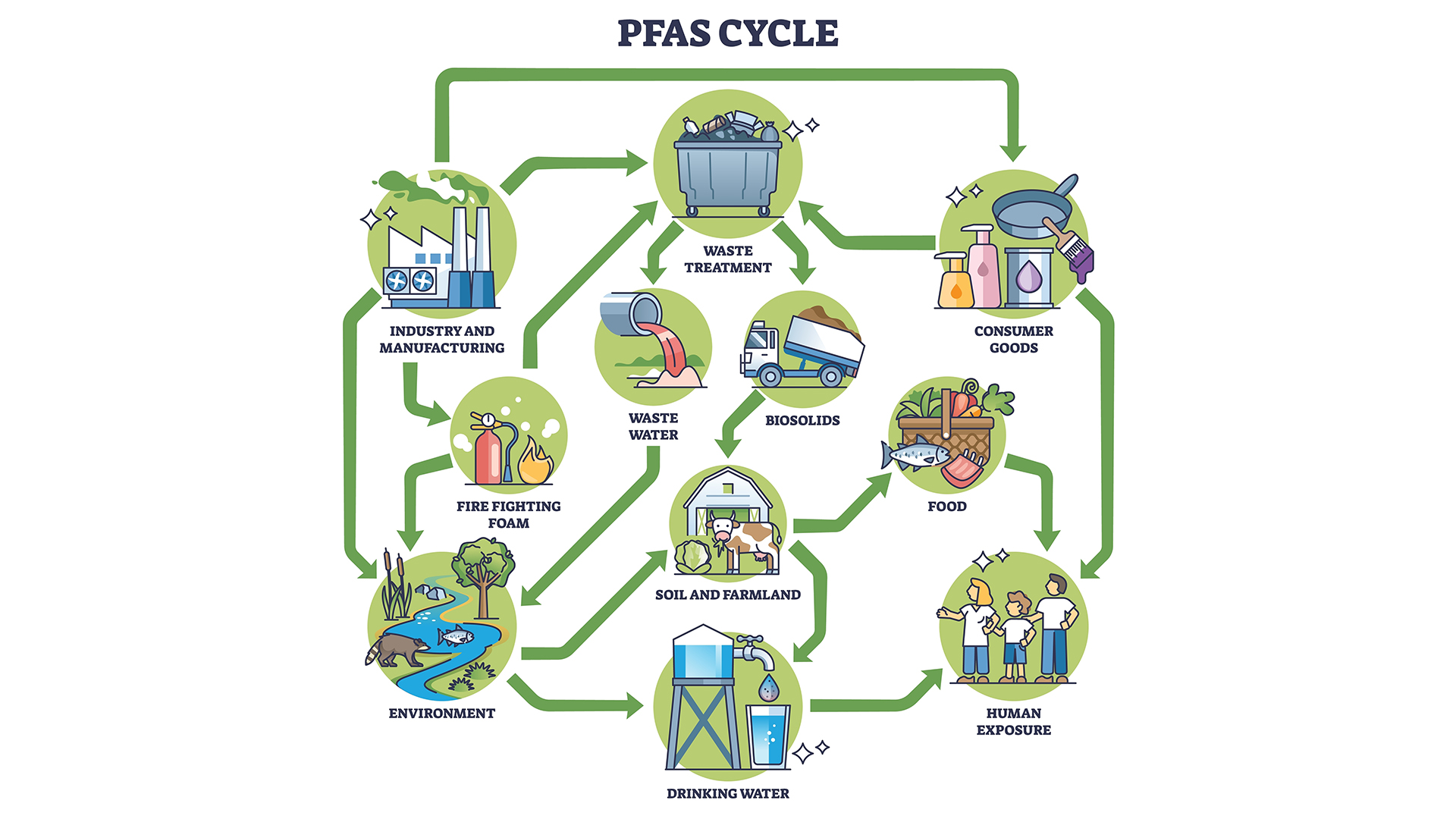 (Image source : here)
Biological Engineering Governance Analysis
1. The Scientific Application
General Context
Per- and polyfluoroalkyl substances (PFAS) represent one of the most intractable environmental contamination challenges of the 21st century. Comprising over 12,000 synthetic compounds characterized by extraordinarily stable carbon–fluorine (C–F) bonds — among the strongest in organic chemistry (bond dissociation energy ~544 kJ/mol) — PFAS have earned the designation “forever chemicals” for their near-complete resistance to biological, chemical, and photolytic degradation under ambient conditions. Their widespread use in aqueous film-forming foams (AFFF), food packaging, non-stick coatings, and industrial surfactants since the 1940s has resulted in ubiquitous environmental distribution: PFAS are now detectable in Arctic ice cores, deep ocean sediments, human breast milk, and the bloodstreams of wildlife on every continent. 1
The purpose and description of the biological application:
In this context, there is a need for PFAS depollution. One specific solution is “Bioremediation”, i.e. the use of biological components for the break-down and degradation of PFAS
2. Governance & Policy Goals
High-Level Governance Goals
- Safety by preventing physical or environmental harm due to the extensive use of PFAS
- Security by preventing the use of PFAS in the future (general ban)
- Equity by allowing global protection from these pollutants and by a distribution of the health/enviornment benefits
- Autonomy by creating solutions that are piloted on a large scale
- Accountability by defining the clear responsible and the payers due the extensive pollution
3. Governance Actions
3.1 Proposed Governance Actions
Describe at least three governance actions. Each action may involve different actors and mechanisms.
1. General Ban of production/use of PFAS
Primary Actor(s):
- [] Academic researchers
- [] Industry / startups
- [] Funders / investors
- Federal regulators
- Law enforcement
- International bodies (US/EU/etc.)
- General opinion / NGOs / Journalists
Purpose
- There is a general direction globally towards banning the use of all PFAS (PFOA and PFOS for instance have been banned years ago), this action takes it one step further.
Design
- Goverments, pressure groups and policy makers should must opt in, and approve/implement this action via national and international legal structures.
Assumptions
- Stakeholders will comply
- Technical enforcement is feasible such as PFAS alternatives
- Incentives align with behavior (polluters pay if they don’t comply for example)
Risks of Failure & “Success”
- Lobbying of multinational companies could make such an action very hard to be implemented
- Effects on essential uses of PFAS (irreplaceable) as well as economic consequences
2. Controlled expression of recombinant proteins or genetically modified strains
Primary Actor(s):
- Academic researchers
- Industry / startups
- Funders / investors
- [] Federal regulators
- [] Law enforcement
- [] International bodies (US/EU/etc.)
- General opinion / NGOs / Journalists
Purpose
- Finding the strain or protein of interest capable of degrading PFAS implies the possibility of using genetically modified material.
- The environmental sovereignty control on waste treatement
Design
- Researchers, entrepreneurs and innovators should assess the feasability of such a project as well as the future implementation in an industrial setting (e.g. for wastewater or soil treatement)
Assumptions
- The scientific burden is feasible (PFAS are well-known to be very recalcitrant)
- Protein production or bacterial culture is safe and economically advantageous
- The general opinion and public laws is favorable for such an application using GMOs
- Public and private funds accessible for such applications
Risks of Failure & “Success”
- The experimental engineering and cash burn in terms of research & development of the application in a certain time frame
- Blocus of the developement and commercialization of such an application due to local or international laws
- Use of such engineered biological material causes more harm than good
3. Build dedicated trust fund
Primary Actor(s):
- Academic researchers
- Industry / startups
- Funders / investors
- Federal regulators
- Law enforcement
- International bodies (US/EU/etc.)
- General opinion / NGOs / Journalists
Purpose
- Funding the research for PFAS depollution
“Pollution from PFAS could cost €440 billion on the European Union by 2050, if current contamination continues unchecked” 2
Design
- All bodies from researchers to public actors should discuss, exchange and collaborate to fund projects aiming for the depollution of PFAS.
- Comprehensionof the value chain of PFAS remediation (such as public bodies for law enforcement, investors for fundraising, researchers and industrials for technologies like seperation and destruction of PFAS)
Assumptions
- The scientific burden is feasible (PFAS are well-known to be very recalcitrant)
- Protein production or bacterial culture is safe and economically advantageous
- The general opinion and public laws is favorable for such an application using GMOs
Risks of Failure & “Success”
- The experimental engineering and cash burn in terms of research & development of the application in a certain time frame
- Blocus of the developement and commercialization of such an application due to local or international laws
4. Governance Matrix
4.1 Governance Action vs. Policy Goals
Score each governance action against the policy goals.
Scoring Key:
- 1 = Strong contribution
- 2 = Moderate contribution
- 3 = Weak contribution
- N/A = Not applicable
| Ban of PFAS | Engineer biological material | Trust Fund | |
|---|---|---|---|
| Enhance Biosecurity | 1 | 3 | N/A |
| Foster Lab Safety | 1 | 3 | 3 |
| Protect the environment | 1 | 1 | 1 |
| Other considerations | |||
| • Minimizing costs and burdens to stakeholders | 3 | 3 | 1 |
| • Feasibility? | 3 | 1 | 1 |
5. Prioritization & Recommendation
5.1 Preferred Governance Strategy
Top Priority Action(s):
- [A] Engineer biological material
- [B] Trust Fund
- [C] Ban of PFAS
Rationale:
This option allows to advantage on the scientific level and bypassing the regulatory and legal hurdles that can frain the developement of scientific applications. Debates are still being done at a national and international levels concerning the feasibility and necessity of banning PFAS and even some experts argue that such a generalistic decision could do more harm than good by ignoring the fact that some PFAS are needed and they aren’t all troublesome.
5.2 Trade-offs and Uncertainties
Key Trade-offs Considered:
- Faster reaserch on the cost of safety concerning public disposal of engineered proteins/strains
- Distributed action but centralized governance with a worldwide consensus is needed at the policy-making level
- Equity can be somewhat affected as citizens near chemical factories for example are more subject for the health effects than the whole population, whereas the efficiency of bioremediation is seen in waste treatement facilities
References
- Glüge, J. et al. A1. Glüge, J. et al. An overview of the uses of per- and polyfluoroalkyl substances (PFAS). Environ. Sci.: Processes Impacts 22, 2345–2373 (2020). An overview of the uses of per- and polyfluoroalkyl substances (PFAS). Environ. Sci.: Processes Impacts 22, 2345–2373 (2020).
- https://aragorn-horizon.eu/counting-the-cost-of-pfas-pollution-a-growing-bill-for-europe/
Week 2 HW: DNA Read/Write/Edit
My homework
Homework Questions from Professor Jacobson: [Lecture 2 slides]
- Nature’s machinery for copying DNA is called polymerase. What is the error rate of polymerase? How does this compare to the length of the human genome. How does biology deal with that discrepancy?
- The error rate of a polymerase is 1:10^6 error rate with a 3.2 billion nucleotide in the human genome. In biology, base pairing and proofreading/erro correction mechanisms and layers exist to minimize mutations inside the genome.
- How many different ways are there to code (DNA nucleotide code) for an average human protein? In practice what are some of the reasons that all of these different codes don’t work to code for the protein of interest?
- Proteins are strings of amino acids, there are 20 typical amino acids encoded by codons of 3 nucleotides. The genetic material in mRNA is written in codons, a set of specific consecutive triplets of nucleotides. Because RNA contains four different bases (A, U, C, G), there are 4³ = 64 possible codons. These 64 codons are more than enough to specify the 20 amino acids, resulting in some redundancy (multiple codons can code for the same amino acid). Additionally, three special codons function as stop signals that mark the end of the protein sequence. Also That being said, there are an enormous number of possible DNA sequences that can encode the same average human protein due to redundancy in the genetic code. Since most amino acids are encoded by multiple codons, a ~400-amino-acid protein could theoretically be encoded by roughly 3400 (~10190) different DNA sequences. However, in practice, many of these sequences do not work well because synonymous codons affect translation efficiency, mRNA stability and structure, splicing, protein folding, and overall gene expression. So while the amino acid sequence may be the same, the cellular outcome can differ significantly.
Homework Questions from Dr. LeProust: [Lecture 2 slides]
- What’s the most commonly used method for oligo synthesis currently?
- Chemical synthesis (phosphoramidite method)
- Why is it difficult to make oligos longer than 200nt via direct synthesis? Why can’t you make a 2000bp gene via direct oligo synthesis?
- Since oligo synthesis is done by chemical synthesis, bases are added one at a time, increasing the number of errors thus as teh fragment size increases. Thus uligos longer than ~200 nt are difficult because each nucleotide addition has a small error rate, so errors accumulate with length—making direct synthesis of something like a 2000 bp gene impractical due to low yield and high mutation frequency.
Homework Question from George Church: [Lecture 2 slides]
Choose ONE of the following three questions to answer; and please cite AI prompts or paper citations used, if any.
- [Using Google & Prof. Church’s slide #4] What are the 10 essential amino acids in all animals and how does this affect your view of the “Lysine Contingency”?
- Until now, essential amino acids (EAAs) are defined as AAs whose carbon skeletons are insufficiently or not synthesized in a de novo manner by animal cells relative to metabolic needs. EAAs are Cysteine, Histidine, Isoleucine, Leucine, Lysine, Methionine, Phenylalanine, Threonine, Tryptophane, Tyrosine, and Valine. The lysine contingency is a description of an attempt to control the uncontrollable. A researcher genetically edited organisms to make them lysine deficient, the idea behind it as a security to control animals. If the latter weren’t supplied with this specific amino acid they would cease to exist. However, this in reality doesn’t matter as these animals can be able to find food sources rich in lysine and survive.
- [Given slides #2 & 4 (AA:NA and NA:NA codes)] What code would you suggest for AA:AA interactions? •
- [(Advanced students)] Given the one paragraph abstracts for these real 2026 grant programs sketch a response to one of them or devise one of your own: https://arpa-h.gov/explore-funding/programs/boss https://www.darpa.mil/research/programs/smart-rbc https://www.darpa.mil/research/programs/go