Week 1 HW: Principles and Practices
1. A biological engineering application or tool I want to develop and why:
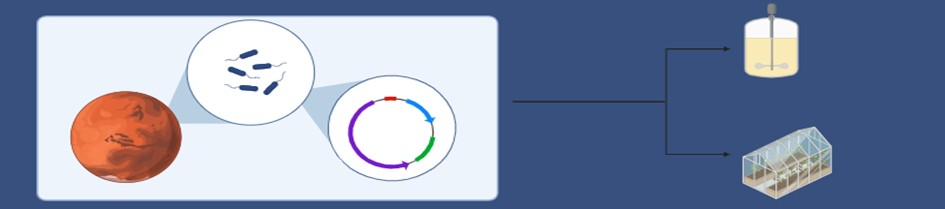
I want to develop an engineered consortium of microorganisms for pilot-scale biomanufacturing on Mars. The microbes will be engineered for self-sufficent surival subject to the multitude of constraints of the red planet.
This insitu resource utilization (ISRU) will be a key step towards the goal of the eventual colonization of Mars, by reducing the import from Earth. The current methods of ISRU, although in their rudimentary stages, rely on high energy chemical conversion process. My application aims at providing an alternative to this, and pave way for sustainable biomanufacturing away from the Earth.
2. Governance/policy goals related to ensuring that this application or tool contributes to an “ethical” future, like ensuring non-malfeasance (preventing harm):
Goal 1- Prevention of forward contamination: Great care must be ensured in making sure that only the right microorganisms will colonize the desired niche. Since this may very well fit into the definition of ‘forward contamination,’ a thorough conformation of the non-existence of native Martian microbes shall guide the policy decision. International collaboration is going to be of prominence, because this goal will be of no consequence if even one of the space-capable nation refuses to abide by this.
Goal 2- Address dual use concerns: It is inevitable that any microbe that has been engineered to tolerate Martian conditions would have multiple survival mechanisms that grant it an upper hand over its Earthen coutnerparts.Therefore, any type of microorganism that may even remotely prove to be pathogenic to humans must be avoided at all costs.
Goal 3- Level playing fields: Monopolies and oligopolies should be prevented to the largest possible extent, especially in the early days of the settlement plan. If such imbalanced playing fields get established, it will stiffle innovations for generations to come by restricting know-hows and resources.
3. Next, describe at least three different potential governance “actions” by considering the four aspects below:
3.1 Technical Goverenance: The policy must ensure that whoever wants to set up biomanufacturing on Mars has suitably demonstrated the presence of kill switches (auxotrophic, toxin-anti-toxin etc.) to prevent accidental release into the environment. Completely orthogonal biological systems may be used in place of kill switches, but given today’s biotechnology, the former is more likely than the latter.
Purpose: To prevent forward contamination.
Design: Genetic circuits can be embedded with toxic-anti-toxic systems like CcdB-CcdA, MazF-MazE, and hok-soc etc. Strains auxotrophic for Glucosamine-6-phosphate Synthase ((\Delta glmS)) can be used as auxotrophic chassis organisms.
Assumptions: The assumptions here would be that the strain will not bypass these kill-switches by any means, and also these kill-switches will not interefere with the organisms’ ability to synthesize the product of interest.
Risks of Failure & Success: Failure to meet these parameters may lead to forward contamination, preventing the study of ‘pristine’ Martian grounds. However, the success in this context would not be permanent and require repeated peroidic demonstrations. There is also the possibility of false trigerring of kill-switch, leading to a wasted batch of products.
3.2 Regulatory Governance: A system to inventory and track all the organisms, genetic components, and manufacturing methods becomes important. This will provide a starting point to study the evolution of the microorganisms that might arise in the future. A high degree of match to the inventoried parts can help rule out any fasle-positivity regarding native Martian microbe claims.
Purpose: To track any suspicious new microbes in the vicinity and beyond.
Design: A robust inventory software, and the adherence of the players to documentation.
Assumptions: All the players will abide by the regulations, and will not send any undocumented organisms to gain a competitive edge.
Risks of Failure & Success: Failure would mean lots of undocumented and potentially unsafe microorganisms on Mars. It would also prevent any means of studying weather Mars had evolved any microbes independent of the Earth. On the other hand, a policy that is too transparent will hinder intellectual property safeguard.
3.3 Economic Incentive Governance: For this, I envision a system of “Biosecurity Bonds.” Any entity that wants to carry out biotechnology research on Mars would need to furnish a bond of a certain amount (probably in millions of dollars). If, after a period of time, no contamination can be established, the amount is refuned. If any contamination is found, the bonded amount can be utilized to ameliorate the spread.
Purpose: To incentivize players to adhere to high standards of biosecurity.
Design: A techno-legal framework in the form of an international treaty or agreement, among all the spacce-faring nations and also similar incentives at national level.
Assumptions: None of the players will take this bond as an opportunity to “pay to pollute” and think that forfeiting the bond amount is cheaper than adhereing to the standards of biosecurity.
Risks of Failure & Success: Failure can lead to an incentiveless, haphazard business models, that would aim towards establishing monopolies for profit. If this aspect is successfully governed, then there is still the risk of wealthy corporations outcompeting the not-so-wealthy ones.
4. Score (from 1-3 with, 1 as the best, or n/a) each of your governance actions against the rubric of policy goals.
| Does the option: | Option 1 | Option 2 | Option 3 |
|---|---|---|---|
| Planetary Protection (forward) | 1 | 3 | 3 |
| • By preventing incidents | 1 | 2 | 1 |
| • By helping respond | 1 | 3 | 1 |
| Biosafety | 1 | 3 | 1 |
| • By preventing incident | 1 | 3 | 1 |
| • By helping respond | 1 | 3 | 1 |
| Redundancy and backup plans | 1 | 2 | 1 |
| • By preventing incidents | 1 | 3 | 2 |
| • By helping respond | 3 | 1 | 1 |
| Other considerations | |||
| • Minimizing costs and burdens to stakeholders | 2 | 3 | 3 |
| • Economic feasibility | 3 | 2 | 3 |
| • Not impede research | 2 | 3 | 3 |
| • Promote constructive applications | 1 | 1 | 1 |
5. Drawing upon this scoring, describe which governance option, or combination of options, you would prioritize, and why. Outline any trade-offs you considered as well as assumptions and uncertainties.
Based on these parameters, I would priortize option 1, i.e, Technical Governance, and option 2, Economic Incentive Governance. Both of these would go hand in hand to cover the technical and the financial safeguards agianst the forward contamination, establishment of monopolies, and an imbalanced playing fields. However, the main trade off in not prioritizing option 2, i.e., regulatory governing would be the existence of loopholes to evade accountability. The uncertainty of non-adhering players will always remain as a looming threat in establishing a stable policy towards extraterrestrial resource utilization.
Homework questions from Dr. LeProust:
- What’s the most commonly used method for oligo synthesis currently?
Solid phase phosphoaramidite method is the most widely used method to synthesize oligonucleotides. Nucleoside phosphoramidites are used as the precursor molecules. It proceeds through 4 steps:
- Detritylation: dimethoxytrityl group is removed from the 5’ end of the last nucleotide attached to the support using triacetic acid, activating the -OH group.
- Coupling: Phosphoaramidite monomers are added along with an activator (usualy tetrazole), that protanates the phosphoaramidite. Now, the 5’ hydroxyl end of the growing chain can form a phosphite triester linkage at the 3’ phosphorous.
- Oxidation: The unstable phosphite triester linkage is oxidized using iodine solution form a stable phosphate triester bond.
- Capping: Once the required number of nucleotides have been synthesised using the above 3 steps, the unreacted 5’ ends are capped using an acetylation mix of acetic anhydride and N-methylimidazole. This is done to prevent wrong reactions in further cycles.
Why is it difficult to make oligos longer than 200nt via direct synthesis?
If oligos are synthesized using phosphoaramidite method, the yield follows the equation Y = $C^{n}$; where Y is the yield %, C is the coupling efficiency, and n is the number of couplings. A diakósiamer (200mer) will have 199 couplings. This implies, even with a success rate of 99%, the yield would be $0.99^{199}$, which is around 13.5%. The rest of the sequences would be truncated at random lenghts less than 200 bps.Why can’t you make a 2000bp gene via direct oligo synthesis?
Using the same equation as above, we get the yield of only 1.88 * $10^{-7}$ percent, which is as good probability as nil in order to synthesize a 2 kb gene.
Homework Questions from Professor Jacobson:
Nature’s machinery for copying DNA is called polymerase. What is the error rate of polymerase? How does this compare to the length of the human genome. How does biology deal with that discrepancy?
DNA polymerarases are accurate with upto $10^{−6}$ mutations/bp. Since human genome is around 3.2 * $10^{9}$ bp long, it would imply 3200 mutations per generation. Biology deals with this descrepancy by having a multitude of proofreading mechanisms like 3’-5’exonuclease activity in the polymerase that cleaves incorrect nucleotides, mismatch repair post replication where a protein complexes can recognize the template strand and the newly-synthesized strand due to the presence of nicks in the latter, and cleave the ‘wrong’ base pairs. Then, DNA ligase joins the correct nulceotides.How many different ways are there to code (DNA nucleotide code) for an average human protein? In practice what are some of the reasons that all of these different codes don’t work to code for the protein of interest?
Considering an average protein to be 375 amino acids long, and each amino acid requiring 3 codons, there can be $3^{375}$ DNA sequences for an average protein. But in reality, the number of translatable codon is limited by the properties of mRNA and the availability of tRNA. Certain DNA sequenes transcript into an mRNA that will have haripin loop, tendency to form dsRNA and other difficult-to-translate structures. And also, the translational machinery possesses a limited number of tRNA, which is the limiting factor for the number of amino acids that can be translated, and thus protein that can be synthesized.
Homework Questions from George Church:
- What are the 10 essential amino acids in all animals and how does this affect your view of the “Lysine Contingency”?
The nutritionally essential amino acids in all animals are: Cystine, Leucine, Lysine, Methionine, Histidine, Phenylalanin, Tyrosine, Threonine, Tryptophan, and Valine. Since lysine is already an essential amino acid, meaning, it cannot be synthesized by reptiles on their own, lysine contingency does not make any sense. It can be easily obtained by feeding on the plant matter, and the orgnaisms that feed on the plant matter, readily. The scientists of the Jurassic Park were better off in making the dinosaurs auxtorphic to certain enzymes that are very much necessary for metabolic reactions.
References:
https://www.khanacademy.org/science/biology/dna-as-the-genetic-material/dna-replication/a/dna-proofreading-and-repair
https://bionumbers.hms.harvard.edu/bionumber.aspx?s=n&v=4&id=106445
https://pmc.ncbi.nlm.nih.gov/articles/PMC4150459/
https://www.bocsci.com/resources/principles-of-phosphoramidite-reactions-in-dna-assembly.html
Write up of webpage personalization
- Feb 8, 2026: Added a profile photo
- Feb 8, 2026: Replaced template bio with my own background.
- Feb 8, 2026: Added my contacct details.
- Feb 9, 2026: Initial draft uploaded (Homework 1)
- Feb 10, 2026: Added content for the Professors’ questions
- Feb 10, 2026: Added math: true tag, tested equations.
- Feb 10, 2026: Edited all the homeworks for clarity
- Feb 10, 2026: Added References section with four sources.