Week-07-HW-genetic-circuits-part-ii
Assignment Part 1: Intracellular Artificial Neural Networks (IANNs)
What advantages do IANNs have over traditional genetic circuits, whose input/output behaviors are Boolean functions?
- They can interpret a range of inputs as opposed to the 0, 1 inputs of traditional genetic circuits. This allows them to aggregate multiple signals and apply the activation fucntion to filter biological noise.
- Traditional circuits often require a cascade of genetic logic gates, which lead to metabolic burden and competition for substrates. By utilizing weighted interactions, IANNs can accomplish the same task using fewer biolocial components.
- Nonlinear descision making is a struggle for tradional genetic circuits. They struggle to take into accout the relative ratios and thresholds of a multitude of proteins simultaneously, limiting themselves to simple linear logics. However, using ReLU and sigmoid -like activation behaviours, IANNs can perform complex tasks. Eg: A cell may be engineered to apoptosize only when a commplex profile of cancer markers are met, as oppossed to the presence of some of those markers that may not be cancerous.
Describe a useful application for an IANN; include a detailed description of input/output behavior, as well as any limitations an IANN might face to achieve your goal.
A useful applicaiton of IANN would be rapid plant cell response when it is infected by a pathogen.- Input 1: Detection of Pathogen Associated Molecular Patterns. Chitin would be a good choice given that fungi are the most damaging plant pathogens.
- Input 2: Detection of Plant Stress Volatiles like Methyl Salicylate. This adds one more layer of confirmation that the plant is under attack.
- Input 3: Detection of Effector Proteins like Avr4 that are used by fungi to protect itself fromm plant defense mechanisms.
- Different weights need to be assigned for different inputs. In this case, input 3 may be given more weightage compared to input 1.
- The output may be in the form of a targeted release of antifungal peptide or apoptosis.
Draw a diagram for an intracellular multilayer perceptron where layer 1 outputs an endoribonuclease that regulates a fluorescent protein output in layer 2.
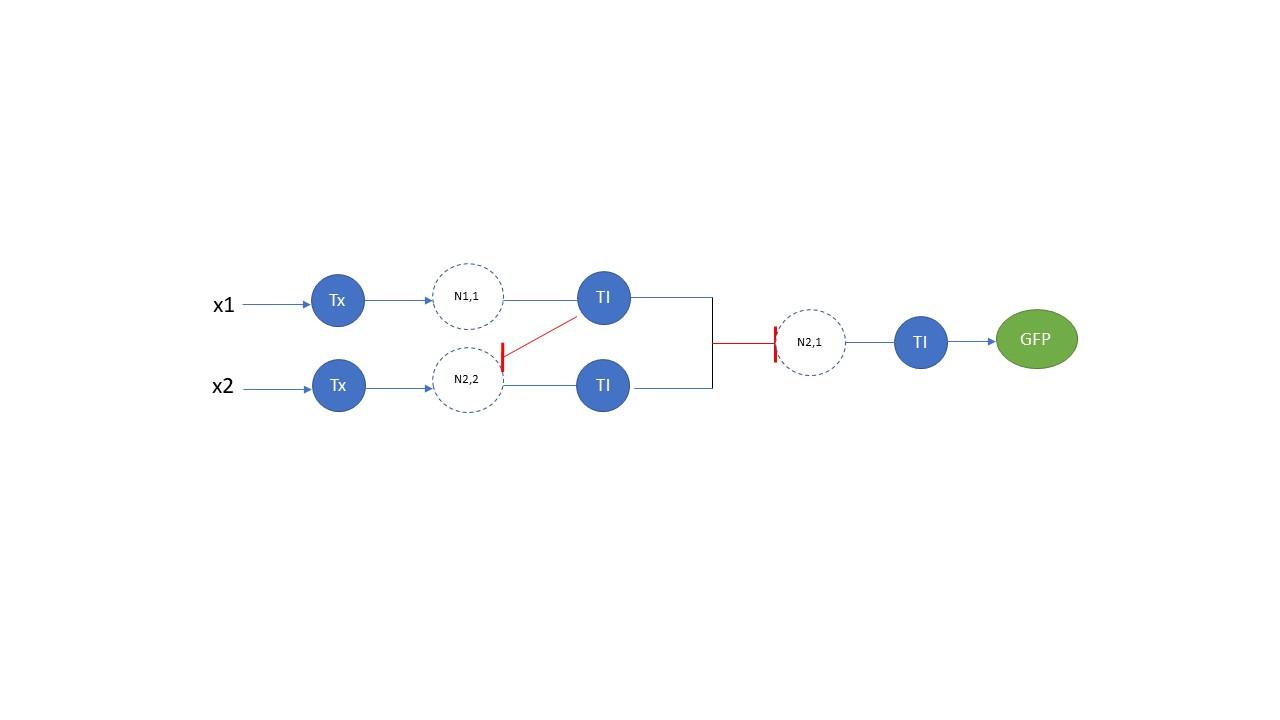
Assignment Part 2: Fungal Materials
What are some examples of existing fungal materials and what are they used for? What are their advantages and disadvantages over traditional counterparts?
- Mycelium Leather: A sustainable alternative to traditional leather. Unlike the latter, it can be produced in as little as 5 days, and is biodegradable too. It can be treated with different chemicals to make it waterproof, weatherproof, and damage resistant. The chief disadvantage is that it is less robust than the animal-based ones and since it requires a controlled enviornment, the production costs will be on a higher side.
- Mycellium-based composites: Organic wastes, especially agriculture wastes like wood chips, straws etc. are used as substrates to grow the fungi. The fungl mycellium holds the substrate together and the resulting material, after killing the fungi by baking, is called ‘MBC’. It finds its use in numerous fields such as packaging, insulation, construction materials etc. The primary disadvantage is that it is difficult to scale, and therefore, is not cost-effective. Some companies like Evocative, Mycoworks, and Mogu are working on MBCs.
- Martian shelters: NASA is working on a system where the astronauts carry dormant fungi and a mould. When activated with water, the fungi grows around the mould, forming a fully functional human habitat. Prototypes have been built using Ganoderma lucidum, and have shown significant potential for water filtration, bioluminescent lighting, and self-repair. Additionally, pound for pound, mycellium-based builidng materials can outperform concrete in terms of strength.
What might you want to genetically engineer fungi to do and why? What are the advantages of doing synthetic biology in fungi as opposed to bacteria?
Fungi can be better chassis organisms for genetic engineering than bacteria as they possess eukaryotic cell machinery, and are capable of post-translational modificaitons. The latter can be exploited for glycosylation of proteins, especially of antibodies; and phosphorylation and acetylation for protein modification. This, coupled with the fact that they are capable of advanced protein folding makes them the organism of choice to produce complex human proteins.Additionally, fungi have superior secretion capacity that is complemented by compartmentalization. They can sequester toxic intermediates in organelles like vacuoles and peroxisomes and allow the cell to secrete high concentrations of desired chemicals that would have been lethal if it were to be found in cytoplasm. Their superior secretion capacity allows them to produce chemicals in “grams per litres” concentration. Moreover, the chemicals are usually secreted outside the cell, saving us the cost of cell-disruption and simplyfying the purification.
Even the growth requirement of fungi is more robust and adaptive compared to the bacteria. They can be grown on solid substrate with minimal additions, and can tolerate acidic enviornments better.
I would love to engineer fungi to produce biological selenomelanin- a type of melanin that incorporates selenium instead of sulphur. Fungi can be engineered to utilize selenocystine for the bioproduciton of selenomelanin. Also, fungal mycellium can be engineered to produce selenomelanin to proivde superior radiation protection to be used as martian shelters.
Assignment Part 3: First DNA Twist Order
Review the Individual Final Project documentation guidelines. Submit this Google Form with your draft Aim 1, final project summary, HTGAA industry council selections, and shared folder for DNA designs.
- Lorem ipsum
Review Part 3: DNA Design Challenge of the week 2 homework. Design at least 1 insert sequence and place it into the Benchling/Kernel/Other folder you shared in the Google Form above.
- Lorem ipsum
Document the backbone vector it will be synthesized in on your website.
- Lorem ipsum