Week 11-hw-Bioproduction
Part A: The 1,536 Pixel Artwork Canvas | Collective Artwork
1. Contribute at least one pixel to the global artwork experiment before the editing ends on Sunday 4/19 at 11:59 PM EST.
2. On your HTGAA webpage, note:
1. What you contributed to the community bioart project (e.g., “I made part of the DNA on the bottom right plate”). Contriubted 4 different fluorscent proteins in the bottom of the art.
A. 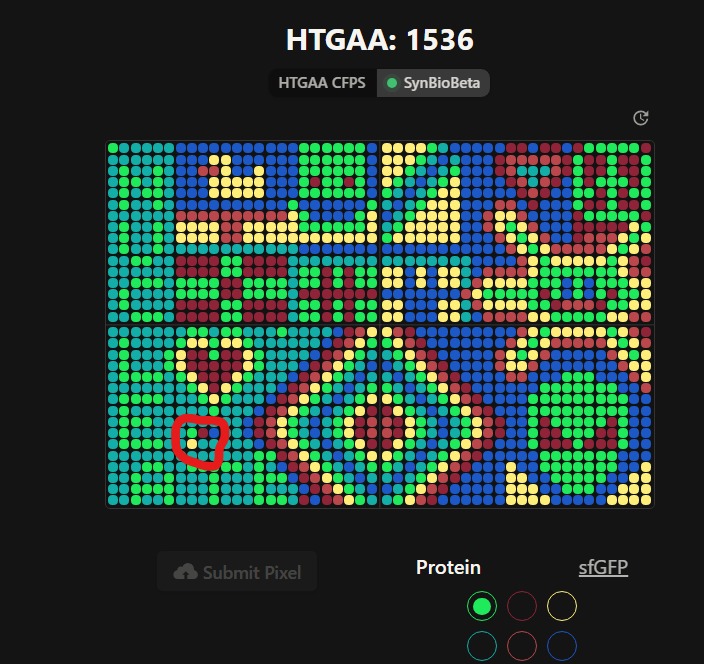
B. 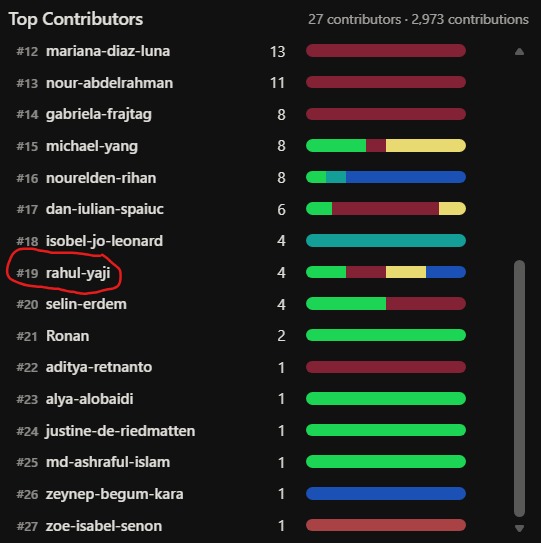
2. What you liked about the project.
The massive collaboration among the committed listener community. I think we had dedicated students from all the continents except anatartica.
3. What could be improved for next year.
The students can be given the opportunity to print it in their nodes.
Part B: Cell-Free Protein Synthesis | Cell-Free Reagents
1. Referencing the cell-free protein synthesis reaction composition, provide a 1–2 sentence description of each component’s role in the reaction:
E. coli Lysate BL21 (DE3) Star Lysate (includes T7 RNA Polymerase): Provides the essential molecular machinery (ribosomes, tRNAs, and enzymes) and T7 RNA Polymerase required for coupled transcription and translation of the target DNA.
Salts/Buffer
Potassium Glutamate: Acts as the primary potassium source and a biocompatible anion that maintains osmotic balance and stabilizes protein-nucleic acid interactions.
HEPES-KOH pH 7.5: Functions as a stable buffering agent to maintain a constant physiological pH, which is critical for enzymatic activity throughout the reaction.
Magnesium Glutamate: Supplies $Mg^{2+}$ ions, which are essential cofactors for ribosome assembly, mRNA stability, and the catalytic function of polymerases.
Potassium phosphate monobasic: Serves as a source of inorganic phosphate and contributes to the acidic component of the phosphate buffering system.
Potassium phosphate dibasic: Acts as the basic component of the phosphate buffer to help stabilize the system and provide additional ionic strength.
Energy / Nucleotide System
Ribose: Serves as a carbon source and a structural backbone precursor for the de novo synthesis of nucleotides.
Glucose: Acts as a primary energy substrate that can be metabolized to regenerate ATP through glycolytic pathways within the lysate.
AMP, CMP, GMP, UMP: These monophosphate nucleotides serve as the building blocks for RNA synthesis and are phosphorylated into active triphosphates (e.g., ATP, GTP) to drive the reaction.
Guanine: Provides a specific purine base precursor to ensure an adequate supply of guanosine nucleotides for transcription and translation initiation.
Translation Mix (Amino Acids)
17 Amino Acid Mix: Provides a concentrated blend of standard amino acids required for the elongation of the polypeptide chain during translation.
Tyrosine: Supplemented separately due to its lower solubility to ensure it reaches the necessary concentration for efficient protein synthesis.
Cysteine: Added individually to prevent its degradation or oxidation and to ensure precise control over disulfide bond formation if required.
Additives
Nicotinamide: Serves as a precursor to $NAD^{+}$ and $NADP^{+}$, which are vital redox cofactors for the metabolic pathways that regenerate energy within the system.
Backfill
Nuclease Free Water: Used to adjust the final volume of the reaction mixture while ensuring no exogenous enzymes degrade the DNA template or RNA products.
Homework Question
Describe the main differences between the 1-hour optimized PEP-NTP master mix and the 20-hour NMP-Ribose-Glucose master mix shown in the Google Slide above. (2–3 sentences) The main difference is in the energy strategy: the 1-hour mix utilizes PEP and NTPs for immediate, high-rate transcription and translation, while the 20-hour mix uses Ribose, Glucose, and NMPs to support a sustained protein production via secondary metabolic pathways. Structurally, the 20-hour mix utilizes Potassium phosphate buffering system and modifies salt concentrations, such as lowering HEPES and slightly increasing Magnesium Glutamate, to optimize for long-term stability rather than initial speed. In contrast, the 20-hour mix simplifies the additive profile by focusing on Nicotinamide for redox balance, while the 1-hour mix requires a broader range of boosters like Spermidine, DMSO, and Folinic Acid.
Part C: Planning the Global Experiment | Cell-Free Master Mix Design
1. For each of the 6 fluorescent proteins used (sfGFP, mRFP1, mKO2, mTurquoise2, mScarlet_I, Electra2), identify and explain at least one biophysical or functional property affecting expression/readout in cell-free systems (1–2 sentences each):
- sfGFP: Exceptionally fast folding kinetics and high thermodynamic stability allow it to mature quickly in the simplified, non-chaperone-rich environment of cell-free lysates.
- mRFP1: While it provides a distinct red readout, it matures slowly gives a lower quantum yield compared to second-generation variants can lead to a delayed or weaker signal in short-duration cell-free reactions.
- mKO2: It features a high molar extinction coefficient and rapid maturation at $37$°C, making it an excellent high-brightness reporter for tracking protein synthesis rates.
- mTurquoise2: This protein possesses a remarkably high quantum yield and long fluorescence lifetime, significantly improving the signal-to-noise ratio in systems with high background autofluorescence.
- mScarlet_I: Extreme brightness and high acid stability make mScarlet-I specifically optimized for efficient folding, which minimizes the formation of non-fluorescent aggregates during high-yield cell-free production.
- Electra2: This variant is engineered for ultra-rapid chromophore maturation, making it the ideal candidate for “real-time” reporting where the delay between translation and fluorescence detection must be kept to a minimum.
2. Create a hypothesis for how adjusting one or more reagents in the cell-free mastermix could improve a specific property to maximize fluorescence over a 36-hour incubation. Clearly state:
- The protein
- The reagent(s)
- The expected effect
To achieve a stable and productive 36-hour “Artwork” incubation, the master mix must not be a flash of lightining- a high-intensity burst of energy- but a sustained lantern of slow-release metabolic states. By significantly increasing the concentration of Ribose and Glucose and also elevating the Potassium Phosphate buffer strength, the system can sustain the secondary metabolism required to recycle NMPs into NTPs over several days. This high-capacity phosphate buffering is essential because the extended metabolic activity generates significant acidic byproducts that would otherwise crash the pH and halt translation within the first few hours. And also, adjusting the Magnesium Glutamate levels upward compensates for the gradual sequestration of magnesium ions by the accumulating inorganic phosphate, ensuring that the ribosomes remain structurally intact and functional for the duration of the long-term protein synthesis. This shift from the immediate energy of PEP-based systems to a precursor-fed ribose system allows for the sustainable production of fluorescent proteins, making it both cost-effective and ideal for biological art that develops over time.