Week 7 HW: Genetic Circuits Part II
Assignment Part 1: Intracellular Artificial Neural Networks (IANNs)
- What advantages do IANNs have over traditional genetic circuits, whose input/output behaviors are Boolean functions?
Intracellular Artificial Neural Networks (IANNs) have several advantages over traditional Boolean genetic circuits. Traditional genetic circuits usually operate in an ON/OFF manner where genes are either expressed or not expressed. In contrast, IANNs can process inputs in a continuous and graded manner similar to biological systems. This allows IANNs to respond to multiple inputs at once with varying strengths instead of simple binary outputs. IANNs are also more capable of pattern recognition, noise tolerance, and complex decision making. These systems can integrate many molecular signals simultaneously and produce more flexible cellular behaviors than standard Boolean logic gates.
- Describe a useful application for an IANN; include a detailed description of input/output behavior, as well as any limitations an IANN might face to achieve your goal.
One useful application for an IANN would be cancer detection and treatment within engineered immune cells. In this system, the inputs could be concentrations of different cancer biomarkers such as HER2, EGFR, and inflammatory cytokines. The IANN would process all of these molecular inputs simultaneously and determine whether the detected pattern matches that of a cancer cell. If the combined weighted inputs surpass a threshold value, the output would activate the expression of a therapeutic protein or induce apoptosis in the target cell. Unlike traditional Boolean systems which may require perfect combinations of biomarkers, the IANN could tolerate noisy or partial signals and still make accurate decisions. However, limitations include metabolic burden on the cell, unintended cross-talk between pathways, difficulty tuning regulatory weights, and slow response times caused by transcriptional and translational delays.
- Below is a diagram depicting an intracellular single-layer perceptron where the X1 input is DNA encoding for the Csy4 endoribonuclease and the X2 input is DNA encoding for a fluorescent protein output whose mRNA is regulated by Csy4. Tx: transcription; Tl: translation. Draw a diagram for an intracellular multilayer perceptron where layer 1 outputs an endoribonuclease that regulates a fluorescent protein output in layer 2.
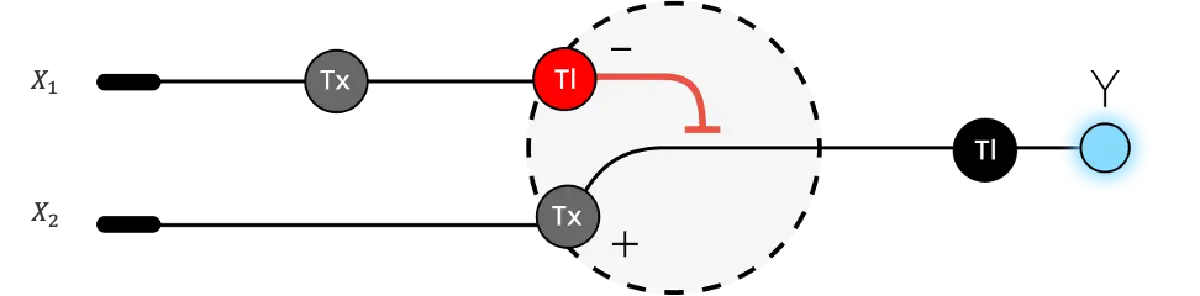
Draw a diagram for an intracellular multilayer perceptron where layer 1 outputs an endoribonuclease that regulates a fluorescent protein output in layer 2.
Info
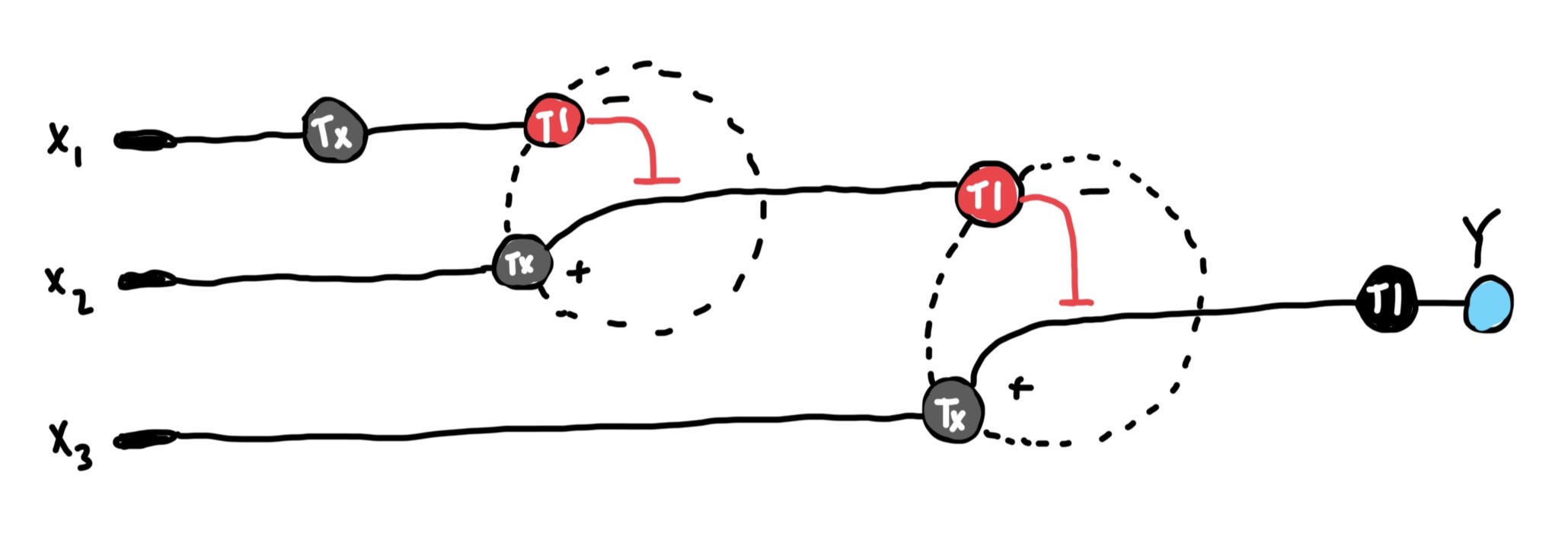
This is the multilayer perceptron diagram I created. The fluorescent protein is encoded in x3 which is regulated by the endoribonuclease encoded in the DNA of the x2 output. The x2 DNA’s transcribed mRNA is regulated by the endoribonuclease generated by x1’s DNA.
Assignment Part 2: Fungal Materials
- What are some examples of existing fungal materials and what are they used for? What are their advantages and disadvantages over traditional counterparts?
Existing fungal materials include mycelium packaging materials, fungal leather, fungal insulation, and fungal construction materials. Mycelium packaging is used as a biodegradable replacement for polystyrene foam packaging. Fungal leather is used in clothing, shoes, and furniture as an alternative to animal leather. Mycelium insulation and building materials are being explored for sustainable construction due to their lightweight and fire-resistant properties. Advantages of fungal materials include biodegradability, sustainability, low energy production costs, and reduced environmental impact compared to plastics or animal-derived materials. However, disadvantages include lower durability, sensitivity to moisture, slower manufacturing times, and limited large-scale production infrastructure.
- What might you want to genetically engineer fungi to do and why? What are the advantages of doing synthetic biology in fungi as opposed to bacteria?
One potential application of genetically engineered fungi would be to create self-healing construction materials. Fungi could be engineered to sense cracks or structural damage and produce adhesive biomaterials to repair the damaged region. Fungi could also be engineered for environmental remediation by degrading plastics, toxins, or oil contaminants in soil. Synthetic biology in fungi has several advantages over bacteria because fungi naturally grow as large multicellular networks called mycelia which can penetrate solid materials and survive in harsh environments. Fungi are also capable of secreting large amounts of enzymes and biomolecules into their surroundings. In addition, many fungi can process complex organic substrates that bacteria cannot efficiently metabolize. However, fungi generally grow more slowly and can be more difficult to genetically manipulate than bacteria.
Assignment Part 3: First DNA Twist Order
For this assignment, I reviewed the Individual Final Project documentation guidelines and submitted the Google Form with my draft Aim 1, final project summary, HTGAA industry council selections, and a shared folder for DNA designs.