Week 7 Lab: Neuromorphic Circuits
Info
As a fully online Committed Learner, I do not have lab access to complete the wet lab portions of this assignment. I document my labs to acknowledge that I reviewed the provided material and answered any required questions on the website. In this case, there was a wet lab and a dry lab portion of the lab work. I answered the questions and completed the dry lab work below.
Pre-Lab | Overview
In the first part of the lab, I had to download and install NeuromophicWizard and familiarize myself with endoribonuclease arithmetic and the use of Lipofectamine 3000.
Background
In this two-day lab, you will design and build your very own IANN using a library of plasmids from the Ron Weiss lab and human embryonic kidney (HEK) 293 cells. IANNs differ from traditional synthetic genetic circuits because IANNs can perform analog computations, rather than being limited to digital computations. IANNs are also universal function approximators–given an adequate number of intracellular artificial neurons, you can use an IANN to achieve any input/output behavior you’d like.
Concepts Learned & Skills Gained
This is a lab with a dry and wet component. In the dry lab component, you will design a neuromorphic circuit in groups of 3. Once your design has been finalized, you will write instructions for an OT-2 to build your circuit for you. In the wet lab component, a TA will upload your OT-2 instructions and you will observe the OT-2 building and transfecting your IANN into HEK293 cells.
Protocol
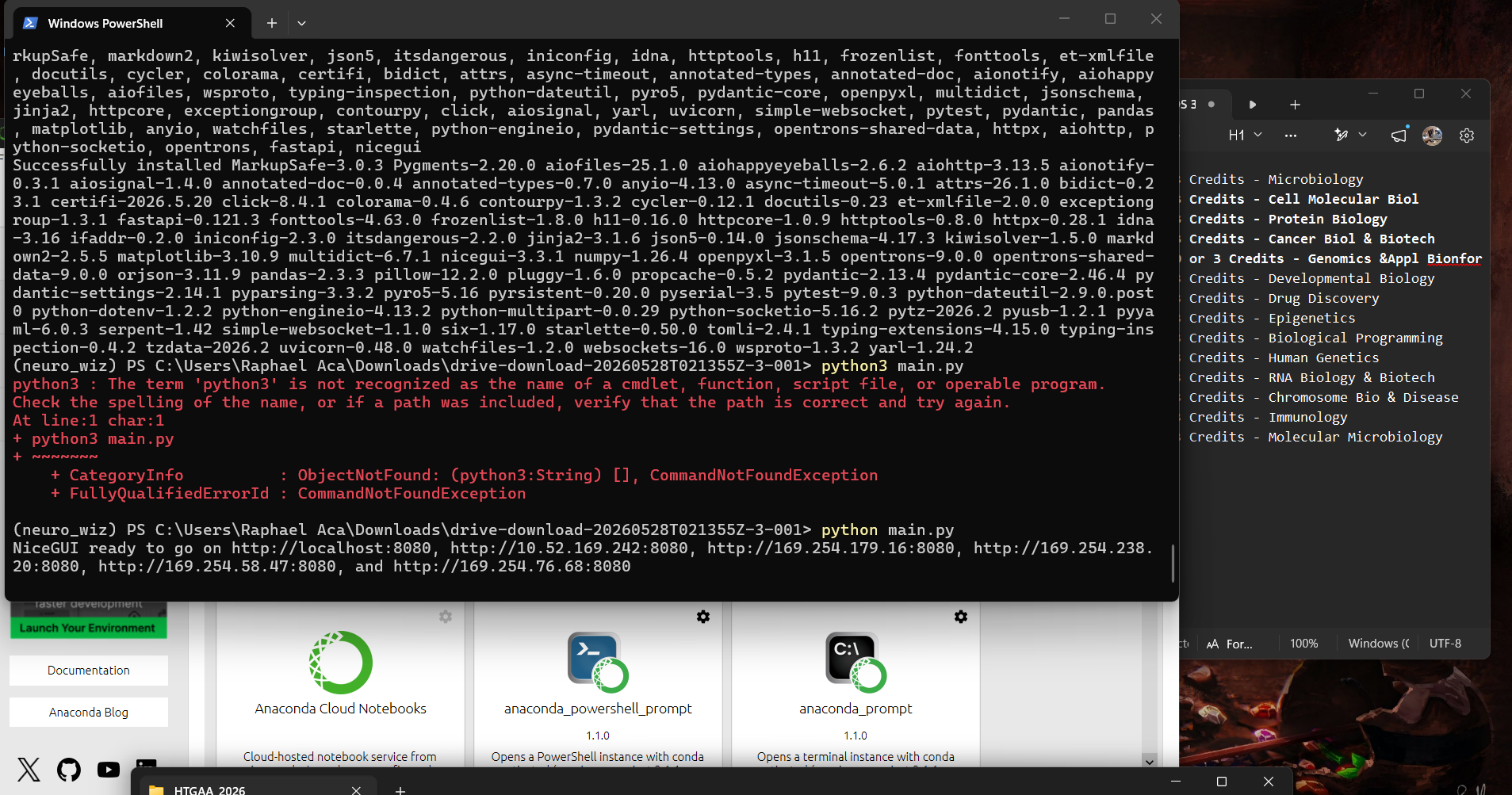
Then, I went through the process of downloading Anaconda and the NeuromorphicWizard.
 Using the provided template, I created the table shown below which I used in NeuromorphicWizard:
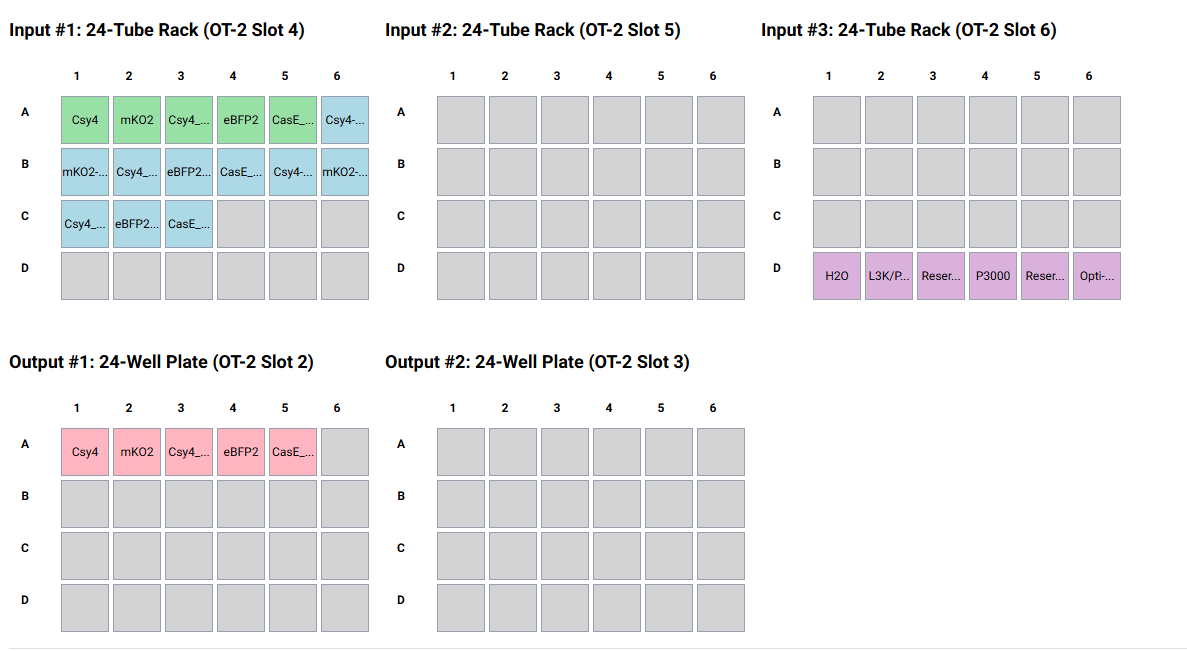
 Then, I designed the experiment layout shown below:
When the simulation was run, it returned the results shown in this file. After all this, I submitted my experiment design to the Google Form.