Info Since I was a fully-online Committed Listener, I did not have wet lab resources to complete my final project. Therefore, there may be some parts of my final project that were said to happen but were not completed.
SECTION 1: ABSTRACT Seasonal allergic rhinitis affects hundreds of millions of people globally, heavily driven by major pollen allergens like Bet v 1 from birch trees. Current treatments rely on systemic pharmaceuticals, such as antihistamines or steroids, that manage human immune symptoms post-exposure but fail to address the environmental trigger itself. This project addresses this critical gap by shifting the paradigm from symptom management to active, localized bioremediation inside the human nasal cavity. The broad objective of this project is to engineer a “Living Bio-Shield”: a bacterial genetic circuit designed to operate within a nasal commensal that detects and neutralizes pollen proteins upon inhalation. We hypothesize that a chimeric two-component receptor system can be engineered to specifically bind Bet v 1, subsequently triggering a genetic circuit to secrete neutralizing nanobodies (VHH domains) via a Sec-dependent pathway. The specific aims involve designing the chimeric receptor in silico, assembling the genetic circuit plasmid, and validating the computational folding and binding affinity of the receptor-nanobody complex. This will be achieved using bioinformatics databases, AlphaFold for protein design, Benchling for DNA construct assembly, and simulated structural analysis. By neutralizing allergens before they interact with the mucosal epithelium, this project establishes a novel preventative biotherapeutic platform for respiratory health.
For this Final Project, I joined a group of students consisting of Jason Ross, Jay Handfield, Nana Agyei Afrane-Asare, Xavier-Lewis Palmer, and myself. After going through the phage reading and reviewing the bacteriophage final project goals, we opted to increase the thermodynamic stability of the Lysis Protein.
Our group’s plan for engineering a bacteriophage includes multiple steps and various protein engineering tools. First, we will use BLAST and Clustal Omega to discover amino acid residues that are conserved between Lysis protein homologs. ESM2 will be used to score mutations for their evolutionary plausibility and ESM-Fold/ProteinMPNN/Boltz-1 will be used to refine the folded protein. EvolvePro will be used to computationally direct evolution in this protein structure. Lastly, we can use computational stress-testing under varying environmental conditions to test for destabilization.
Subsections of Projects
Individual Final Project
Info
Since I was a fully-online Committed Listener, I did not have wet lab resources to complete my final project. Therefore, there may be some parts of my final project that were said to happen but were not completed.
SECTION 1: ABSTRACT
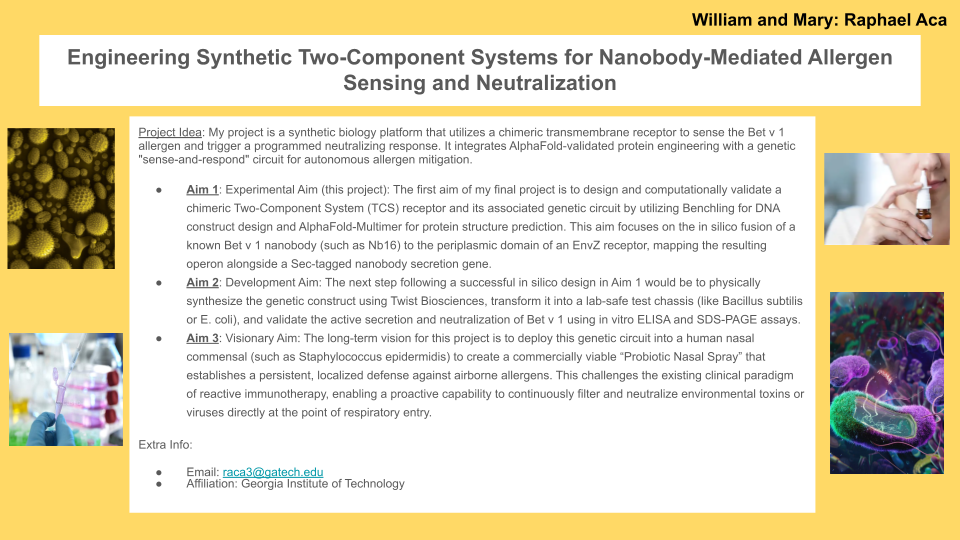
Seasonal allergic rhinitis affects hundreds of millions of people globally, heavily driven by major pollen allergens like Bet v 1 from birch trees. Current treatments rely on systemic pharmaceuticals, such as antihistamines or steroids, that manage human immune symptoms post-exposure but fail to address the environmental trigger itself. This project addresses this critical gap by shifting the paradigm from symptom management to active, localized bioremediation inside the human nasal cavity. The broad objective of this project is to engineer a “Living Bio-Shield”: a bacterial genetic circuit designed to operate within a nasal commensal that detects and neutralizes pollen proteins upon inhalation. We hypothesize that a chimeric two-component receptor system can be engineered to specifically bind Bet v 1, subsequently triggering a genetic circuit to secrete neutralizing nanobodies (VHH domains) via a Sec-dependent pathway. The specific aims involve designing the chimeric receptor in silico, assembling the genetic circuit plasmid, and validating the computational folding and binding affinity of the receptor-nanobody complex. This will be achieved using bioinformatics databases, AlphaFold for protein design, Benchling for DNA construct assembly, and simulated structural analysis. By neutralizing allergens before they interact with the mucosal epithelium, this project establishes a novel preventative biotherapeutic platform for respiratory health.
SECTION 2: PROJECT AIMS
Aim 1: Experimental Aim (this project):
The first aim of my final project is to design and computationally validate a chimeric Two-Component System (TCS) receptor and its associated genetic circuit by utilizing Benchling for DNA construct design and AlphaFold-Multimer for protein structure prediction. This aim focuses on the in silico fusion of a known Bet v 1 nanobody (such as Nb16) to the periplasmic domain of an EnvZ receptor, mapping the resulting operon alongside a Sec-tagged nanobody secretion gene.
Aim 2: Development Aim:
The next step following a successful in silico design in Aim 1 would be to physically synthesize the genetic construct using Twist Biosciences, transform it into a lab-safe test chassis (like Bacillus subtilis or E. coli), and validate the active secretion and neutralization of Bet v 1 using in vitro ELISA and SDS-PAGE assays.
Aim 3: Visionary Aim:
The long-term vision for this project is to deploy this genetic circuit into a human nasal commensal (such as Staphylococcus epidermidis) to create a commercially viable “Probiotic Nasal Spray” that establishes a persistent, localized defense against airborne allergens. This challenges the existing clinical paradigm of reactive immunotherapy, enabling a proactive capability to continuously filter and neutralize environmental toxins or viruses directly at the point of respiratory entry.
SECTION 3: BACKGROUND
Background and Literature Context The current state of allergy mitigation heavily relies on either avoidance or post-exposure immune suppression, leaving a significant gap in technologies that neutralize allergens at the environmental-mucosal interface. Recent advancements in protein engineering have successfully identified high-affinity camelid nanobodies (VHH) that bind specifically to Bet v 1, effectively blocking human IgE recognition (Bauernfeind et al., Frontiers in Immunology, 2024). Concurrently, synthetic biology has demonstrated the feasibility of engineering live biotherapeutic products (LBPs), where commensal bacteria are modified to secrete therapeutic proteins directly into human microbiomes, such as the gut (Steidler et al., Science, 2000).
This project is highly innovative because it applies the concepts of environmental bioremediation directly to the human microbiome. Instead of relying on passive physical masks or systemic drugs, it utilizes a novel application of chimeric bacterial sensors to create a “smart” biological filter. By engineering a two-component system to respond to a plant protein rather than a bacterial signaling molecule, this work challenges the assumption that mucosal defense must be entirely managed by the human immune system. This expands the boundaries of synthetic biology by proposing a programmable, symbiotic relationship between humans and engineered commensals for respiratory protection.
This project addresses the pressing real-world problem of the escalating global burden of seasonal allergies, which are worsening due to climate-change-driven increases in pollen production. The current reliance on daily antihistamines presents a significant barrier to quality of life due to side effects like fatigue and mucosal drying. If fully realized, this project could benefit society by providing a “once-a-season” localized treatment that eliminates systemic side effects entirely. Furthermore, the outcomes of this project represent a modular platform technology; if the system works for Bet v 1, the nanobody cassette can be swapped to neutralize other airborne threats, including industrial pollutants or respiratory viruses. Ultimately, this field-level change could shift allergy treatment from pharmacology to engineered preventative ecology.
Ethical Implications
The primary ethical implications involved in this project center around the eventual deployment of genetically modified organisms (GMOs) into the human respiratory tract. This directly invokes the principle of non-maleficence (do no harm) and the responsibility to protect both the human host and the broader ecosystem. Introducing an engineered commensal carries the risk of unintended immune responses, potential dysbiosis of the natural nasal microbiome, or the horizontal gene transfer of the synthetic plasmid to pathogenic bacteria. Additionally, from an ecological standpoint, we must consider the risk of these engineered bacteria escaping the host via sneezing or exhalation and establishing themselves in the natural environment.
To ensure this project is conducted ethically, stringent biocontainment measures must be integrated into the fundamental design of the bacteria. I propose the implementation of a genetic “kill-switch,” specifically a strict auxotrophy for a synthetic amino acid not found in nature or the human diet. The bacteria would only survive if the user periodically applies a specialized nasal spray containing this nutrient; if discontinued, the engineered colony would rapidly die off. A potential unintended consequence of this action is genetic mutation or recombination that breaks the kill-switch, allowing the bacteria to survive independently. If we are wrong in our assumptions about the stability of the chimeric receptor, the bacteria might chronically secrete proteins, leading to localized tissue inflammation. An alternative to this live-commensal approach would be utilizing cell-free systems embedded in a physical, wearable bio-mask, which achieves the neutralization goal without the risks associated with human colonization.
SECTION 4: EXPERIMENTAL DESIGN, TECHNIQUES, TOOLS, AND TECHNOLOGY
Experimental Plan and Timeline:
Week 1 (Sequence Acquisition): Mine the Protein Data Bank (PDB) and UniProt to retrieve the exact amino acid sequences for the Bet v 1 allergen, a validated Bet v 1 nanobody (e.g., Nb16), and the standard E. coli EnvZ/OmpR two-component system.
Week 2 (Receptor Design): Utilize AlphaFold via an available high-performance computing cluster or Colab notebook to design the chimeric receptor, fusing the Nb16 nanobody to the periplasmic domain of EnvZ.
Week 3 (Structural Simulation): Run AlphaFold-Multimer to simulate the docking of the newly designed chimeric receptor with the Bet v 1 protein to verify that the binding affinity and conformational shift are preserved.
Week 4 (Plasmid Architecture): Open Benchling and construct the full genetic circuit in silico.
Week 5 (Circuit Assembly): Map the OmpR-responsive promoter (pOmfC), followed by a Ribosome Binding Site (RBS), a Sec-dependent signal peptide (e.g., pelB), and the gene for the neutralizing nanobody.
Week 6 (Safety Integration): Integrate a standard auxotrophic marker or biocontainment gene into the plasmid backbone within the Benchling design.
Week 7 (Synthesis Preparation): Optimize the entire plasmid sequence for E. coli expression using the Asimov Kernel or Benchling’s codon optimization tools.
Week 8 (Order and Final Review): Format the sequence into standard modular parts (G-Blocks) and generate a simulated order manifest for Twist Biosciences, verifying all restriction sites and Gibson Assembly overlaps.
Expected Results
The expected outcome is a fully annotated, error-free plasmid map in Benchling that successfully integrates all necessary components, alongside a computational model demonstrating high-confidence binding between the chimeric receptor and the Bet v 1 protein.
Techniques Relevant to Project
Bioethical Considerations
DNA Construct Design
Databases (e.g., GenBank, NCBI, Ensembl, and UCSC Browser)
I will heavily utilize DNA Construct Design via Benchling to architect the core logic of my biological circuit. This involves not only placing the genes in the correct order but mathematically balancing the promoter strengths, RBS translation initiation rates, and ensuring proper terminator placement to avoid transcriptional read-through. Secondly, I will employ Protein Design tools, specifically AlphaFold, to create the chimeric receptor. Because I am swapping the sensory domain of a natural transmembrane protein with a nanobody, I must use these models to predict if the new fusion protein will fold correctly in a lipid membrane without disrupting the internal phosphorylation mechanics of the EnvZ tail.
HTGAA Industry Council Companies Associated
Twist Biosciences
Ginkgo Bioworks
Asimov (Kernel)
SECTION 5: Results & Quantitative Expectations
Validation Choice
For this project, I chose to validate the computational design and simulation of the chimeric receptor and the corresponding DNA circuit. This validation ensures that the theoretical fusion of the nanobody to the transmembrane receptor is structurally sound and that the resulting genetic payload can be viably synthesized.
Validation Protocol
Imported the FASTA sequence of the EnvZ transmembrane protein into a protein editing software environment.
Truncated the sequence to remove the natural periplasmic sensing loop.
Spliced in the FASTA sequence of the Nb16 (Bet v 1 specific) nanobody, utilizing a flexible Glycine-Serine (G4S) linker to prevent steric hindrance.
Input the final chimeric sequence, alongside the Bet v 1 target sequence, into AlphaFold-Multimer.
Analyzed the resulting Predicted Aligned Error (PAE) plots and pLDDT scores to confirm stable folding.
Reverse-translated the successful protein sequence into DNA, optimized codons, and assembled the final functional plasmid map in Benchling, verifying proper Gibson Assembly overlaps.
Techniques Utilized
This validation relied heavily on Databases, utilizing the RCSB PDB to source the foundational structures of the proteins involved. I then applied Protein Design and Models/Notebooks by using AlphaFold to run predictive structural simulations of my novel fusion protein. Finally, the project relied on DNA Construct Design utilizing Benchling to translate the structural success into a tangible, manufacturable genetic blueprint that could be ordered for physical assembly.
Data and Analysis
The data presented consists of simulated structural models generated by AlphaFold and detailed plasmid maps generated in Benchling. The analysis of the AlphaFold PAE plots will determine if the nanobody domain maintains its distinct binding pocket when fused to the receptor, while the Benchling sequence analysis will confirm that the construct is free of secondary structural issues (like hairpin loops) that would inhibit bacterial transcription.
Info
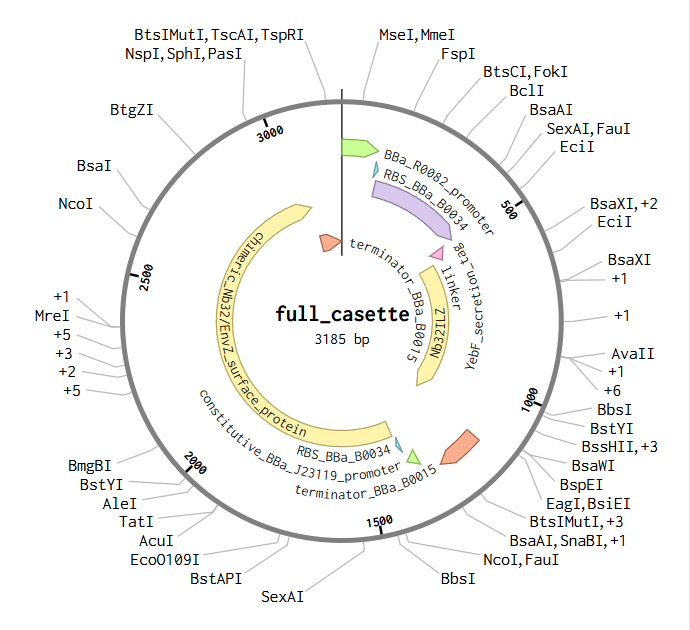
The fully designed plasmid cassette from Benchling. Takes the signal from the Chimeric surface receptor and outputs nanobodies.
Info
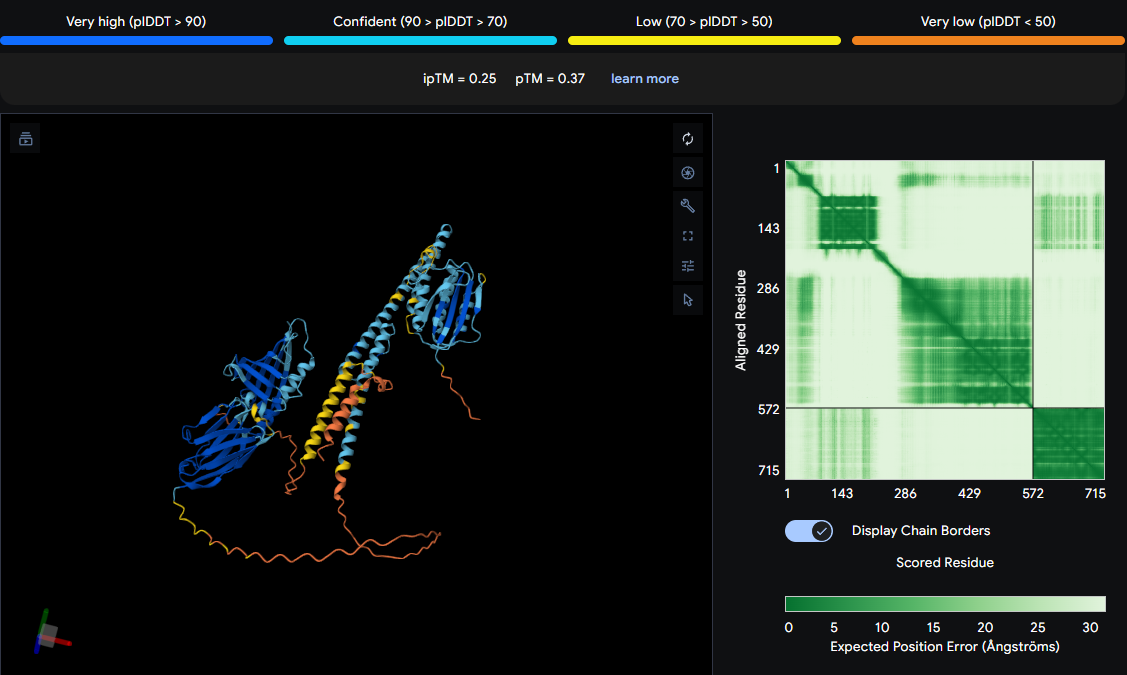
The Chimeric surface receptor protein that detects Bet v 1 proteins and creates a signal within the bacterial cell. Created in AlphaFold Server
In the AlphaFold creation, there is a low ipTM of 0.25 and a relatively low pTM of 0.37. This shows that the AlphaFold server was not very confident in making the protein. Thus, it is unknown if this protein will fold correctly when done experimentally. More experimentation must be done to determine this.
Challenges and Strategies
A major unexpected challenge in this in silico validation is the inherent difficulty computational models face when predicting the folding of transmembrane proteins. Because part of the chimeric receptor exists inside the lipid bilayer and part exists in aqueous environments, standard predictive models can return low confidence scores or suggest misfolding. If the chimeric receptor proves too unstable or fails to show an adequate conformational shift to trigger the circuit, my alternative strategy is to abandon the complex Two-Component System. Instead, I will pivot the design to a simpler “Repressor-Tug-of-War” circuit using an allosteric transcription factor, allowing Bet v 1 that naturally leaks into the periplasm to trigger the genetic circuit directly, bypassing the need for a custom membrane receptor entirely.
SECTION 6: ADDITIONAL INFORMATION
12. References
Bauernfeind, C., et al. (2024). “Trimeric Bet v 1-specific nanobodies cause strong suppression of IgE binding” Frontiers in Immunology.
Steidler, L., et al. (2000). “Treatment of murine colitis by Lactococcus lactis secreting interleukin-10.” Science.
Jumper, J., et al. (2021). “Highly accurate protein structure prediction with AlphaFold.” Nature.
13. Supply List and Budget
Item
Estimated Cost
DNA Synthesis (Custom G-Blocks via Twist Biosciences)
~$300
NEB Gibson Assembly Master Mix
~$150
DH5-alpha E. coli Competent Cells
~$50
Plasmid Miniprep Kits
~$80
Recombinant Bet v 1 Protein (for in vitro binding assays)
~$250
LB Broth, Agar, and appropriate antibiotics (e.g., Kanamycin)
~$50
Bet v 1 specific ELISA quantification kits
~$400
Total Estimated Budget
~$1,280
Group Final Project
For this Final Project, I joined a group of students consisting of Jason Ross, Jay Handfield, Nana Agyei Afrane-Asare, Xavier-Lewis Palmer, and myself. After going through the phage reading and reviewing the bacteriophage final project goals, we opted to increase the thermodynamic stability of the Lysis Protein.
Our group’s plan for engineering a bacteriophage includes multiple steps and various protein engineering tools. First, we will use BLAST and Clustal Omega to discover amino acid residues that are conserved between Lysis protein homologs. ESM2 will be used to score mutations for their evolutionary plausibility and ESM-Fold/ProteinMPNN/Boltz-1 will be used to refine the folded protein. EvolvePro will be used to computationally direct evolution in this protein structure. Lastly, we can use computational stress-testing under varying environmental conditions to test for destabilization.
Our group’s full one page proposal is linked here.