Week 7 HW: Genetic Circuits Part II: Neuromorphic Circuits
Assignment Part 1: Intracellular Artificial Neural Networks (IANNs)
1. What advantages do IANNs have over traditional genetic circuits, whose input/output behaviors are Boolean functions?
Traditional genetic circuits behave like simple ON/OFF switches (Boolean logic), but IANNs provide:
- Analog processing → Your construct’s aptamer-based 5′UTR already hints at graded responses (not just ON/OFF).
- Weighted inputs → Different regulators (e.g., RNA cleavage rates, promoter strengths) can tune output strength.
- Noise tolerance → Important in TX-TL systems where expression fluctuates.
- Complex decision-making → Enables pattern recognition rather than simple logic gates
2. Application of an IANN
Use case
- Environmental toxin detection
- Diagnostics (e.g., metabolite sensing)
Limitations
- Resource competition in TX-TL (limited ribosomes, ATP)
- Signal crosstalk between RNA regulators
- Difficulty tuning weights precisely
- Degradation variability in cell-free systems
- Scaling issues for deeper networks
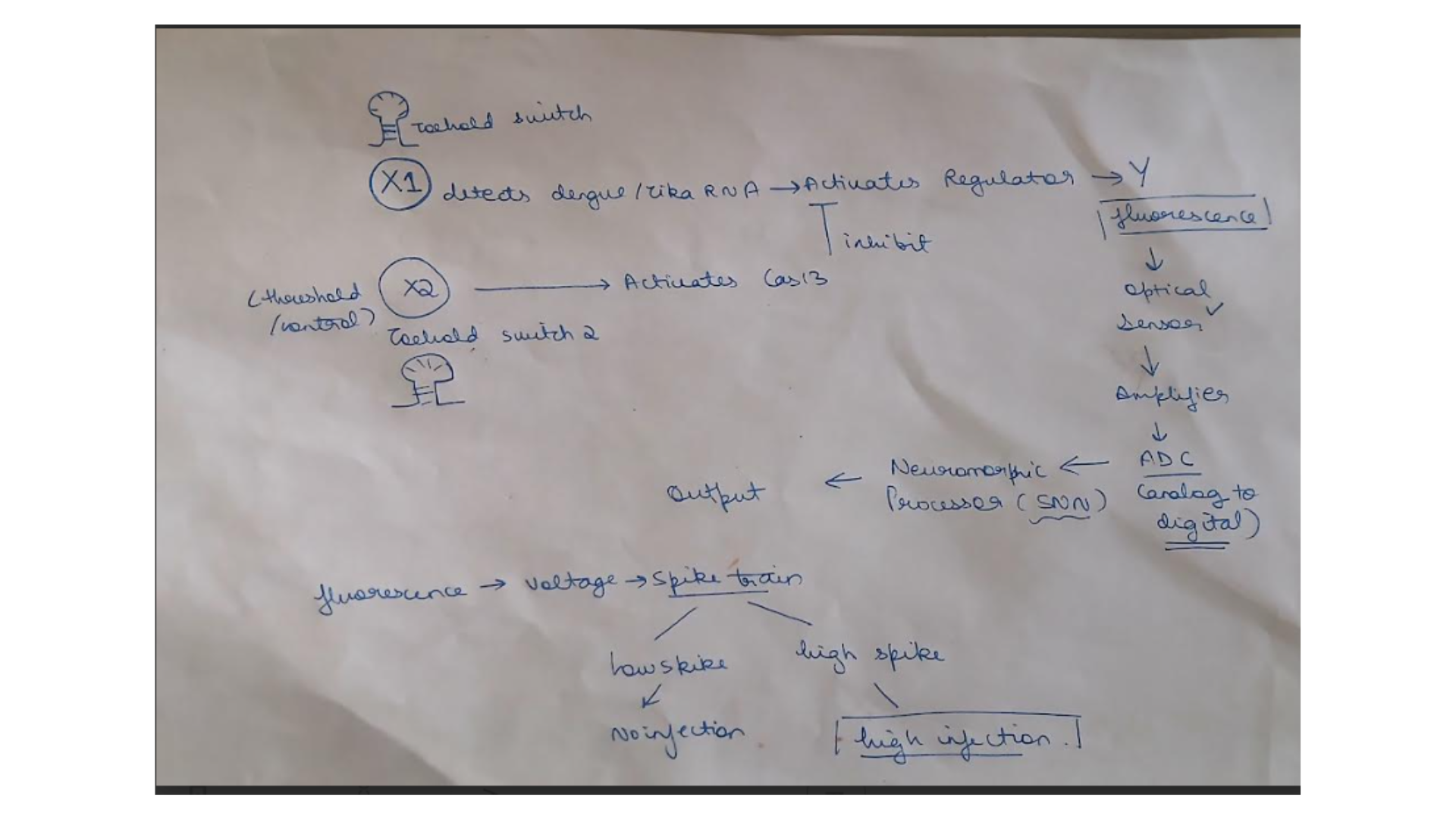
3. Diagram
Assignment Part 2: Fungal Materials
Examples of fungal materials-
- Mycelium-based packaging → alternative to Styrofoam
- Fungal leather → sustainable textile alternative
- Construction materials → bricks, insulation
- Filtration materials → water purification
Advantages over traditional materials
- Biodegradable
- Renewable and low-energy production
- Self-healing potential
- Carbon sequestration
Disadvantages
- Lower mechanical strength vs plastics/metals
- Moisture sensitivity
- Growth time variability
- Scaling challenges
We could engineer fungi to:
- Sense environmental toxins and fluoresce
- Produce functional biomolecules
- Self-heal structural materials
Why fungi over bacteria
- Multicellular structure → ideal for materials
- Secretion capability → easier protein harvesting
- Robust growth on waste substrates
- Better suited for large-scale physical materials
Part 3: First DNA Twist Order
Construct Summary
Name: T7-driven aptamer-regulated sfGFP cassette Backbone: pTwist Chlor (high copy)
Design Components
- T7 Promoter
- 5′ UTR with Aptamer
- RBS
- Reporter Gene
- Terminator
Benchling Link for the Twist Order: https://benchling.com/reet123/f_/DvufGAFHIG-final-project-construct/
Final Project Form also submitted-