Week 9 — Cell-Free Systems
Homework Part A: General Questions
Q: Explain the main advantages of cell-free protein synthesis over traditional in vivo methods, specifically in terms of flexibility and control over experimental variables. Name at least two cases where cell-free expression is more beneficial than cell production.
Answer: Cell-free protein synthesis allows direct control over reaction conditions such as DNA concentration, ion composition, temperature, and energy supply without the constraints of maintaining living cells. It enables rapid prototyping because there is no need for cloning or cell growth. Additionally, toxic proteins can be expressed safely since there are no viability constraints.
Two cases where cell-free systems are more beneficial:
- Expression of toxic proteins (e.g., antimicrobial peptides)
- Rapid biosensing applications (e.g., paper-based diagnostics using sfGFP reporters like my construct)
Q: Describe the main components of a cell-free expression system and explain the role of each component.
Answer:
- Cell extract → Contains ribosomes, tRNAs, enzymes for transcription/translation
- DNA template → Encodes the target protein (e.g., T7-sfGFP construct)
- RNA polymerase (T7 RNAP) → Drives transcription from T7 promoter
- Amino acids → Building blocks for protein synthesis
- Energy system (ATP, GTP, regeneration system) → Powers transcription/translation
- Cofactors and salts (Mg²⁺, K⁺) → Maintain enzymatic activity
- Regulatory elements → Your aptamer 5′UTR controls translation efficiency
Q: Why is energy provision regeneration critical in cell-free systems? Describe a method you could use to ensure continuous ATP supply in your cell-free experiment.
Answer: Energy regeneration is critical because transcription and translation consume large amounts of ATP and GTP. Without regeneration, the reaction quickly stops.
One method is using a phosphoenolpyruvate (PEP)-based system, where PEP regenerates ATP via pyruvate kinase. Alternatively, a creatine phosphate + creatine kinase system can sustain ATP levels for longer reactions.
Q: Compare prokaryotic versus eukaryotic cell-free expression systems. Choose a protein to produce in each system and explain why.
Answer:
Prokaryotic systems (e.g., E. coli)
- Fast, inexpensive, high yield
- Limited post-translational modifications
- Example: sfGFP (my construct) → does not require complex modifications
Eukaryotic systems (e.g., wheat germ, mammalian extracts)
- Support folding, disulfide bonds, glycosylation
- Lower yield, more expensive
- Example: antibodies or membrane receptors → require proper folding and modifications
Q: How would you design a cell-free experiment to optimize the expression of a membrane protein? Discuss the challenges and how you would address them in your setup.
Answer: Challenges include improper folding, aggregation, and lack of membrane insertion.
Design:
- Add liposomes or nanodiscs to mimic membranes
- Include detergents (e.g., DDM) for solubilization
- Optimize Mg²⁺ and temperature conditions
- Use chaperones to assist folding
This allows proper insertion and stabilization of the membrane protein.
Q: Imagine you observe a low yield of your target protein in a cell-free system. Describe three possible reasons for this and suggest a troubleshooting strategy for each.
Answer:
- Poor transcription Cause: weak promoter or degraded DNA Fix: increase DNA concentration or verify T7 promoter integrity
- Inefficient translation Cause: weak RBS or inhibitory RNA structure (important for my aptamer design) Fix: optimize RBS or redesign 5′UTR
- Energy depletion Cause: insufficient ATP regeneration Fix: improve energy system (e.g., add PEP or creatine phosphate)
Homework Question from Kate Adamala
Q: Pick a function and describe it.
Answer: A cell-free biosensor synthetic cell that detects a small molecule (e.g., theophylline) and produces a fluorescent signal (sfGFP).
Q: What would your synthetic cell do? What is the input and what is the output?
Answer:
Input: Theophylline binding to aptamer in 5′UTR Output: sfGFP fluorescence The system uses my T7-driven aptamer-regulated construct
Q: Could this function be realized by cell-free Tx/Tl alone, without encapsulation?
Answer: Yes, but encapsulation improves signal localization and environmental control, making sensing more precise.
Q: Could this function be realized by genetically modified natural cell?
Answer: Yes, but cell-free systems are faster, safer, and easier to tune, especially for biosensing applications.
Q: Describe the desired outcome of your synthetic cell operation.
Answer: Fluorescence is produced only in the presence of the target molecule, enabling specific and rapid detection.
Q: Design all components that would need to be part of your synthetic cell.
Answer:
- Lipid membrane vesicle
- Cell-free TX-TL system
- DNA construct (T7–aptamer–sfGFP–terminator)
- Energy regeneration system
- Cofactors and salts
Q: What would be the membrane made of?
Answer: Phospholipids such as POPC + cholesterol for stability.
Q: What would you encapsulate inside?
Answer:
- Cell-free extract
- DNA construct
- ATP regeneration system
- Amino acids and cofactors
Q: Which organism your Tx/Tl system will come from?
Answer: Bacterial (E. coli) system, since T7 promoter and aptamer regulation work efficiently.
Q: How will your synthetic cell communicate with the environment?
Answer:
Small molecules (e.g., theophylline) diffuse across membrane Output (fluorescence) is detectable externally Q: Experimental details — list all lipids and genes.
Answer:
Lipids: POPC, cholesterol
Genes: T7 promoter, Aptamer-regulated 5′UTR, RBS, sfGFP, Terminator
Q: How will you measure the function of your system?
Answer: Measure sfGFP fluorescence using a plate reader or fluorescence viewer.
Homework Question from Peter Nguyen
Q: One-sentence pitch
Answer: Freeze-dried cell-free biosensors embedded in textiles that detect environmental toxins and fluoresce in real time.
Q: How will the idea work?
Answer: Cell-free reactions containing my T7–sfGFP construct are embedded into fabric fibers. Upon exposure to water (e.g., sweat or rain), the system activates. If a target molecule binds the aptamer, translation is activated and produces fluorescence. This allows wearable, real-time detection of toxins or pollutants.
Q: What societal challenge does this address?
Answer: Provides low-cost environmental monitoring and personal safety, especially in polluted or hazardous environments.
Q: How will you address limitations of cell-free systems?
Answer:
- Use freeze-drying for long-term storage
- Design water-triggered activation
- Create modular replaceable patches to overcome one-time use
Homework Question from Ally Huang (Genes in Space)
Q: Background (≤100 words)
Answer: Spaceflight conditions such as microgravity and radiation affect gene expression and protein folding, posing risks to astronaut health. Understanding how biomolecular systems behave in space is critical for long-duration missions. Cell-free systems provide a controlled platform to study gene expression without relying on living cells. This enables rapid, low-resource experiments aboard spacecraft and supports development of diagnostic and therapeutic tools for space exploration.
Q: Relation to space biology question (≤100 words)
Answer: The construct allows measurement of how microgravity affects transcription and translation efficiency. Changes in fluorescence indicate differences in gene expression dynamics. Aptamer regulation adds sensitivity to environmental conditions, enabling study of RNA folding and regulation in space.
Q: Hypothesis / research goal (≤150 words)
Answer: Hypothesis: Microgravity alters transcriptional and translational efficiency in cell-free systems, affecting protein yield and RNA structure-function relationships. The goal is to quantify how space conditions impact gene expression using a controlled T7-driven system. The aptamer-regulated 5′UTR provides an additional layer to study RNA folding behavior. Differences in sfGFP output between Earth and space samples will reveal how physical conditions influence molecular biology processes.
Q: Experimental plan (≤100 words)
Answer: Prepare freeze-dried BioBits® reactions with the T7–aptamer–sfGFP construct. Rehydrate samples in space and on Earth (control). Measure fluorescence using the P51 viewer. Include controls without aptamer and without DNA. Compare fluorescence intensity to assess effects of microgravity on gene expression.
Homework Part B: Individual Final Project
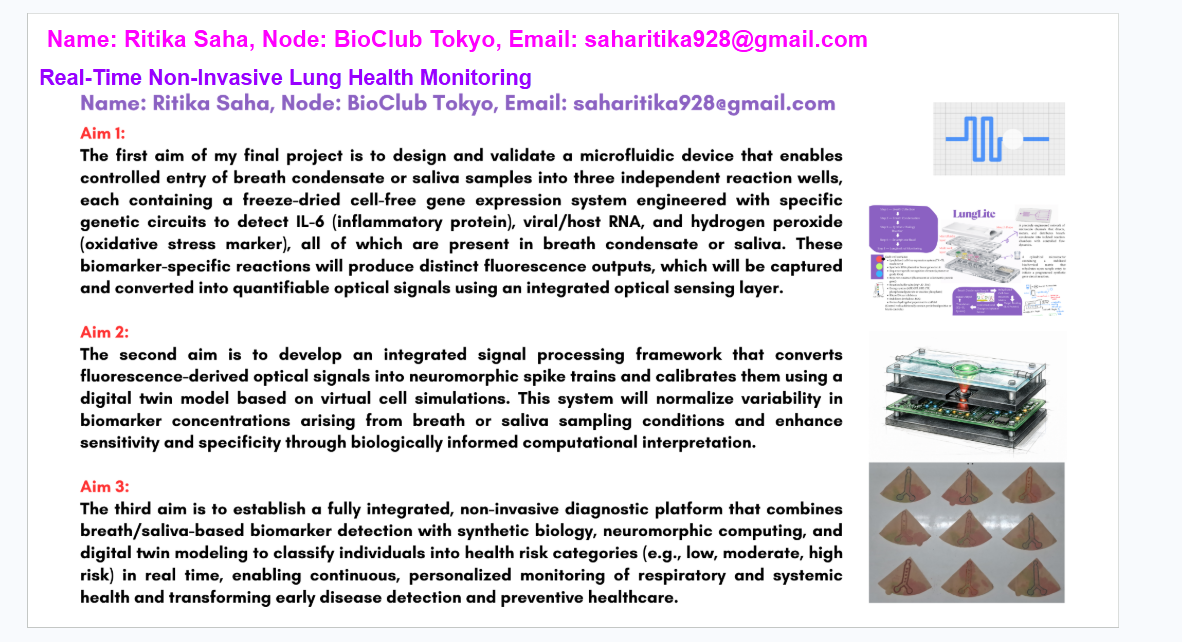
- Submitted the final project slide to the deck: https://docs.google.com/presentation/d/142YNBXXcDJBfGO_OaF0DpeaF_287YsDeH1-Acp7kUI0/edit?slide=id.g3d412cafaa8_4_0#slide=id.g3d412cafaa8_4_0
- Places twist order as well: https://benchling.com/reet123/f_/DvufGAFHIG-final-project-construct/