Week 1 HW: Principles and Practices
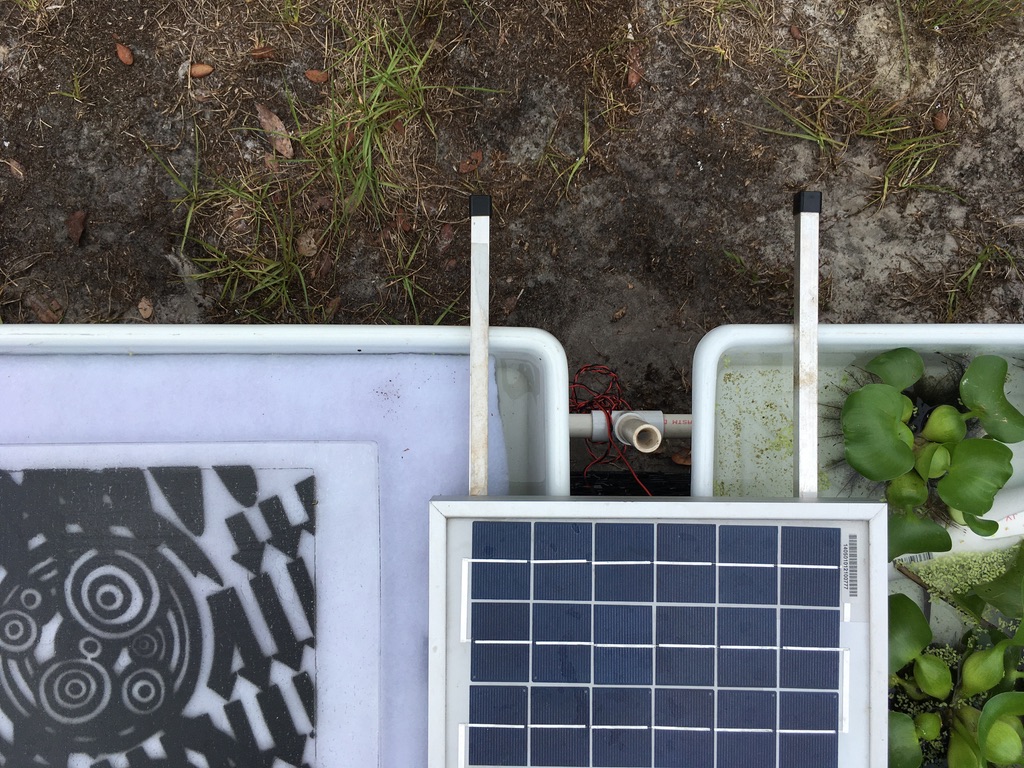
Photosynthetic Image Generation (PIG)
“Art cannot be separated from life. It is the expression of the greatest need of which life is capable, and we value art not because of the skilled product, but because of its revelation of a life’s experience.”
-Robert Henri-
Overview
PIG is an experimental combination of biology, glassmaking, printmaking, and photography which produces a living, two dimmensional surface of bacteria cultured as graphic imagery. The research behind the process to date has produced a small series of images grown on a synthetic felt substrate.
Background
The project emerged over the course of a two year period of experimental interactions with biological material on a Brooklyn rooftop, which began in 2016. It was the site of a collaborative project with my partner, Sarah Max Beck, called studioHydrostatic. It was located on top of a four story walkup in Bedford Stuyvesant, where we had set up a small greenhouse to carry out visual media experiments using an artificial wetland ecosystem. The system was a hybridized combination of aquaponic and terraponic technologies chemically driven by urine, seashells, and chelated iron as nutrient sources. The elevated levels of nitrogen in the water lead to cyanobacteria growing on wet surfaces exposed to sunlight. It was interesting to observe how the bacteria would form into very specific shapes and patterns depending on the qualities of whatever it was interacting with, and marked the beginning of this project. It reveals the collaborative nature of life, the ongoing exchange of resources between organisms -which is more than one life’s experience- it’s the sum of many in a vibrant display of living energy.
Process
The live culture of cyanobacteria occurs in and around aquatic ecosystems, so I decided to set up a simple recirculating pond in a pasture to further experiment with the process. The main body of water was held by a fifty gallon, black plastic, water trough stocked with water hyacinth (Pontederia crassipes), which was harvested from a nearby body of freshwater. A small solar powered water pump moved water from the pond into a smaller processing tray which rested on top of the trough. Inside the tray was a piece of white polyester felt stretched over a foam board. I punched a small hole through the foam board and connected the water supply tube from the water pump. Resting on top of the felt was a plate of glass which had a negative image fused into its surface. The result was a water fed piece of felt sandwiched between foam and glass. As the sun shined, water moved from the pond up to the tray saturating the felt underneath the glass. The contraption exposed the felt to water, sunlight, and nutrients whereby, underneath the glass, cyanobacteria began to grow on the felt and produce an image pattern grown by photosynthetic bacteria.
Research with HTGAA
The beauty of this process is its ability to work with naturally occurring bio-cycles, organic matter, and the resources of its surroundings. These qualities do present a challenge to the idea of working with synthetic biology to augment a process which seems to work quite well without any manipulation. However, the current direction of the research is focused on the recyclability of the media, and since the current system utilizes a synthetic material to manifest the image on, I believe bacterial cellulose holds potential as an organic imaging substrate.
Perhaps differnt qualities of cellulose produced from certain strains of BC could be modified to obtain more desirable results, or perhaps change the process altogether. The possibility of creating something completely different also exist, and while my focus at this point is directed towards PIG, I am open to whatever I may discover through this course!
Strategies for Governance
The goal of my research with PIG is to produce a scalable, mobile technology for producing live surfaces as working media for visual artists in their studio practices as well as in exhibition environments. I believe it is important to research these potential pathways for humans to find new ways of interacting with ecology which are mutually beneficial, or symbiotic. However there are many potential hazards associated with the manipulation of any environment or material. Listed below are three real examples this project currently faces without synthetic alteration of organism genomes. Actions or considerations for GMO would be similar, but may be more procedurally specific.
- Environmental protection from:
- Release of foreign or exotic organisms from working displays into other ecosystems.
- Equipment or device contamination from installations environments upon return to origin.
- Release of foreign cultures from lab or experimental waste/water.
- Self contamination from interaction with media:
- Practioners could become infected by or transmit biological organisms from content/media to themselves or others.
- Engaged public interaction poses similar risks.
- Spread of Misinformation:
- Public opposition to content insiting the spread of “bad” or incorrect information.
- Misinterpreted information by gallerists, voluteers, or public.
Environmental Protection Policy
Environmental contamination could result from the improper handling or disposal of materials associated with work. While it is easier to safeguard in controlled laboratory settings, the potential still exists. There are additional risks once materials leave the lab for transportation between works sites, as well as for the work sites themselves.
Environmental Protection Goals
- Protect localized environments from contamination by foreign organisms.
- Protect people/personel interacting with experimental media.
- Protect organizations hosting experimental media from harmful content.
Protection of Localized Environments
Actions to be taken
- Follow Laboratory Protocals (this project is not currently active in any laboratories or public spaces.)
- Follow BSL1 safety protocals and procedures.
- Create list of ALL pertinent safety information specific to research for lab technicians/researcher working with media.
- Awareness of experimental media’s location within the lab space: Use signs and markers to identify project space.
- Be tidy and make sure surfaces are clean, organised, and clearly marked.
- Make Visitors aware of active experiments. Remind them: please do not to touch anything w/o permission.
- Post emergency contact information.
- Design experiments and equipment for safe containment.
- Equipment should be easy to clean and properly sealed.
- Design traveling systems with primary and backup sealing/containment systems.
- Improperly sealed systems could leak: always double check containment before transport.
- Risk of containment breach is low with well maintained systems and adherence to protocals.
- Clearly label shipping containers with contents and emergency contact information.
- Maintain equipment to ensure systems and safety mechanisms are working properly.
- Assess equipment before project initiation.
- Replace any worn parts or seals and make any repairs.
- Clean final assemblies.
- Schedule maintenance with time for service before initiating project.
| Does the Action: | Action 1 | Action 2 | Action 3 |
|---|---|---|---|
| Enhance Biosecurity | |||
| • By preventing incidents | 1 | 1 | 1 |
| • By helping respond | 1 | 2 | 3 |
| Foster Lab Safety | |||
| • By preventing incident | 1 | 1 | 1 |
| • By helping respond | 1 | 2 | 3 |
| Protect the environment | |||
| • By preventing incidents | 1 | 1 | 1 |
| • By helping respond | 2 | 1 | 3 |
| Other considerations | |||
| • Minimizing costs and burdens to stakeholders | 3 | 2 | 1 |
| • Feasibility? | 1 | 2 | 1 |
| • Not impede research | 1 | 3 | 2 |
| • Promote constructive applications | 2 | 1 | 2 |
| —————————————————– | ———- | ———- | ———- |
| Score | 14 | 16 | 18 |
Conclusion
While I cannot imagine conducting any experimental research without following all the actions listed aboove, the exercise did make it clear that the research is still very much in a developmental phase, and there needs to be a little more care taken when considering the project’s deployment in non-laboratory environemnts. Overall, I believe the risk to benefit ratio to be very low, especially in its research and development phases. The application of the technology could be interesting as a bioprinting technique, but I’m more interested in exploring its application as an experiential/phenominological application within the visual arts. I’m not sure how synthetic biology will play into the research at this point, but I can see how this may change as I learn more about the organisms I’m working with, and the environmental challenges I may face when developing transport and display systems.