Week 6 HW: Genetic Circuits Part I
Guess what. What? It’s time to do your homework. OMG!!! It’s never ending… I’m always doing my homework for HTGAA.
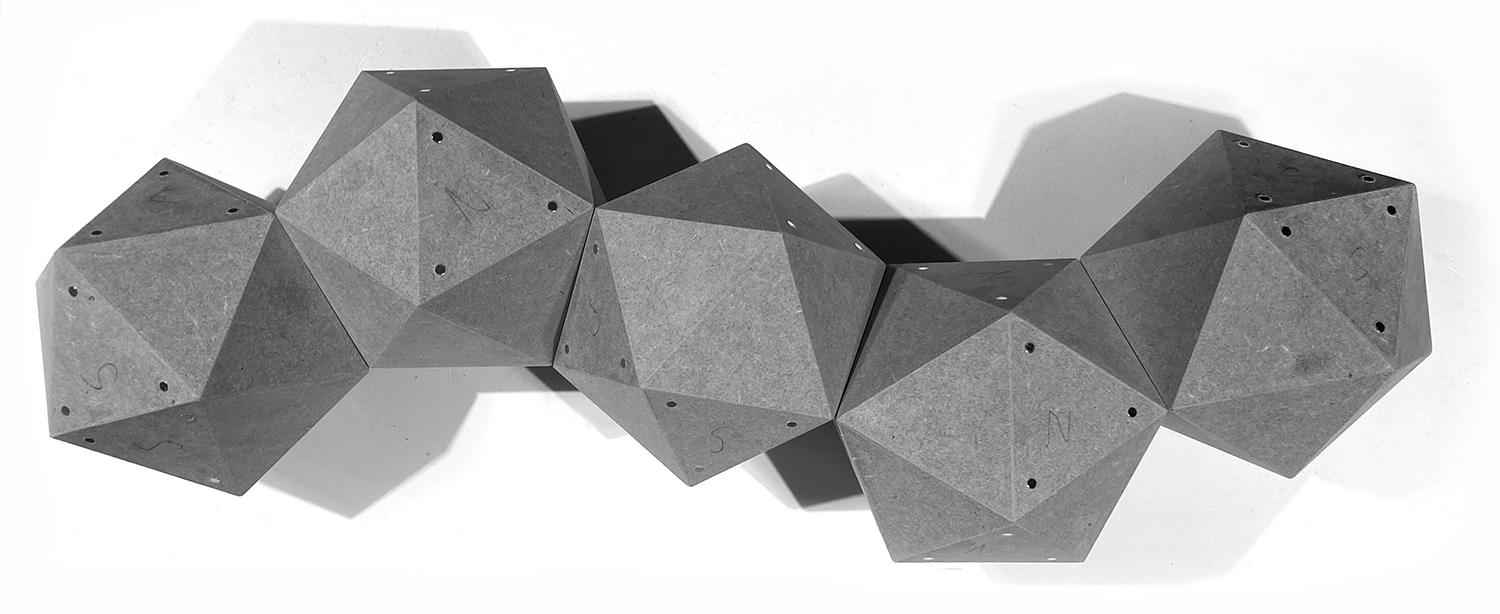 Icosohedronic Molecular Model II -RCBeck
Assignment: DNA Assembly
Answer these questions about the protocol in this week’s lab
What are some components in the Phusion High-Fidelity PCR Master Mix and what is their purpose?
Answer: There are several components in the master mix. It contains - DNA polymerase, dNTP’s, reaction buffers, and MgCL2.- DNA polymerase is an enzyme which catylizes the replication of DNA by reading the parent’s unzipped DNA aa sequence and pairing it with its corresponding dNTP to synthesize a new strand of target DNA.
- dNTP is short for Deoxyribonucleotide Triphosphate. They are the building blocks which allow DNA replication to take place. They consist of a deoxyribose sugar molecule, a nitogenous base (A,C,T,G), and a triphosphate group.
- There are four dNTP’s - dATP, dCTP, dTTG, and dGTP.
- The reaction buffers dissolve, or lyse the phospholipid cell membranes which hold the DNA inside the cell.
- The MgCl2 is magnesium salt which neutralizes the charge on the sugar-phosphate backbone making the DNA less water soluble aiding in its precicipitation. It aslo helps remove proteins from DNA and keeps them dissolved in the lysed cell solution.
What are some factors that determine primer annealing temperature during PCR? Answer: There are three tempererature cycles protocals important to PCR, denaturization, annealing, and extension.
- The melting temperature (Tm) for primers is an important factor which initializes the PCR process, this is called denaturing. The increase in temperature is what separates the primers so they become single stranded.
- The annealing temperature (Ta) is dependent upon the length, sequence and concentration of primers.
- The extension process temperature is lower than first two and the last step where the 3’ ends are bound into finished PCR product.
There are two methods from this class that create linear fragments of DNA: PCR, and restriction enzyme digests. Compare and contrast these two methods, both in terms of protocol as well as when one may be preferable to use over the other.
- PCR stands for Polymerase Chain Reaction and is widely used for its ability to amplify specific segments of DNA for study or testing. As stated above in question 2, it’s a thermocycling process using specific sets or a custom blend of primers, short single-stranded segments of DNA usually 18-25 nucleotides long, which bind to the target DNA strand in specific regions based on the primer sequence used. It is a relatively cheap and practical way to analyze DNA which requires a very basic “kitchen sink” lab to run protocal. It only requires small trace samples of DNA, which can be sourced from basically any tissue, and usually produces blunt end segments of DNA.
- Restriction enzymes are proteins found in bacteria which can be used to cut DNA at specific target sites. They cut either blunt, or sticky ends - an advantageous quality for constructing recombinant DNA strands; there are three types.
- Type I: recognize shorter sequences and do not cut at their recognition sites but rather at the unprotected ends.
- Type II: Most widely used and available in many different forms. They cut at specific recognition sites to a predictable sequence.
- Type III: Recognize short asymmetric DNA sequences and cut them nonspecfically into 25–28 nucleotide long sequences.
- The main difference between these two methods is in the way they reform DNA segments. PCR seperates the strands and reforms them using DNA polymerase dNTP’s and designed primers, and is very good at generating millions of copies for testing. Restiction enzymes cut double stranded segments of DNA with either sticky or blunt ends. Sticky ends are ideal when assembling recombinant strands.
How can you ensure that the DNA sequences that you have digested and PCR-ed will be appropriate for Gibson cloning? Answer: Gibson cloning works best when the PCR amplified fragments have overlapping ends which are 20-40 base pairs long with a high GC content. This can be achieved by optimizing the PCR conditions to ensure they are clean and specific, then checking the PCR product with gel electrophoresis before proceeding.
How does the plasmid DNA enter the E. coli cells during transformation?
Answer: Heat shock and thermal cycling of transformed competent cells, or optimized reagents.Describe another assembly method in detail (such as Golden Gate Assembly). Explain the method in 5 - 7 sentences plus diagrams.
Model this assembly method with Benchling or Asimov Kernel!- Golden Gate Assembly is similar to Gibson in that it’s also a single step reaction however, it’s better for repetitive cloning tasks, whereas Gibson assembly is more appropriate for building longer sequences. Golden Gate is a restriction enzyme process using Type IIP enzymes which cut outside the recognition sites and create 3 or 4 nucleotide 5′-overhangs. The most common restriction enzymes are BsaI-HFv2, BsmBI-v2, and PaqCI, which recognize asymmetric non-palindromic sites which reduces the chances of creating oligimers. One of the current limitations of Golden Gate is the abvailabilty of Type IIS enzymes, there are only about a half dozen to choose from, most with base recognition sites.
Illustration by Tasha José (2024)
Model of Golden Gate in Benchling:
First I started by researching the restriction enzymes used. Then I downloaded a FASTA sequence from the Aanbaena genome and looked for these sites in Benchling. This lead me to conclude that approaching this manually was going to be very tricky.
During last homework session, Xavier suggested I try and use a backbone modeled for Golden Gate.
Below is the backbone sourced from Addgene: pLM433 (Empty Backbone) for creating CyanoTag vectors by Golden Gate cloning (BspQI version). I was able to locate the BsaX1 restriction cut site, but I’m not sure how to relocate the promoter to the cut site. I’m not sure if I should use the reverse DNA sequence as the promoter appears to going in 3’ to 5’ direction, and when I tried to paste it in front of cut site the sequnce became unselected. Very frustrating to say the least.
I chose this particular backbone because it’s modeled for cyanobacteria, which falls within the focus of my final project.
Benchling is not an intuitive application. I had trouble with it in the week two homework, and I’m not sure I will be able to successfully use it without some specific instruction- YouTube doesn’t really cut it, pardon the pun.
Tag / Fusion Protein mNeonGreen - 3x FLAG (C terminal on insert) Growth in Bacteria
Bacterial Resistance(s) Ampicillin, 100 μg/mL
Growth Temperature 37°C
Growth Strain(s) ccdB Survival
Citation:
- Lorenz TC. Polymerase chain reaction: basic protocol plus troubleshooting and optimization strategies. J Vis Exp. 2012 May 22;(63):e3998. doi: 10.3791/3998. PMID: 22664923; PMCID: PMC4846334.
- ThermoFischer Scientific (2018). PRODUCT INFORMATION, Thermo Scientific, Phusion High-Fidelity PCR Master Mix, Pub. No. MAN0012771. Available at: https://documents.thermofisher.com/TFS-Assets/LSG/manuals/MAN0012771_Phusion_HiFi_PCR_MasterMix_100rxn_UG.pdf (Accessed: 21-3-2026)
- Garibyan L, Avashia N. Polymerase chain reaction. J Invest Dermatol. 2013 Mar;133(3):1-4. doi: 10.1038/jid.2013.1. PMID: 23399825; PMCID: PMC4102308.
- Michael R. Green and Joseph Sambrook (2022). Restriction Enzymes. Cold Spring Harb Protoc; doi:10.1101/pdb.top101360
- Greg J.S. Lohman, Ph.D., Illustrations by Tasha José (2024). Getting Started with Golden Gate Assembly New England Biolabs. Available at: https://www.neb.com/en-gb/nebinspired-blog/getting-started-with-golden-gate (Accessed: 23-3-2026).
- Optimizing Restriction Endonuclease Reactions. New England Biolabs (2025). Available at: https://www.neb.com/en-gb/protocols/optimizing-restriction-endonuclease-reactions?pdf=true (Accessed: 29-4-2026).
- pLM433 was a gift from Luke Mackinder (Addgene plasmid # 217293 ; http://n2t.net/addgene:217293 ; RRID:Addgene_217293)