Week 7 HW: Gentetic Circuits Part II: Neuromorphic Circuits
After this assignment, it will finally not be time to do your homework for one day… Happy Spring Break!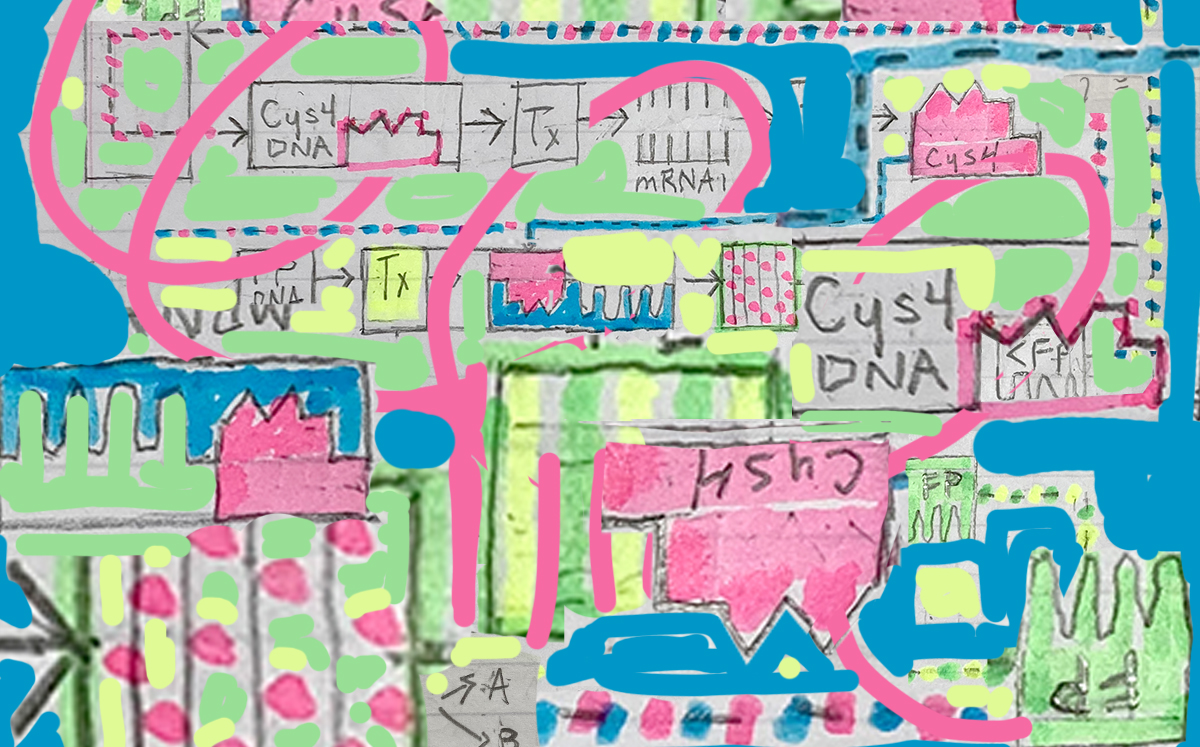 This is Your Brain on HTGAA- RCBeck
Assignment Part 1: Intracellular Artificial Neural Networks
What advantages do IANNs have over traditional genetic circuits, whose input/output behaviors are Boolean functions?
- They can be weighted with high and low input values which gives them unique capabilities.
- Unlike a Bool - which is if this then that - the specificity of an IANN means they can be designed to produce more specific outcomes in cellular function by responding to multiple control parameters. Boolean functions have one input.
Describe a useful application for an IANN; include a detailed description of input/output behavior, as well as any limitations an IANN might face to achieve your goal.
- In an application working with cyanobacteria, I think it would be interesting to use an IANN to sense the enviromnetal conditions with designed responses to stimuli.
- For instance, in a freshwater ecosystem, the bicarbonate cycle of the water body can produce radical swings in pH depending on the water’s carbon and oxygen content. During photosynthesis plants absorb carbon from water to produce glucose and oxygen, which raises water pH from an increase of hydroxide. Without sunlight for photosynthesis, plants burn glucose producing CO2 which lowers pH. In a healthy ecosystem this realtionship is in balance.
- In systems where there is excessive cyanobacteria growth from high nutrient levels (pollution), water pH can swing from >8 during peak photosynthesis to <6 during the night. Oxygen levels are affected in a similar way where there is high dissolved O2 during day and very low at night, which can be lethal to fish populations.
- I’m realizing that releasing a synthetic cyanobacteria with IANN has some significant ethical issues, but perhaps it could be useful in a biofuel application where the goal is to produce dense populations of bacteria in closed loop systems. In this case, bacteria which could stop photosynthesizing in response to increasing pH and oxygen levels could be very useful in production systems, which in theory would have no need for artificial buffering.
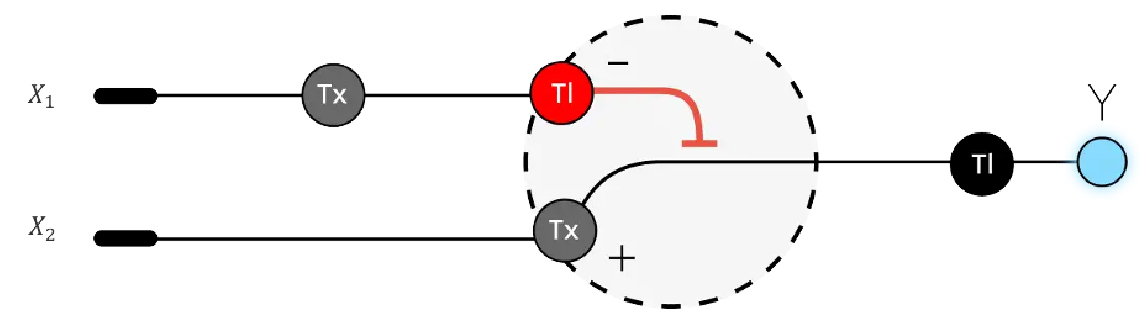
Below is a diagram depicting an intracellular single-layer perceptron where the X1 input is DNA encoding for the Csy4 endoribonuclease and the X2 input is DNA encoding for a fluorescent protein output whose mRNA is regulated by Csy4. Tx: transcription; Tl: translation.
Attempted Design
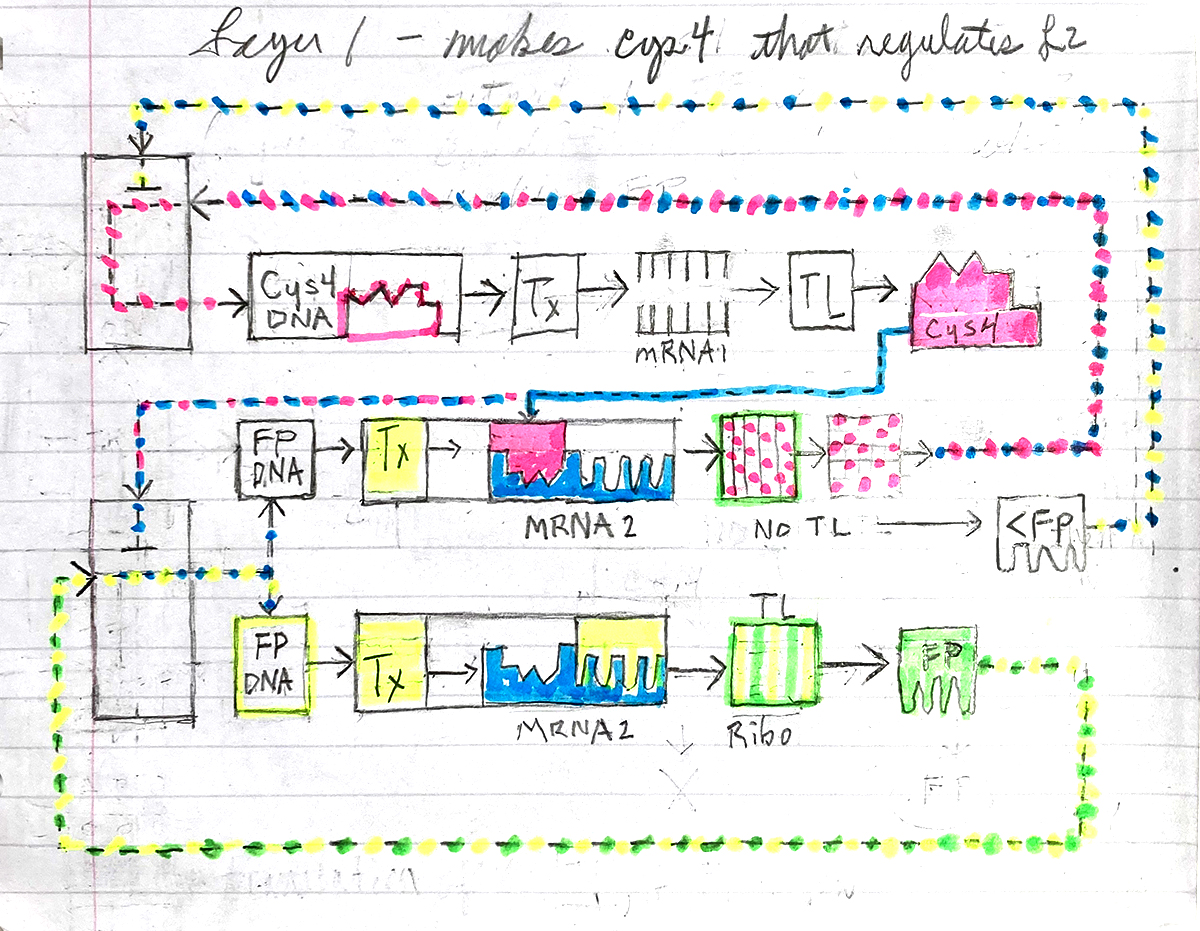
- Logic failed me on this part of the assignment. The visual compartmentalization of it helped to describe the relationship between enzymes, which block the production of others, but I failed to design a proper theoretical logic circuit.
- The idea of what constitutes an input in terms of X1 and X2 and creating a functional loop with them is not clear. An electrical circuit is a complete loop of electron flow. There are no loose ends, and trying to conceptualize the inside of a cell as a circuit loop is very confusing.
- An anology which seems fitting is how an electrical appliance works. It doesn’t work unless its plugged in, turned on, and receives input from an external variable/user.
- In the drawing above, FP stands for Fluorescent Protein which is regulated by the Cys4 enzyme.
- The second or middle line represents the instance where Cys4 binds to a post transcription (Tx) RNA site preventing translation (TL) of mRNA into FP. The Cys4 is released from the site, breaks up, and returns to the cell unorganised for reassembly by DNA.
- The bottom line represents the normal processing of FP.
- I attempted to produce a weighted function where low FP (<FP) would interupt Tx of Cys4 mRNA thereby allowing normal processing of FP. If there is too much Cys4, limiting FP production, normal FP production continues.
- In retrospect, this represents Cys4 regulation by FP, not FP regulated by Cys4, which was assigned task. And it’s not a proper logic circuit design in my opinion.
Assignment Part 2: Fungal Materials
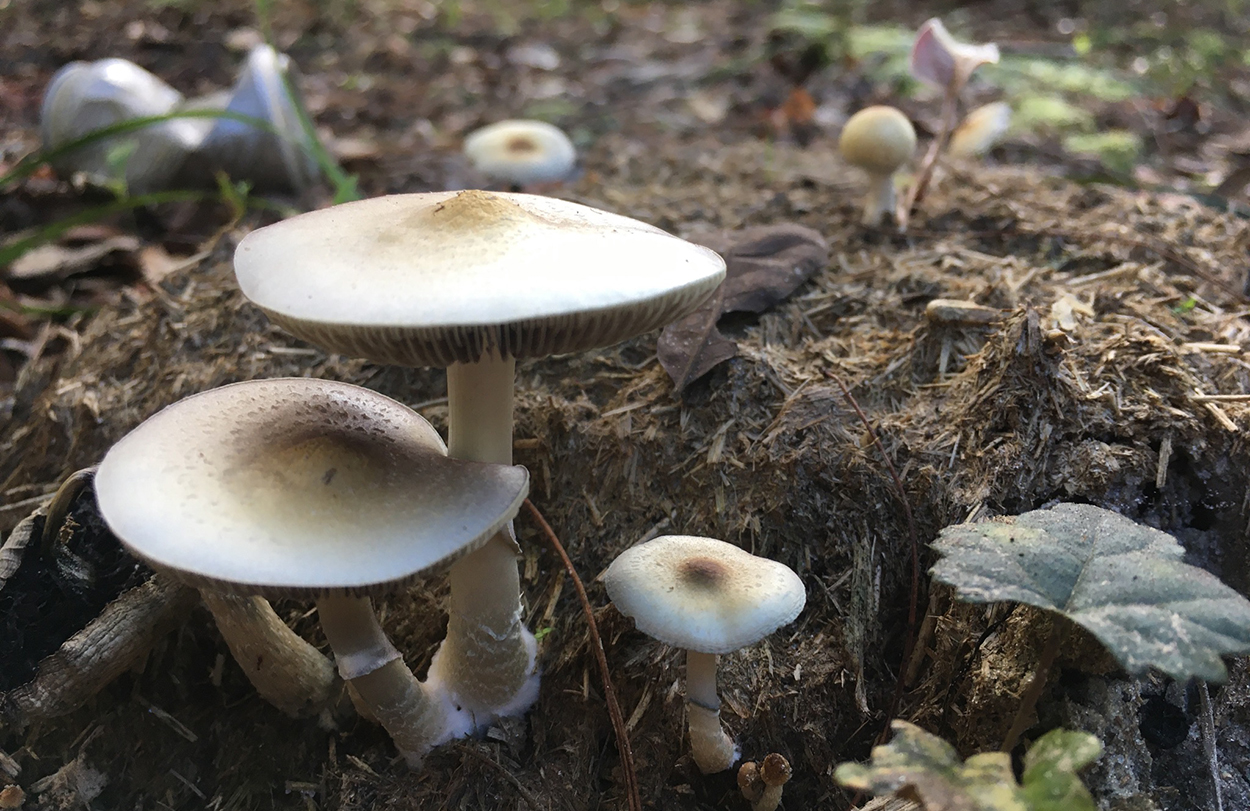 Golden Top (Psilocybe cubensis) -RCBeck
What are some examples of existing fungal materials and what are they used for? What are their advantages and disadvantages over traditional counterparts?
- Aside of making tasty treats and good times, they can be used in many different material applications. They can make bricks from organic material substrates by using it as a casting medium, and probably mold making as well.
- Apparently they can even function as a refractory material under thermal extremes, since it can be used as insulation.
- In the biological sense, they break down and process minerals, act as nutrient delivery systems, and convey information between plants, soil and bacteria.
What might you want to genetically engineer fungi to do and why? What are the advantages of doing synthetic biology in fungi as opposed to bacteria?
- I can imagine using mycelium to mine and transport specific minerals, or to collect and extract pollution.
- Fungi has been prolifically studied since Alexander Fleming’s discovery of Penicillin 1928. This has lead to the development of a wide range of synthetically produced “natural products” or NPs. From this perspective, the groundwork for research with fungi is in place. These compounds are generally produced using biosythetic pathways, which are closely related to one another; sometimes refered to as biosynthetic gene clusters (BGCs).
- Research within the fungal domain of BGCs leads researchers to believe the number of unknown compounds which have yet to be synthesised is staggering in number. This is promising for the development of many discoveries in research which could produce treatments, medications, material technologies and industrial applications.
Citation:
- Valiante V. Advances in Synthetic Biology of Fungi and Contributions to the Discovery of New Molecules. Chembiochem. 2023 Jun 1;24(11):e202300008. doi: 10.1002/cbic.202300008. Epub 2023 May 4. PMID: 36862368. Available at: https://chemistry-europe.onlinelibrary.wiley.com/doi/10.1002/cbic.202300008 (Accessed: 3-29-26).
- Huang M, Hull CM. Sporulation: how to survive on planet Earth (and beyond). Curr Genet. 2017 Oct;63(5):831-838. doi: 10.1007/s00294-017-0694-7. Epub 2017 Apr 18. PMID: 28421279; PMCID: PMC5647196.