Week 9: Cell Free Systems
It’s that time again… RrrrrrraaAAHH!!!
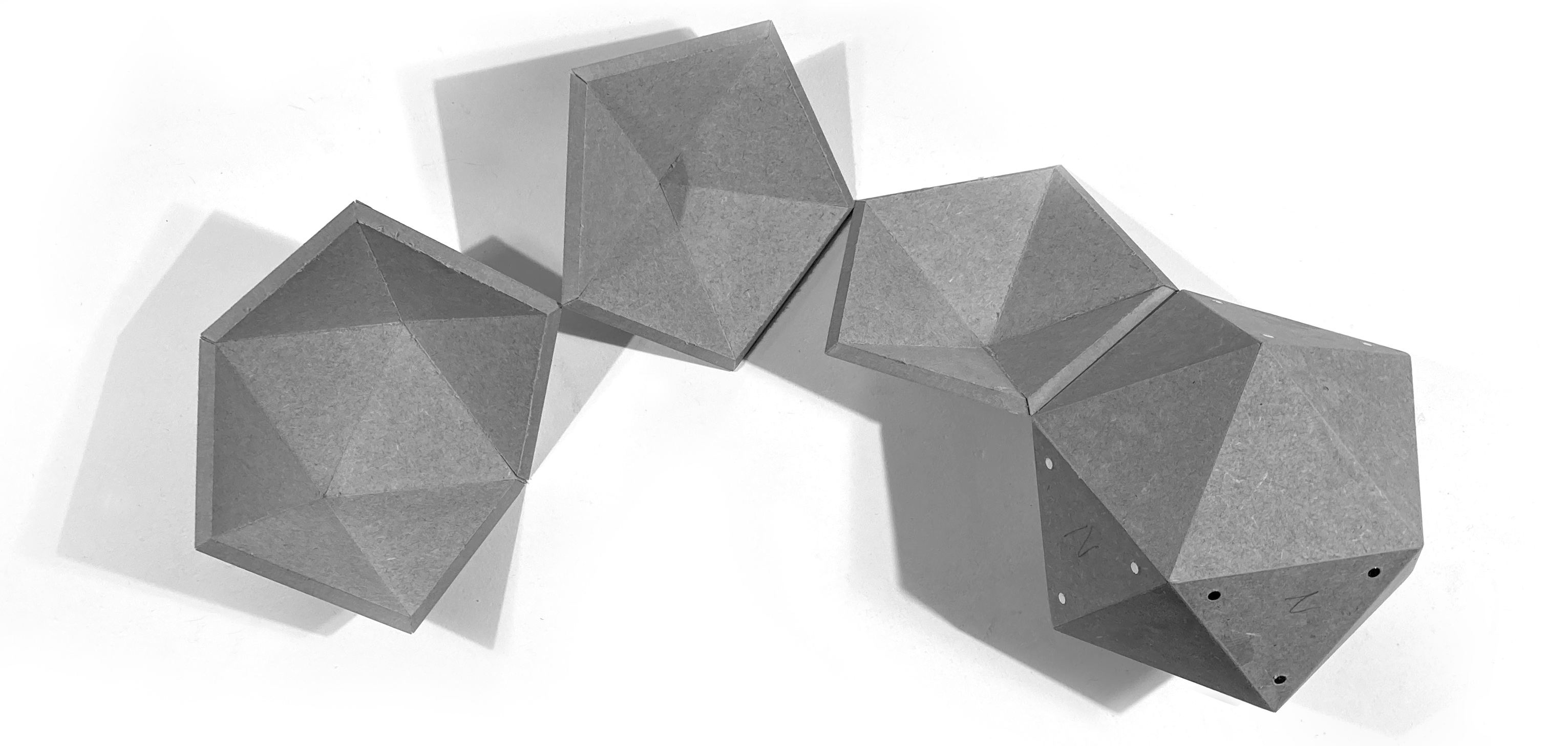 Glueless Icosahedron - RCBeck
General and Lecturer-Specific Questions
General homework questions
Explain the main advantages of cell-free protein synthesis over traditional in vivo methods, specifically in terms of flexibility and control over experimental variables. Name at least two cases where cell-free expression is more beneficial than cell production.
- CFPS have many advantages over traditional in vivo processes. Since there’s not a cell to keep alive, it doesn’t have the constraints of live culture, such as time, cell stabiltiy, cytotoxicity etc.
- It’s also an on demand process, which makes accessing the materials for reactions easier, and it’s scalable from low output to industrial manufacturing.
Describe the main components of a cell-free expression system and explain the role of each component.
- DNA Polymerase: Enzymes which catylize nucleoside molecules in DNA replication.
- RNA Polymerase: Enzyme for replicating RNA.
- Ribosome: Assembles protein from mRNA coding.
- Plasmid DNA: Contains instructions for specific/desired protein construction.
- Amino Acids, buffers, cofactors, salts: Provide building blocks for assembly of desired product. [1]
Why is energy provision regeneration critical in cell-free systems? Describe a method you could use to ensure continuous ATP supply in your cell-free experiment.
- Energy is requred to drive chemical reactions both in and outside of cells. ATP is the main source of energy for cellular reactions and it’s synthesis is critical to functionality.
- In cell free systems, there are pathways which function similar to cellular ATP production, but are more affordable to produce.
- Based on quick research, d-fructose to d-erythrose and AcP in a PKT-catalyzed reaction [2]seems to be a promising solution for producing ATP in a stable, cost affective system.
Compare prokaryotic versus eukaryotic cell-free expression systems. Choose a protein to produce in each system and explain why.
- The simplicity of prokaryotic cells streamlines the process of CFPS for more efficient output versus complex eukaryotic cells, which are more complex and require more attention to process design.
- Prokaryotic could be any number proteins, something I would want to produce a lot of. My final project proposal is based on GFP, which would benefit from CFPS for its on demand production and streamlined process.
- Eukaryotic proteins are certainly just as important to the future development of the research, and if I were to move away from bacteia towards plants the Bryophytes would be an interesting area of research. I would like to focus on the resurrection plants [3], and perhaps draw a correlation between protein producion and the characteristics which give this particular group their ability to survive desiccation.
How would you design a cell-free experiment to optimize the expression of a membrane protein? Discuss the challenges and how you would address them in your setup.
- This is an interesting question being that cell free systems are inherently membrane free. The first thing to consider are the building blocks of a membrane system which will determine the type/indgredients of the CFPS. What are the chemical characteristics of the membrane and what type of environment would be most hospitable for production? pH, temp, charge?
- Challenges would be producing functional membranes which incorporate pore systems and all the dynamics of a working membrane. This is dependent upon the function/type of cell the membrane is encapsulating and the what the cell needs to exchange for function.
Imagine you observe a low yield of your target protein in a cell-free system. Describe three possible reasons for this and suggest a troubleshooting strategy for each.
- Problems could include insufficient material for desired output, system contamination, or lack of control over process variables.
- The first thing to check for would be any signs of contamination, check the state of reagents used, and trace back executed steps with protocal. Was anything missed, out of date, or compromised?
- If so, then how or what needs to be changed in the setup?
- Triple check new set up before proceeding and streamline the process to avoid confusion which could lead to error.
- If available, perhaps building an Opentron protocal would help streamline.
- Problems could include insufficient material for desired output, system contamination, or lack of control over process variables.
Homework question from Kate Adamala
Design an example of a useful synthetic minimal cell as follows:
- Pick a function and describe it.
- A cell which would group/bind together with other similar/same cell types to form a collective would be an interesting place to start as it could potentially be used to build larger more complex structures based on a known architecture.
- What would your synthetic cell do? What is the input and what is the output?
- This is a color shifting cell, which can assume a high or low level of color intensity depending on environmental feedback, such as temperature change.
- Could this function be realized by cell-free Tx/Tl alone, without encapsulation?
- If one of it’s characteristics is to join together and create more complex structures then it seems like encapsulation would be necessary.
- It’s color shifting response could be achieved without encapsulation but organised structure not.
- Could this function be realized by genetically modified natural cell?
- Possibly, I did read a paper recently which described how Orange Carotenoid Proteins can shift their color from orange to red which helps with heat dissipation. But the structural aspects of design may be limited by cell type and their functional relationship with OCP.
- Also, OCP is only one example of a color shifting protein, so if the goal was to produce a more diverse range of color shifting protein then maybe not.
- Describe the desired outcome of your synthetic cell operation.
- With exposure to environmental stress such as heat or intense radiation, the cell would change color as desiccation progressed giving a visual indicator of drought and its intensity.
- What would your synthetic cell do? What is the input and what is the output?
- Design all components that would need to be part of your synthetic cell.
- What would be the membrane made of?
- Most cell membranes seem to be made of a glycerophospholipids which are hydrphylic on both the inside and outside of cell with a hydrophbic interior. If the cell is supposed to be capable of rehydrating after desication then the membrane would need to be very elastic to allow for expansion and contraction during this process. I would imagine that’s a function of what type of proteins are embedded into the phospholipid bilayer.
- What would you encapsulate inside? Enzymes, small molecules.
- First it needs to have genetic information for replication, and since it’s elastic there should be some kind of osmotic pressure sensor/regulator which will help it manage water and other molecules pass through its membrane.
- A nucleous containing genetic information which is protected by the outer membrane which expands and contracts with changing water conditions.
- It will also need some ribisomes for protein assembly, which will help with its color changing ability also linked to an osmotic pressure switch.
- Enzymes for activating color regulation relative to photosynthesis, and osmotic pressure.
- Which organism your Tx/Tl system will come from? Is bacterial OK, or do you need a mammalian system for some reason? (hint: for example, if you want to use small molecule modulated promotors, like Tet-ON, you need mammalian)
- How will your synthetic cell communicate with the environment? (hint: are substrates permeable? or do you need to express the membrane channel?)
- The elasticity of the outer membrane would probably benefit from an integral membrane protein system where channels are fixed into the flexible membrane which holds them, allowing transport of water, minerals, and materials for cellular function.
- Experimental details
- List all lipids and genes. (bonus: find the specific genes; for example, instead of just saying “small molecule membrane channel” pick the actual gene.)
- How will you measure the function of your system?
- In silico models would be the best place to start.
- Once a working theoretical model is established, then individual systems could be tested for isolated functionality.
- Building on functional test data, more complex system to system interactions wwould be next.
- Combine systems in a stacking order of functionality when building actual cell starting with most basic functions first.
- Complete cell tested for multifunctionality with controlled input and measured output.
Homework question from Peter Nguyen
Freeze-dried cell-free systems can be incorporated into all kinds of materials as biological sensors or as inducible enzymes to modify the material itself or the surrounding environment. Choose one application field — Architecture, Textiles/Fashion, or Robotics — and propose an application using cell-free systems that are functionally integrated into the material. Answer each of these key questions for your proposal pitch:
- Healthy Air- it’s in your control with the AQ+ test strip, real time indoor air quiltiy data.
- Proposal: Indoor air quility conditions are a moving target for both new structures as well as older ones. The increased dependance on HVAC to maintain conditions is growing in demand, and while these mechanical systems do help, they have functional limitations. Air filtration systems deal with the mechanical filtration of particles, but they are often ineffective due to lack of maintenance, which can lead to poor indoor air quality and affect resparatory health. This could easily be improved with the addition of an affordable paper based, or other biodegradable substrate, sensor, which would indicate air quality parameters. These sensors could offer a variety of conditions to monitor, as well as a built in exporation indicator for the test. Based on specific needs/environment, the sensor could be incorporated into an existing AC filter or placed on the exterior of air supply intakes. They could aslo help HVAC technicians test ducting and harware for contaminants in systems. Access to this technolgy would give people knowledge of their environment, and the ability to take appropriate action before their health or business is impacted.
Homework question from Ally Huang
- Provide background information that describes the space biology question or challenge you propose to address. Explain why this topic is significant for humanity, relevant for space exploration, and scientifically interesting. (Maximum 100 words)
- The ability to grow food in space is essential for human health on long term missions. Further, the recyclability of material is paramount, which includes the food/digestion relationship between plants and humans. There needs to be a clear and functional system developed for food production and recycling in closed loop environments such as space.
- Name the molecular or genetic target that you propose to study. Examples of molecular targets include individual genes and proteins, DNA and RNA sequences, or broader -omics approaches. (Maximum 30 words)
- Veggie depends on fertilizers for plants. Nitrifying bacteria, Nitrosospira and Nitrosomonas are key to recycling nutrients in space. This project explores the complete ammonia oxidizing bacteria (Comammox), Nitrospira inopinataammonia, for producing fertilizer in space.
- Describe how your molecular or genetic target relates to the space biology question or challenge your proposal addresses. (Maximum 100 words)
- Designing a closed loop biological system is the key to growing food in space. A critical part of this is the nitrogen cycle. This experiment will test Comammox enzymes which should convert ammonia into a bioavailable form of nitrogen for plant growth.
- Clearly state your hypothesis or research goal and explain the reasoning behind it. (Maximum 150 words)
- How will food be grown in space for long term missions? By working with cell free systems, enzymes produced by nitrifying bacteria can convert toxic ammonia into food for plants. The focus of this project isolates bacterial genes associated with enzyme production to produce fertilizer needed for plant cultivation. Comammox bacteria has been found to efficiently convert ammonia into nitrite/nitrate through its amoA gene sequence. Using restriction enzymes, gel electrophoresis, and PCR, this project will attempt to produce the amoA enzyme responsible for nitrification. Successful synthesis of this enzyme in space could play a critical role in establishing closed loop biological systems for space travel.
- Outline your experimental plan - identify the sample(s) you will test in your experiment, including any necessary controls, the type of data or measurements that will be collected, etc. (Maximum 100 words)
Part 1: Hydrate Complete ammonia oxidizing bacteria (Comammox), Nitrospira inopinata. Using preprepared restriction enzymes, isolate target gene sequences amoA, Ca. N. Inopinata. Select sequence using gel electrophoresis.
Part 2: PCR amplify amoA, combine with reagents, produce protein. Microdose samples with three different dilutions of ammonia - H2O, test for nitrite/nitrate ppm.
Part 3: Based on results from part 2, optimize cell free reaction protocol, produce nitrate/nutrient mix for Veggie plant pillow.
Part 4: Inoculate plant pillow with mix, compare plant growth against veggie system.
Citation:
- Gregorio NE, Levine MZ, Oza JP. A User’s Guide to Cell-Free Protein Synthesis. Methods Protoc. 2019 Mar 12;2(1):24. doi: 10.3390/mps2010024. PMID: 31164605; PMCID: PMC6481089.
- Cell-Free Reaction System for ATP Regeneration from d-Fructose Franziska Kraußer, Kenny Rabe, Christopher M. Topham, Julian Voland, Laura Lilienthal, Jan-Ole Kundoch, Daniel Ohde, Andreas Liese, and Thomas Walther ACS Synthetic Biology 2025 14 (4), 1250-1263 DOI: 10.1021/acssynbio.4c00877
- Commisso M, Guarino F, Marchi L, Muto A, Piro A, Degola F. Bryo-Activities: A Review on How Bryophytes Are Contributing to the Arsenal of Natural Bioactive Compounds against Fungi. Plants (Basel). 2021 Jan 21;10(2):203. doi: 10.3390/plants10020203. PMID: 33494524; PMCID: PMC7911284.
- Gechev T, Lyall R, Petrov V, Bartels D. Systems biology of resurrection plants. Cell Mol Life Sci. 2021 Oct;78(19-20):6365-6394. doi: 10.1007/s00018-021-03913-8. Epub 2021 Aug 14. PMID: 34390381; PMCID: PMC8558194.
- Clark, I.M., Hughes, D.J., Fu, Q. et al. Metagenomic approaches reveal differences in genetic diversity and relative abundance of nitrifying bacteria and archaea in contrasting soils. Sci Rep 11, 15905 (2021). https://doi.org/10.1038/s41598-021-95100-9
- Hayatsu, M., Katsuyama, C., & Tago, K. (2021). Overview of recent researches on nitrifying microorganisms in soil. Soil Science and Plant Nutrition, 67(6), 619–632. https://doi.org/10.1080/00380768.2021.1981119