Week 7: Genetic Circuits Part II: Neuromorphic Circuits
Part 1: Intracellular Artificial Neural Networks (IANNs)
Question 1 - Advantages of IANNs Over Traditional Genetic Circuits
Traditional genetic circuits usually work through Boolean logic. An input is treated as either ON or OFF, and the circuit produces an output based on that discrete state. This is useful for simple decisions, but it is limited when the cell needs to respond to gradual or mixed signals.
IANNs have several advantages over that kind of circuit.
Continuous input processing
IANNs can respond to graded signals, such as different concentrations of transcription factors, proteins, or small molecules. Instead of only detecting whether a signal is present or absent, the circuit can respond differently to low, medium, and high input levels.
Weighted signal integration
In an IANN, each input can contribute with a different strength. For example, one marker could have a strong positive effect on the output, while another marker has a weaker or inhibitory effect. This makes the circuit more flexible than a simple AND/OR gate, where inputs are usually treated more equally.
More complex classification
Because IANNs can combine several continuous inputs, they can classify cellular states that are hard to define with simple Boolean gates. A cell state may depend on the relative levels of multiple markers rather than one clear signal. An IANN is better suited for this kind of decision.
Potential adaptability
If the strength of regulatory connections can be tuned over time, an IANN could also have some capacity for adaptation or memory. This would be difficult to achieve with a fixed Boolean circuit.
Overall, IANNs are useful because they allow genetic circuits to behave more like analog decision-making systems rather than simple switches.
Question 2 - A Useful Application for an IANN
Concept: Smart CAR-T Cells for Solid Tumor Targeting
One application I would be interested in is a CAR-T cell that uses an IANN to decide whether a target cell is likely to be a tumor cell. A major problem in CAR-T therapy, especially for solid tumors, is off-target toxicity. Many tumor-associated antigens are also present at lower levels in healthy tissue, so a single-input circuit can be too blunt.
In this design, the engineered T cell would read several continuous inputs at the same time:
- X1: surface density of a tumor-associated antigen, such as HER2
- X2: level of an immune checkpoint ligand, such as PD-L1
- X3: level of a hypoxia-related signal, such as HIF-1alpha, which is often higher in a tumor microenvironment
Each input would feed into a regulatory layer with a different weight. The final output would control a killing response, such as expression or activation of a cytotoxic program. The cell would only respond strongly when the weighted sum of the inputs passes a threshold.
This would be useful because the circuit would not rely on a single marker. A healthy cell might express a small amount of HER2, but it may not also show the same PD-L1 and hypoxia-related profile as a tumor cell. The IANN would allow the CAR-T cell to respond to a combined pattern instead of one isolated signal.
There are also clear limitations. Gene expression is noisy, so the same circuit may behave differently across individual cells. It would also be hard to tune the weights precisely, because biological regulatory parts are not as predictable as electronic components. Another issue is timing. Transcription and translation are relatively slow, so the circuit may not respond quickly enough in every therapeutic setting. Finally, patient-to-patient and cell-to-cell variability could make the behavior of the engineered T-cell population difficult to predict.
Question 3 - Diagram: Intracellular Multilayer Perceptron
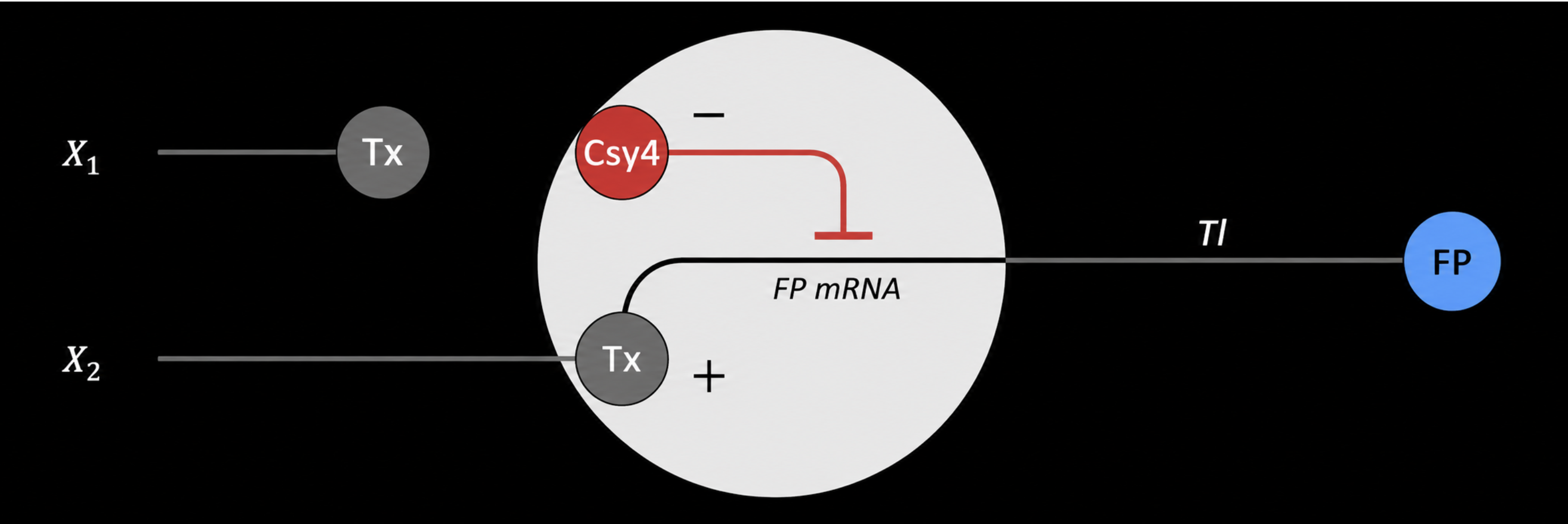
In this design, X1 drives the production of an endoribonuclease, such as Csy4. This creates the intermediate regulatory signal in the first layer.
X2 drives the production of fluorescent protein mRNA. This mRNA contains a recognition site for the endoribonuclease made from X1. When Csy4 is present, it can cleave or regulate the FP mRNA, changing how much fluorescent protein is translated.
The final fluorescent output depends on both inputs. X2 provides the transcript for the fluorescent protein, while X1 controls a regulator that changes how efficiently that transcript becomes protein. In that sense, the system behaves like a simple multilayer perceptron: the first layer converts one input into a regulatory molecule, and the second layer combines that regulatory signal with another input to control the final output.
Part 2: Fungal Materials
Question 1 - Existing Fungal Materials: Examples, Advantages, and Disadvantages
Fungal materials are often based on mycelium, the root-like network of fungal hyphae. These materials are already being explored in packaging, fashion, food coatings, and building materials.
Mycelium-Based Packaging
One common example is mycelium packaging. Companies such as Ecovative grow mycelium on agricultural waste, such as hemp hurd or corn stalks, inside molds. After the material grows into the desired shape, it is dried or heat-treated so it becomes a stable packaging block. It can be used as an alternative to expanded polystyrene foam.
| Feature | Mycelium Packaging | EPS / Styrofoam |
|---|---|---|
| Biodegradability | Compostable under the right conditions | Persists for a very long time |
| Feedstock | Can use agricultural waste | Petroleum-derived |
| Shape control | Can be grown in molds | Easily molded through industrial processing |
| Cushioning | Good enough for many packaging uses | Very strong and lightweight |
| Moisture resistance | Usually weaker unless coated or treated | Strong moisture resistance |
| Cost and scale | Improving, but still less mature | Very cheap and highly scaled |
The main advantage of mycelium packaging is that it can use waste biomass and break down after use. The main disadvantages are moisture sensitivity, slower production, and the difficulty of competing with the cost and performance of mature plastic foams.
Mycelium Leather Alternatives
Another example is mycelium-based leather alternatives. Bolt Threads developed Mylo, which was used in limited products and prototypes by brands such as Stella McCartney, Adidas, and lululemon. MycoWorks makes Reishi, another mycelium-based material aimed at leather-like applications.
Compared with animal leather, mycelium leather alternatives can avoid animal use and may require less land and water. They can also be grown into sheets with some control over thickness, texture, and surface quality.
The disadvantages are still important. These materials are expensive to produce, and their durability, abrasion resistance, and long-term aging are still being tested against traditional leather. Some products may also require finishing layers, backing materials, or coatings, which can make end-of-life composting more complicated.
Other Examples
Fungal chitosan can be used for films, food coatings, and biodegradable packaging. These materials are interesting because chitosan has film-forming and antimicrobial properties.
Mycelium biocomposites are also being explored for insulation panels and acoustic materials. In those cases, mycelium is useful because it can bind plant fibers together into a lightweight structure. The challenge is that building materials need to meet strict requirements for strength, fire behavior, moisture resistance, and long-term stability.
Question 2 - Genetically Engineering Fungi: What and Why
If I were engineering fungi for materials, I would focus on improving mechanical strength and moisture resistance. Those are two major limits for many mycelium-based products. Native mycelium networks are useful because they grow into a shape and bind biomass together, but they can still be brittle or sensitive to water.
One possible direction would be to engineer fungi to produce stronger structural proteins as they grow. For example, a fungus could be designed to secrete silk-like proteins into the mycelium matrix. This could make the final material tougher and more flexible while keeping the basic advantage of mycelium: it grows into the structure itself.
Another direction would be controlling degradation rate. For packaging, fast composting is useful. For furniture, shoes, or building materials, the material needs to last much longer during normal use. By tuning genes involved in cell wall formation and breakdown, such as chitin synthases or glucanases, it may be possible to make fungal materials that are stable in use but degrade under specific composting conditions.
Fungi are also a strong chassis for synthetic biology compared with bacteria for several reasons.
First, fungi are eukaryotes, so they are often better at folding and secreting complex proteins than bacteria such as E. coli. This matters if the engineered material depends on secreted enzymes or structural proteins.
Second, filamentous fungi naturally form a physical network. With bacteria, the cells usually need to be harvested and processed into a material after growth. With mycelium, the organism is already building a material as it grows. That makes genetic engineering directly connected to the material-forming process.
Third, many fungi can grow on lignocellulosic feedstocks, including agricultural waste. This is useful for biomaterials because the feedstock is cheap and renewable.
Finally, some industrial fungi, such as Aspergillus and Trichoderma species, are already used for high-level protein secretion. That makes them attractive if the goal is to produce and export useful proteins directly into a growing material.
Overall, I would use fungal synthetic biology to make mycelium materials stronger, more water-resistant, and more controllable after disposal. The strongest reason to use fungi is that the growth process and the material-making process are closely linked.