Week 11 HW: Week 11 — Bioproduction & Cloud Labs
Part 1: The 1,536 Pixel Artwork Canvas | Collective Artwork
For the collective bioart project, I contributed a small bacteriophage drawing in the upper-right corner of the canvas. (Later seemed to have been modified by someone else)
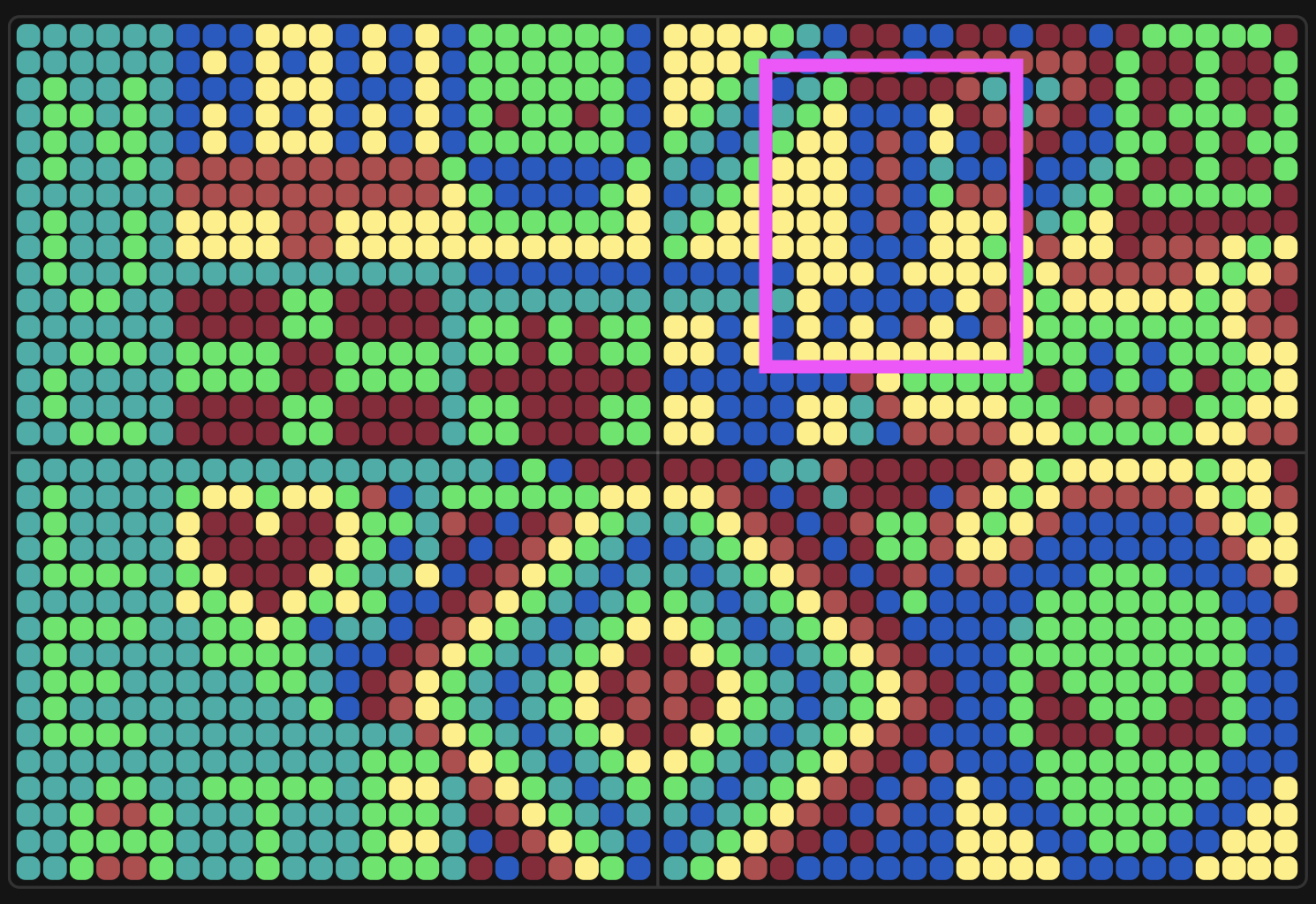
What I liked about this project is that it made the artwork feel genuinely collective. Instead of everyone making a separate image, the final result became a shared and evolving biological canvas. The fact that my pixel contribution could be changed by someone else was a little unexpected, but it also made the project feel more alive.
For next year, it could be helpful to have a simple version-history or layer system, so each person can still see what they originally contributed. Another small improvement could be to reserve some collaborative zones and some individual zones, so the artwork can support both collective editing and personal authorship.
Part 2: Cell-Free Protein Synthesis | Cell-Free Reagents
Roles of Each Component
E. coli Lysate / BL21(DE3) Star Lysate
The lysate provides the core biological machinery for transcription and translation, including ribosomes, tRNAs, translation factors, metabolic enzymes, and T7 RNA polymerase. In this reaction, it functions like the “cell” without the cell membrane.
Potassium Glutamate
Potassium glutamate helps set the ionic strength of the reaction and makes the environment more similar to the inside of an E. coli cell. This supports proper ribosome function, enzyme activity, and protein folding.
HEPES-KOH pH 7.5
HEPES-KOH is the main buffer that keeps the reaction near physiological pH. This is important because transcription, translation, and fluorescent protein maturation are all sensitive to pH changes.
Magnesium Glutamate
Magnesium is essential for ribosome stability, RNA structure, and many enzymatic reactions in transcription and translation. However, too much or too little magnesium can strongly reduce cell-free protein expression.
Potassium Phosphate Monobasic / Dibasic
The phosphate buffer pair helps control pH and provides phosphate species that can participate in energy metabolism. Using both monobasic and dibasic forms allows the system to tune the buffer around the desired pH.
Ribose
Ribose provides a sugar backbone source for nucleotide regeneration. In the longer NMP-ribose-glucose system, ribose helps the lysate rebuild nucleotide triphosphates from simpler nucleotide or base precursors.
Glucose
Glucose works as a long-term carbon and energy source. Instead of giving the reaction all of its energy immediately, glucose allows the lysate’s metabolic enzymes to regenerate energy over a longer incubation.
AMP, CMP, GMP, UMP
These nucleotide monophosphates act as lower-cost precursors for the NTPs needed during transcription. The lysate can phosphorylate them into ATP, CTP, GTP, and UTP.
Guanine
Guanine is a nucleobase precursor that can be converted into GMP through salvage pathways in the lysate. This allows the system to produce GTP even when GMP is reduced or omitted.
17 Amino Acid Mix
The amino acid mix supplies most of the building blocks needed for protein synthesis. The ribosome uses these amino acids to translate the fluorescent protein sequence.
Tyrosine
Tyrosine is included separately because it has solubility and stability issues compared with many other amino acids. It is still essential for translation and is also part of the chromophore chemistry in many fluorescent proteins.
Cysteine
Cysteine is also supplied separately because it can be chemically unstable and oxidation-sensitive. Keeping it separate helps maintain a more controlled amino acid composition.
Nicotinamide
Nicotinamide supports cofactor metabolism and can help maintain redox and energy-related activity in the lysate. This is especially useful for longer cell-free reactions.
Nuclease-Free Water
Nuclease-free water is used to bring the reaction to the final volume without adding enzymes that could degrade DNA or RNA.
Difference Between the 1-Hour PEP-NTP Mix and the 20-Hour NMP-Ribose-Glucose Mix
The 1-hour optimized PEP-NTP master mix is designed for fast expression. It directly provides NTPs and uses PEP as an immediate energy source, so transcription and translation can start quickly and produce a strong short-term signal.
The 20-hour NMP-ribose-glucose master mix is designed for longer, more sustainable protein production. Instead of directly providing all NTPs, it uses NMPs, ribose, glucose, and guanine so the lysate can regenerate nucleotides and energy over time. This makes it more suitable for long-incubation fluorescent artwork, where the goal is not only fast expression but sustained fluorescence over many hours.
Bonus: How can transcription occur if GMP is not included but Guanine is?
Transcription can still occur because guanine can be converted into GMP through nucleotide salvage pathways in the E. coli lysate. After guanine is converted to GMP, cellular kinases can phosphorylate GMP into GDP and then GTP, which T7 RNA polymerase can use for RNA synthesis.
Part 3: Planning the Global Experiment | Cell-Free Master Mix Design
Biophysical / Functional Properties of the Six Fluorescent Proteins
sfGFP
sfGFP is useful in cell-free systems because it folds very efficiently and matures quickly, making it a strong positive-control fluorescent protein. Its main advantage is that it is robust, so changes in fluorescence are more likely to reflect the reaction condition rather than complete folding failure.
mRFP1
mRFP1 is a red fluorescent protein, but it matures more slowly and has lower brightness compared with newer red fluorescent proteins. In a cell-free reaction, this means the readout may lag behind actual protein production.
mKO2
mKO2 is an orange fluorescent protein with moderate acid sensitivity and relatively slow maturation. For a long 36-hour incubation, pH stability could strongly affect how much orange fluorescence is visible at the endpoint.
mTurquoise2
mTurquoise2 is a cyan fluorescent protein with high quantum yield, rapid maturation, and very low acid sensitivity. These properties make it a good candidate for stable readout over time, although cyan fluorescence can be closer to background autofluorescence than red/orange channels.
mScarlet-I
mScarlet-I is a bright, rapidly maturing monomeric red fluorescent protein. Its brightness makes it attractive for artwork, but its moderate acid sensitivity means that pH control still matters during long incubation.
Electra2
Electra2 is a blue fluorescent protein with strong brightness and blue emission around 454 nm. Since blue fluorescence can be more sensitive to background and imaging conditions, the final readout may depend strongly on the plate reader settings and optical channel.
Hypothesis for Master Mix Adjustment
For mKO2, I would test whether increasing the buffering capacity of the master mix improves the final fluorescence after 36 hours. Because mKO2 has moderate acid sensitivity and slow maturation, a longer reaction may lose signal if the reaction becomes too acidic over time.
My hypothesis is that adding extra HEPES-KOH pH 7.5 and/or carefully tuning the potassium phosphate buffer would help maintain pH stability during the 36-hour incubation. The expected result would be stronger and more consistent orange fluorescence at the endpoint, especially compared with conditions where the reaction produces protein but the fluorescent signal is reduced by pH drift.
Assigned Wells / Final Project Slide
For the next phase, I would use the assigned wells to test how the custom reagent supplement changes fluorescence over time. My final project slide is focused on Glowing Ice Cream, so I would connect this experiment back to the broader question of how biological light production or fluorescence can be made visible, playful, and stable enough for a designed experience.
Data Analysis Plan
Once the fluorescence data is returned, I would compare not only the final endpoint brightness, but also the shape of the fluorescence curve over time. For artwork, the most useful condition is not necessarily the one with the highest short peak, but the one that gives a strong and stable visible signal across the full incubation window.