Week 11 HW: Bioproduction and Cloud Labs
Part A: The 1,536 Pixel Artwork Canvas | Collective Artwork
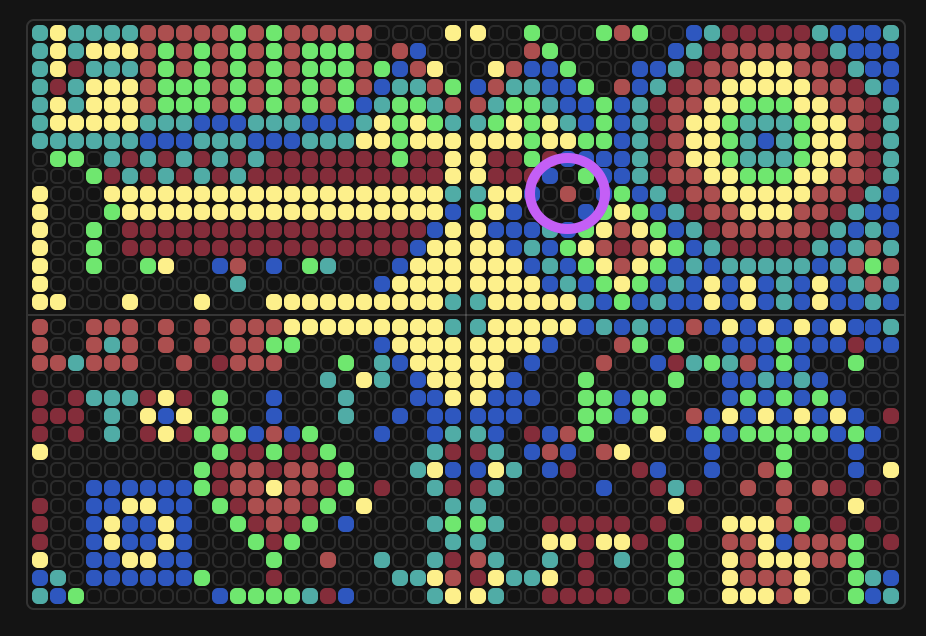
My contribution to the Pixel Artwork Canvas is the red pixel circled in pink, located on position Q2K7 and was the 1298th contribution overall. What I like about the project is that it showcases fundamental aspects of human collaboration, by having decisionmaking simplified and visualised in the artwork. The participant is asked to question prioritising their own agency or the agency of another contributor: do you reject what was made before you or do you honour its legacy?
What could make the experience better next year, would be to make the canvas bigger. I think it would be interesting to see what emerges when people have enough space to draw without having to compete for space as much. Would it create smaller islands? Would it still be completely covered?
Part B: Cell-Free Protein Synthesis | Cell-Free Reagents
Referencing the cell-free protein synthesis reaction composition (the middle box outlined in yellow on the image above, also listed below), provide a 1-2 sentence description of what each component’s role is in the cell-free reaction.
Lysate components
E. coli lysate. This provides the core machinery needed for protein synthesis, including ribosomes, enzymes, and other factors that carry out transcription and translation.
BL21 (DE3) Star lysate (includes T7 RNA polymerase). This is a more specialized extract that contains T7 RNA polymerase, which helps transcribe the DNA template into mRNA efficiently.
Salts and buffer
Potassium glutamate. Helps maintain the right ionic conditions in the reaction so the protein synthesis machinery can work properly.
HEPES-KOH pH 7.5. Acts as a buffer to keep the reaction at a stable pH.
Magnesium glutamate. Supplies magnesium, which is important for ribosome function and many enzyme activities.
Potassium phosphate monobasic. Helps with buffering and maintaining the correct chemical environment.
Potassium phosphate dibasic. Works together with the monobasic form to keep the pH balanced.
Energy / nucleotide system
Ribose. Supports nucleotide-related metabolism and helps with maintaining the reaction chemistry.
Glucose. Serves as an energy source that can help regenerate ATP during the reaction.
AMP. Helps support the energy pool in the reaction.
CMP. Supplies pyrimidine nucleotide building blocks.
GMP. Supplies guanine-related nucleotide building blocks.
UMP. Supplies uracil-related nucleotide building blocks.
Guanine. Helps replenish guanine nucleotide pools for RNA synthesis.
Translation mix
17 amino acid mix. Provides most of the amino acids needed to build the protein.
Tyrosine. Added separately to make sure there is enough of this amino acid in the reaction.
Cysteine. Added separately for the same reason, since it can sometimes be limiting.
Additives
Nicotinamide. Helps support the extract’s metabolism and can improve overall reaction performance.
Backfill
Backfill. Used to make up the remaining volume in the reaction without changing the chemistry too much.
Nuclease-free water. Adjusts the final reaction volume while avoiding contamination that could break down DNA or RNA.
References:
Gregorio, N. E., Levine, M. Z., & Oza, J. P. (2019). A User's Guide to Cell-Free Protein Synthesis. Methods and protocols, 2(1), 24. https://doi.org/10.3390/mps2010024
Krinsky N, Kaduri M, Shainsky-Roitman J, Goldfeder M, Ivanir E, Benhar I, et al. (2016) A Simple and Rapid Method for Preparing a Cell-Free Bacterial Lysate for Protein Synthesis. PLoS ONE 11(10): e0165137. https://doi.org/10.1371/journal.pone.0165137
Describe the main differences between the 1-hour optimized PEP-NTP master mix and the 20-hour NMP-Ribose-Glucose master mix shown in the Google Slide above. (2-3 sentences)
The 1-hour optimized PEP-NTP master mix is designed for faster, short-term protein production, while the 20-hour NMP-Ribose-Glucose master mix is set up to support longer reactions over a much longer incubation time. In simple terms, the PEP-NTP mix is more geared toward quick energy use and fast output, whereas the NMP-Ribose-Glucose mix seems designed to sustain protein synthesis more gradually over time.
Part C: Planning the Global Experiment | Cell-Free Master Mix Design
sfGFP is a superfolder GFP variant with very fast maturation, so it becomes fluorescent quickly after translation and is usually a strong readout in cell-free systems. Its good folding robustness also helps it fluoresce even when expression conditions are not ideal.
mRFP1 is a red fluorescent protein with relatively slow maturation compared with sfGFP, so fluorescence can lag behind protein production in short cell-free runs. It also has moderate acid sensitivity, which can affect signal if the reaction conditions drift in pH.
mKO2 is an orange fluorescent protein that is strongly oxygen dependent for chromophore maturation, so low-oxygen conditions can reduce or delay its fluorescence. It also has moderate acid sensitivity, which can influence readout in reactions where pH is not tightly controlled.
mTurquoise2 is a cyan FP with very low acid sensitivity, which makes its fluorescence more reliable if the reaction environment changes slightly in pH. It is also reported to mature quickly, so it is useful when you want a relatively fast signal after expression.
mScarlet-I is a very bright red FP with relatively fast maturation, so it gives a strong fluorescence signal once enough protein has been made. Its moderate acid sensitivity means low pH could still reduce the observed fluorescence a bit.
Electra2 is a blue fluorescent protein and one important practical point is that blue FPs often tend to be less bright than many green or red FPs, which can make the readout harder in cell-free assays. It also depends on proper folding and chromophore formation, so expression conditions can affect how much signal you actually see. Electra2, published in 2022, is considerable brighter than other bFPs.
2. Create a hypothesis for how adjusting one or more reagents in the cell-free mastermix could improve a specific biophysical or functional property you identified above, in order to maximize fluorescence over a 36-hour incubation. Clearly state the protein, the reagent(s), and the expected effect.
As stated above, mKO2 is an orange fluorescent protein that is strongly oxygen dependent for chromophore maturation, so low-oxygen conditions can reduce or delay its fluorescence. It also has moderate acid sensitivity, which can influence readout in reactions where pH is not tightly controlled. Therefore, maximizing fluorescence over a 36-hour incubation period would only be feasible through higher-oxygen conditions and a controlled pH that stays near neutral to slightly basic.
I therefore hypothesise that an increase in HEPES-KOH pH 7.5 buffer would allow for the necessary stability of the pH of the mastermix. Oxygen availability on the other hand, does not necessarily relate to any specific reagent, but rather the aeration of the reaction. This includes allowing for sufficient headspace, not too much total volume and potentially aeration through continuous stirring.
3. The second phase of this lab will be to define the precise reagent concentrations for your cell-free experiment. You will be assigned artwork wells with specific fluorescent proteins and receive an email with instructions this week (by April 24). You can begin composing master mix compositions here.
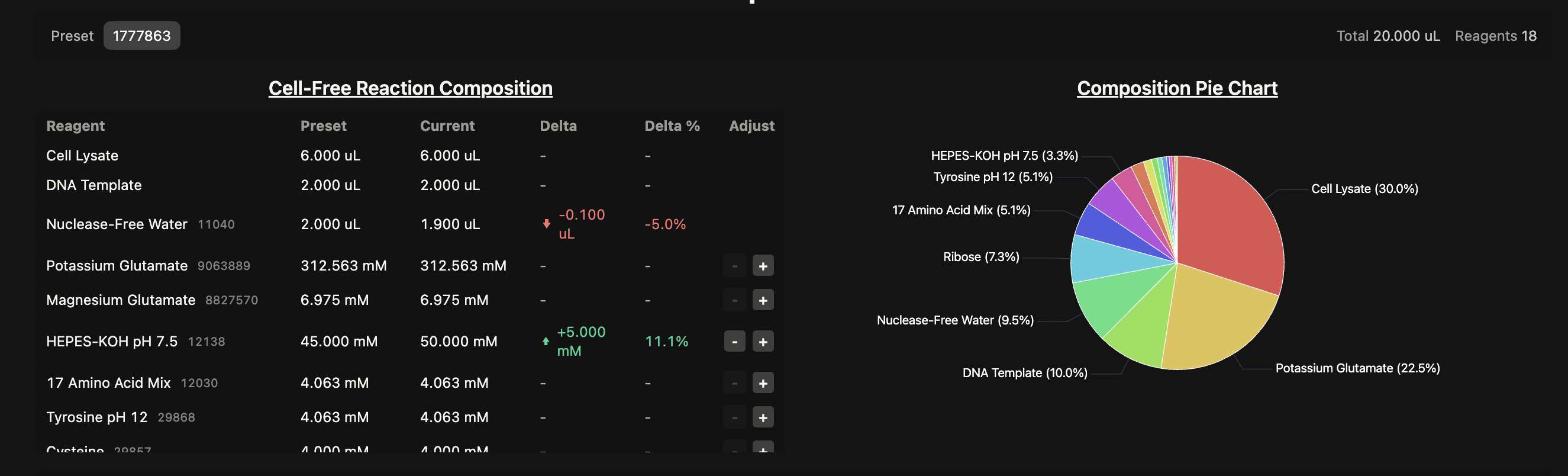
Based on my answer to question 2, I decided to increase the amount of HEPES-KOH pH 7.5 in the master mix composition with 5.000 mM to test whether my hypothesis was correct. Due to the fact that I do not have access to the lab, I would unfortunately not be able to test it in vitro.