Week 1 HW: Principles and Practices
1.First, describe a biological engineering application or tool you want to develop and
why?
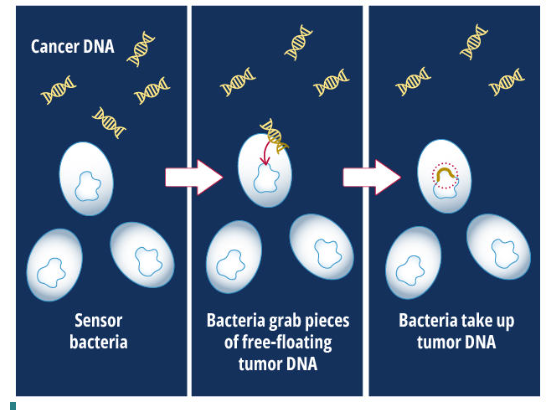
Biosensors (living sensors) are not a new concept. They have already been used to detect metals in water, metabolites in bioreactors, pathogens in food, and plant stress signals in agriculture. However, an exciting future application would be designing biosensors that can detect tumors inside the human body and assist in cancer diagnosis.
My interest lies in cancer biology and applying synthetic biology to combat this disease. I want to design and engineer bacteria that can sense tumor-specific signals in the body and produce a measurable response, such as fluorescence or secretion of a detectable biomarker.
This technology could:
- Enable early cancer detection
- Improve treatment outcomes
- Complement existing diagnostic methods
- Reduce invasive diagnostic procedures
- Detect tumor-associated metabolites or surface markers
2.Next, describe one or more governance/policy goals related to ensuring that this
application or tool contributes to an “ethical” future, like ensuring non-malfeasance (preventing harm). Break big goals down into two or more specific sub-goals?
Past global health events, such as COVID-19, demonstrate how biological systems—whether naturally mutated or engineered—can spread widely and have major unintended consequences. Therefore, the overarching governance goal is to ensure tumor-sensing engineered bacteria are developed and used ethically, prioritizing safety, environmental protection, and social responsibility.
Sub-Goals
1. Non-maleficence (prevent harm)
- Minimize unintended pathogenicity
- Prevent horizontal gene transfer
- Reduce harmful immune responses in the host
2. Environmental protection
- Prevent persistence outside intended environments
- Avoid uncontrolled dissemination
- Minimize ecological disruption
3. Equity and access
- Ensure fair access to the technology
- Distribute benefits across populations
- Prevent socioeconomic disparities in availability
3.Next, describe at least three different potential governance “actions” by considering
the four aspects below (Purpose, Design, Assumptions, Risks of Failure & “Success”)?
Option 1 — Biosafety Regulation
Engineered microorganisms are tested for laboratory safety, but additional requirements should include:
- Genetic kill-switch testing
- Immunogenicity testing
- Containment validation
- Standardized regulatory protocols (FDA, EMA)
- Mandatory approval before clinical trials
Assumptions
- Lab testing predicts in-body behavior accurately
- Kill switches function reliably
Risks
- Failure → infection or environmental persistence
- Regulatory burden may slow research
Potential Success
- Reduced patient risk and improved clinical safety
Option 2 — Incentives for Fair Access and Ethical Use
Commercialization is necessary for implementation, but profit incentives can limit accessibility.
Proposed actions:
- Funding incentives tied to equity plans
- Ethical research and commercialization guidelines
- Grant approval contingent on fair-access strategies
- Responsible research training in universities and industry
Assumption
- Financial and policy incentives influence behavior
Risks
- Companies prioritize profit over guidelines
Potential Success
- More equitable distribution of benefits
Option 3 — Environmental Containment & Monitoring
Containment practices vary across laboratories, creating inconsistency.
Proposed actions:
- Standardized containment protocols
- Gut simulator testing models
- Routine environmental monitoring
- Mandatory reporting requirements
- Implementation by regulators, biotech companies, and academic labs
Risks
- Human error
- System failure
- False sense of security if protocols become outdated
Potential Success
- Early detection of accidental release
- Reduced environmental risk
Costs
- Additional training and infrastructure
4.Next, score (from 1-3 with, 1 as the best, or n/a) each of your governance actions
against your rubric of policy goals. The following is one framework but feel free to make your own?
| Does the option: | Option 1 | Option 2 | Option 3 |
|---|---|---|---|
| Enhance Biosecurity | |||
| • By preventing incidents | 1 | 2 | 2 |
| • By helping respond | 1 | 2 | 2 |
| Foster Lab Safety | |||
| • By preventing incident | 1 | 2 | 2 |
| • By helping respond | 1 | 2 | 2 |
| Protect the environment | |||
| • By preventing incidents | 2 | 2 | 1 |
| • By helping respond | 2 | 2 | 1 |
| Other considerations | |||
| • Minimizing costs and burdens to stakeholders | 3 | 1 | 2 |
| • Feasibility? | 2 | 1 | 2 |
| • Not impede research | 3 | 1 | 2 |
| • Promote constructive applications | 1 | 1 | 2 |
5.Last, drawing upon this scoring, describe which governance option, or combination of
options, you would prioritize, and why. Outline any trade-offs you considered as well as assumptions and uncertainties?
Based on the scoring, I would prioritize Option 1 (Biosafety Regulation) in combination with Option 2 (Fair Access and Ethical Use).
This combination provides the strongest protection for both human health and society, which are primary ethical priorities. Biosafety regulation ensures risk control, while equity-focused policies ensure responsible distribution of benefits.
Option 3 (environmental containment) remains important but serves more as a supporting framework.
Trade-offs
- Increased regulatory oversight may slow research
- Higher costs for labs and companies
- Training and monitoring systems require infrastructure
Assumptions
- Genetic kill switches function reliably
- Lab testing predicts biological behavior accurately
- Institutions comply with containment and monitoring protocols
- No major ecological disruption occurs if accidental release happens
Overall Rationale
Maximizing safety and ethical use outweighs the potential slowdown in research progress.
References
- Panteli JT, Forbes NS. Engineered bacteria detect spatial profiles in glucose concentration within solid tumor cell masses. Biotechnol Bioeng. 2016.
- Zúñiga A et al. Engineered L-lactate responding promoter system. ACS Synth Biol. 2021.
- Chien T et al. Enhancing bacterial tropism via genetically programmed biosensors. Nat Biomed Eng. 2022.
- National Cancer Institute. Engineered bacteria detect cancer.
- Ma X et al. Modular-designed engineered bacteria for precision tumor immunotherapy. Nat Commun. 2023.
- Part 2
Homework Questions
Homework Questions from Professor Jacobson
1. DNA Polymerase Error Rate and Genome Replication
Nature’s machinery for copying DNA is called DNA polymerase.
Question:
What is the error rate of polymerase? How does this compare to the length of the human genome? How does biology deal with that discrepancy?
Answer:
DNA polymerase error rate is roughly 1 per 10,000–100,000 bp
(10⁻⁵ to 10⁻⁷), whereas the length of the human genome is around
3.2 billion (3.2 × 10⁹) bp.
So, compared to the human genome length, DNA polymerase would introduce approximately 30,000–300,000 errors in a daughter cell during cell division.
Estimated errors:
- Haploid genome
- 10⁻⁵ to 10⁻⁷ × 3.2 × 10⁹ = 32,000 errors
- Diploid genome
- 10⁻⁵ to 10⁻⁷ × 6.4 × 10⁹ = 64,000 errors
Error-correction mechanisms:
DNA polymerase has built-in error removal capabilities:
- Nucleotide filtering (selection)
- Proofreading
The first reduces errors to about 1 in 10,000 bp, and proofreading reduces errors to about 10⁻⁷.
Cells also have repair systems such as:
- Mismatch repair → reduces errors 100–1000 fold
- DNA damage repair pathways
Together, these mechanisms reduce the overall error rate to approximately: one
This ensures genetic stability, meaning most cells copy their entire genome with zero permanent mistakes, and sometimes only one.
2. Number of Possible DNA Codes for an Average Human Protein
Question:
How many different ways are there to code (DNA nucleotide code) for an average human protein? In practice, why don’t all of these different codes work to produce the protein of interest?
Answer:
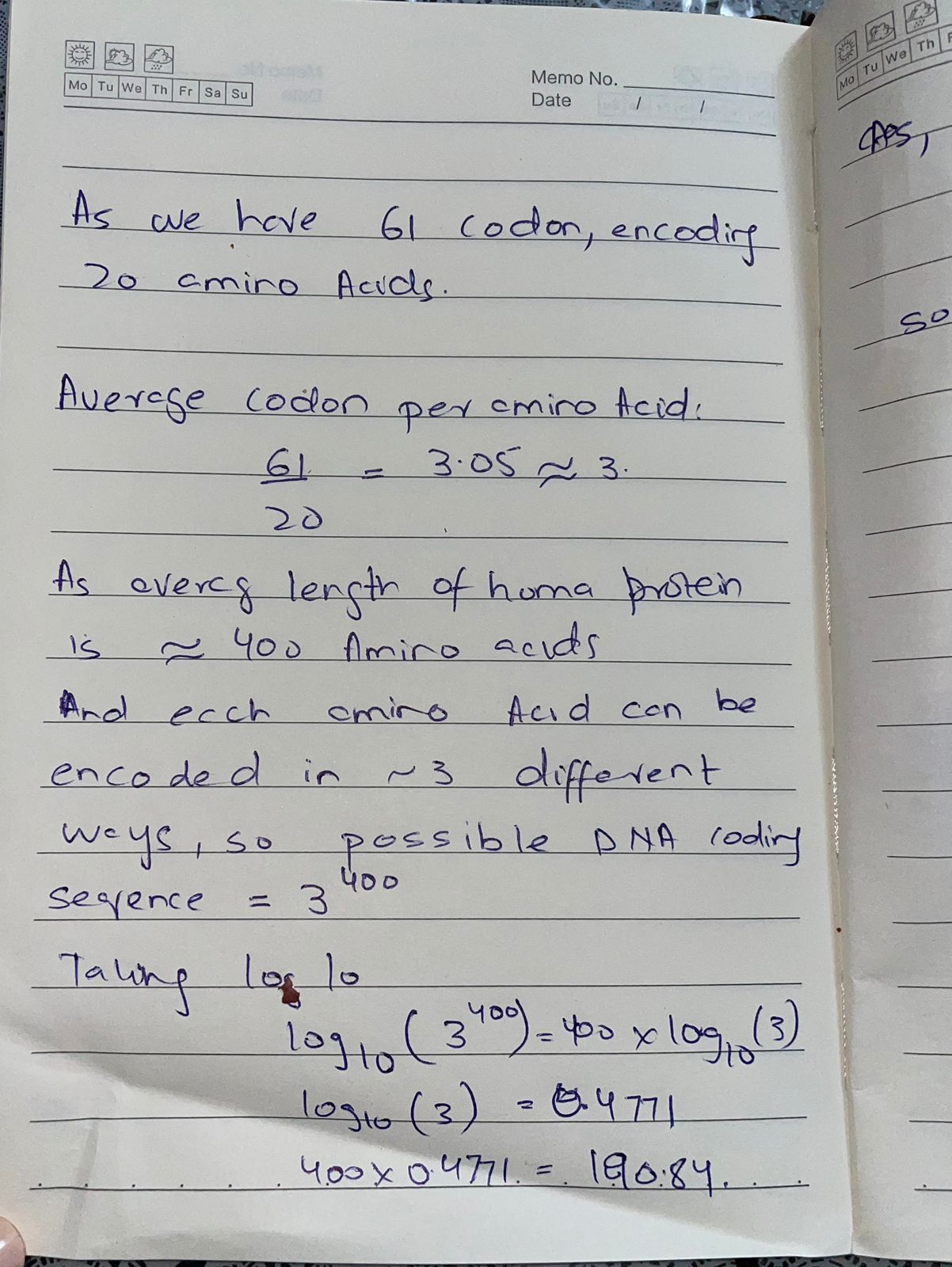
Due to the degeneracy of the genetic code, multiple codons can encode the same amino acid.
- There are 20 amino acids encoded by 61 codons
- Most amino acids are encoded by more than one codon
- The average human protein is roughly 400 amino acids long
- If each amino acid is encoded in 3 different ways on average
Then the number of possible DNA sequences encoding the same protein is approximately:~10¹⁹⁰

Why many sequences don’t work in practice:
Even if different DNA sequences produce the same amino acid chain, they may not produce the desired functional protein because biological function also depends on:
- Protein folding
- Gene regulation
- Translational efficiency
- RNA stability
- Cellular compatibility
Protein sequence alone is not sufficient for proper function.
Homework Questions from Professor LeProust
Oligo Synthesis
Questions:
- What is the most commonly used method for oligo synthesis currently?
- Why is it difficult to make oligos longer than 200 nt via direct synthesis?
- Why can’t you make a 2000 bp gene via direct oligo synthesis?
Answer:
The most common method is solid-phase phosphoramidite synthesis.
During chemical synthesis, each nucleotide addition has less than perfect efficiency. As the strand grows longer:
- The probability of adding incorrect nucleotides increases
- Errors accumulate exponentially
- Many strands become incomplete
After about 150–200 bases, most DNA molecules contain errors or are truncated, making purification difficult.
It is difficult to directly synthesize long genes (e.g., 2000 bp) because:
- Thousands of sequential chemical steps would be required
- Error accumulation would make accurate full-length products extremely rare
Solution used in practice:
Scientists synthesize many short DNA fragments (100–200 bases each) and assemble them using enzymatic methods to build the full gene.
Homework Questions from Professor George Church
Essential Amino Acids and the Lysine Contingency
Question:
What are the 10 essential amino acids in all animals, and how does this affect your view of the “Lysine Contingency”?
Answer:
The ten essential amino acids in animals are:
- Histidine
- Isoleucine
- Leucine
- Lysine
- Methionine
- Phenylalanine
- Threonine
- Tryptophan
- Valine
- Arginine
Lysine Contingency:
In synthetic biology biocontainment discussions, the lysine contingency refers to engineering organisms that require lysine to survive, preventing growth without external supply.
However:
- Lysine is essential for all animals
- It is widely present in tissues, food, and nutrient-rich environments
- It is commonly available in biological systems
Conclusion:
Because lysine is widely available, dependence on lysine alone is not a reliable or strict biocontainment strategy.
References
Chan, C. T. Y., et al. (2016).
“Deadman” and “Passcode” microbial kill switches for bacterial containment.
Nature Chemical Biology, 12, 82–86.
https://doi.org/10.1038/nchembio.1979
Mandell, D. J., et al. (2015).
Biocontainment of genetically modified organisms by synthetic protein design.
Nature, 518, 55–60.
https://doi.org/10.1038/nature14121
Gallagher, R. R., et al. (2015).
Multilayered genetic safeguards limit growth of microorganisms to defined environments.
Nature Communications, 6, 1–9.
https://doi.org/10.1038/ncomms6823