Week 11 — Week 11 — Bioproduction & Cloud Labs
Homework: Week 11 — Bioproduction & Cloud Labs
Part A: The 1,536 Pixel Artwork Canvas | Collective Artwork
1. Contribute at least one pixel to this global artwork experiment before the editing ends on Sunday 4/19 at 11:59 PM EST.
• A personalized URL was sent to the email address associated with your Discourse account, and you can discuss the artwork on the Discourse.
• If you did not have a chance to contribute, it’s okay, just make sure you become a TA this fall! 😉
Most of my contributions were in the top right quadrant, followed by the top left quadrant. Initially the top left was the LifeLabs logo, which is now the 2026. The top right is the ‘MIT’ now. I also contributed to the bottom left, which is now formed a bacteriophage. I forgot to take screenshots at the time.
I really like the collaborative aspect of this project. Also, it gives us the opportunity to see emergent art as it happens.
To improve on the project, I would maybe have 1 large contribution followed by lab-specific artwork; each lab across the world could make their own design. Obviously, this would be subject to time and financial constraints. But, if possible, it would be very cool!
Part B: Cell-Free Protein Synthesis | Cell-Free Reagents
1. Referencing the cell-free protein synthesis reaction composition (the middle box outlined in yellow on the image above, also listed below), provide a 1-2 sentence description of what each component’s role is in the cell-free reaction.
E. coli Lysate
(i) BL21 (DE3) Star Lysate (includes T7 RNA Polymerase):
Produces high levels of protein from the T7 promoter and can be used with high or low copy number plasmids, making BL21(DE3) competent cells the preferred strains for protein expression in bacteria [1].
Thermo Fisher Scientific. Competent cells for protein expression in E. coli BL21(DE3) and derivatives [Internet]. Waltham (MA): Thermo Fisher Scientific; [cited 2026 May 3]. Available from: https://www.thermofisher.com/uk/en/home/life-science/cloning/competent-cells-for-transformation/competent-cells applications/comp-cells-for-protein-expression.html
Salts/Buffer
(i) Potassium Glutamate
It is a salt that salt that maintains ionic strength. It leads to transcriptional activation of sets of genes that allow the cell to achieve long-term adaptation to high osmolarity
Gralla JD, Vargas DR. Potassium glutamate as a transcriptional inhibitor during bacterial osmoregulation. EMBO J. 2006;25(7):1515–1521. doi:10.1038/sj.emboj.7601041.
(ii) HEPES-KOH pH 7.5
HEPES-KOH is a buffering agent that maintains a stable physiological pH during the cell-free reaction. Maintaining pH near 7.5 is essential because transcription and translation enzymes are highly sensitive to pH fluctuations.
Good NE, Winget GD, Winter W, Connolly TN, Izawa S, Singh RMM. Hydrogen ion buffers for biological research. Biochemistry. 1966;5(2):467-477. doi:10.1021/bi00866a011.
(iii) Magnesium Glutamate
Magnesium glutamate supplies Mg²⁺ ions that stabilize ribosomes, RNA, and ATP-dependent enzymatic reactions during transcription and translation. Magnesium concentration strongly affects protein synthesis efficiency and overall fluorescence yield in cell-free systems.
Jewett MC, Swartz JR. Rapid expression and purification of 100 nmol quantities of active protein using cell-free protein synthesis. Biotechnol Prog. 2004;20(1):102-109. doi:10.1021/bp0342330.
(iv) Potassium phosphate monobasic
Potassium phosphate monobasic contributes to phosphate buffering and helps maintain intracellular-like ionic conditions in the reaction. It also supports ATP regeneration and metabolic stability during extended incubations.
Kim DM, Swartz JR. Regeneration of adenosine triphosphate from glycolytic intermediates for cell-free protein synthesis. Biotechnol Bioeng. 2001;74(4):309-316. doi:10.1002/bit.1110.
(v) Potassium phosphate dibasic
Potassium phosphate dibasic works together with monobasic phosphate to maintain buffering capacity and phosphate balance in the cell-free system. This helps stabilize enzymatic activity and sustain long-term transcription and translation reactions.
Kim DM, Swartz JR. Regeneration of adenosine triphosphate from glycolytic intermediates for cell-free protein synthesis. Biotechnol Bioeng. 2001;74(4):309-316. doi:10.1002/bit.1110.
Energy / Nucleotide System
(i) Ribose
D-ribose is a naturally occurring monosaccharide within the pentose pathway that assists with ATP (Adenosine Triphosphate) production. In cell-free systems, it helps sustain nucleotide regeneration and prolonged protein synthesis.
Mahoney DE, Hiebert JB, Thimmesch A, Pierce JT, Vacek JL, Clancy RL, et al. Understanding D-ribose and mitochondrial function. Adv Biosci Clin Med. 2018;6(1):1-5. doi:10.7575/aiac.abcmed.v.6n.1p.1.
(ii) Glucose
Glucose serves as a major energy source that is metabolized to generate ATP through glycolysis and related metabolic pathways. In cell-free protein synthesis systems, glucose supports ATP regeneration, helping sustain transcription and translation during long incubations.
Hantzidiamantis PJ, Awosika AO, Lappin SL. Physiology, glucose. In: StatPearls [Internet]. Treasure Island (FL): StatPearls Publishing; 2024 [cited 2026 May 24]. Available from: https://www.ncbi.nlm.nih.gov/books/NBK545201/
(iii) AMP
Adenosine triphosphate is a nucleotide involved in cellular energy metabolism and nucleotide biosynthesis. For cell-free protein synthesis systems, AMP contributes to ATP regeneration pathways and helps sustain transcriptional and translational activity during extended incubations.
Hardie DG. AMP-activated protein kinase: maintaining energy homeostasis at the cellular and whole-body levels. Annu Rev Nutr. 2014;34:31-55.
(iv) CMP
Cytidine monophosphate is a pyrimidine nucleotide involved in RNA synthesis and nucleotide metabolism. In cell-free protein synthesis systems, CMP will help maintain nucleotide pools required for sustained transcription during extended reactions
BOC Sciences. Comprehensive discussion on pyrimidine nucleotides [Internet]. Shirley (NY): BOC Sciences; [cited 2026 May 24]. Available from: https://www.bocsci.com/resources/comprehensive-discussion-on-pyrimidine-nucleotides.html
(v) GMP
Guanosine monophosphate is a purine nucleotide that serves as a precursor for Guanosine triphosphate (GTP) synthesis; which is essential for transcription and translation elongation. In cell-free systems, GMP supplementation can help sustain nucleotide availability and prolonged protein synthesis.
ScienceDirect. Guanosine monophosphate [Internet]. Amsterdam: Elsevier; [cited 2026 May 24]. Available from: https://www.sciencedirect.com/topics/neuroscience/guanosine-monophosphate
https://pmc.ncbi.nlm.nih.gov/articles/PMC9620470/
(vi) UMP
Uridine monophosphate is a pyrimidine nucleotide involved in RNA biosynthesis and cellular nucleotide metabolism. In cell-free synthesis systems, UMP can support RNA production by contributing to the regeneration of uridine nucleotide pools.
ScienceDirect. Uridine monophosphate [Internet]. Amsterdam: Elsevier; [cited 2026 May 24]. Available from: https://www.sciencedirect.com/topics/neuroscience/uridine-monophosphate
(vii) Guanine
Guanine is one of the four nitrogenous bases found in nucleic acids and is an essential component of RNA and DNA. In cell-free protein synthesis systems, guanine can be converted through nucleotide salvage pathways into GMP and GTP, supporting continued transcription and translation activity.
National Human Genome Research Institute. Guanine [Internet]. Bethesda (MD): National Human Genome Research Institute; [cited 2026 May 24]. Available from: https://www.genome.gov/genetics-glossary/guanine
Translation Mix (Amino Acids)
(i) 17 Amino Acid Mix
A combined stock of the standard proteinogenic amino acids excluding tyrosine and cysteine, which are added separately due to solubility and oxidation issues. In cell-free protein synthesis systems, this mix supplies the substrates charged onto tRNAs for ribosomal elongation, sustaining translation during extended reactions.
Caschera F, Noireaux V. Synthesis of 2.3 mg/ml of protein with an all Escherichia coli cell-free transcription–translation system. Biochimie. 2014;99:162-8. doi:10.1016/j.biochi.2013.11.025.
(ii) Tyrosine
Tyrosine is an aromatic, polar amino acid with notably low aqueous solubility. In cell-free systems, it is supplemented separately to maintain accurate concentrations without precipitation, and it supports consistent incorporation into nascent polypeptides during translation.
ScienceDirect. Tyrosine [Internet]. Amsterdam: Elsevier; [cited 2026 May 24]. Available from: https://www.sciencedirect.com/topics/biochemistry-genetics-and-molecular-biology/tyrosine
(iii) Cysteine
Cysteine is a sulfur-containing amino acid whose thiol side chain is prone to oxidation and disulfide cross-linking. For cell-free protein synthesis systems, it is added separately to preserve the free thiol pool and support correct incorporation and folding, particularly for cysteine-rich or disulfide-bonded proteins.
Sigma-Aldrich. Cysteine [Internet]. Burlington (MA): Merck KGaA; [cited 2026 May 24]. Available from: https://www.sigmaaldrich.com/GB/en/technical-documents/technical-article/cell-culture-and-cell-culture-analysis/mammalian-cell-culture/cysteine
Additives
(i) Nicotinamide
Nicotinamide is the amide form of vitamin B3 (niacin) and a precursor in the biosynthesis of NAD⁺ and NADP⁺. In cell-free systems, it supports the maintenance of nicotinamide cofactor pools required for energy regeneration reactions that sustain ATP supply during prolonged transcription and translation. ScienceDirect. Nicotinamide [Internet]. Amsterdam: Elsevier; [cited 2026 May 24]. Available from: https://www.sciencedirect.com/topics/biochemistry-genetics-and-molecular-biology/nicotinamide
Backfill
(i) Nuclease Free Water
Nuclease-free water is highly purified, deionized, filtered, and autoclaved water certified to be free of endonuclease, exonuclease, and RNase activity. In cell-free systems, it is used to adjust reaction volumes and dilute components without introducing contaminants that could degrade DNA, mRNA, or compromise reaction efficiency.
Thermo Fisher Scientific. Nuclease-free water [Internet]. Waltham (MA): Thermo Fisher Scientific; [cited 2026 May 24]. Available from: https://www.thermofisher.com/order/catalog/product/AM9930
2. Describe the main differences between the 1-hour optimized PEP-NTP master mix and the 20-hour NMP-Ribose-Glucose master mix shown in the Google Slide above. (2-3 sentences)
The 1-hour PEP/NTP mix supplies energy and nucleotides quickly via their ready-to-use forms (ATP, GTP, CTP, UTP plus PEP-Mono and maltodextrin), providing immediate phosphorylation power for fast transcription and translation but exhausting quickly. In comparison, the 20-hour NMP-Ribose mix is slow releasing. It feeds in low-cost precursors (NMPs, guanine, ribose, glucose, phosphate buffer) and relies on the lysate’s own metabolism to regenerate NTPs and ATP gradually, sustaining protein synthesis over a much longer window.
3. Bonus question: How can transcription occur if GMP is not included but Guanine is?
Guanine + ribose + ATP from the metabolic system enable the production of GTP. It is done inside the lysate using the purine salvage pathway, then phosphorylated up to GTP for transcription. The mix supplies the raw ingredients (guanine + ribose) and lets the cell extract’s own enzymes do the assembly.
Smith AA, Wong EL, Donovan RC, Chapman BA, Harry R, Tirandazi P, et al. Using a GPT-5-driven autonomous lab to optimize the cost and titer of cell-free protein synthesis. bioRxiv [Preprint]. 2026. Available from: https://www.biorxiv.org/content/10.64898/2026.02.05.703998v1
Part C: Part C: Planning the Global Experiment | Cell-Free Master Mix Design
1. Given the 6 fluorescent proteins we used for our collaborative painting, identify and explain at least one biophysical or functional property of each protein that affects expression or readout in cell-free systems. (Hint: options include maturation time, acid sensitivity, folding, oxygen dependence, etc) (1-2 sentences each)
- sfGFP
This is a variant with fast, robust folding (maturation half-time ~10 min in E. coli) that tolerates misfolding-prone fusion partners. As a result, it’s the default CFPS reporter, giving the earliest and most reliable readout.
- mRFP1
It is described on Pbase as a “somewhat slowly-maturing monomer” (~1 h half-time) with a low pKa (~4.5). The slow chromophore maturation means fluorescent readout lags well behind actual protein production in CFPS, plus a residual green immature intermediate (inherited from DsRed) can complicate spectral readout.
- mKO2
It is a coral-derived monomeric Kusabira-Orange variant specifically engineered for rapid maturation. In CFPS reactions that drift acidic during prolonged ATP regeneration, signal can drop without strong buffering.
- mTurquoise2
It has the highest quantum yield (~93%) of any monomeric fluorescent protein and high photostability, giving a strong, stable signal in CFPS. This is useful when expression levels are modest, as is common with non-optimised constructs
- mScarlet_I
This variant evolved from the bright but very slow-maturing mScarlet (~132 min) down to a maturation half-time of ~36 min, trading a small brightness loss for much earlier red signal. This can be important for short CFPS incubations.
- Electra2
A blue fluorescent protein derived from Entacmaea quadricolor. It is reported to reported to form aggregates in multiple organisms (C. elegans, zebrafish, mice, Dictyostelium). This aggregation could compromise solubility and skew fluorescence readout in CFPS.
2. Create a hypothesis for how adjusting one or more reagents in the cell-free mastermix could improve a specific biophysical or functional property you identified above, in order to maximize fluorescence over a 36-hour incubation. Clearly state the protein, the reagent(s), and the expected effect.
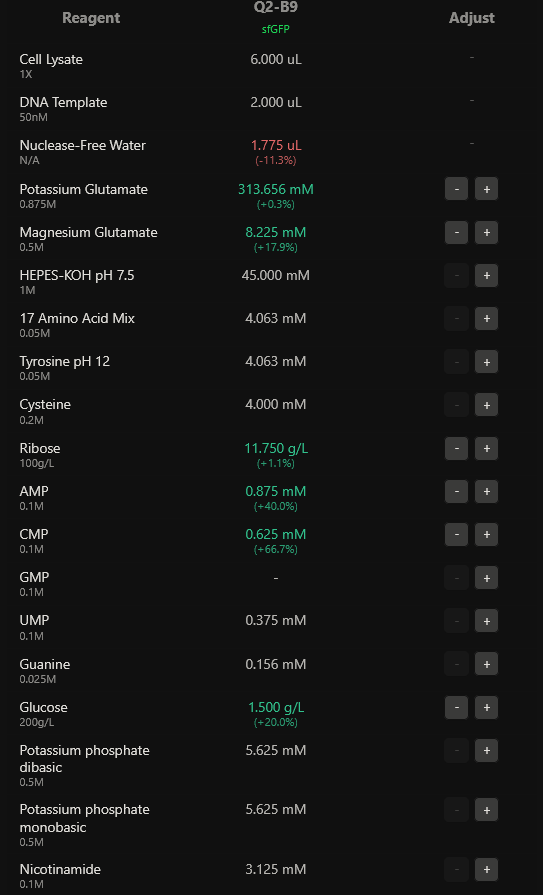
In the sfGFP cell-free system, increasing glucose, magnesium glutamate, and nucleotide precursors (AMP/CMP/ribose) is expected to extend ATP and nucleotide regeneration capacity, thereby sustaining transcription and translation over the full 36-hour incubation. This should increase total sfGFP accumulation and result in higher final fluorescence due to prolonged protein synthesis rather than early energy depletion.
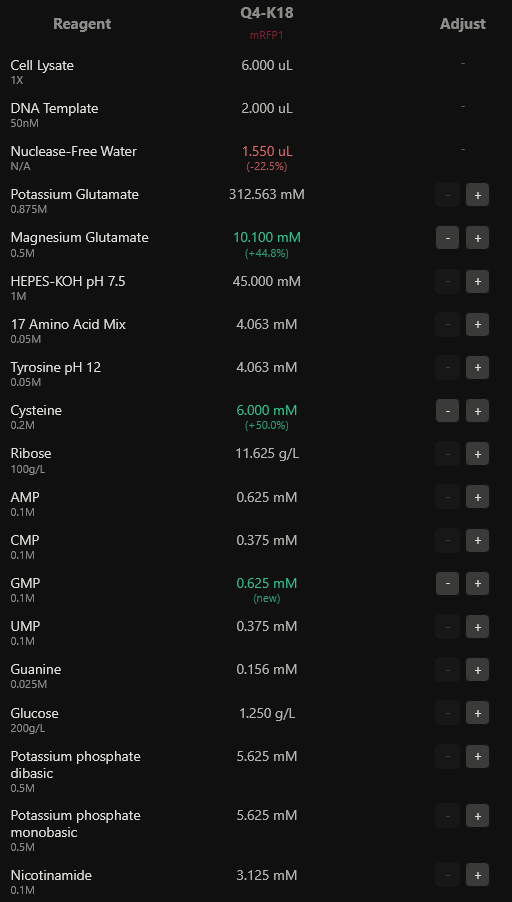
For mRFP1, increasing magnesium glutamate to 10 mM is expected to improve ribosome stability and translation efficiency, while supplementation with GMP at 0.625 mM may help sustain GTP pools required for transcription and translation elongation. Increasing cysteine to 6 mM may also support proper protein folding and help maintain a favorable redox environment during the extended incubation, improving maturation and accumulation of functional fluorescent protein.
Together, these adjustments are expected to sustain translation capacity and improve fluorescent protein maturation over the 36-hour reaction, reducing losses from energy depletion and inefficient folding.
3. The second phase of this lab will be to define the precise reagent concentrations for your cell-free experiment. You will be assigned artwork wells with specific fluorescent proteins and receive an email with instructions this week (by April 24). You can begin composing master mix compositions here.
Well 1: Q2-B9
In the sfGFP cell-free system, increasing glucose, magnesium glutamate, and nucleotide precursors (AMP/CMP/ribose) is expected to extend ATP and NTP regeneration capacity, thereby sustaining transcription and translation over the full 36-hour incubation. This should increase total sfGFP accumulation and result in higher final fluorescence due to prolonged protein synthesis rather than early energy depletion.
Well 2: Q4-K18
To maximize mRFP1 (monomeric red fluorescent protein 1) fluorescence over 36 hours, I increased magnesium glutamate to 10 mM to stabilize translation and protein folding, added guanosine monophosphate (GMP) at 0.625 mM to sustain guanosine triphosphate (GTP) pools for translation elongation, and increased cysteine to 6 mM to prevent aggregation-promoting disulfide bonds.
Together, these adjustments sustain both translation output and chromophore stability over the extended reaction, preventing energy depletion and misfolding that would limit fluorescence accumulation at the 36-hour timepoint.
4. The final phase of this lab will be analyzing the fluorescence data we collect to determine whether we can draw any conclusions about favorable reagent compositions for our fluorescent proteins. This will be due a week after the data is returned (date TBD!). The reaction composition for each well will be as follows:
6 μL of Lysate
10 μL of 2X Optimized Master Mix from above
2 μL of assigned fluorescent protein DNA template
2 μL of your custom reagent supplements
Total: 20 μL reaction
We never received data for this part. With permission of Node leads, skipping this!