Week 1 HW: Principles and Practices
Bio-Hybrid Fusion Blanket
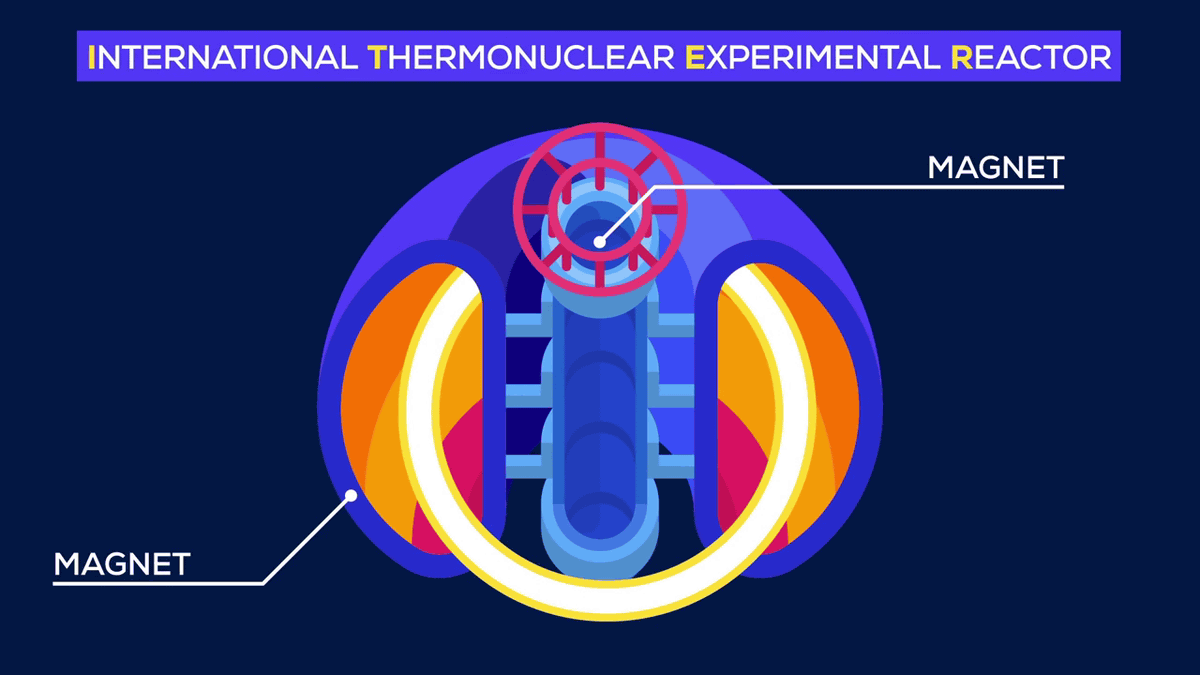
Research Context:
I am currently a research assistant investigating Magnetohydrodynamics (MHD), specifically focusing on the complex interactions between magnetic fields and 150-million-degree plasma. My work involves optimizing plasma confinement within Tokamak reactors. At these extreme temperatures, the behaviour of the plasmas is governed by a delicate balance of magnetic pressure and fluid dynamics, creating an environment that is incredibly hostile to the physical structures surrounding it.
Physics Problem:
In a Deuterium-Tritium fusion reactor, the blanket is a critical component that lies in the interior of the reactor. It captures high energy neutrons released by fusion converting their kinetic energy into heat which generated electricity. It also contains lithium which when struck by those neutrons breeds tritium, the fuel we can recycle in the reactor.
Currently, these blankets are limited by severe material degradation. High-energy neutron bombardment causes metals to swell, become brittle, and crack from the inside out as waste reactants accumulate. Plasma is also a volatile fluid that is difficult to control with magnets; sudden disruptions can dump massive thermal loads onto the reactor walls. Since current materials are rigid and static, they cannot absorb or repair these shocks, leading to surface melting and catastrophic structural failures.
The proposal:
The idea is to develop a bio-hybrid, self-healing blanket for the fusion reactor replacing rigid metal walls with a dynamic system where biology acts as both the architect and the maintenance crew.
One idea could be utilizing synthetic biology to grow the initial reactor structure. By using biology as a 3D template, we can grow a reactor structure that places lithium atoms with perfect accuracy. This creates a more efficient fuel-making system inside a heat-shield wall filled with tiny, vein-like cooling channels that traditional machines simply can’t build.
Another idea involves using the reactor’s downtime as a biological recovery phase. Once the system is cooled, the network of vascular channels becomes a highway for bespoke, bio-engineered cells designed to seek out and clear trapped helium waste. These cellular workers then secrete new mineral precursors to “re-grow” the scaffolding at the site of neutron-induced cracks, allowing the blanket to rejuvenate its structural integrity like a self-maintaining organ.
One goal would be to ensure the bio-hybrid blanket is easy to clean up. We want to avoid creating bio-nuclear waste that is harder to handle than regular blanket material.
Sub goal 1: Easy deconstruction – the biological structure should be non-toxic and easy to recycle and dissolve away after use; we should be able to filter out and recycle expensive metals used such as lithium.
Sub goal 2: Chemical safety – the maintenance cells must be engineered so they don’t produce harmful chemicals while they work, so the reactor process doesn’t require hazardous waste treatment.
Action 1: Digital DNA Registry (Technical Strategy)
Actor: Researchers
Purpose: Move away from secret, proprietary cell design to a shared public database of genetic blueprints.
Design: Researchers must upload their genetic code of their cells to a registry so other people know how to handle and recycle them.
Assumptions: Assumes labs will share blueprints, and that a global standard for DNA data would work.
Risk of Failure: Bad actors could learn how to destabilise or reverse engineer cells since it’s public.
Success: Any country could build and recycle their reactors and blankets.
Action 2: Green Fusion Tax Credits (Financial Incentive)
Purpose: Reward reactors that prove they are highly recyclable.
Design: The government would give extra funding or tax breaks to companies whose bio blankets leave minimal toxic waste behind.
Assumptions: Assumes money is the biggest motivator for companies to prioritize over speed of reactor development.
Risk of Failures: Companies might greenwash their data to get money without being clean.
Success: Low waste reactors become the most profitable way to run and becomes industry standard.
Action 3: Biological Security (New Rule)
Purpose: Prevent technology from being turned into a biological weapon that can survive extreme environments.
Design: Require fusion labs to store biological material in high security facilities with background checks like those used for handling nuclear fuel.
Assumptions: Assumes these bio engineered cells are dangerous.
Risk of Failure: Expensive security could slow down science, so we never get to clean fusion energy.
Success: Only good actors working on building innovative materials to help achieve clean energy get access to these biomaterials.
| Does the option: | Option 1: DNA Registry | Option 2: Green Tax Credits | Option 3: Bio-Security Rule |
|---|---|---|---|
| Enhance Biosecurity | |||
| By preventing incidents | 3 | 2 | 1 |
| By helping respond | 1 | 3 | 2 |
| Foster Lab Safety | |||
| By preventing incident | 2 | 3 | 1 |
| By helping respond | 1 | 3 | 2 |
| Protect the environment | |||
| By preventing incidents | 2 | 1 | 2 |
| By helping respond | 1 | 2 | 3 |
| Other considerations | |||
| Minimizing costs or burdens | 1 | 2 | 3 |
| Feasibility | 2 | 1 | 3 |
| Not impede research | 2 | 3 | 1 |
| Promote constructive applications | 1 | 2 | 3 |
I would prioritize Action 3: Biological Security as the main requirement addressed to the U.S. Department of Energy and Defense. This is because we first and foremost should address the immediate risk of creating bioweapons that can withstand radiation and high temperatures. This ensures that the foundation of the industry is built on containment and control before scaling or commercialization. Once the technology is regulated in a similar manner to nuclear fuel, Action 1 should be incentivized serving as a long-term safety net, providing a transparent repair manual for materials once they are safely deployed.
Trade-offs and Uncertainties:
Innovation vs. Security: The primary trade-off is that high security increases costs and can slow down academic research. There is a risk that over-regulating early-stage biology could delay clean fusion energy development.
Assumption of Risk: This plan assumes these bio-engineered cells are dangerous enough to warrant military-grade security. If the cells are actually fragile outside the reactor, the security measures might be unnecessary.
Error rate for polymerase is 1 in 106 bases. The human genome length is 3.2 × 10⁹ bases. Biology deals with the discrepancy using the MutS Repair system.
Average Human Protein: 1036bp = 345 amino acids
Each amino acid can have 61 sense codons – so that’s 61^345 = huge number of different ways. Most codes don’t work in practice because differences in codon bias, mRNA and translation efficiency can disrupt expression, stability, or correct protein production.
Phosphonamidite DNA Synthesis.
Due to the high error rate – 1 in 10^2 per base so errors and truncated products accumulate exponentially with each base addition cycle.
After 2000 chemical synthesis cycles, errors and incomplete couplings accumulate at each step, and because the process has no proofreading, nearly all strands become truncated or mutated, leaving virtually no correct full-length product.
10 essential amino acids which can’t be synthesized in the body:
Phenylalanine
Valine
Threonine
Tryptophan
Isoleucine
Methionine
Histidine
Arginine
Leucine
Lysine
Since Lysine is one of the amino acids which can’t be synthesised, lysine contingency as a strategy for bio containment exploits this natural dependency to control.
Sources:
Ai prompt – What is Lysine Contingency:
Lysine Contingency is a biocontainment strategy where an engineered organism is made unable to synthesize lysine, so it can only survive if lysine is externally supplied.