Week 5 HW: Protein Design II
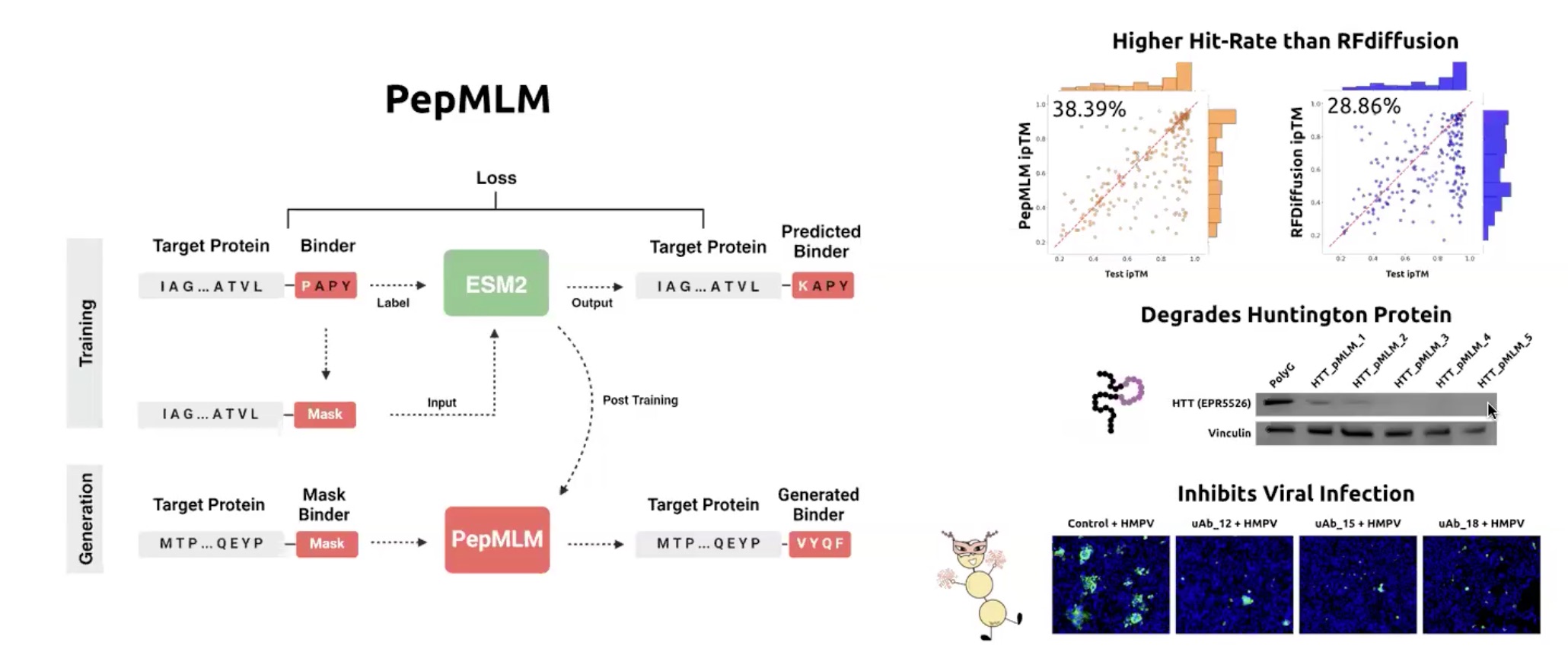
Human SOD1 Sequence:
https://www.uniprot.org/uniprotkb/P00441/entry
https://www.uniprot.org/uniprotkb/P00441/entry#sequences
SOD1 sequence
SOD1 sequence with A4V mutation
Here is a table with the binders ranked and compared against a known binder:
| Rank | Peptide Source | Sequence | Pseudo Perplexity |
|---|---|---|---|
| 1 | Reference (Experimental) | FLYRWLPSRRGG | 2.2833 |
| 2 | PepMLM (Candidate 0) | KLVPAVVLAHKX | 7.4714 |
| 3 | PepMLM (Candidate 1) | KRSYPTALRHWX | 10.1367 |
| 4 | PepMLM (Candidate 2) | WRYPVAABHGK | 11.0383 |
| 5 | PepMLM (Candidate 3) | WHVYVVGLRHKE | 25.8914 |
The perplexity metric measures how perplexed or “surprised” as it were, a model is by a sequence. Hence a lower score represents higher model confidence or predicted affinity. Here, the known binder FLYRWLPSRRGG acts as a benchmark, scoring 2.28 on the pseudo perplexity rating, which is significantly lower than the newly generated designs. As you can see, I have ranked the binders in order of their respective perplexity ratings.
| Rank | Job Name | ipTM | pTM | Primary Binding Location | Target Engagement |
|---|---|---|---|---|---|
| 1 | SOD1 and KLVPAVVLAHK | 0.58 | 0.82 | N-terminus Groove | High (Pocket) |
| 2 | SOD1 and WHVYVVGLRHKE | 0.49 | 0.81 | Upper β-barrel Ridge | Moderate (Surface) |
| 3 | SOD1 and KRSYPTALRHW | 0.44 | 0.90 | β-barrel Loops | Moderate (Surface) |
| 4 | SOD1 and WRYPVAABHGK | 0.39 | 0.83 | Lower Dimer Interface | Low/Mod (Surface) |
| 5 | SOD1 and FLYRWLPSRRGG (Ref) | 0.26 | 0.81 | Surface Loops | Low (Transient) |
Key
| Confidence Level | pLDDT Range | Corresponding Color |
|---|---|---|
| Very High | pLDDT > 90 | Dark Blue |
| Confident | 90 > pLDDT > 70 | Light Blue (Cyan) |
| Low | 70 > pLDDT > 50 | Yellow |
| Very Low | pLDDT < 50 | Orange |
Protein-peptide complex Models using AlphaFold3 and Residue Alignment Charts (Green)
They are ordered according to their ipTM score, with the first (KLVPAVVLAHK) having the greatest score (0.58) etc
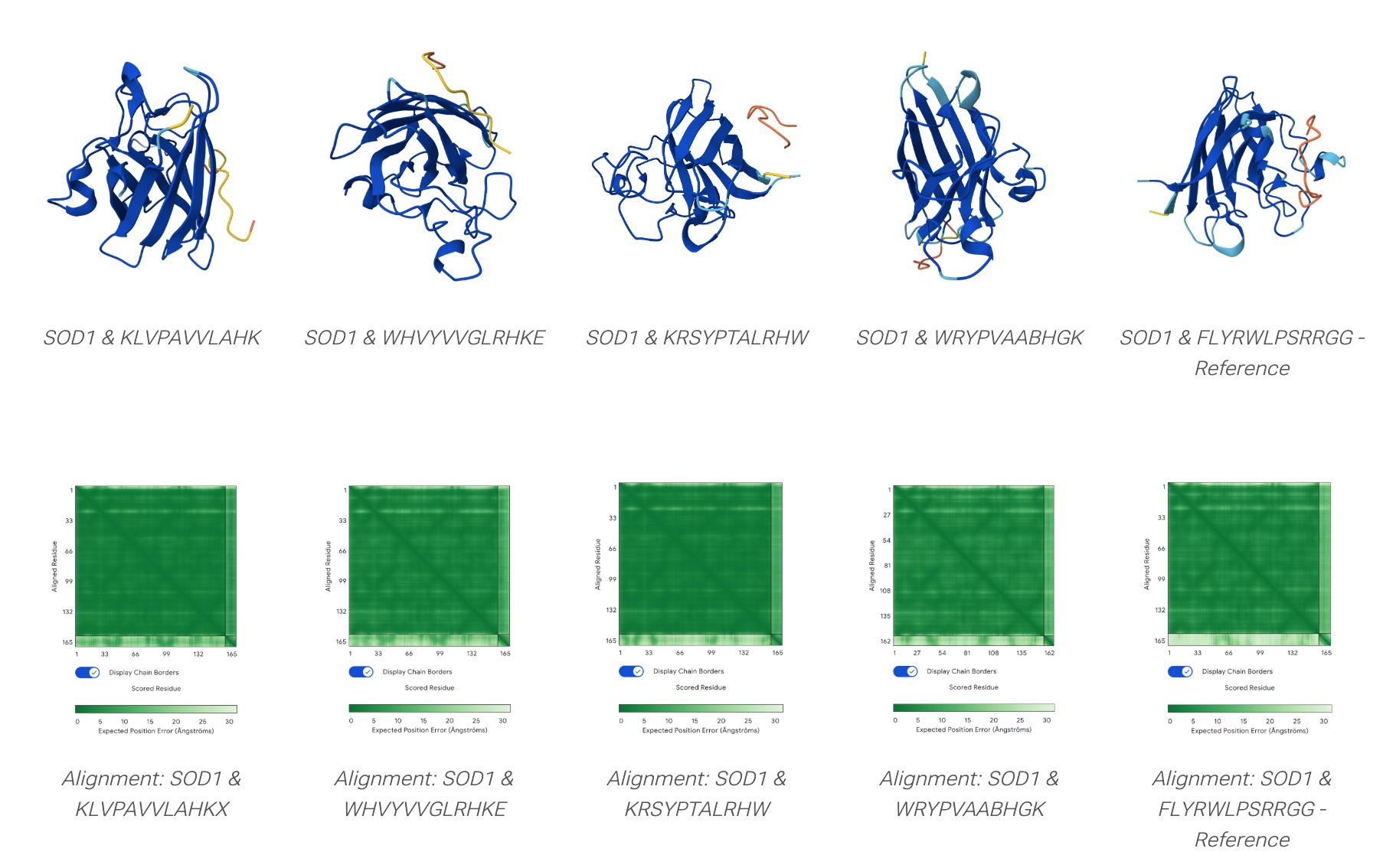
AlphaFold 3 modelling supported the binding potential of the peptides generated using PepMLM. Notably, all four model-generated peptides outperformed the experimental reference peptide, FLYRWLPSRRGG, in terms of ipTM (interface confidence), despite the reference having the lowest pseudo-perplexity score.
Candidate 0, KLVPAVVLAHK, achieved the highest ipTM score of 0.58 and also exhibited the lowest pseudo-perplexity score of 7.4714. Its elevated ipTM score suggests a strong ability to dock deeply within the N-terminal groove of SOD1, specifically near the ALS-associated A4V mutation site. In contrast, the remaining peptides displayed differing binding preferences across the β-barrel region and dimer interface.
The second strongest binder was Candidate 3, WHVYVVGLRHKE, with an ipTM score of 0.49. Interestingly, this peptide also had the highest pseudo-perplexity score at 25.8914, indicating that although it demonstrates favourable binding to mutant SOD1, its sequence is less likely to occur naturally compared with the other generated candidates.
In the search for peptides capable of stabilizing the SOD1 protein, a major therapeutic target in ALS research, the focus shifts from structural prediction in AlphaFold 3 to therapeutic evaluation in PeptiVerse. While AlphaFold 3 provides insight into the three-dimensional binding structure of a peptide, the 11 profiling metrics generated by PeptiVerse offer a broader assessment of how each candidate may behave in a biological and therapeutic context. Shown below are the results of evaluating the four PepMLM-designed peptide candidates against the established reference binder, FLYRWLPSRRGG, ranked from highest to lowest ipTM score.
| Metric / Property | KLVPAVVLAHK | WHVYVVGLRHKE | KRSYPTALRHW | WRYPVAABHGK | FLYRWLPSRRGG (Ref) |
|---|---|---|---|---|---|
| ipTM (Structural) | 0.58 | 0.49 | 0.44 | 0.39 | 0.26 |
| Solubility | 1.000 | 1.000 | 1.000 | 1.000 | 1.000 |
| Permeability | 0.242 | 0.143 | 0.849 | 0.359 | 0.862 |
| Hemolysis | 0.032 | 0.052 | 0.022 | 0.010 | 0.047 |
| Non-Fouling | 0.285 | 0.297 | 0.549 | 0.480 | 0.666 |
| Half-Life (hrs) | 0.438 | 0.412 | 0.342 | 0.339 | 0.310 |
| Binding (pKd) | 5.528 | 5.919 | 5.965 | 5.300 | 5.968 |
| Length (aa) | 11 | 12 | 11 | 11 | 12 |
| Mol. Weight (Da) | 1174.5 | 1522.8 | 1414.6 | 1166.5 | 1507.7 |
| Net Charge (pH 7) | +1.59 | +0.94 | +2.85 | +1.85 | +2.76 |
| Isoelectric Point | 10.00 | 8.60 | 11.00 | 9.99 | 11.71 |
| GRAVY (Hydrophobicity) | 1.02 | -0.38 | -1.44 | -0.73 | -0.71 |
The results revealed an interesting trade-off between structural binding confidence and therapeutic potential.
Although Candidate 0 (KLVPAVVLAHK) achieved the highest ipTM score of 0.58, indicating that AlphaFold 3 predicts a highly confident structural interaction with mutant SOD1, PeptiVerse’s therapeutic profiling identified Candidate 1 (KRSYPTALRHW) as the most promising overall candidate despite its lower ipTM score of 0.44.
This distinction likely arises from the balance between binding performance and drug-like properties. Candidate 1 exhibited one of the lowest pseudo-perplexity scores among the generated peptides at 7.4714, suggesting that its sequence remains relatively biologically plausible and potentially more nature-like. In addition, it achieved the highest predicted binding affinity of the generated candidates, with a pKd score of 5.965, alongside the strongest permeability score of 0.849, indicating an increased likelihood of penetrating cells and reaching intracellular mutant SOD1 targets.
Importantly, Candidate 1 also displayed the highest positive net charge of all tested peptides, including the reference peptide, with a score of +2.85. This characteristic may enhance its ability to cross the blood–brain barrier and interact with the negatively charged aggregates associated with mutant SOD1 pathology.
Taken together, these results suggest that while Candidate 0 demonstrates the strongest predicted structural fit, Candidate 1 offers the most balanced combination of binding capability, permeability, and therapeutic suitability, making it the strongest candidate for further investigation.
| Run | Sequence | Affinity (pKd) | Solubility | Specificity | Motif Score | Hemolysis |
|---|---|---|---|---|---|---|
| #1 | RFKCIVKVMVRR | 8.881 | 0.500 | 0.615 | 0.553 | 0.944 |
| #2 | KRLQLYRKKCAE | 7.193 | 0.750 | 0.737 | 0.634 | 0.964 |
| #3 | QRACDYFRDDED | 7.783 | 0.833 | 0.679 | 0.059 | 0.895 |
| #4 | KEKEGPCWESEK | 7.360 | 0.833 | 0.871 | 0.002 | 0.962 |
The PepMLM-generated peptides primarily emphasize high-confidence structural docking alongside balanced biophysical properties, resulting in a more conservative yet affinity-improving profile relative to the baseline reference. In contrast, the moPPIt-generated peptides explore a broader chemical space and place greater emphasis on targeted binding interactions.