Week 6 HW: Genetic Circuits I
Phusion High-Fidelity PCR Master Mix contains several important components needed for accurate DNA amplification during PCR. The main component is Phusion DNA Polymerase, which is a highly accurate and thermostable enzyme that quickly copies DNA while minimizing mistakes. This makes it especially useful for applications such as cloning and DNA sequencing where precision is important.
The mix also contains deoxynucleotide triphosphates (dNTPs), which are the building blocks used to create new DNA strands. In addition, there is an optimized reaction buffer that provides the ideal chemical environment for the polymerase to work efficiently by maintaining the correct pH and ionic strength, while also helping stabilize the enzyme during the high temperatures of PCR.
Another key component is magnesium chloride (MgCl₂). Magnesium ions act as essential cofactors for the polymerase, allowing it to catalyse DNA synthesis by helping form phosphodiester bonds between nucleotides. They also help primers anneal to the template DNA by reducing electrostatic repulsion between the negatively charged DNA strands.
Some of the main factors that determine primer annealing temperature during PCR include the primer’s melting temperature (Tm), primer length, GC content, primer concentration, and the ionic strength of the reaction buffer. Primers with higher GC content generally require higher annealing temperatures because GC base pairs form three hydrogen bonds compared with two in AT base pairs, making them more stable. Longer primers also tend to have higher melting temperatures. In addition, buffer conditions and salt concentration influence how strongly the primer binds to the template DNA, which can affect the optimal annealing temperature.
PCR and restriction enzyme digests both create linear DNA fragments, but they do so in very different ways and are used for different purposes. PCR is an additive process that amplifies a specific DNA sequence, essentially acting like a biological photocopier. It uses thermal cycling, DNA polymerase, primers, and dNTPs to generate millions of copies of a target DNA fragment. PCR is most useful when only a very small amount of DNA is available, such as from a cheek swab or ancient DNA, and when a specific gene or sequence needs to be isolated and amplified from an entire genome.
In contrast, a restriction enzyme digest is a subtractive process that cuts DNA at specific recognition sequences using restriction endonucleases, acting like biological scissors. The reaction is usually performed at a constant temperature, around 37°C, and produces multiple DNA fragments of different sizes. Restriction digests are mainly used to manipulate or verify existing DNA, particularly plasmids, such as checking whether a gene has been successfully inserted or cutting plasmids open for cloning and ligation. They were also historically important for genomic mapping techniques like RFLP analysis. Overall, PCR is primarily used for finding and amplifying DNA, whereas restriction enzyme digests are mainly used for cutting, modifying, and analysing DNA.
To ensure that DNA fragments produced through PCR and restriction enzyme digestion are suitable for Gibson cloning, several factors must be considered. First, the DNA should be purified using a PCR clean-up kit to remove residual enzymes, salts, and buffers that could interfere with the Gibson Assembly Master Mix. Gel electrophoresis should then be used to confirm that the correct DNA fragments and gene sizes were successfully generated. In addition, the fragments must contain overlapping regions of at least ~20 base pairs so they can anneal correctly during Gibson assembly. This is usually achieved by designing PCR primers with appropriate overlap tails that match the adjacent DNA fragment or vector sequence.
Plasmid DNA enters E. coli cells during transformation by temporarily creating pores in the bacterial cell membrane. This can be achieved through heat shock or electroporation. In heat shock transformation, the cells are exposed to a sudden change in temperature, while electroporation uses a brief high-voltage electrical pulse. Both methods disrupt the membrane enough to allow plasmid DNA to diffuse into the cells.
After transformation, the E. coli cells are incubated in a nutrient-rich broth such as LB or SOB at 37°C to allow them to recover, begin multiplying, and express the antibiotic resistance gene carried by the plasmid. The cells are then plated onto agar containing antibiotics, so only bacteria that successfully took up the plasmid survive and form colonies. If the plasmid contains a reporter gene such as GFP, the transformed colonies may also display visible fluorescence or colour after incubation.
a. Explain the other method in 5 - 7 sentences plus diagrams (either handmade or online).
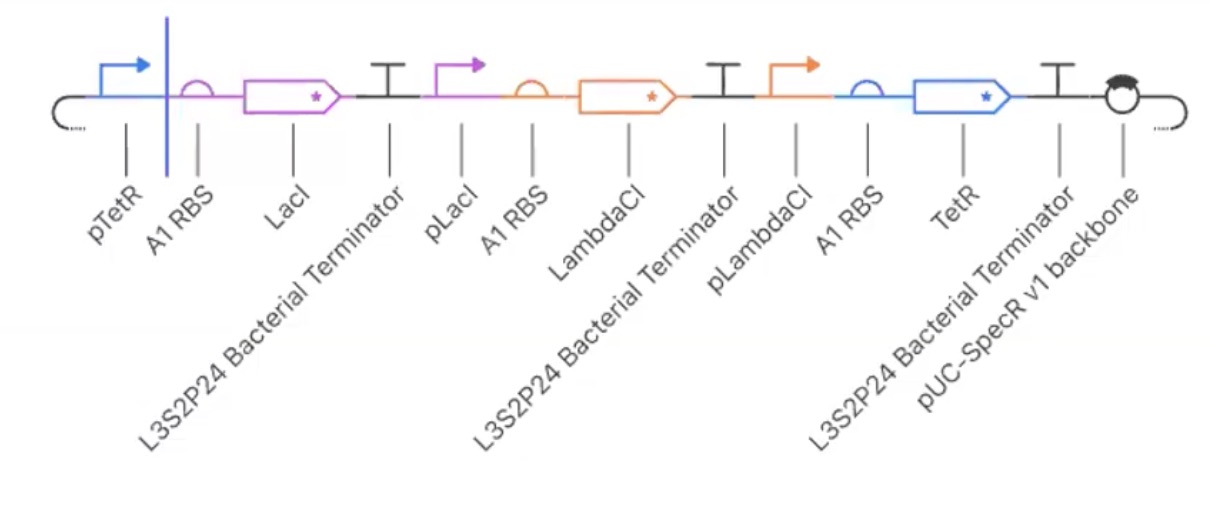
b. Model this assembly method with Benchling or Asimov Kernel!
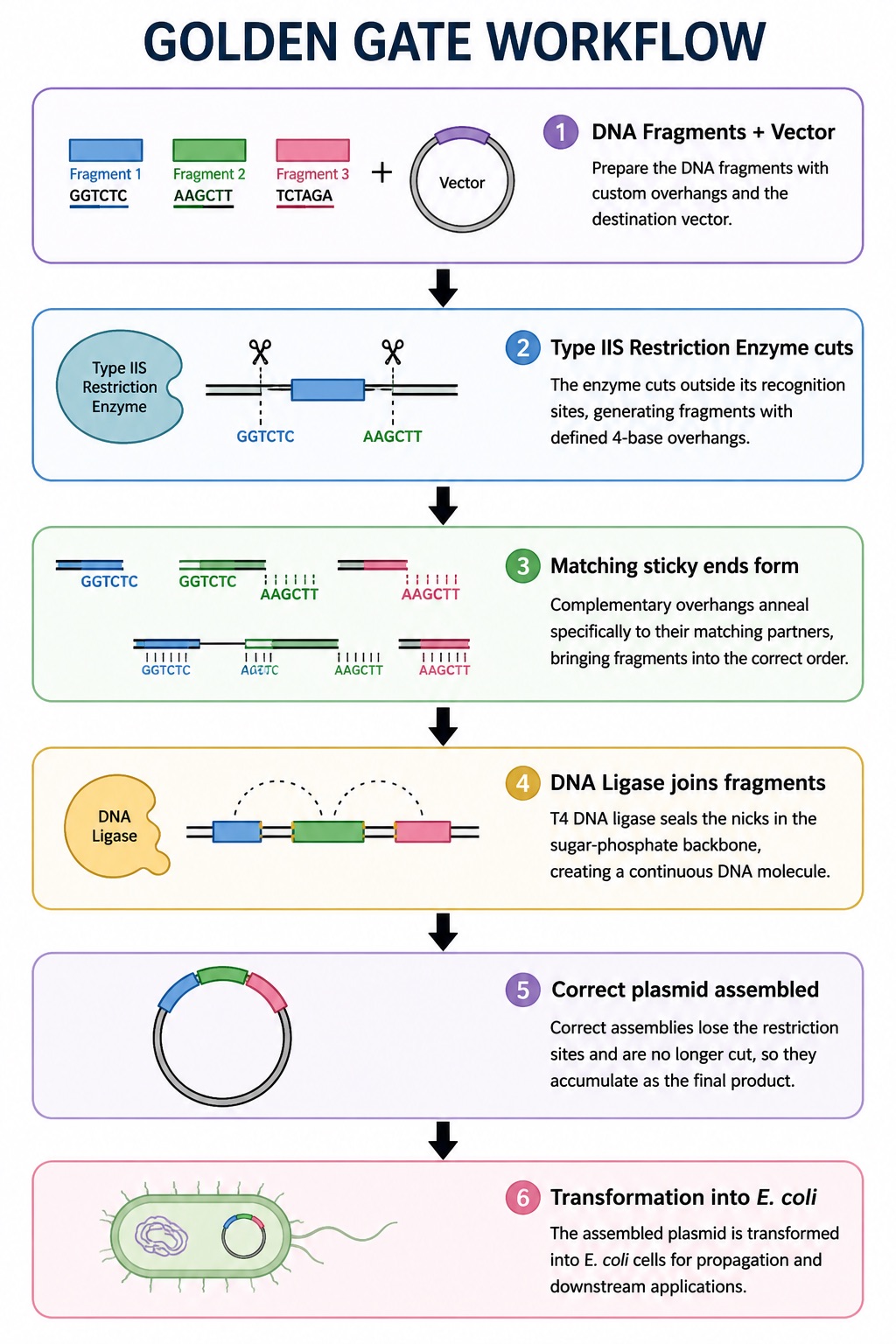
Golden Gate Assembly is a cloning method that allows multiple DNA fragments to be assembled seamlessly in a single reaction using Type IIS restriction enzymes such as BsaI. Unlike standard restriction enzymes, Type IIS enzymes cut outside of their recognition sequence, creating custom 4-base overhangs that determine the exact order in which fragments join together. In a single tube, the DNA fragments, destination vector, restriction enzyme, T4 DNA ligase, and reaction buffer are combined and cycled through alternating temperatures for digestion and ligation. During the reaction, correctly assembled DNA loses the restriction sites, making it resistant to further cutting, while incorrect products continue to be digested. This makes the process highly efficient and scarless, meaning no unwanted sequences are left between assembled fragments. After the reaction is complete, the enzymes are heat-inactivated and the assembled plasmid can be transformed into E. coli for propagation.