Week 7 HW: Genetic Circuits Part II: Neuromorphic Circuits
This page tackles all homeworks of week 7.
Assignment Part 1: Intracellular Artificial Neural Networks (IANNs)
- What advantages do IANNs have over traditional genetic circuits, whose input/output behaviors are Boolean functions?
- Describe a useful application for an IANN; include a detailed description of input/output behavior, as well as any limitations an IANN might face to achieve your goal. IANNs can be also used when the input data is scarce or not fully available. They can also be favoured or act as an additional pipeline within large computational biological pipelines where timing is of the essence and algorithmic suggestions would anyways be validated using wetlab experimentations.The inputs can be continuous molecular signals, such as varying extracellular metabolite concentrations or precise intracellular temperature readings. The network integrates these signals to output suggested genetic interventions (e.g., specific promoter strength combinations) to maximize a target metabolic flux.
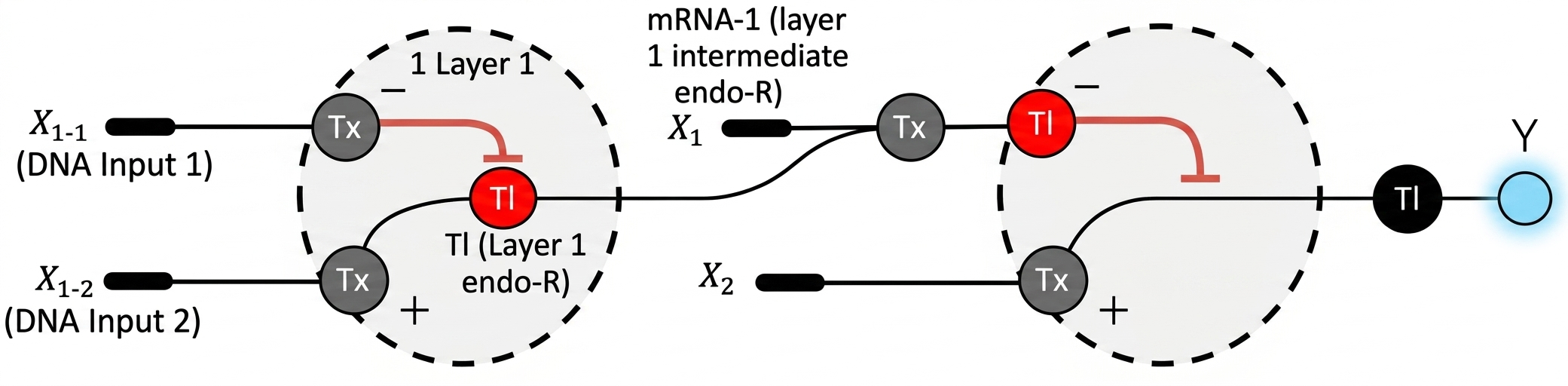
- A diagram depicting an intracellular single-layer perceptron where the X1 input is DNA encoding for the Csy4 endoribonuclease and the X2 input is DNA encoding for a fluorescent protein output whose mRNA is regulated by Csy4 (Tx: transcription; Tl: translation) is provided. Draw a diagram for an intracellular multilayer perceptron where layer 1 outputs an endoribonuclease that regulates a fluorescent protein output in layer 2.
IANNs are prediction systems trained to ensure that the active genetic circuits have higher outputs and inactive ones have lower outputs (continuous domain outputs); they can be trained also to have boolean output incase the penultimate layer exceeds a specific prediction threshold (for specific reactions), as well as can be trained to give quantitative reaction flux as outputs. Ideally, they should be paired with traditional genetic circuits for enhanced results (quantitative reactions can also be found using traditional Flux Balance Analysis - FBA/FVA/FPA, etc.).
This diagram is retained, and at the X1 position (which is the first input of the original diagram), the output of another perceptron is sent:
Assignment Part 2: Fungal Materials
- What are some examples of existing fungal materials and what are they used for? What are their advantages and disadvantages over traditional counterparts?
- Researcher develop living material from fungi
- Fungi as source for new bio-based materials: a patent review
- Amazing pictures collected by Zeynep
- What might you want to genetically engineer fungi to do and why? What are the advantages of doing synthetic biology in fungi as opposed to bacteria?
- Eukaryotic Expression Machinery: Fungi possess advanced post-translational modification capabilities (like complex glycosylation and proper disulfide bond folding) necessary to express intricate eukaryotic proteins that form inclusion bodies or fail in bacteria.
- Hyphal Network Growth: Fungi grow via three-dimensional, interconnected hyphal networks (mycelium) that physically bind loose agricultural byproducts into solid macro-structures, whereas bacteria typically form amorphous biofilms or liquid cultures. (A fungi network is supposed to be the largest living organism in the world).
- Extracellular Secretion: Fungi naturally secrete massive quantities of enzymes and proteins directly into their surroundings, significantly simplifying downstream harvesting and processing pipelines compared to lysing bacterial cells.
Mushrooms are fungi; probably some cakes can also be made out of them. There are upcoming climate startups which are designing fungi-based materials that can fix carbon on tiles, the tiles will be fixed on public places or inside/outside of buildings and the genetically modified fungi would do the trick.
References:
Genetically engineer fungal mycelium to express self-healing proteins or secrete natural hydrophobic resins directly into their chitin-glucan cell wall matrix. This would allow the creation of living, water-resistant bio-composites that can autonomously repair structural micro-cracks when exposed to moisture or specific nutrients. Fungi could also be engineered to secrete heavy-metal-binding peptides for the in-situ bioremediation of contaminated soil while simultaneously forming structural blocks.
The advantages of performing synthetic biology in fungi as opposed to bacteria include:
Assignment Part 3: First DNA Twist Order
- Review Part 3: DNA Design Challenge of the week 2 homework. Design at least 1 insert sequence and place it into the Benchling/Kernel/Other folder you shared in the Google Form above. Document the backbone vector it will be synthesized in on your website.
I will continue this on the benchling link already posted within the week 2 homework section (see the end of my week 2 homework page).