Week 09 HW -cell-free-systems
‘week-09-hw-cell-free-systems’
Documentation
Homework: Cell Free Systems
Homework Part A: General and Lecturer-Specific Questions
General homework questions
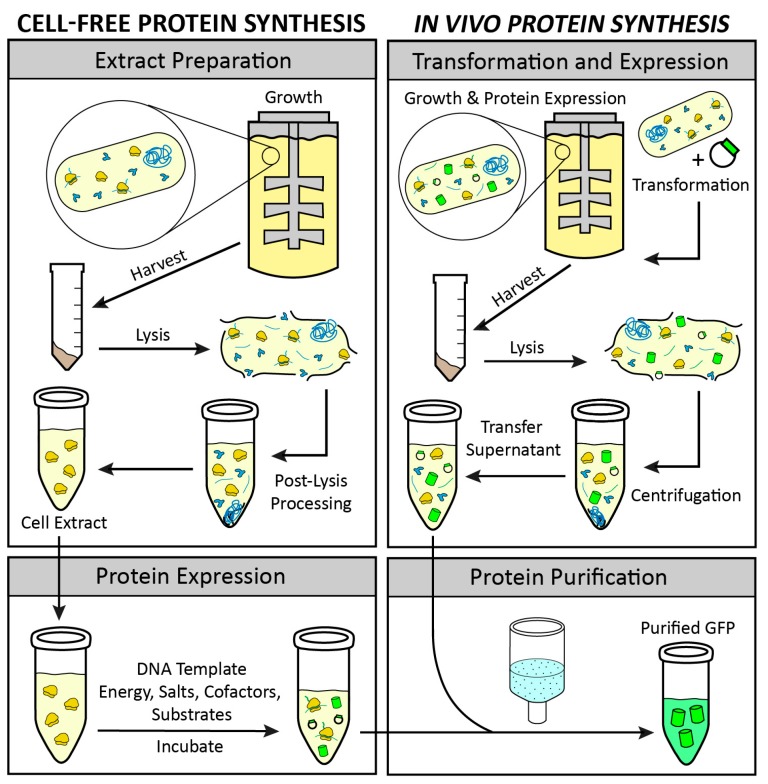
Cell-free protein synthesis
https://en.wikipedia.org/wiki/Cell-free_protein_synthesis#:~:text=CFPS has many advantages over,required for such a reaction.
Traditional protein expression methods present multiple challenges
https://www.biocompare.com/Editorial-Articles/594727-Advantages-of-Cell-Free-Protein-Expression/
A User’s Guide to Cell-Free Protein Synthesis
https://pmc.ncbi.nlm.nih.gov/articles/PMC6481089
Main advantages of cell-free protein synthesis 無細胞タンパク質合成の主な利点
Faster 速い
A cell-free reaction can often be completed within 1–2 days, so results can be obtained much more quickly than with in vivo expression.
無細胞反応は 1〜2 日で完了することが多く、in vivo 発現よりも短時間で結果を得られる。
Greater flexibility and control 柔軟性と制御性が高い
Because CFPS is an open system, components such as DNA concentration, salts, cofactors, and engineered tRNAs can be directly adjusted.
CFPS は開放系であるため、DNA 濃度、塩濃度、補因子、改変 tRNA などを直接調整できる。
Less concern about toxicity 毒性の影響を受けにくい
The target protein does not need to be produced inside living cells, so toxic proteins are easier to handle.
標的タンパク質を生きた細胞内で作る必要がないため、毒性タンパク質でも扱いやすい。
Useful for toxic proteins 毒性タンパク質の発現に有利
Proteins that would damage or kill host cells during in vivo expression can often be produced more easily in a cell-free system.
細胞内で作ると宿主にダメージを与えるタンパク質でも、無細胞系では発現しやすい。
Useful for proteins containing unnatural amino acids 非天然アミノ酸を含むタンパク質の生産に有利
Since the reaction is open, modified tRNAs and unnatural amino acids can be introduced more easily.
開放系なので、改変 tRNA や非天然アミノ酸を導入しやすい。
Advantageous for membrane proteins 膜タンパク質の発現にも有利
Membrane proteins, which are often difficult to express correctly in living cells, can be tested under more controllable conditions in CFPS.
生細胞内では正しく発現させにくい膜タンパク質でも、条件を調整しながら発現を試せる。
Main components of a cell-free expression system
無細胞発現系の主な構成要素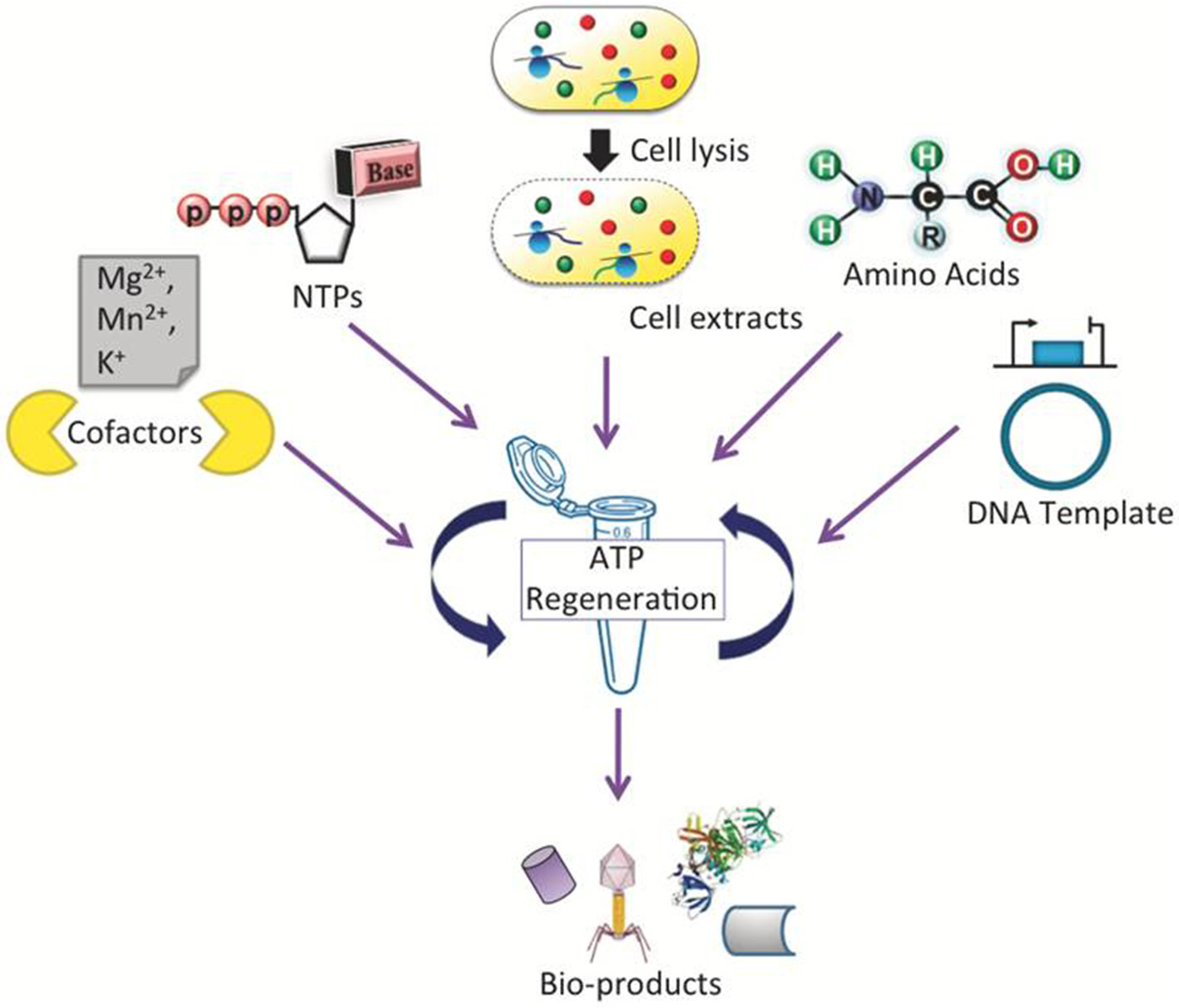
Comparison of the workflows of an in vivo system and a CFPS system
in vivo system と CFPS system の流れの比較図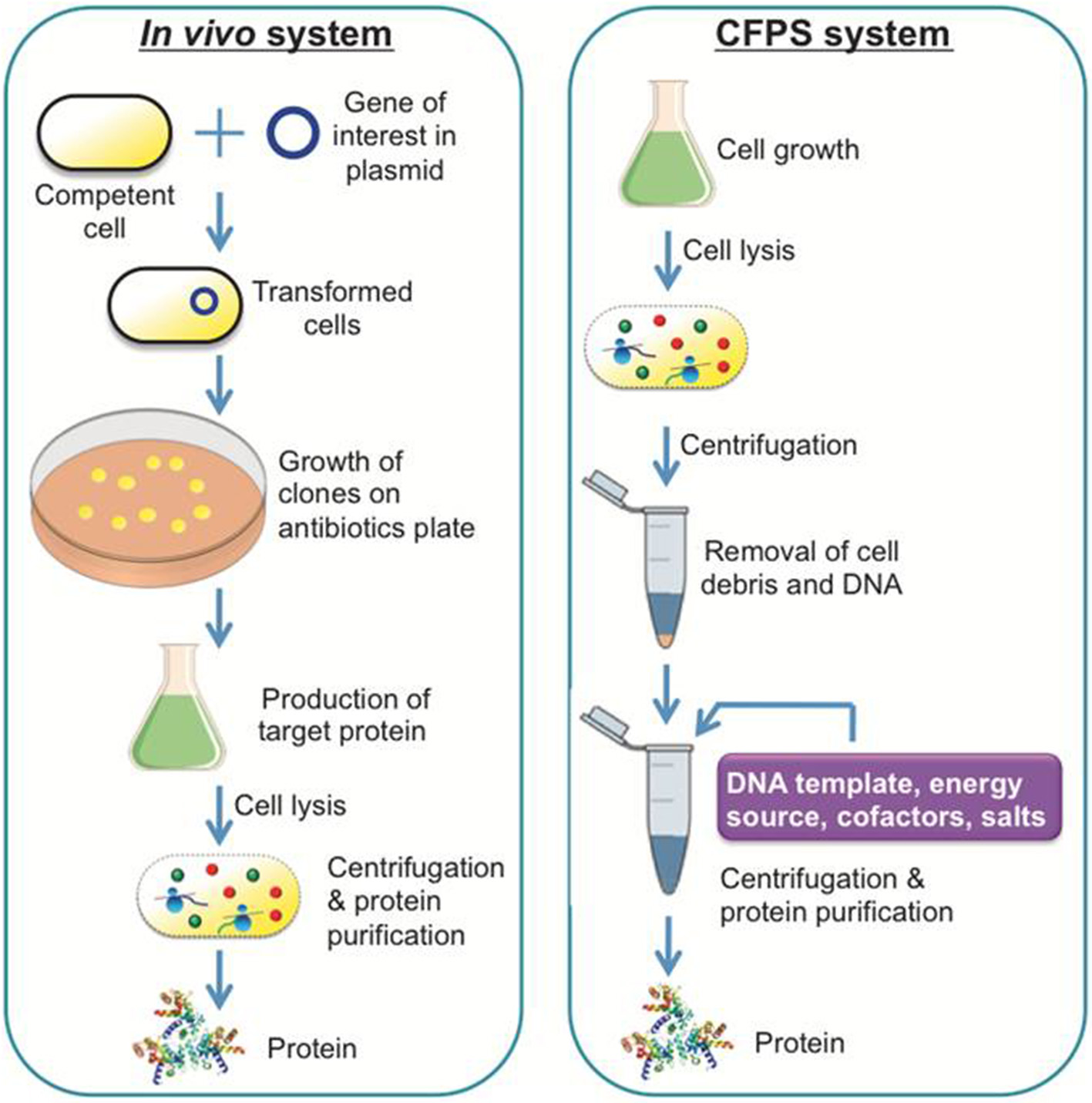
A cell-free expression system consists of a DNA template, transcription and translation machinery, amino acids, nucleotides, an energy regeneration system, and cofactors, salts, and buffers.
These components respectively serve as the genetic blueprint, the synthesis machinery, the building materials, the energy supply, and the reaction environment.
無細胞発現系は、DNA テンプレート、転写・翻訳装置、アミノ酸、ヌクレオチド、エネルギー再生系、補因子・塩・バッファー からできており、
それぞれが「設計図」「合成機械」「材料」「エネルギー」「反応環境」となっている。
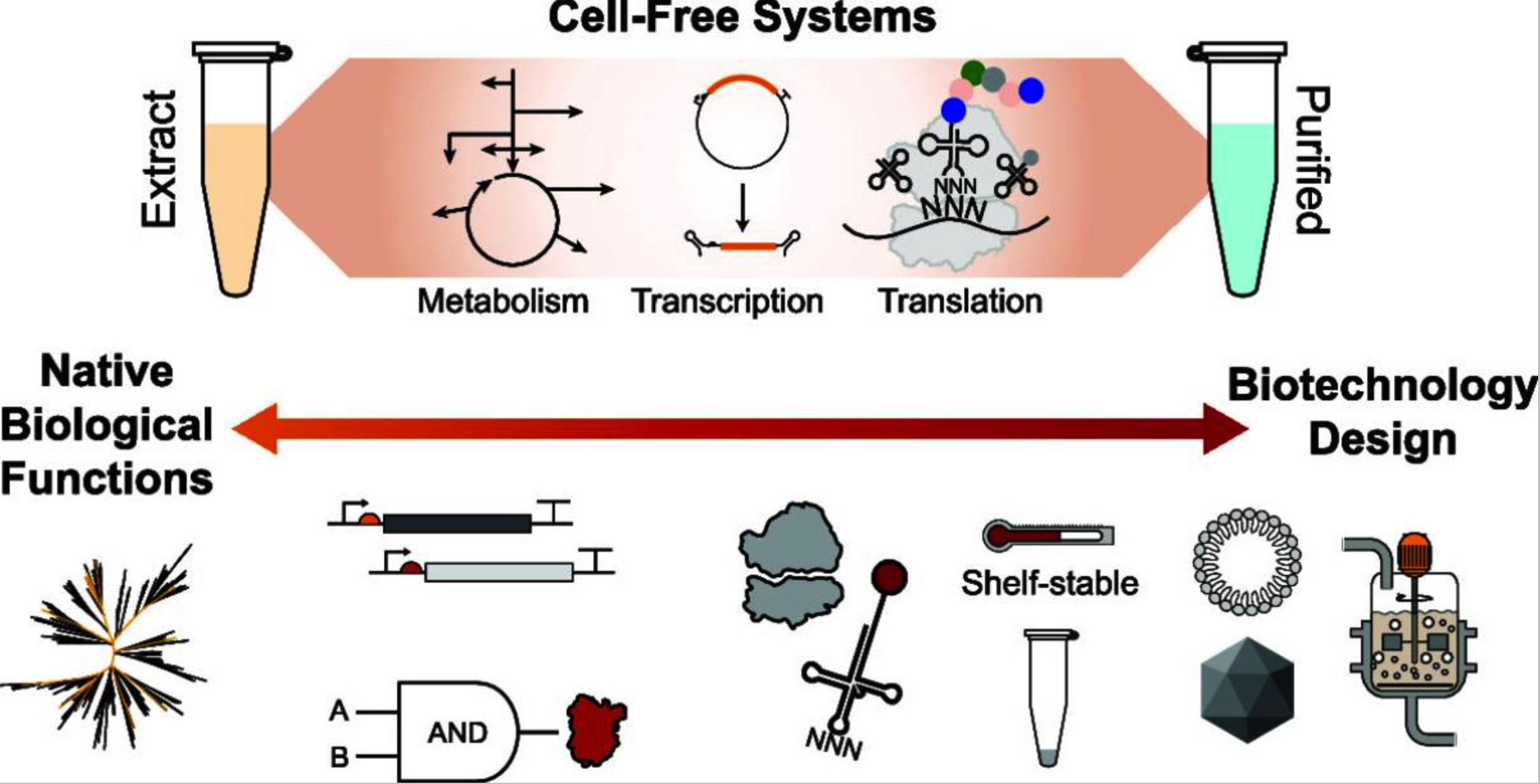
Energy regeneration is critical in cell-free systems because transcription and translation consume large amounts of ATP and GTP.
Without continuous energy supply, these molecules are rapidly depleted, the reaction stops, and protein yield decreases.
One method to ensure continuous ATP supply is to use phosphoenolpyruvate (PEP) as an energy substrate.
PEP can regenerate ATP from ADP through pyruvate kinase, making it a common energy regeneration strategy in cell-free expression systems.
無細胞系では、転写と翻訳の両方に大量の ATP や GTP が必要であり、これらは反応中にすぐ消費されるため。
エネルギー再生がないと反応は短時間で止まり、目的タンパク質の収量も低下する。
ATP を継続的に供給する方法としては、phosphoenolpyruvate(PEP)を用いる方法がある。
PEP は pyruvate kinase を介して ADP から ATP を再生できるため、無細胞発現系のエネルギー供給法としてよく利用される。
Development of a robust Escherichia coli-based cell-free protein synthesis application platform
https://pmc.ncbi.nlm.nih.gov/articles/PMC7568173
Cell-Free Protein Synthesis: Pros and Cons of Prokaryotic and Eukaryotic Systems
https://pmc.ncbi.nlm.nih.gov/articles/PMC4676933
Prokaryotic cell-free expression system 原核生物由来の無細胞発現系 (for example, an E. coli extract 抽出液)
Characteristics
It is fast, easy to handle, and suitable for producing simple soluble proteins.
E. coli-based systems have been developed as platforms that can achieve high expression levels, and the experimental setup is relatively simple.
On the other hand, they are not well suited for complex eukaryotic post-translational modifications.
速くて扱いやすく、単純な可溶性タンパク質を作るのに向いている。
E. coli ベースの系では高い発現量が得られるプラットフォームが開発されており、実験系も比較的シンプル。
一方、複雑な真核生物型の翻訳後修飾は苦手。
Example protein
I would choose to produce sfGFP (superfolder GFP). sfGFP is soluble, easy to handle, and does not require complex glycosylation,
so it can be expressed efficiently in an E. coli-based system.
In fact, sfGFP is commonly used as a model protein in E. coli-based cell-free expression systems.
sfGFP(superfolder GFP) を作る。
sfGFP は可溶性で扱いやすく、複雑な糖鎖修飾を必要としないので、E. coli 系で十分に発現しやすい。
実際に、E. coli ベースの cell-free 系では sfGFP がよくモデルタンパク質として使われている。
Cell-Free Systems Based on CHO Cell Lysates: Optimization Strategies, Synthesis of “Difficult-to-Express” Proteins and Future Perspectives
https://pmc.ncbi.nlm.nih.gov/articles/PMC5042383
Cell-free synthesis of functional antibodies using a coupled in vitro transcription-translation system based on CHO cell lysates
https://pmc.ncbi.nlm.nih.gov/articles/PMC5607253
Production of G protein‐coupled receptors in an insect‐based cell‐free system
https://pmc.ncbi.nlm.nih.gov/articles/PMC5599999
Characterisation of a cell-free synthesised G-protein coupled receptor https://pmc.ncbi.nlm.nih.gov/articles/PMC5430785
Eukaryotic cell-free expression system 真核生物由来の無細胞発現系
(for example, systems derived from CHO cells or insect cells (CHO や昆虫細胞由来))
Characteristics:
It is well suited for producing complex eukaryotic proteins and membrane proteins.
For example, CHO-based cell-free systems contain ER-derived microsomal structures, which can support membrane insertion and some post-translational processes.
Insect cell-derived cell-free systems have also been used to synthesize membrane proteins such as GPCRs.
複雑な真核タンパク質や膜タンパク質に向いている。
たとえば CHO 由来の無細胞系には ER 由来の microsomal structures が含まれており、膜への挿入や一部の翻訳後過程を助けることができる。
昆虫細胞由来の無細胞系でも、GPCR のような膜タンパク質の合成が行われている。
Example proteins
I would choose to produce complex proteins such as GPCRs (G protein-coupled receptors) or antibodies.
These proteins require an appropriate membrane environment, correct folding, and often more complex assembly or modification, so eukaryotic cell-free systems are more suitable than E. coli-based systems.
Functional antibody production has been reported in CHO-based systems, and GPCR synthesis has been reported in insect cell-based systems.
GPCR(G protein-coupled receptor) や 抗体 のような複雑なタンパク質を作る。
こうしたタンパク質は、膜環境、正しい折りたたみ、複雑な会合や修飾 が重要で、E. coli 系よりも真核由来の無細胞系のほうが適している。
CHO系では機能的な抗体、昆虫系では GPCR の合成例が報告されている。
High-throughput Cell-free Screening of Eukaryotic Membrane Protein
Expression by R. Bruni, Q. Liu
https://www.osti.gov/servlets/purl/1837204
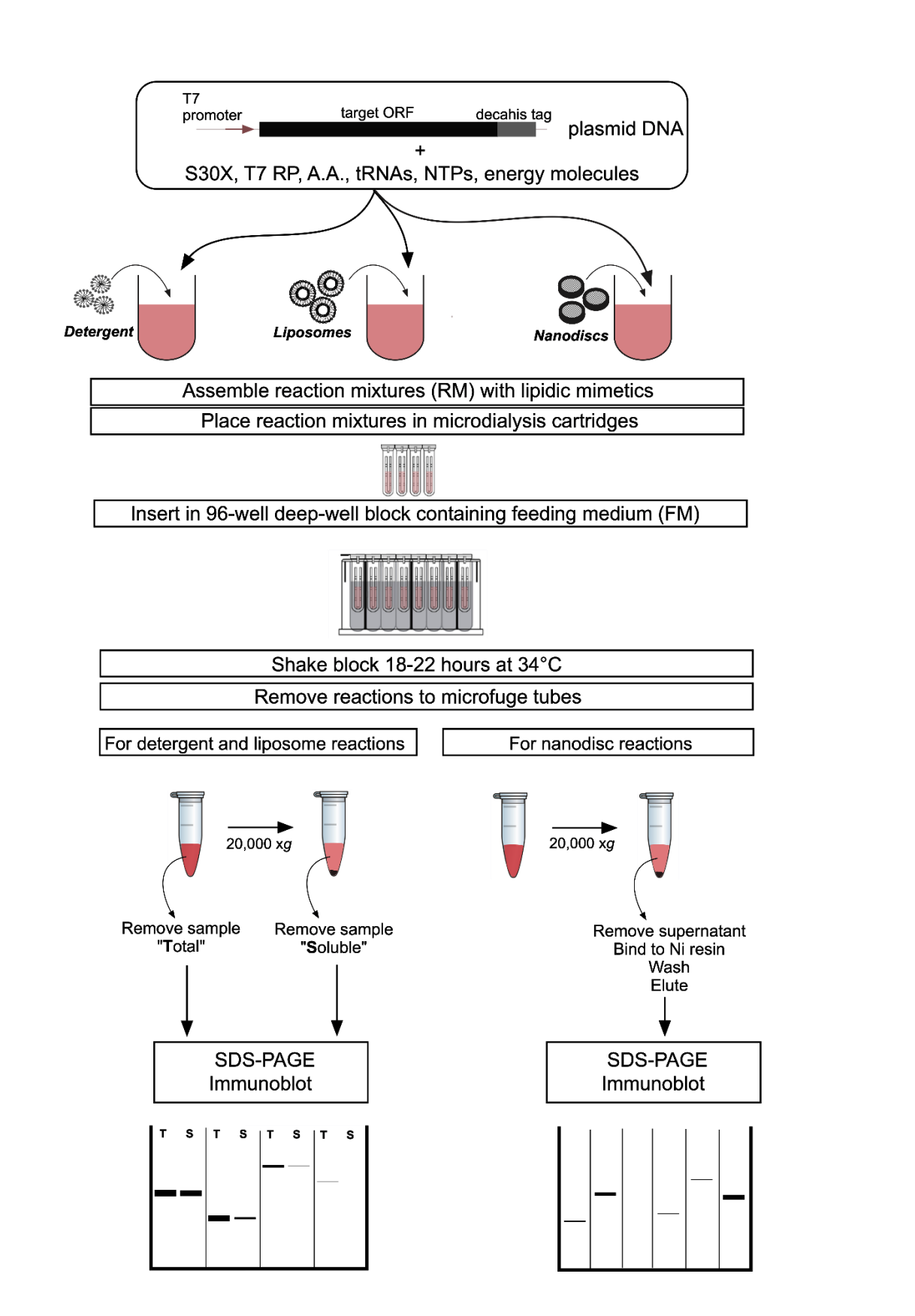
A cell-free system for functional studies of small membrane proteins
https://www.sciencedirect.com/science/article/pii/S0021925824023524
Troubleshooting Guide for NEBExpress™ Cell-free E. coli Protein Synthesis System (NEB #E5360)
https://www.neb.com/ja-jp/tools-and-resources/troubleshooting-guides/troubleshooting-guide-for-nebexpress-cell-free-e-coli-protein-synthesis-system-neb-e5360
・Possible causes of low yield in cell-free protein synthesis include contamination of the template DNA, RNase contamination, inappropriate DNA concentration, and problems in template design.
cell-free protein synthesis で収量が低い原因として、template DNA の汚染、RNase contamination、DNA濃度の不適切さ、template design の問題などが挙げられている。
NEB. NEBExpress™ Cell-free E. coli Protein Synthesis System Manual.
https://www.neb.com/en/-/media/nebus/files/manuals/manuale5360.pdf
・The amount and purity of the DNA template, the difference between linear DNA and plasmid DNA, and mRNA stability can affect the efficiency of a cell-free reaction.
DNA template の量や純度、linear DNA / plasmid DNA の違い、mRNA stability などが、cell-free reaction の効率に影響することが説明されている。
Zemella A. et al. Cell-Free Protein Synthesis: Pros and Cons of Prokaryotic and Eukaryotic Systems.
https://pmc.ncbi.nlm.nih.gov/articles/PMC4676933/
・In cell-free protein synthesis, it is important to optimize reaction conditions such as Mg²⁺, K⁺, amino acids, and the energy system. cell-free protein synthesis では Mg²⁺、K⁺、amino acids、energy system などの反応条件を最適化することが重要だと述べられている。
Homework question from Kate Adamala
Design an example of a useful synthetic minimal cell as follows:
以下の条件に沿って、有用な synthetic minimal cell(合成ミニマル細胞) の例を設計しなさい。
Input:
K⁺ contained in body-derived samples such as sweat.(汗などの身体由来サンプルに含まれる K⁺)
Output:
A fluorescent signal produced by fluorescent proteins such as GFP.(GFP などの蛍光タンパク質による蛍光シグナル)
Explain
This synthetic minimal cell receives body-derived K⁺ and outputs its presence as fluorescence.
K⁺ itself is invisible, but by converting it into a biological reaction inside the artificial cell, its presence can be visually detected.
この synthetic minimal cell は、身体由来のK⁺を受け取り、その存在を蛍光として出力する。
K⁺そのものは目に見えないが、人工細胞の内部で生物学的な反応に変換されることで、視覚的に確認できるようになる。
Conditions where cell-free Tx/Tl alone would be sufficient (cell-free Tx/Tl だけでできる条件)
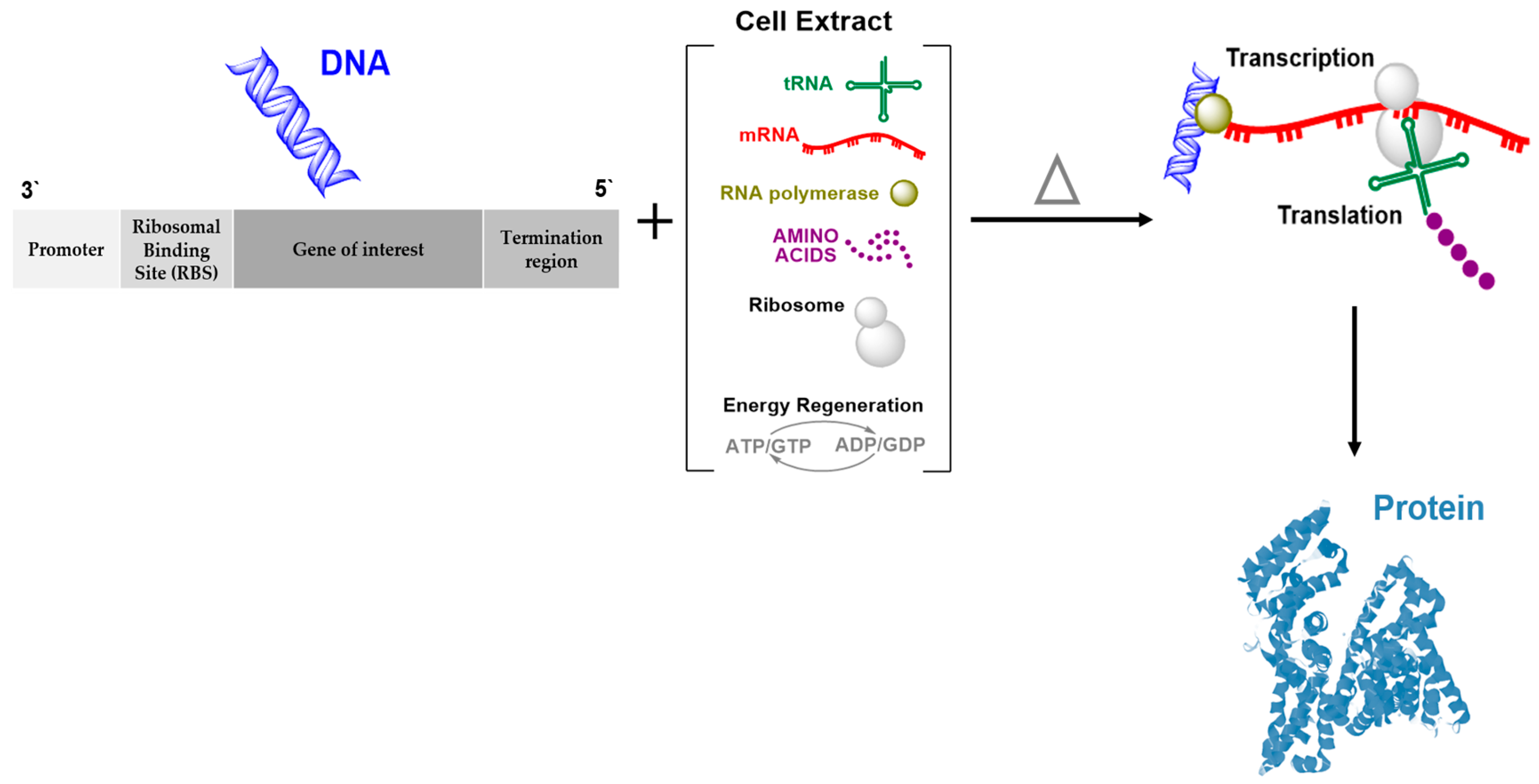
Ref:https://www.mdpi.com/2073-4425/9/3/144
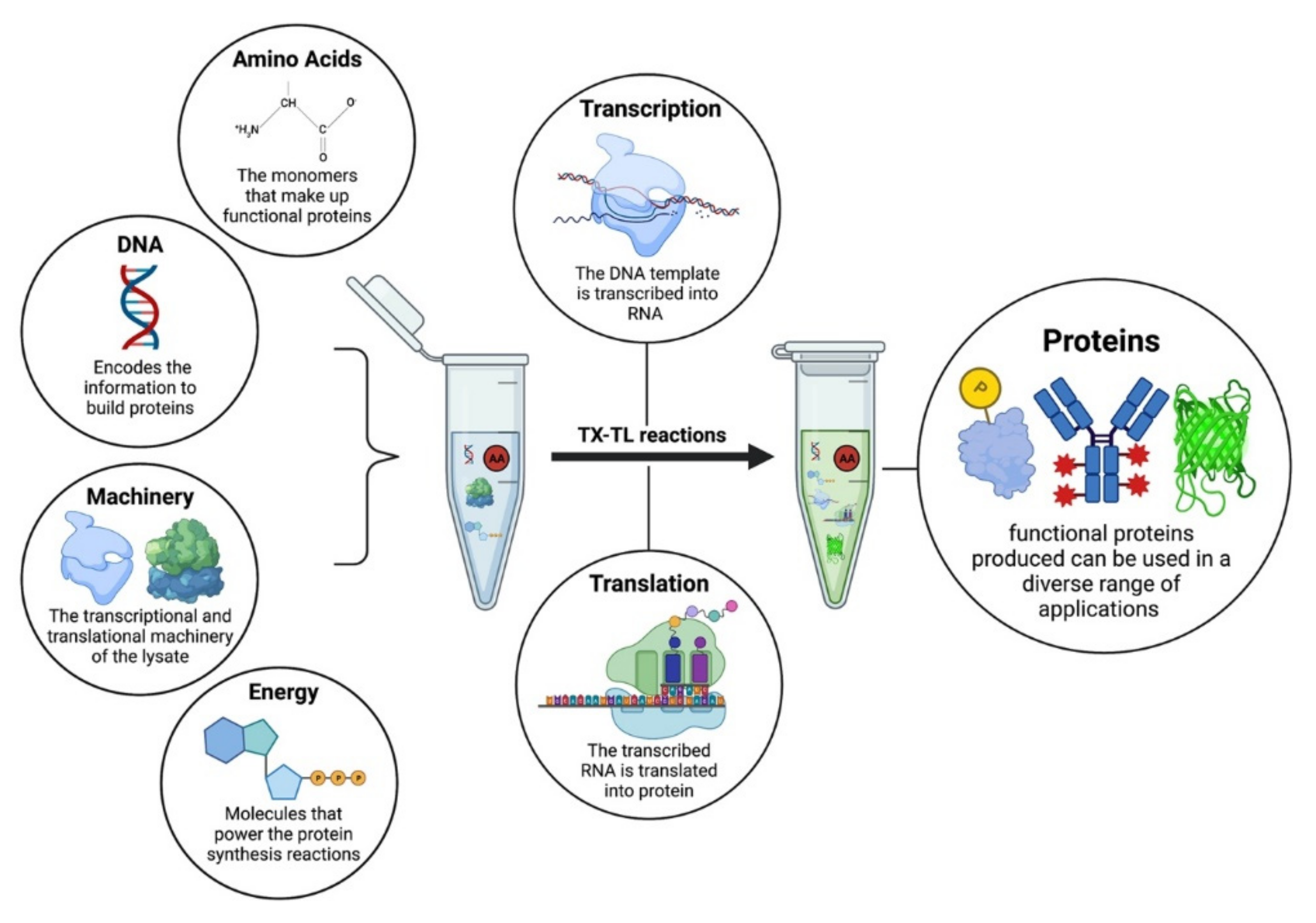
Ref:https://www.mdpi.com/2075-1729/11/12/1367
-If the goal is simply to express a fluorescent protein such as GFP in response to K⁺, this function could be partly realized by cell-free Tx/Tl alone.
Cell-free Tx/Tl is a system that can synthesize RNA and proteins from DNA in vitro, without using living cells.
目的が、K⁺に応答して GFP などの蛍光タンパク質を発現することだけであれば、cell-free Tx/Tl だけでもある程度実現できる。
Cell-free Tx/Tl は、生きた細胞を使わずに、試験管内の反応液中で DNA から RNA、タンパク質を合成できるシステムである。
https://pmc.ncbi.nlm.nih.gov/articles/PMC7211207/
-Cell-free Tx/Tl is useful when the reaction conditions need to be directly controlled.
DNA concentration, salt concentration, K⁺ concentration, Mg²⁺ concentration, and the energy system can be adjusted from outside the reaction.
This makes it suitable for testing a K⁺-responsive genetic circuit.
反応条件を直接コントロールしたい場合には、cell-free Tx/Tl は有利である。
DNA濃度、塩濃度、K⁺濃度、Mg²⁺濃度、energy system などを外から調整できるため、K⁺応答回路のテストには適している。
https://pmc.ncbi.nlm.nih.gov/articles/PMC10196276/
At the initial testing stage, where the goal is to check whether the genetic circuit responds to K⁺ and produces GFP, a bulk cell-free reaction without encapsulation would be sufficient.
In other words, cell-free Tx/Tl alone is suitable for early testing and reaction optimization.
(まず遺伝子回路が本当にK⁺に応答するかを確認する段階では、カプセル化なしの bulk solution で十分である。つまり、初期テストや条件最適化には cell-free Tx/Tl alone が向いている。)
Conditions where encapsulation would be necessary (カプセル化が必要な条件)
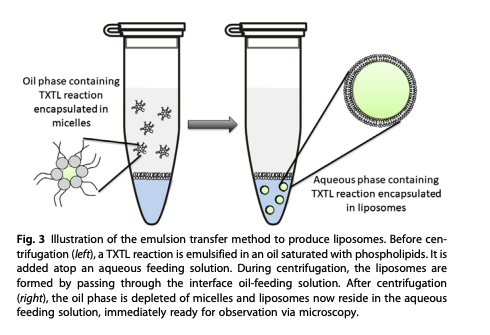
Ref: “TXTL-based approach to synthetic cells”
Jonathan Garamella, David Garenne, Vincent Noireaux
https://www.noireauxlab.org/html%20pages/docs%20website/publications/Garamella%20et%20al%20-%202019A.pdf
Encapsulation is necessary if the goal is to make a synthetic minimal cell with a cell-like boundary.
Without encapsulation, the reaction would only occur in a bulk solution, and there would be no clear distinction between inside and outside. synthetic minimal cell として「細胞のような境界」を持たせたい場合には、カプセル化が必要である。
カプセル化しない場合、反応は単なる溶液中で起こるだけで、内側と外側の区別がない。f the system is designed to receive K⁺ from an external body-derived sample and respond internally through the membrane, a compartment such as a liposome would be necessary.
This allows the artificial cell to receive an external molecular input and produce an internal output.外部の身体由来サンプルからK⁺を受け取り、膜を通して内部で応答するシステムにしたい場合には、liposome などの compartment が必要になる。
これにより、人工細胞が外部環境から input を受け取り、内部で output を作るという構造を持てる。https://www.sciencedirect.com/science/article/pii/S0958166918301629
Encapsulation is also important if each synthetic minimal cell needs to behave as an independent small reaction unit.
By placing cell-free Tx/Tl inside microcompartments, the system can mimic cell size, cellular individuality, and cell-like behavior.個々の synthetic minimal cell が、それぞれ独立した小さな反応単位としてふるまうことを示したい場合にも、カプセル化が重要である。
Cell-free Tx/Tl を microcompartment に入れることで、cell size、cell individuality、cell-like behavior を模倣できる。https://www.sciencedirect.com/science/article/pii/S0958166918301629
It is important that body-derived K⁺ enters from the “outside” and is converted into fluorescence on the “inside” of the artificial cell.
Therefore, encapsulation would be necessary for the final synthetic minimal cell design.
(身体由来のK⁺が「外側」から入り、人工細胞の「内側」で蛍光へ変換されることが重要なので、最終的にはカプセル化が必要である。)
・Technically possible(技術的には可能):
Bacteria already have mechanisms to regulate K⁺ homeostasis. For example, the KdpD/KdpE two-component system is known to regulate the expression of the K⁺ transport system, the Kdp-ATPase / kdpFABC operon.
If a K⁺-responsive circuit and a GFP reporter were introduced into a genetically modified cell such as E. coli, it may be possible to create a cell that responds to K⁺ by producing fluorescence.
細菌にはもともと K⁺ homeostasis を制御する仕組みがある。たとえば KdpD/KdpE two-component system は、K⁺輸送系である Kdp-ATPase / kdpFABC operon の発現制御に関わるシステムとして知られている。 遺伝子改変 E. coli などに K⁺応答回路と GFP reporter を入れれば、K⁺に応答して蛍光を出す細胞は作れる可能性がある。
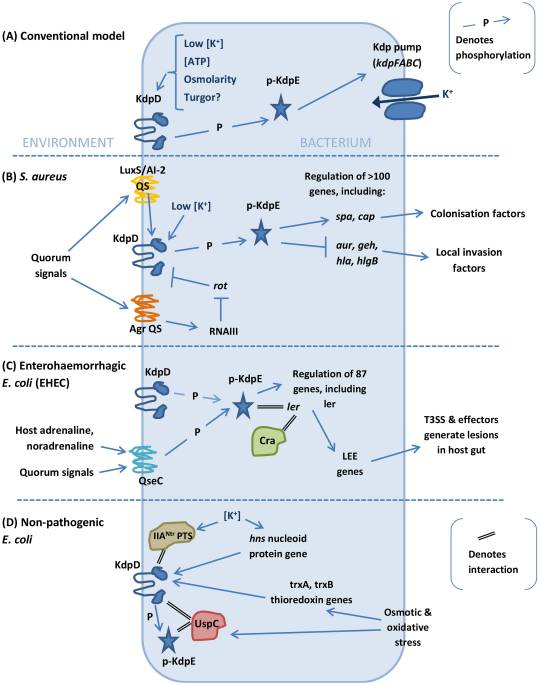
Ref:The KdpD/KdpE Two-Component System: Integrating K+ Homeostasis and Virulence
Zoë N Freeman, Steve Dorus, Nicholas R Waterfield
https://pmc.ncbi.nlm.nih.gov/articles/PMC3610689
However, a synthetic minimal cell is more suitable for the purpose of this project
(しかし今回の目的には synthetic minimal cell の方が適している)
Natural cells involve issues such as growth, metabolism, biosafety, and environmental release.
In contrast, a synthetic minimal cell can be designed as a more controlled system by extracting only the necessary sensing and expression functions. This would allow body-derived K⁺ to be converted into fluorescence inside an artificial cell.
自然細胞は増殖・代謝・安全性・環境放出の問題を持つ。
一方、synthetic minimal cell なら、必要な sensing と expression だけを取り出し、身体由来K⁺を人工細胞内部で蛍光に変換する、より制御されたシステムとして設計できる。
Scientific outcome (科学的な成果):
The synthetic minimal cell operates successfully by detecting body-derived K⁺ and visualizing it as GFP fluorescence.
身体由来K⁺を検出し、GFP蛍光として可視化する synthetic minimal cell が作動すること。
Design outcome(設計上の成果):
The external K⁺ input is converted into a fluorescent output inside the membrane-enclosed artificial cell.
外部のK⁺入力が、膜で囲まれた人工細胞の内部で蛍光出力に変換されること。
Conceptual outcome(コンセプト上の成果):
Invisible body-derived material is transformed into visible light through an artificial biological system.
見えない身体由来の物質が、人工的な生命システムを通して、目に見える光へ変換されること。
Membrane design / 膜の設計
膜は phospholipid bilayer でできた liposome / vesicle とする。
Liposome は、cell-free Tx/Tl system を封入して synthetic cell を作るためによく使われる compartment である。
https://pmc.ncbi.nlm.nih.gov/articles/PMC7613214/Phospholipid vesicle は、自然細胞の膜に近い lipid bilayer を持つため、synthetic minimal cell に「内側」と「外側」の境界を与えることができる。
https://pmc.ncbi.nlm.nih.gov/articles/PMC5518703/今回の synthetic minimal cell では、外部の身体由来K⁺を受け取り、内部でGFP蛍光に変換する必要がある。
そのため、単なる bulk solution ではなく、liposome membrane による compartmentalization が重要である。
https://pmc.ncbi.nlm.nih.gov/articles/PMC7613214/
Body-derived K⁺ comes from the “outside” and is converted into GFP fluorescence on the “inside” of the artificial cell.
(身体由来のK⁺が「外側」から来て、それが人工細胞の「内側」でGFP蛍光に変換される。)
Outside: body-derived samples such as sweat (汗などの身体由来サンプル)
Membrane(膜): the boundary of the artificial cell(人工細胞の境界)
Inside: cell-free Tx/Tl system
Output: GFP fluorescence
This structure is necessary for the design.
In other words, the phospholipid bilayer is necessary as the “boundary” of a small artificial cell that converts K⁺ into fluorescence.
つまり、リン脂質二重膜は、K⁺を蛍光に変える小さな人工細胞の「境界」として必要である。
An important point is that K⁺ does not easily pass through a phospholipid bilayer by itself. Because K⁺ is a charged ion, it cannot easily cross a pure phospholipid bilayer.
ここで重要なのは、K⁺はそのままだとリン脂質二重膜を通りにくいという点である。K⁺は電荷を持つイオンなので、純粋な phospholipid bilayer は簡単には通過できない。
Therefore, it is not enough to encapsulate the cell-free Tx/Tl system inside a liposome and create a small cell-like compartment. The synthetic minimal cell would also need a mechanism that allows K⁺ to enter from the outside to the inside.
そのため、liposome に cell-free Tx/Tl を封入して細胞に似た小さな区画を作るだけでなく、K⁺が外部から内部へ入るための 仕組みも必要になる。
I would encapsulate the complete cell-free Tx/Tl reaction system needed to express GFP after receiving K⁺.
K⁺を受け取ったあとに GFP を発現するための cell-free Tx/Tl reaction 一式を封入する。
Components to encapsulate(封入するもの):
・DNA template
This would include a K⁺-responsive genetic circuit and a GFP reporter gene. When K⁺ enters from the outside to the inside, this change would be converted into gene expression and output as GFP fluorescence.
(K⁺応答性の genetic circuit と GFP reporter gene を含む。K⁺が外部から内部に入ると、その変化が遺伝子発現に変換され、GFP fluorescence として出力される。)
・RNA polymerase
To transcribe mRNA from the DNA template.
(DNA template から mRNA を転写するため。)
・Ribosomes
To read the mRNA and synthesize proteins.
(mRNA を読み取り、タンパク質を合成するため。)
・tRNAs
To carry the amino acids corresponding to each mRNA codon to the ribosome.
(mRNA の codon に対応する amino acids を ribosome に運ぶため。)
・Amino acids
As the building blocks for proteins such as GFP.
(GFP などのタンパク質を作るための材料。)
・Nucleotides
As the building blocks for synthesizing mRNA. ATP and GTP are also involved in the energy required for transcription and translation.
(mRNA を合成するための材料。また ATP や GTP は転写・翻訳のエネルギーにも関わる。)
・Energy regeneration system
To continuously supply and regenerate ATP / GTP required for transcription and translation.
(転写・翻訳に必要な ATP / GTP を継続的に供給・再生するため。)
・Salts
To adjust the ionic environment, including Mg²⁺, K⁺, and other ions, and to support the activity of RNA polymerase and ribosomes.
(Mg²⁺、K⁺、その他のイオン環境を整え、RNA polymerase や ribosome の活性を支えるため。)
・Buffer
To stabilize the pH and maintain a reaction environment suitable for cell-free Tx/Tl.
(pH を安定させ、cell-free Tx/Tl reaction が進みやすい反応環境を保つため。)
・GFP reporter system
To generate GFP fluorescence as the output in response to K⁺ input. However, this would basically be designed as a GFP reporter gene included in the DNA template.
(K⁺入力に対する出力として、GFP fluorescence を発生させるため。ただし、これは基本的には DNA template に含まれる GFP reporter gene として設計する。)
Cell-Free Protein Synthesis: A Promising Option for Future Drug Development Srujan Kumar Dondapati, Marlitt Stech, Anne Zemella, Stefan Kubick
https://pmc.ncbi.nlm.nih.gov/articles/PMC7211207/Cell-Free Protein Synthesis: Pros and Cons of Prokaryotic and Eukaryotic Systems
Anne Zemella, Lena Thoring, Christian Hoffmeister, Stefan Kubick
https://pmc.ncbi.nlm.nih.gov/articles/PMC4676933/The KdpD/KdpE Two-Component System: Integrating K+ Homeostasis and Virulence
Zoë N Freeman, Steve Dorus, Nicholas R Waterfield
https://pmc.ncbi.nlm.nih.gov/articles/PMC3610689/
I would use a bacterial cell-free Tx/Tl system derived from E. coli.
今回は E. coli 由来の bacterial cell-free Tx/Tl system*を使う。
This is because the goal of this synthetic minimal cell is to receive K⁺ input and express GFP, and it does not require complex mammalian proteins or glycosylation. (理由は、今回の synthetic minimal cell の目的が、K⁺入力を受け取って GFP を発現することであり、複雑な哺乳類タンパク質や糖鎖修飾を必要としないためである。)
Also, since I do not plan to use a mammalian promoter system such as Tet-ON, a mammalian Tx/Tl system is not necessary. (また、Tet-ON のような mammalian promoter system も使わないため、哺乳類由来の Tx/Tl system は必要ない。)
This synthetic minimal cell receives K⁺ from an external body-derived sample, such as sweat, as its input.
However, K⁺ is a charged ion and cannot easily pass through a pure phospholipid bilayer. Therefore, the liposome membrane needs a mechanism that allows K⁺ to enter from the outside to the inside.
Possible mechanisms include a potassium channel or an ionophore.
(この synthetic minimal cell は、外部の身体由来サンプル、たとえば汗に含まれる K⁺ を input として受け取る。
しかし、K⁺は電荷を持つイオンなので、純粋な phospholipid bilayer を簡単には通過できない。そのため、liposome membrane には、K⁺が外部から内部へ入るための仕組みが必要になる。
具体的な方法としては、potassium channel、pore-forming protein、または ionophore を使うことが考えられる。)
potassium channel:
A potassium channel is a membrane protein that selectively allows K⁺ to pass through the membrane. This would be suitable for a more cell-like and selective communication system.
(K⁺を選択的に通す膜タンパク質である。より細胞らしく、選択的な communication を作る場合に向いている。)
ionophore:
An ionophore is a small molecule that binds ions and transports them across a lipid membrane. For example, valinomycin is known as a K⁺-selective ionophore and has been used to study K⁺ transport across lipid membranes.
(イオンを結合して脂質膜を横切らせる小分子である。たとえば valinomycin は K⁺に選択性を持つ ionophore として知られ、K⁺を脂質膜越しに輸送する仕組みの研究に使われている。)
For this design, the simplest option would be to use a K⁺ ionophore such as valinomycin. In a more advanced and cell-like version, a potassium channel could be incorporated into the liposome membrane.
(今回の設計では、最もシンプルには valinomycin のような K⁺ ionophore を使う案が考えられる。より cell-like な設計にするなら、liposome membrane に potassium channel を組み込む方法も考えられる。)
Ion channels form aqueous pores across lipid bilayers and allow specific inorganic ions to pass through the membrane.
https://www.ncbi.nlm.nih.gov/books/NBK26910
Valinomycin is a K⁺-selective ionophore that can transport potassium ions across lipid membranes.
https://pubs.acs.org/doi/10.1021/acs.langmuir.1c01500
Lipids / membrane components (脂質・膜の構成要素)
POPC POPC would be used as the main phospholipid component of the liposome membrane. It forms a phospholipid bilayer that creates the boundary of the synthetic minimal cell.
(POPC は、liposome membrane の主なリン脂質成分として使う。リン脂質二重膜を形成し、synthetic minimal cell の境界を作る。)
Cholesterol Cholesterol would be added to improve membrane stability and make the liposome membrane less fragile.
(Cholesterol は、膜の安定性を高め、liposome membrane を壊れにくくするために加える。)
Valinomycin Valinomycin is not a lipid, but it would be included as a K⁺ ionophore in the membrane. It would help transport K⁺ across the phospholipid bilayer.
(Valinomycin は lipid ではないが、K⁺ ionophore として膜に含める。K⁺がリン脂質二重膜を通過するのを助ける。)
Genes
K⁺-responsive regulatory element / promoter
This regulatory element would connect K⁺ input to gene expression. It could be designed based on bacterial K⁺ homeostasis systems, such as the KdpD/KdpE system or the kdpFABC regulatory region. (この制御要素は、K⁺ input を gene expression につなげるために使う。細菌の K⁺ homeostasis system、たとえば KdpD/KdpE system や kdpFABC regulatory region をもとに設計できる。)GFP reporter gene
The GFP gene would be used as the output. When the K⁺-responsive circuit is activated, GFP would be expressed and produce fluorescence. (GFP gene は output として使う。K⁺ responsive circuit が活性化されると、GFP が発現し、蛍光を発する。)Optional: potassium channel gene
In a more advanced version, a potassium channel gene could be included to express a membrane channel that selectively allows K⁺ to enter the synthetic cell. However, in the simple version of this design, valinomycin would be used instead, so this gene is optional. (より発展的なバージョンでは、K⁺を選択的に synthetic cell 内へ入れる membrane channel を発現するために、potassium channel gene を含めることもできる。
ただし、このシンプルな設計では valinomycin を使うため、この gene は optional である。)
TXTL-based approach to synthetic cells
Jonathan Garamella, David Garenne, Vincent Noireaux
https://pubmed.ncbi.nlm.nih.gov/30784403/
Preparing Protein Producing Synthetic Cells using Cell Free Bacterial Extracts, Liposomes and Emulsion Transfer
https://pmc.ncbi.nlm.nih.gov/articles/PMC7613214
The all-E. coliTXTL toolbox 3.0: new capabilities of a cell-free synthetic biology platform
David Garenne, Seth Thompson, Amaury Brisson, Aset Khakimzhan, Vincent Noireaux
https://academic.oup.com/synbio/article/6/1/ysab017/6320565
I would measure the function by detecting GFP fluorescence.
(システムの機能は、GFP fluorescence(GFP蛍光)を検出することで測定する。)
I would prepare samples with different K⁺ concentrations, such as(K⁺濃度の異なるサンプルを用意する。たとえば):
- no K⁺
- low K⁺
- high K⁺
These samples would be added outside the synthetic minimal cells.(これらのサンプルを、synthetic minimal cell の外側に加える。)
If K⁺ enters the liposome and activates the K⁺-responsive circuit, GFP will be expressed.
(K⁺が liposome の内部に入り、K⁺ responsive circuit を活性化すれば、GFP が発現する。)
The output would be measured by fluorescence microscopy or a plate reader.
(出力は、fluorescence microscopy(蛍光顕微鏡)または plate readerを使って測定する。)
I would compare the fluorescence intensity between the no K⁺ condition and the K⁺ conditions.( K⁺なしの条件と、K⁺ありの条件の蛍光強度を比較する。)
The expected result is that higher K⁺ concentration produces stronger GFP fluorescence.
期待される結果は、K⁺濃度が高いほど GFP fluorescence が強くなることである。
Homework question from Peter Nguyen
wearable biological sensor
A sweat-activated wearable biological sensor that uses freeze-dried cell-free systems embedded in textile to visualize invisible bodily stress through fluorescence or color change.
汗で起動する凍結乾燥 cell-free system を布に組み込み、見えない身体ストレスを蛍光や色変化として可視化するウェアラブル・バイオセンサー。
The freeze-dried cell-free system would be embedded into the textile as small biosensor patches.
In the dry state, the system would remain inactive, but it would be reactivated when moisture from sweat is added.
Body-derived ions such as K⁺ in sweat would act as the input, and the cell-free Tx/Tl system would express fluorescent proteins such as GFP.
As a result, invisible bodily conditions related to dehydration or heat stress would be displayed as fluorescent signals on the textile.
(凍結乾燥された cell-free system を、布の中の小さなバイオセンサーパッチとして組み込む。
乾燥状態では反応せず、汗によって水分が加わると再び活性化する。
汗に含まれる K⁺ などの身体由来イオンが入力となり、cell-free Tx/Tl system が GFP などの蛍光タンパク質を発現する。
その結果、脱水や熱ストレスに関係する見えない身体状態が、布の上の蛍光シグナルとして表示される)
This idea addresses social challenges related to heat stress, dehydration, outdoor labor, and sports safety.
Changes in sweat, such as K⁺ concentration and moisture, are related to the condition of the body, but they are usually invisible.
This wearable biological sensor would be activated by sweat and display invisible bodily changes as fluorescent signals on the textile.
This could help the wearer or people around them notice the risk of dehydration or heat stress earlier.
It could be especially useful for outdoor workers, athletes, elderly people, and children who are more vulnerable in hot environments.
このアイデアは、熱中症、脱水、屋外労働、スポーツ時の身体ストレスなどの社会的課題に対応する。
汗に含まれるK⁺や水分量の変化は、身体の状態と関係しているが、通常は目に見えない。
この wearable biological sensor は、汗によって起動し、身体の見えない変化を布の上の蛍光シグナルとして表示する。
これにより、着用者本人や周囲の人が、脱水や熱ストレスのリスクに早く気づくことができる。
特に、屋外労働者、アスリート、高齢者、子どもなど、暑熱環境でリスクの高い人々に役立つ可能性がある。
The system would be designed as a dry, replaceable patch.
It would remain inactive until sweat rehydrates it and activates the reaction.
Because the reaction may be one-time use, the patch would be replaced after activation.
このシステムは、乾燥した交換可能なパッチとして設計する。
普段は不活性で、汗によって再水和されると反応が始まる。
一回使用を前提とし、使用後は新しいパッチに交換する。
Homework question from Ally Huang
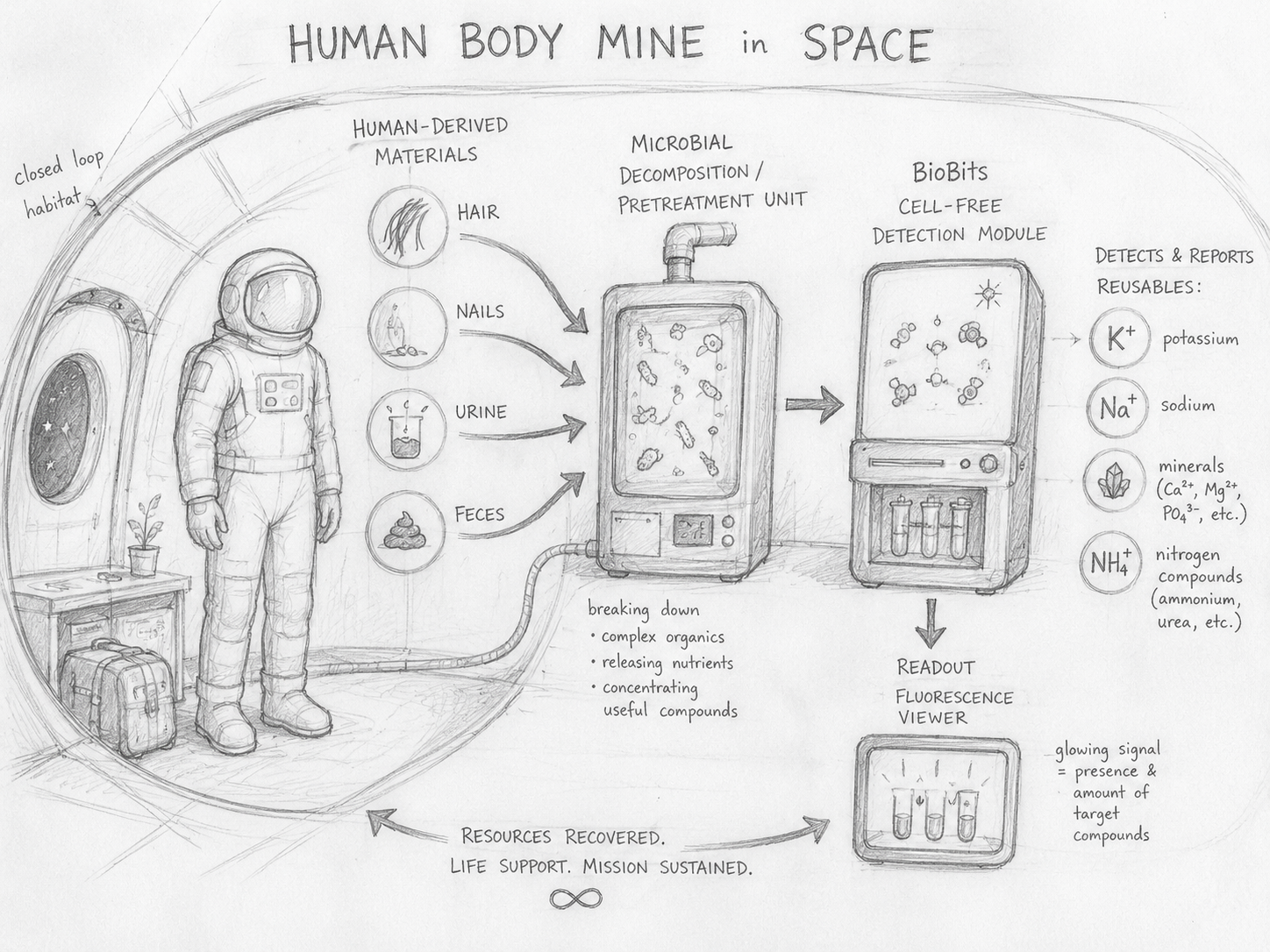
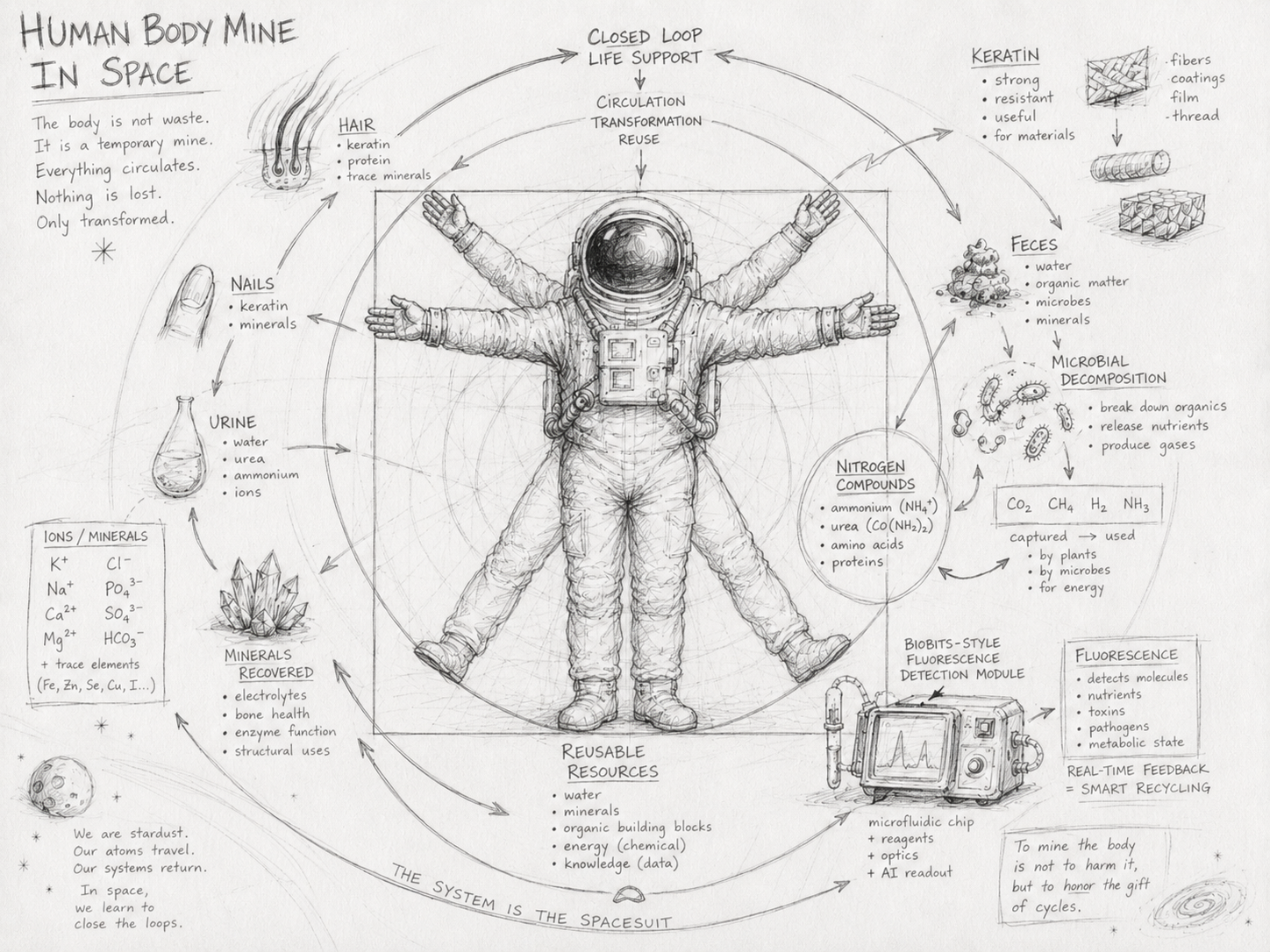
Human Body Mine in Space
This project treats human-derived waste produced inside a spacecraft, such as hair, nails, urine, and feces, as a potential resource. These materials would first be decomposed by microorganisms, and reusable ions, minerals, and nitrogen-containing compounds would then be detected using the BioBits cell-free system.
(宇宙船内で発生する髪、爪、尿、排泄物などの人体由来廃棄物を、微生物によって分解し、そこに含まれる再利用可能なイオン・ミネラル・窒素化合物を BioBits cell-free system で検出する。)
Useful components(使える要素)
Hair and nails:
Solid body-derived waste rich in keratin.(keratin を多く含む固形の身体由来廃棄物)Urine 尿:
Liquid waste containing nitrogen-containing compounds, K⁺, Na⁺, and other ions.(窒素化合物、K⁺、Na⁺などを含む液体廃棄物)Feces 排泄物:
Complex biological waste containing organic matter, minerals, and trace elements.(有機物、ミネラル、微量元素を含む複合的廃棄物)
System components
Microorganisms 微生物:
Used for decomposition and pretreatment of the body-derived waste.(分解・前処理を担う)BioBits®:
Used to detect useful components through fluorescence.(有用成分の存在を蛍光で検出する)
Significance in space:
In a closed environment where resources cannot be easily brought from Earth, waste can be read as a circular resource rather than something to discard.
(資源を持ち込めない閉鎖環境で、廃棄物を循環資源として読む)
In long-duration space missions, human-derived waste such as hair, nails, urine, and feces should not be treated only as trash. These materials contain organic matter, ions, minerals, and nitrogen-containing compounds that could become reusable resources in a closed space habitat. I propose to explore whether these body-derived materials can be decomposed by microorganisms and then analyzed using the BioBits® cell-free protein expression system. This topic is significant because future space exploration will require circular resource systems. Scientifically, it reimagines the human body as a temporary “mine” within a closed ecological environment. (88 words)
長期の宇宙ミッションでは、髪、爪、尿、排泄物などの人体由来廃棄物を、単なるゴミとして扱うべきではない。これらの物質には、有機物、イオン、ミネラル、窒素化合物が含まれており、閉鎖された宇宙居住環境では再利用可能な資源になりうる。私は、これらの身体由来物質を微生物によって分解し、その後 BioBits cell-free protein expression system を用いて分析できるかを探究することを提案する。このテーマは、将来の宇宙探査に循環型資源システムが必要になるため重要であると考える。いわば、人間の身体を閉鎖生態環境の中にある一時的な「鉱山」として再考するものである。
Option Reusable ions, minerals, and nitrogen-containing compounds released from microbially decomposed human-derived waste. 微生物分解された人体由来廃棄物から放出される、再利用可能なイオン、ミネラル、窒素化合物。
Components such as K⁺, Na⁺, Ca²⁺, Mg²⁺, ammonium, and urea contained in decomposed urine, hair, nails, and feces. 尿・髪・爪・排泄物の分解物に含まれる K⁺、Na⁺、Ca²⁺、Mg²⁺、アンモニウム、尿素などの成分。
Cell-free biosensor targets that respond to K⁺ and nitrogen-containing compounds detectable after the decomposition of human-derived waste. 人体由来廃棄物の分解後に検出可能な、K⁺や窒素化合物に応答する cell-free biosensor target。
K⁺, Na⁺, Ca²⁺, Mg²⁺, ammonium, urea, phosphate, sulfate, iron, copper, and keratin-derived peptides released from microbially decomposed urine, feces, hair, and nails. (22 words)
微生物分解された尿、排泄物、髪、爪から放出される K⁺、Na⁺、Ca²⁺、Mg²⁺、アンモニウム、尿素、リン酸、硫酸、鉄、銅、ケラチン由来ペプチド。
These targets are indicators for evaluating human-derived waste as a resource in a closed space environment. Urine and feces contain ions, minerals, and nitrogen-containing compounds, while hair and nails contain keratin-derived components.
If these materials are released through microbial decomposition, they could potentially be reused for life support, plant growth, or material recycling. By detecting these targets with the BioBits® cell-free system, waste inside a spacecraft can be reinterpreted as a circular resource rather than something to discard.
これらのターゲットは、人体由来廃棄物が宇宙船内で再利用可能な資源になりうるかを判断するための指標である。尿や排泄物にはイオン、ミネラル、窒素化合物が含まれ、髪や爪にはケラチン由来の成分が含まれる。
微生物分解によってこれらの成分が放出されれば、閉鎖環境内での資源循環に利用できる可能性がある。
BioBits cell-free system によってこれらを蛍光で検出できれば、宇宙船内の廃棄物を「捨てるもの」ではなく、回収・再利用可能な物質の供給源として評価できる。
Hypothesis(仮説)
Human-derived waste decomposed by microorganisms contains reusable resource components that can be detected by the BioBits® cell-free system.
微生物によって分解された人体由来廃棄物には、BioBits cell-free system で検出可能な再利用資源成分が含まれている。
Research goal(研究目標)
The goal is to test whether ions, minerals, nitrogen-containing compounds, and keratin-derived peptides released from microbially decomposed urine, feces, hair, and nails can be detected as fluorescent signals. These targets may include K⁺, Na⁺, Ca²⁺, Mg²⁺, ammonium, urea, phosphate, sulfate, iron, copper, and keratin-derived peptides.
尿、排泄物、髪、爪などを微生物分解したあと、そこから放出される K⁺、Na⁺、Ca²⁺、Mg²⁺、アンモニウム、尿素、リン酸、硫酸、鉄、銅、ケラチン由来ペプチドなどを、蛍光シグナルとして検出できるかを調べる。
Reasoning
Resources are limited in space, so evaluating waste as a source of reusable materials is important for long-duration missions and closed-loop life support systems.
宇宙では資源が限られており、廃棄物を再利用可能な成分として評価することが、長期滞在や閉鎖型生命維持システムに重要だから。
My hypothesis is that human-derived waste decomposed by microorganisms contains reusable resource components that can be detected by the BioBits® cell-free system. The research goal is to test whether ions, minerals, nitrogen-containing compounds, and keratin-derived components released from microbially decomposed urine, feces, hair, and nails can be detected as fluorescent signals. In a closed environment such as a spacecraft, waste should not only be processed but also reevaluated as a resource. Therefore, this research tests whether human-derived waste can be treated as part of a circular resource system. (91 words)
私の仮説は、微生物によって分解された人体由来廃棄物には、BioBits® cell-free system によって検出可能な再利用資源成分が含まれている、というものである。研究目標は、尿、排泄物、髪、爪などを微生物分解した後、そこから放出されるイオン、ミネラル、窒素化合物、ケラチン由来成分を蛍光シグナルとして検出できるかを調べることである。宇宙船のような閉鎖環境では、廃棄物を単に処理するだけでなく、資源として再評価する必要がある。そのため、この研究は、人体由来廃棄物を循環型資源システムの一部として扱えるかを検証する。
Sample:サンプル:
Liquid extracts from urine, feces, hair, and nails after microbial decomposition.
尿、排泄物、髪、爪を微生物分解した抽出液
Controls コントロール:
・Undecomposed samples. (分解していないサンプル)
・Positive controls with known concentrations of K⁺, ammonium, or other target compounds.
(K⁺やアンモニウムなど既知濃度の positive control)
・A negative control without target compounds.(ターゲットなしの negative control)
Measurement 測定:
・Fluorescence produced by the BioBits® cell-free system.
(BioBits cell-free system による蛍光)
・Fluorescence intensity would be observed using the P51 Molecular Fluorescence Viewer.
(P51 Molecular Fluorescence Viewer で蛍光強度を見る)
Expected result 期待:
Samples containing higher amounts of useful components would produce stronger fluorescence.
有用成分が多いほど蛍光が強くなる
I would test liquid extracts from microbially decomposed human-derived waste samples, including urine, feces, hair, and nails. These extracts would be added to BioBits® cell-free protein expression reactions designed to produce fluorescence in response to target compounds.
Controls would include undecomposed samples, a negative control without target compounds, and positive controls containing known concentrations of K⁺, ammonium, or urea.
Fluorescence would be measured using the P51 Molecular Fluorescence Viewer. The main data would be fluorescence intensity compared across samples and controls, indicating whether useful resource components were released by microbial decomposition.
微生物分解された人体由来廃棄物サンプル、具体的には尿、排泄物、髪、爪から得た液体抽出物をテストする。これらの抽出物を、ターゲット化合物に応答して蛍光を発するように設計された BioBits® cell-free protein expression reaction に加える。
コントロールとして、分解していないサンプル、ターゲット化合物を含まない negative control、そして既知濃度の K⁺、アンモニウム、尿素を含む positive control を用意する。
蛍光は P51 Molecular Fluorescence Viewer を使って測定する。主なデータは、各サンプルとコントロール間の蛍光強度の比較であり、微生物分解によって有用な資源成分が放出されたかを示す。
Homework Part B: Individual Final Project
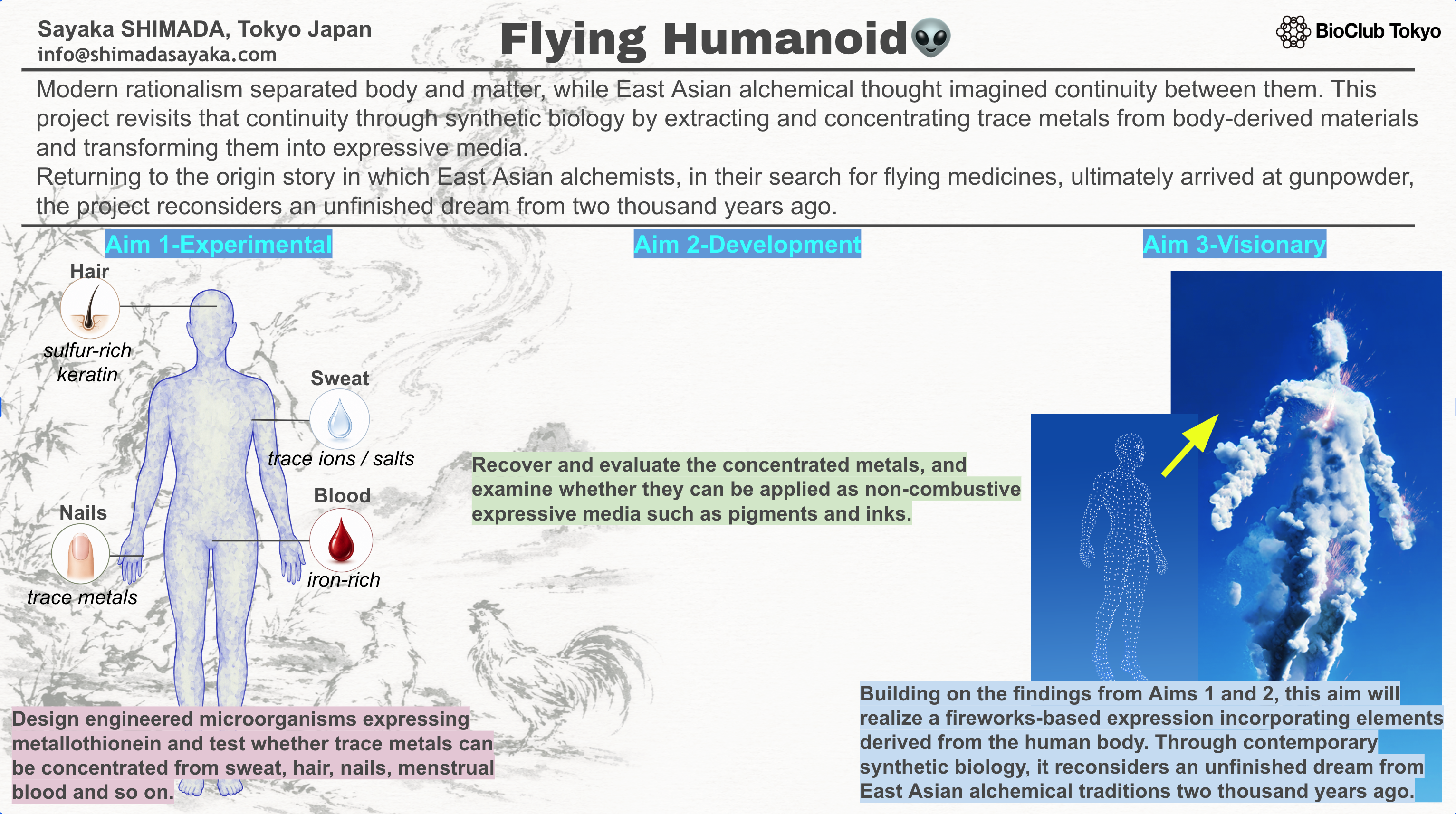
Aim 1 - Experimental:
I will design a first biological system to detect and eventually concentrate body-derived ions and trace metals from materials such as sweat, hair, nails, and menstrual blood.
As an initial test, I will use a cell-free or synthetic minimal cell system to convert body-derived ions such as K⁺ into a fluorescent signal.
In parallel, I will explore engineered microorganisms expressing metallothionein as a future strategy for concentrating trace metals from body-derived materials.
(私はまず、汗、髪、爪、経血などの身体由来物質から、身体由来イオンや微量金属を検出し、最終的には濃縮するための最初の生物学的システムを設計する。
初期実験として、K⁺ などの身体由来イオンを蛍光シグナルに変換する cell-free system、または synthetic minimal cell system を用いる。
並行して、身体由来物質から微量金属を濃縮する将来的な方法として、metallothionein を発現する遺伝子改変微生物の可能性も探る。)
Done
Planned documentation structure:
Background 背景 / Motivation 動機
Body, matter, East Asian alchemy, gunpowder, and fireworks.身体、物質、東アジアの錬丹術、火薬、花火。
Research Question 研究課題
Can body-derived materials be detected, transformed, or concentrated using synthetic biology?身体由来物質は、合成生物学によって検出・変換・濃縮できるのか。
Project Aims
Aim 1: detecting and concentrating body-derived ions and trace metals.Aim 1:身体由来イオンと微量金属の検出・濃縮。
Experimental Design 実験設計
Cell-free / synthetic minimal cell system, GFP fluorescence, and DNA construct design.Cell-free / synthetic minimal cell system、GFP蛍光、DNA construct design。
Results 結果 / Troubleshooting
Protocols, test conditions, images, fluorescence data, failures, and improvements. プロトコル、実験条件、画像、蛍光データ、失敗、改善点。Artistic Development / Future Work
Connection to pigments, inks, smoke, pyrotechnics, and the larger Flying Humanoid vision.顔料、インク、煙、花火表現、そして Flying Humanoid の大きな構想への接続。
For my first DNA order, I am considering two constructs related to Aim 1. 最初のDNA注文として、Aim 1 に関係する2つの construct を検討している。
Construct 1: GFP expression construct (GFP発現 construct)
T7 promoter → RBS → GFP → T7 terminator
This construct will be used as a basic test to confirm that the cell-free Tx/Tl system can express a fluorescent reporter.
これは、cell-free Tx/Tl system が蛍光 reporter を発現できるか確認するための基本テストとして使う。
Construct 2: K⁺-responsive GFP construct(K⁺応答性 GFP construct)
K⁺-responsive regulatory element / promoter → RBS → GFP → terminator
This construct will be used to test whether body-derived K⁺ can be converted into a GFP fluorescent signal.
This is more directly related to Aim 1, but the design of the K⁺-responsive regulatory element still needs to be confirmed before ordering.
これは、身体由来K⁺を GFP蛍光シグナルに変換できるかを調べるために使う。
Aim 1 により直接関係するが、K⁺応答性の regulatory element の設計は、注文前に確認する必要がある。
I will discuss these construct options with my Node Lead before placing the Twist order.
Twist order を出す前に、これらの construct option を Node Lead と相談する。
🧪TWIST ORDER (May 22th)🔬
For Aim 1, I originally wanted to develop a K⁺-responsive GFP system to detect body-derived K⁺. (Aim 1 では本来、身体由来K⁺を検出するための K⁺応答性GFPシステムを開発したいと考えている)However, this construct is difficult to order immediately because it requires further consideration of ….
(しかし、この construct をすぐに注文するには)
・K⁺-responsive regulatory element (K⁺応答性 regulatory element の選定 )
・Background K⁺ concentration in the cell-free system (cell-free system 内の背景K⁺濃度)
・how K⁺ would enter the vesicle. (K⁺が vesicle 内に入る仕組み)
などを検討する必要がある。
Therefore, for the first DNA order, I am considering a metallothionein expression construct that is more directly related to the concentration of trace metals from body-derived materials.
(そのため、最初の DNA order では、身体由来物質から微量金属を濃縮する方向により直接つながる metallothionein expression construct を検討する。)
🧬Construct: Metallothionein expression construct🧬
T7 promoter → RBS → metallothionein → T7 terminator
This construct would be used to express metallothionein as a first step toward binding and concentrating trace metals from body-derived materials such as sweat, hair, nails, and menstrual blood.
(この construct は、汗、髪、爪、経血などの身体由来物質から微量金属を結合・濃縮するための最初のステップとして、metallothionein を発現させるために使う。)