Week 11HW — Bioproduction & Cloud Labs
‘week-11-hw-building-genomes
Documentation
Homework: Bioproduction & Cloud Labs
Part A: The 1,536 Pixel Artwork Canvas | Collective Artwork
- Contribute at least one pixel to this global artwork experiment before the editing ends on Sunday 4/19 at 11:59 PM EST.
- A personalized URL was sent to the email address associated with your Discourse account, and you can discuss the artwork on the Discourse.
- If you did not have a chance to contribute, it’s okay, just make sure you become a TA this fall! 😉
- Make a note on your HTGAA webpages including:
- what you contributed to the community bioart project (e.g., “I made part of the DNA on the bottom right plate”)
- what you liked about the project, and
- what about this collaborative art experiment could be made better for next year.
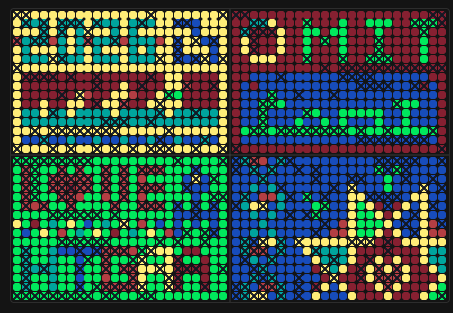
Part A: Community Bioart Project
I liked that the project allowed many people to create one artwork together through small individual actions. Even though each contribution was simple, the final image became much richer through collaboration. It was a fun and interesting way to participate in a collective bioart experiment.
I also thought it was a beautiful form of collaboration that people discussed and worked together toward one shared image.
For next year, it might also be interesting to try a different format that is less about drawing a specific picture and more based on game-like rules.
For example, it could work like a territory game, where participants form teams by node or across nodes, and pixels expand or disappear according to certain rules.
Another possibility would be to limit how participants can edit the image. Instead of drawing freely, each person could only use fixed patterns, such as a three-pixel line, a cross shape, or diagonal marks. The final image might not become a beautiful picture in the usual sense, but the process itself could become more experimental and interesting.
このプロジェクトでは、小さな個人の操作が集まって、ひとつの共同作品になるところが面白かった。
また、参加者が話し合いながら一つの形を作っていくことも、素晴らしい連携だと思った。
来年もし行うなら、あえて具体的な絵を描くのではなく、ゲーム的なルールを設けても面白いと思う。
たとえば陣取りゲームのように、ノードごと、あるいはノードを超えたチームごとに、ピクセルがルールに従って増殖・消滅する仕組みにする。
また、参加者が自由に描くのではなく、「3ピクセル直線」「十字」「斜めだけ」など、決められたパターンでしか編集できないようにしても面白いかもしれない。
完成する絵は通常の意味では美しくないかもしれないが、プロセス自体はより実験的になると思う。

I contributed to the global community bioart project and made 109 contributions, ranking 19th overall.
私は global community bioart project に参加し、109回貢献して全体で19位だった。
Part B: Cell-Free Protein Synthesis | Cell-Free Reagents
無細胞タンパク質合成
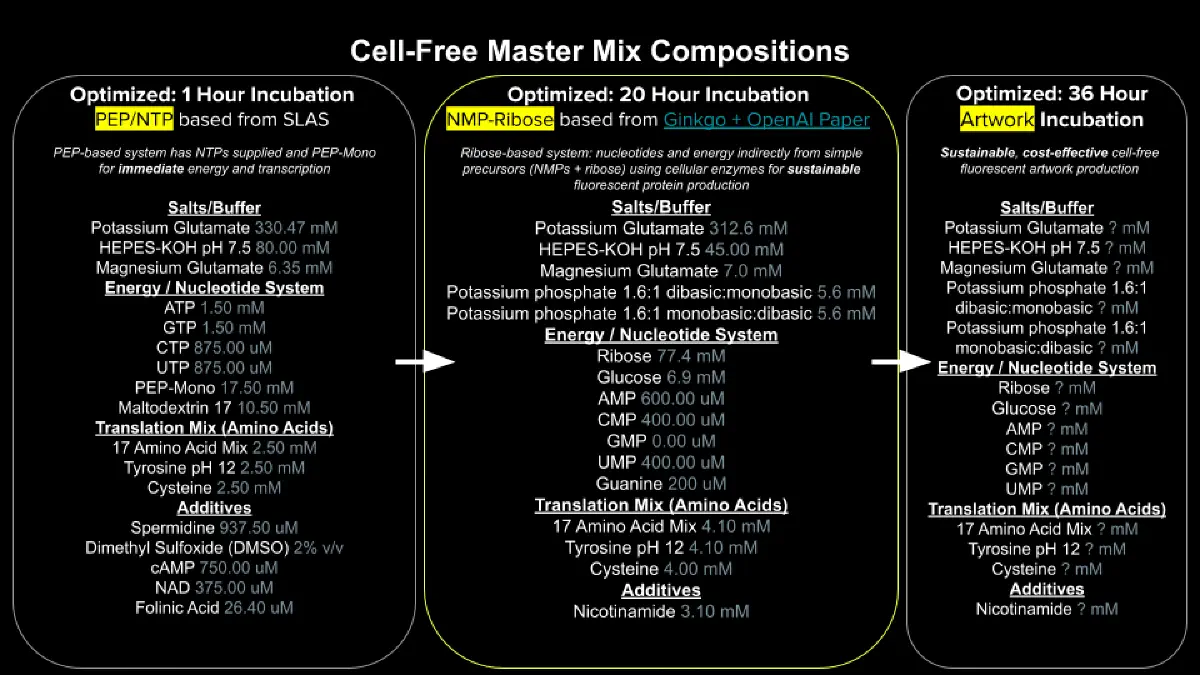
- Referencing the cell-free protein synthesis reaction composition (the middle box outlined in yellow on the image above, also listed below), provide a 1-2 sentence description of what each component’s role is in the cell-free reaction.
上の画像の 中央の黄色い枠で囲まれた cell-free protein synthesis reaction composition を参照し、それぞれの成分が cell-free reaction の中でどのような役割を持つのかを、1〜2文で説明してください。
E. coli Lysate 大腸菌ライセート
- BL21 (DE3) Star Lysate (includes T7 RNA Polymerase)
The E. coli lysate provides the cellular machinery needed for transcription and translation, including ribosomes, tRNAs, enzymes, and other factors. Because this lysate includes T7 RNA polymerase, it can transcribe DNA templates controlled by a T7 promoter.
E. coli lysate は、転写と翻訳に必要な細胞内の仕組みを提供する。これには ribosome、tRNA、酵素、その他の因子が含まれる。この lysate には T7 RNA polymerase が含まれているため、T7 promoter によって制御された DNA template を転写することができる。
Salts/Buffer
Potassium Glutamate
Potassium glutamate helps maintain ionic strength and provides potassium ions, which are important for translation and enzyme activity. It also helps mimic the intracellular environment of E. coli.
Potassium glutamate は、反応の ionic strength を維持し、translation や酵素活性に重要な potassium ions を供給する。また、E. coli の細胞内環境を模倣するのにも役立つ。
HEPES-KOH pH 7.5
HEPES-KOH acts as a buffer to keep the reaction at a stable pH. Maintaining pH around 7.5 is important because transcription and translation enzymes are sensitive to pH changes.
HEPES-KOH は buffer として働き、反応の pH を安定に保つ。転写や翻訳に関わる酵素は pH の変化に敏感なため、pH 7.5 付近を維持することが重要である。
Magnesium Glutamate
Magnesium ions are essential cofactors for many reactions in cell-free protein synthesis. They are especially important for ribosome function, nucleotide reactions, and RNA polymerase activity.
Magnesium ions は、cell-free protein synthesis における多くの反応に必要な cofactor である。特に、ribosome の機能、nucleotide reaction、RNA polymerase activity に重要である。
Potassium phosphate monobasic
Potassium phosphate monobasic contributes phosphate and potassium ions to the reaction. It also helps support buffering and energy-related phosphate chemistry.
Potassium phosphate monobasic は、反応に phosphate と potassium ions を供給する。また、buffering や energy-related phosphate chemistry を支える役割もある。
Potassium phosphate dibasic
Potassium phosphate dibasic works together with monobasic phosphate to help maintain phosphate balance and pH buffering. The ratio of monobasic and dibasic phosphate helps set the chemical environment of the reaction.
Potassium phosphate dibasic は、monobasic phosphate と一緒に働き、phosphate balance と pH buffering を維持する。monobasic と dibasic phosphate の比率は、反応の化学的環境を調整するのに役立つ。
Energy / Nucleotide System
Ribose
Ribose is a sugar component used in nucleotide metabolism. In this system, it helps support the regeneration or production of nucleotide-related molecules needed for transcription.
Ribose は、nucleotide metabolism に使われる糖成分である。この system では、transcription に必要な nucleotide-related molecules の再生や生成を支える。
Glucose
Glucose provides a carbon and energy source for the cell-free reaction. It can be metabolized by enzymes in the lysate to help regenerate energy molecules.
Glucose は、cell-free reaction に炭素源と energy source を提供する。lysate 内の酵素によって代謝され、energy molecules の再生を助ける。
AMP
AMP is a nucleotide precursor that can be converted into ATP-related molecules. It supports the nucleotide and energy system needed for transcription and translation.
AMP は nucleotide precursor であり、ATP-related molecules に変換されることがある。transcription と translation に必要な nucleotide / energy system を支える。
CMP
CMP is a cytidine nucleotide precursor. It helps provide the building blocks needed to regenerate CTP for RNA synthesis.
CMP は cytidine nucleotide precursor である。RNA synthesis に必要な CTP を再生するための building block を提供する。
GMP
GMP is a guanosine nucleotide precursor. It supports the production or regeneration of GTP, which is needed for RNA synthesis and translation. GMP は guanosine nucleotide precursor である。RNA synthesis や translation に必要な GTP の生成または再生を支える。
UMP
UMP is a uridine nucleotide precursor. It helps provide the building blocks for UTP, which is required for transcription.
UMP は uridine nucleotide precursor である。transcription に必要な UTP の building block を提供する。
Guanine
Guanine is a nucleobase that can be used in nucleotide salvage pathways. It helps support nucleotide regeneration in the reaction.
Guanine は nucleobase であり、nucleotide salvage pathway に利用される。反応内で nucleotide regeneration を支える。
Translation Mix (Amino Acids)
17 Amino Acid Mix
The 17 amino acid mix provides most of the amino acids needed to synthesize proteins. These amino acids are used by ribosomes during translation.
17 amino acid mix は、タンパク質合成に必要なほとんどの amino acids を供給する。これらの amino acids は ribosome による translation の際に使われる。
Tyrosine
Tyrosine is supplied separately because it can have solubility or stability issues in amino acid mixtures. It is still required as one of the amino acids incorporated into the protein.
Tyrosine は、amino acid mixture の中で solubility や stability の問題があるため、別に供給される。タンパク質に組み込まれる amino acid の一つとして必要である。
Cysteine
Cysteine is supplied separately because it is chemically reactive and can be unstable. It is needed for protein synthesis and may also affect folding through sulfur-containing chemistry.
Cysteine は化学的に反応性が高く、不安定になりやすいため、別に供給される。タンパク質合成に必要であり、硫黄を含む化学性質によって protein folding にも影響する可能性がある。
Additives 添加物
Nicotinamide
Nicotinamide supports cofactor-related metabolism in the lysate, especially pathways involving NAD-related chemistry. It may help sustain enzyme activity and energy regeneration during the reaction.
Nicotinamide は、lysate 内の cofactor-related metabolism、特に NAD-related chemistry を支える。反応中の酵素活性や energy regeneration を維持する助けになる可能性がある。
Backfill 体積調整用
Nuclease Free Water
Nuclease-free water is used to bring the reaction to the final desired volume. It avoids introducing nucleases that could degrade DNA or RNA templates.
Nuclease-free water は、反応を最終的な必要 volume に調整するために使われる。また、DNA や RNA template を分解する nuclease を反応に持ち込まないために使用される。
- Describe the main differences between the 1-hour optimized PEP-NTP master mix and the 20-hour NMP-Ribose-Glucose master mix shown in the Google Slide above. (2-3 sentences)
上の Google Slide に示されている 1時間反応用に最適化された PEP-NTP master mix と、20時間反応用に最適化された NMP-Ribose-Glucose master mix の主な違いを説明してください。(2~3文で)
「左の1時間用ミックス」と「中央の20時間用ミックス」は、何が違うのか? 特に、エネルギー源・ヌクレオチド供給方法・反応時間の違いを説明する
1-hour PEP-NTP mix:
The 1-hour PEP-NTP master mix uses pre-supplied NTPs and a PEP-based energy system, so it is designed for rapid transcription and protein expression over a short incubation time.
ATP/GTP/CTP/UTP などの NTPを直接入れている。また、PEP / PEP-mono を使って、短時間で強く反応させるタイプ。
→ It starts quickly, but it is not designed to sustain the reaction for a long time.
すぐ動くけど、長時間持続する設計ではない。
20-hour NMP-Ribose-Glucose mix:
The 20-hour NMP-Ribose-Glucose master mix uses NMPs, ribose, glucose, and guanine to regenerate nucleotides and energy through enzymes in the lysate. This makes the reaction more sustainable and suitable for longer cell-free protein synthesis.
NTPを直接入れるのではなく、AMP/CMP/GMP/UMP などの NMP、ribose、glucose、guanine を使い、lysate 内の代謝酵素でヌクレオチドやエネルギーを再生する
→ It is more sustainable and suitable for long-duration cell-free protein production.
より持続的で、長時間のcell-free protein productionに向いている。
Bonus question: How can transcription occur if GMP is not included but Guanine is?
GMP が含まれていないのに Guanine が含まれている場合、どうやって transcription(転写)が起こるのですか?
Ref:
An economical method for cell-free protein synthesis using glucose and nucleoside monophosphates
Kara A Calhoun 1, James R Swartz
https://pubmed.ncbi.nlm.nih.gov/16080695/
E. coli xanthine-guanine phosphoribosyltransferase(gpt)
https://www.uniprot.org/uniprotkb/P0A9M5/entry
Even if GMP is not directly included, guanine may be converted into GMP through the nucleotide salvage pathway remaining in the E. coli lysate.
GMP が直接入っていなくても、E. coli lysate に残っている nucleotide salvage pathway によって、guanine から GMP が作られる可能性がある。
Part C: Planning the Global Experiment | Cell-Free Master Mix Design
- Given the 6 fluorescent proteins we used for our collaborative painting, identify and explain at least one biophysical or functional property of each protein that affects expression or readout in cell-free systems. (Hint: options include maturation time, acid sensitivity, folding, oxygen dependence, etc) (1-2 sentences each)
共同制作のペインティングで使った 6種類の蛍光タンパク質について、それぞれ cell-free system での発現や読み取りに影響する biophysical / functional property を少なくとも1つ挙げて説明しなさい。
1. sfGFP 2. mRFP1 3. mKO2 4. mTurquoise2 5. mScarlet_I 6. Electra2
The amino acid sequences are shown in the HTGAA Cell-Free Benchling folder.
In a cell-free system, even if a protein is produced from DNA, fluorescence may not appear immediately. Therefore, the readout can be affected by the following properties. (cell-free system では、DNAからタンパク質が作られても、すぐに蛍光が見えるとは限らないので、読み取りには以下の性質が影響する。)
・maturation time
The time required after translation for the protein to form a fluorescent structure. A shorter maturation time allows the signal to appear faster.
タンパク質が翻訳されたあと、蛍光を出す構造になるまでの時間。短いほど早くシグナルが見える。
・acid sensitivity / pH sensitivity
The fluorescence may become weaker or disappear depending on the pH of the reaction mixture.
反応液のpHによって蛍光が弱くなったり消えたりすることがある。
・folding
If the protein does not fold correctly, it will not fluoresce. In cell-free systems, proteins that fold efficiently are easier to read reliably.
タンパク質が正しく折りたたまれないと、蛍光が出ない。cell-freeではfoldingしやすいタンパク質の方が安定して読める。
・oxygen dependence
Many fluorescent proteins require oxygen for chromophore maturation, so oxygen conditions can affect fluorescence development.
多くの蛍光タンパク質は chromophore maturation に酸素が必要なので、酸素条件が蛍光の発生に影響する。
・brightness
Even if the same amount of protein is produced, a brighter fluorescent protein will give a stronger signal.
同じ量のタンパク質が作られても、明るいタンパク質ほど強く見える。
・photostability
This refers to how resistant the fluorescence is to bleaching during light exposure. It can affect observation and imaging time.
光を当て続けたときに蛍光がどれくらい退色しにくいか。観察や撮影時間に影響する。
1. sfGFP
sfGFP stands for superfolder GFP. It is designed to fold efficiently, so it can produce a reliable fluorescent signal even in cell-free systems where protein folding conditions may not be perfect.
It is also reported to mature rapidly, so green fluorescence can appear relatively soon after translation.
sfGFP は superfolder GFP の略で、通常のGFPよりも折りたたみやすいように設計された蛍光タンパク質である。
sfGFP は folding しやすく設計されているため、cell-free system のように folding 条件が完全ではない環境でも reporter として使いやすい。
また、成熟が速いとされているため、翻訳後に比較的早く緑色蛍光が見えやすい。
Ref:
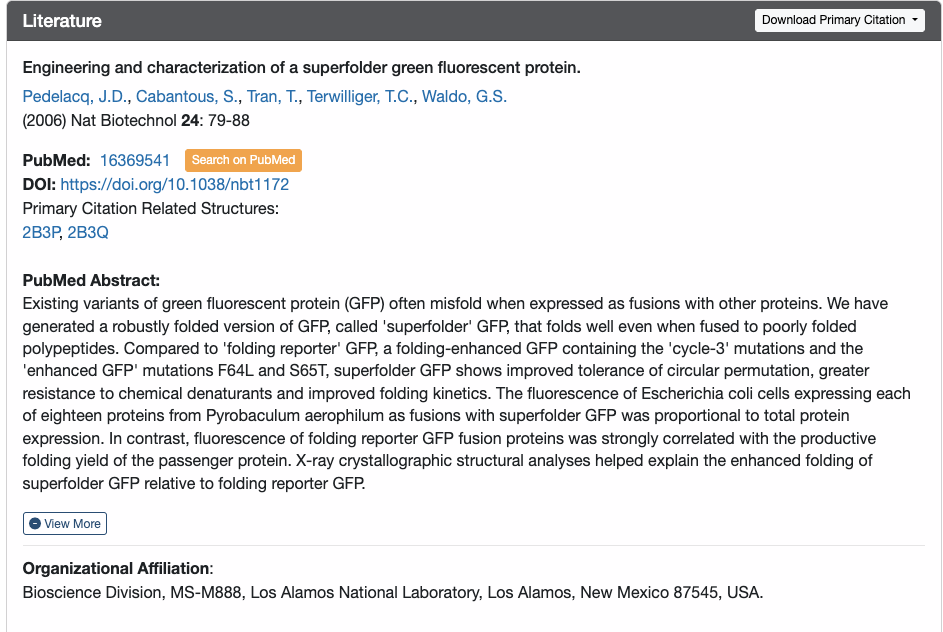
FPbase: Superfolder GFP https://www.fpbase.org/protein/sfgfp : sfGFP が very rapidly-maturing な green fluorescent protein として説明されている。
RCSB PDB: 2B3P / Crystal structure of superfolder GFP: sfGFP が、folding の悪いポリペプチドに融合してもよく折りたたまれるように作られた robustly folded GFP と記載あり。
2. mRFP1
mRFP1 is a monomeric red fluorescent protein, which makes it useful as a reporter because it is less likely to aggregate than tetrameric red fluorescent proteins.
However, it has lower brightness and photostability than DsRed, so its red fluorescence may be weaker or less stable during observation.
It also has relatively low acid sensitivity, which can make its fluorescence more stable under moderate pH variation.
mRFP1 は monomeric red fluorescent protein であり、四量体の赤色蛍光タンパク質よりも凝集しにくいため、reporter として使いやすい。
一方で、DsRed と比べると brightness や photostability が低いため、cell-free system での赤色蛍光シグナルはやや弱く見えたり、観察中に安定性が下がったりする可能性がある。
また、acid sensitivity は低いとされているため、ある程度の pH 変化に対しては蛍光が比較的安定しやすい。
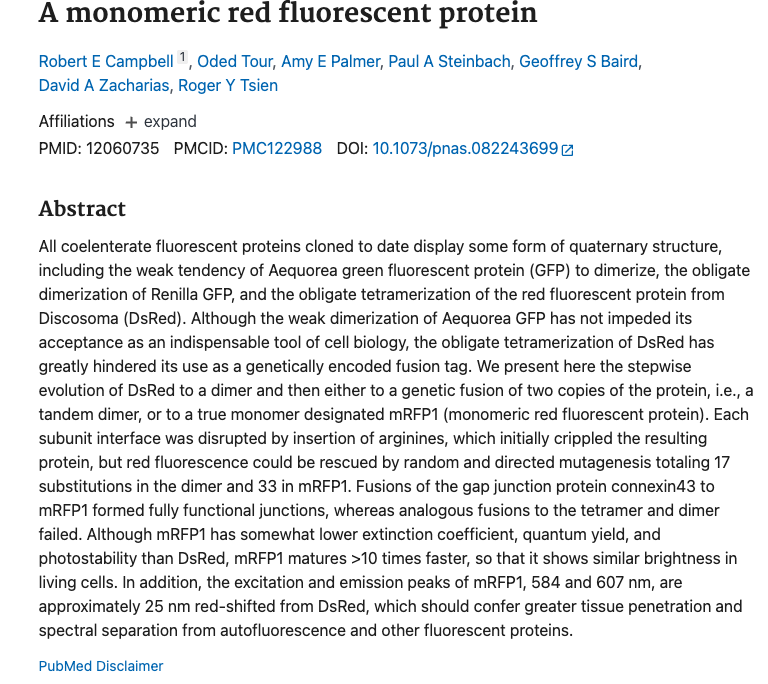
Ref: FPbase: mRFP1 https://www.fpbase.org/protein/mrfp1/ mRFP1 は Discosoma sp. 由来の赤色蛍光タンパク質で、somewhat slowly-maturing monomer、かつ low acid sensitivity と説明
Campbell et al., 2002, “A monomeric red fluorescent protein”
mRFP1 は DsRed より extinction coefficient、quantum yield、photostability が低い一方で、10倍以上速く成熟すると説明されている。
https://pubmed.ncbi.nlm.nih.gov/12060735/
3. mKO2
mKO2 is an orange fluorescent protein with relatively rapid maturation, which can help the orange fluorescence appear sooner after translation in a cell-free reaction. It also has moderate acid sensitivity, so the pH of the cell-free reaction may affect the strength of the fluorescence readout.
mKO2 はオレンジ色の蛍光タンパク質で、比較的 maturation が速いとされているため、cell-free reaction では翻訳後にオレンジ色蛍光が早く見えやすい可能性がある。 一方で、moderate acid sensitivity を持つため、反応液の pH によって蛍光強度が影響を受ける可能性がある。
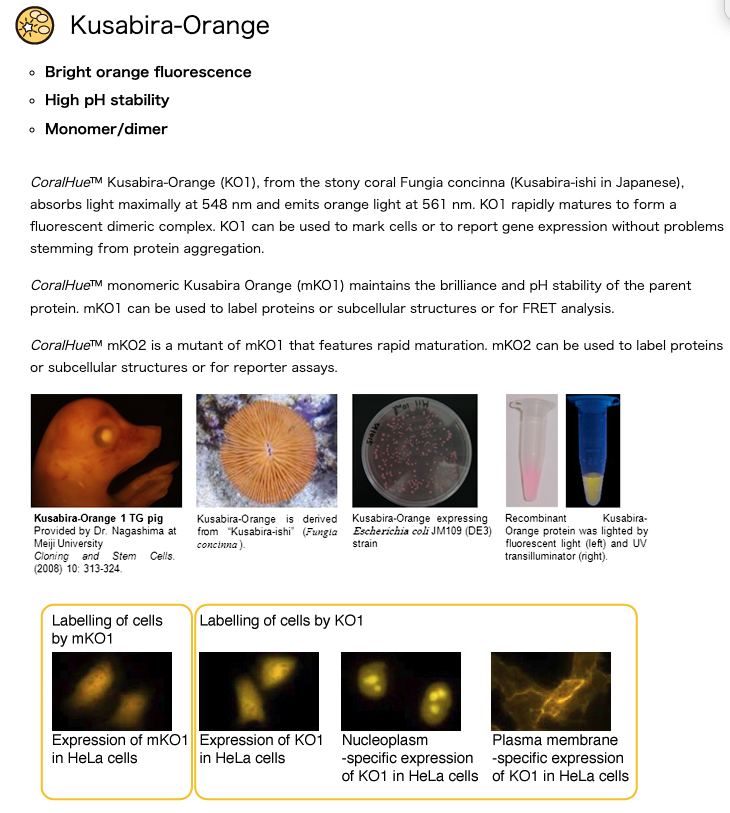
Ref:
FPbase: mKO2
MBL Life Science: Kusabira-Orange / mKO2
https://ruo.mbl.co.jp/bio/e/product/flprotein/ko.html
mKO2 は mKO1 の変異体で、rapid maturation を特徴とし、reporter assay に使える
4. mTurquoise2
mTurquoise2
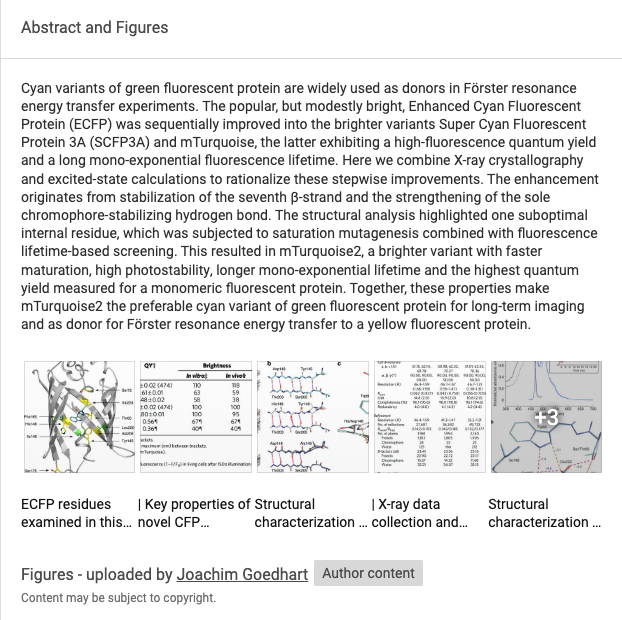
mTurquoise2 is a bright cyan fluorescent protein with faster maturation, high photostability, and high quantum yield.
These properties are useful in cell-free systems because the cyan fluorescence can appear efficiently and remain stable during observation.
mTurquoise2 は、明るく、maturation が速く、photostability が高く、quantum yield も高いシアン色蛍光タンパク質である。 cell-free system では、翻訳後に蛍光が早く見えやすく、観察中もシグナルが安定しやすい点が重要である。
brighter variant → 明るい蛍光タンパク質なので、cell-free system でシグナルが読み取りやすい。 faster maturation → 翻訳後、蛍光が見えるまでの成熟が速いので、短時間の反応でも読み取りやすい。 high photostability → 観察中に蛍光が退色しにくい。 highest quantum yield → 効率よく蛍光を出すため、強いシグナルにつながる。
Ref:
FPbase: mTurquoise2 https://www.fpbase.org/protein/mturquoise2/
Structure-guided evolution of cyan fluorescent proteins towards a quantum yield of 93%
———
5. mScarlet_I
mScarlet-I
mScarlet-I is a monomeric red fluorescent protein related to the mScarlet family, which was engineered for very high brightness and quantum yield.
In a cell-free system, high brightness is useful because it can make the red fluorescence easier to detect even if the amount of expressed protein is limited.
mScarlet-I は mScarlet 系列の単量体赤色蛍光タンパク質であり、mScarlet は高い brightness と quantum yield を持つように設計されている。
cell-free system では、発現量が少ない場合でも、蛍光タンパク質自体が明るいほど赤色シグナルを検出しやすくなる。
Ref:
FPbase: mScarlet_I https://www.fpbase.org/protein/mscarlet/
mScarlet: a bright monomeric red fluorescent protein for cellular imaging
https://experiments.springernature.com/articles/10.1038/nmeth.4074
6. Electra2
Electra2 is a blue fluorescent protein.
Blue fluorescent proteins are often less bright than fluorescent proteins in other color ranges, so the blue signal may be harder to detect in a cell-free readout.
Spectral separation from the other fluorescent proteins is also important when reading the final collaborative painting.
Electra2 は青色蛍光タンパク質である。
Blue fluorescent proteins は、他の色の蛍光タンパク質に比べて brightness が低い傾向があるため、cell-free system では青色シグナルが弱く見える可能性がある。
また、共同制作のように複数の蛍光タンパク質を使う場合、他の色との spectral separation も読み取りに影響する。
Ref:
FPbase: Electra2 https://www.fpbase.org/protein/electra2/
Dual-expression system for blue fluorescent protein optimization
https://www.nature.com/articles/s41598-022-13214-0
- Create a hypothesis for how adjusting one or more reagents in the cell-free mastermix could improve a specific biophysical or functional property you identified above, in order to maximize fluorescence over a 36-hour incubation. Clearly state the protein, the reagent(s), and the expected effect.
上で特定した蛍光タンパク質の biophysical / functional property を改善するために、cell-free mastermix の中の1つ以上の試薬を調整すると、36時間の incubation で蛍光を最大化できるという仮説を立ててください。
その際、以下を明確に書いてください。
- 対象とする蛍光タンパク質
- 調整する試薬
- 期待される効果
36時間という長い cell-free reaction で、蛍光をより強く・長く・安定して見せるには、mastermix のどの成分を調整すればよいか?
mScarlet-I
I chose mScarlet-I as the target protein.
mScarlet-I is already a bright red fluorescent protein, so I thought that if expression could be maintained for a longer time during the 36-hour cell-free artwork incubation, it could produce a stronger red fluorescence signal.
Hypothesis:
By adjusting ribose and NMPs (AMP, CMP, GMP, UMP), the reaction could maintain energy and nucleotide regeneration for a longer period, which could make mScarlet-I fluorescence stronger after 36 hours.
This is because the ribose and NMP system is important for supporting long-duration transcription and translation.
対象タンパク質として mScarlet-I を選ぶ。
mScarlet-I はもともと明るい赤色蛍光タンパク質であるため、36時間の cell-free artwork incubation では、発現を長く維持できれば強い赤色シグナルが得られると考えた。
仮説: riboseとNMPs(AMP, CMP, GMP, UMP)を調整してエネルギーとヌクレオチド再生を長く維持し、mScarlet-I の蛍光を36時間でより強くできるというものである。
ribose と NMP 系は、長時間の転写・翻訳を支えるために重要であるためである。
- The second phase of this lab will be to define the precise reagent concentrations for your cell-free experiment. You will be assigned artwork wells with specific fluorescent proteins and receive an email with instructions this week (by April 24). You can begin composing master mix compositions here. https://rcdonovan.com/cfps
このラボの第2段階では、cell-free experiment に使う 正確な reagent concentration(試薬濃度) を決めます。
あなたには、特定の蛍光タンパク質が割り当てられた artwork well が指定されます。 今週中、4月24日までに、メールで詳しい指示が届きます。
以下のサイトで、master mix composition の作成を始めることができます。
Based on my hypothesis, I used the CFPS Optimization Interface to make a preliminary master mix design.
I started from the 20-hour NMP-Ribose-Glucose master mix and slightly increased ribose and the NMP-related components.
先ほどの仮説に基づき、CFPS Optimization Interface を使って preliminary master mix design を作成した。20-hour NMP-Ribose-Glucose master mix を baseline とし、ribose と NMP 系成分を少し増やした。
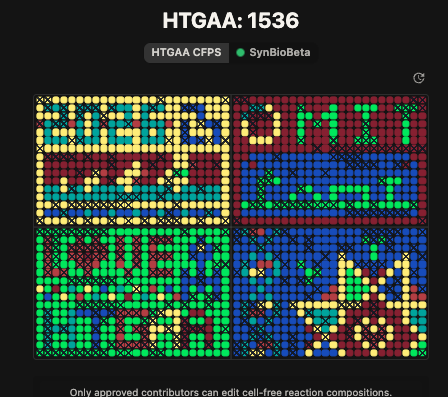
The changes were:
- Ribose: 11.625 g/L → 11.875 g/L
- AMP: 0.625 mM → 0.750 mM
- CMP: 0.375 mM → 0.500 mM
- GMP: 0 mM → 0.125 mM
- UMP: 0.375 mM → 0.500 mM
I kept the adjustment small because this was a preliminary design, not a finalized recipe. The expected effect is that sustained nucleotide regeneration could support longer transcription and translation, allowing more mScarlet-I to be produced and matured over 36 hours.
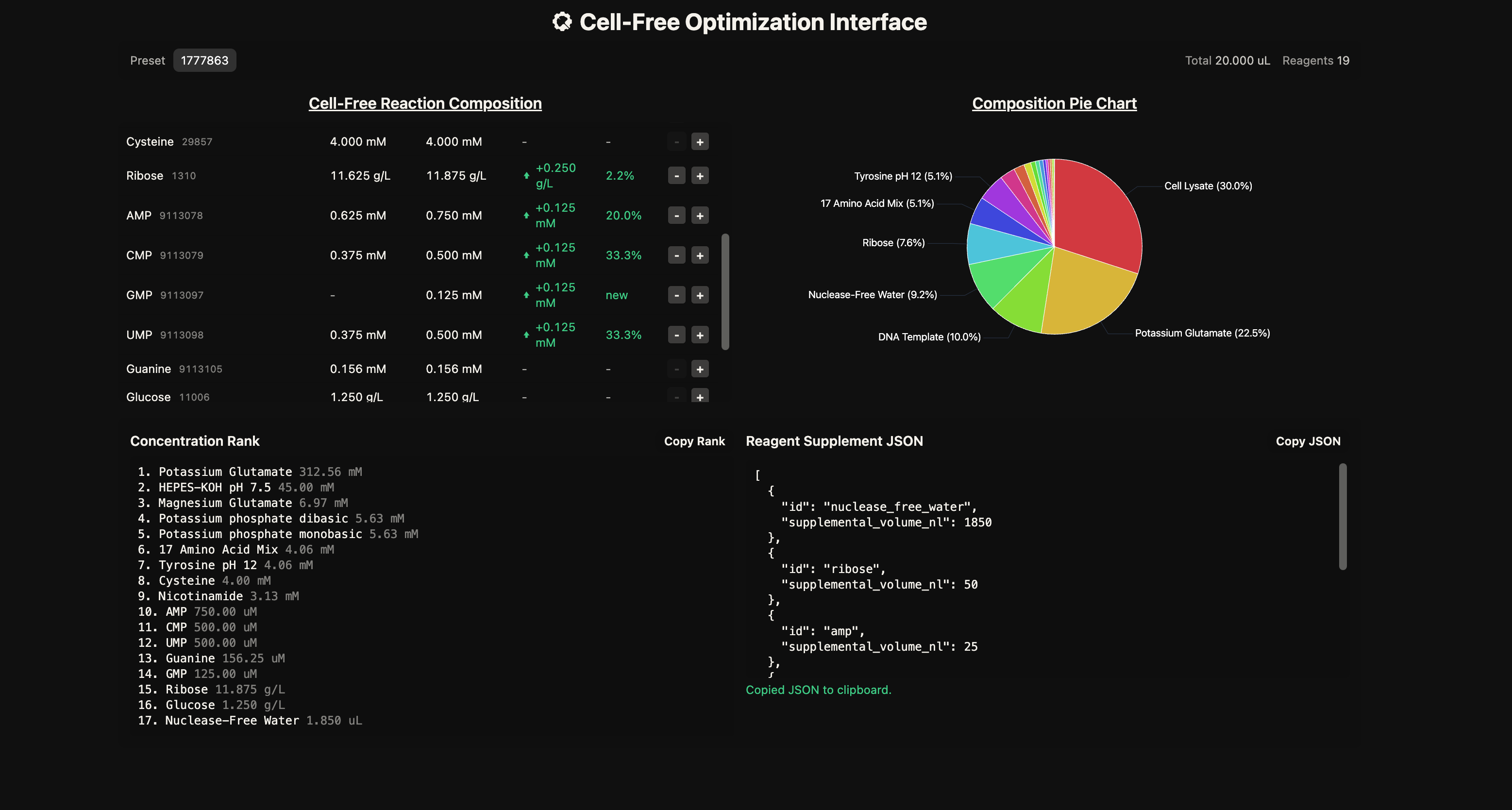
I explored the HTGAA:1536 CFPS page and understood that the completed pixel artwork is connected to cell-free reaction compositions. Some wells already showed assigned fluorescent proteins, contributors, and saved reagent conditions.
I contributed to the pixel artwork, but I was not listed as an approved CFPS contributor for editing the final reaction compositions. Therefore, I could not directly adjust or save reagent concentrations on the final artwork page. 😭
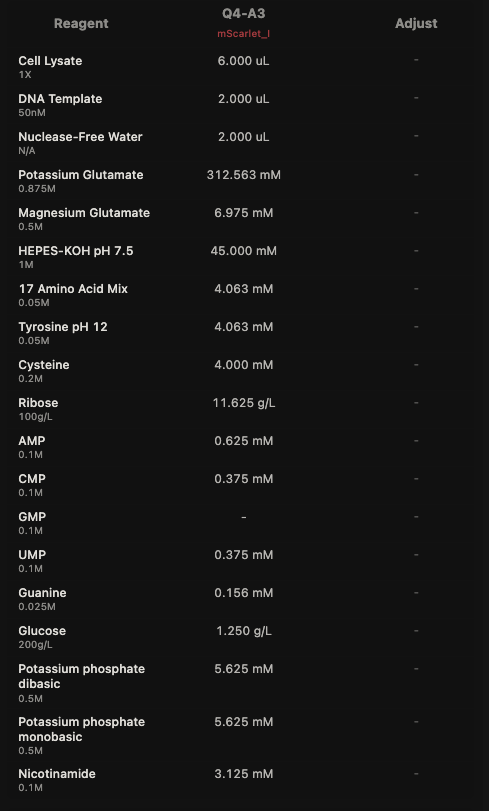
I also checked an existing finalized mScarlet-I reagent composition on the HTGAA:1536 CFPS page. Its reagent concentrations appeared to be close to the original 20-hour NMP-Ribose-Glucose baseline, before the increases I tested in my preliminary design.
実際に実行された mScarlet-I の reagent composition を確認したところ、ribose や NMP 系成分は、自分が増やす前の baseline に近い値だった。
- The final phase of this lab will be analyzing the fluorescence data we collect to determine whether we can draw any conclusions about favorable reagent compositions for our fluorescent proteins. This will be due a week after the data is returned (date TBD!). The reaction composition for each well will be as follows:
- 6 μL of Lysate
- 10 μL of 2X Optimized Master Mix from above
- 2 μL of assigned fluorescent protein DNA template
- 2 μL of your custom reagent supplements
Total: 20 μL reaction
このラボの最終段階では、収集された蛍光データを解析します。 その解析によって、各蛍光タンパク質にとって有利な reagent composition、つまりどの試薬配合がよかったのかについて、何らかの結論を出せるかを判断します。
この課題は、データが返却されてから1週間後に提出となります。 日付はまだ未定です。
各wellの reaction composition は以下のようになります。
Lysate:6 μL 上で作成した 2X Optimized Master Mix:10 μL 割り当てられた fluorescent protein DNA template:2 μL 自分の custom reagent supplements:2 μL
合計:20 μL reaction
To test my hypothesis, I would compare whether the condition with increased ribose and NMP-related components produces stronger mScarlet-I fluorescence than the baseline condition.
If the fluorescence becomes stronger, it may suggest that sustained nucleotide regeneration supported longer transcription and translation.
If there is no improvement, it may mean that ribose and NMPs were not the limiting factors, and that other factors such as pH, magnesium concentration, oxygen availability, or maturation were more important.
自分の仮説の確認のために、ribose と NMP 系成分を増やした条件が、baseline よりも mScarlet-I の蛍光を強くするかを見る。
もし蛍光が強くなっていれば、nucleotide regeneration の維持が長時間の transcription / translation を支えた可能性がある。
改善がなければ、ribose や NMPs は制限要因ではなく、pH、magnesium、酸素、maturation など別の要因が重要だった可能性がある。
Part D: Build-A-Cloud-Lab | (optional) Bonus Assignment
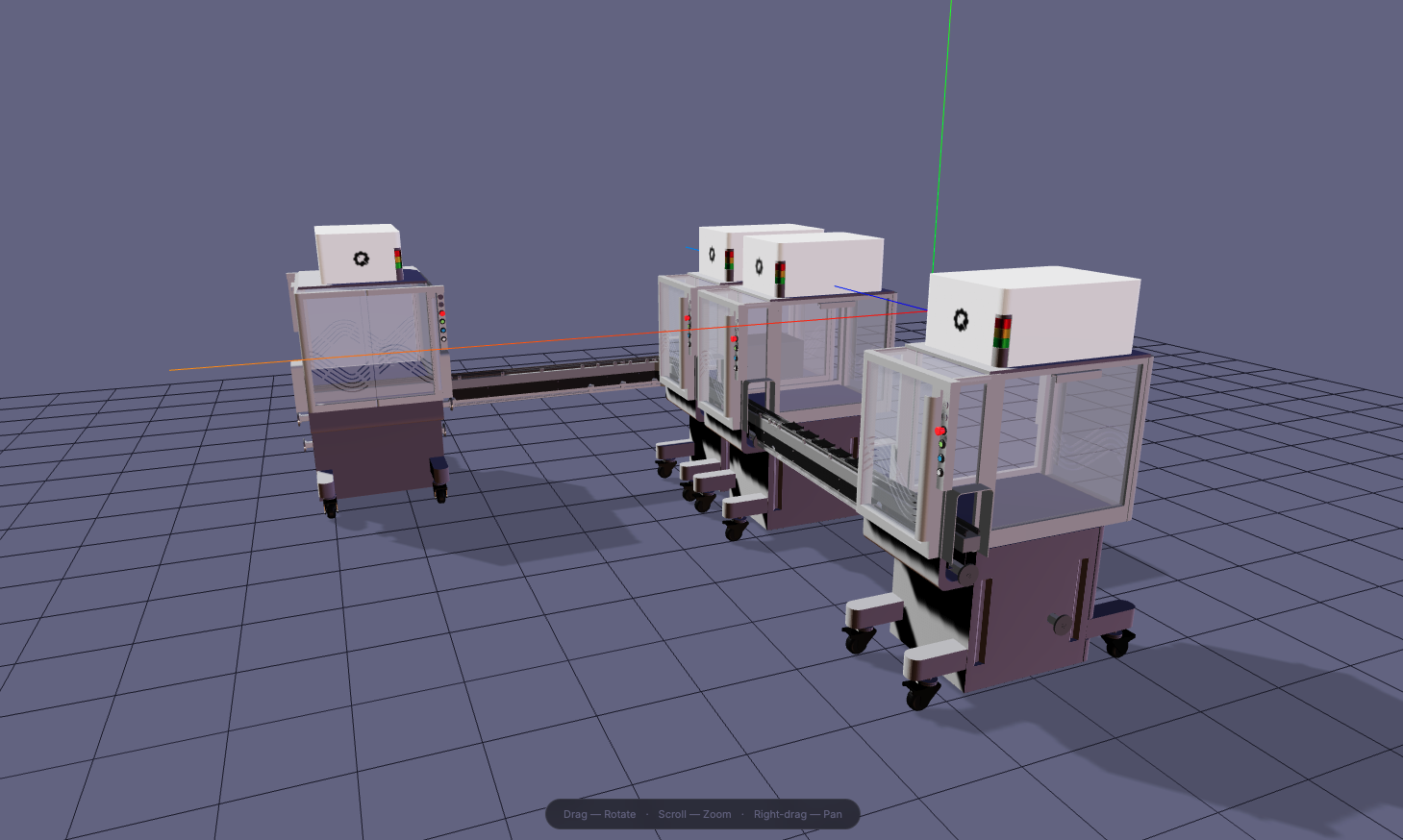
- Use this simulation tool to create an interesting looking cloud lab out of the Ginkgo Reconfigurable Automation Carts. This is just a minimal implementation so far, but I would love to see some fun designs!
Tip!!! Note from Ronan: If you are interested in helping me build out future HTGAA cloud lab software, please fill out this form!
https://docs.google.com/forms/d/e/1FAIpQLScxtSh187245nsYRNHaKn93FTUoRMPjEbNwzltEAibt90g0ew/viewform