Week 07 HW: Genetic Circuit Part 2
Part 1: Intracellular Artificial Neural Networks (IANNs)
- What advantages do IANNs have over traditional genetic circuits, whose input/output behaviors are Boolean functions?
The advantages include nonlinear and adaptive processing, instead of on/off states.
- Describe a useful application for an IANN; include a detailed description of input/output behavior, as well as any limitations an IANN might face to achieve your goal.
I will use the application I proposed in the Week 1 homework, soil microbes to optimize nitrogen release in crops in cold climates.
The input signals include sensing multiple environmental factors, such as soil nitrate levels, plant growth activity, and soil temperature. The IANN processing is weighted and nonlinear. For example, low nitrogen levels combined with active plant behaviours signal strong activation, while cold temperatures signal partial suppression. The output behaviour would regulate the expression of nitrogen-fixation genes under suitable conditions.
The limitations include the inherent noise of gene expression, as well as the limited precision of weights in complex biological systems.
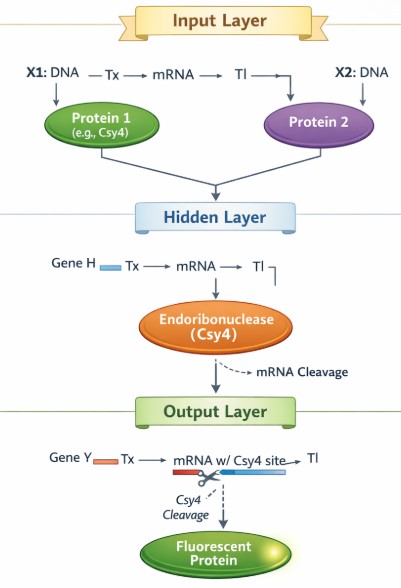
- Below is a diagram depicting an intracellular single-layer perceptron where the X1 input is DNA encoding for the Csy4 endoribonuclease and the X2 input is DNA encoding for a fluorescent protein output whose mRNA is regulated by Csy4. Tx: transcription; Tl: translation.
Got help from GenAI.
Part 2: Fungal Materials
- What are some examples of existing fungal materials and what are they used for? What are their advantages and disadvantages over traditional counterparts?
Fungal materials are primarily based on mycelium, which is the root structure of mushrooms. Sample existing materials include mycelium-based packaging and insulation. The advantage is that it is more environmentally friendly and sustainable than traditional materials, which are manufactured instead of grown. The disadvantage is its high water absorption, which makes it unsustainable in humid environments, and a lack of scalability, especially in areas that need high mechanical strength, such as buildings.
- What might you want to genetically engineer fungi to do and why? What are the advantages of doing synthetic biology in fungi as opposed to bacteria?
Genetically engineering fungi enables the development of valuable, organic materials for food and pharmaceuticals. It also provides environmental solutions when producing what we need in industrial settings. It has an advantage over bacteria because of its eukaryotic internal machinery, protein secretion, and environmental tolerance.
Part 3. Google Form is submitted https://benchling.com/s/seq-zf8zkT2ZGFf6FcWE6HLK?m=slm-EQL3nPYb1xOr3hyj9HDh