Week 3 HW: Lab automation
Part 1:
Here is the reference image that I managed to make using the opentrons art GUI:
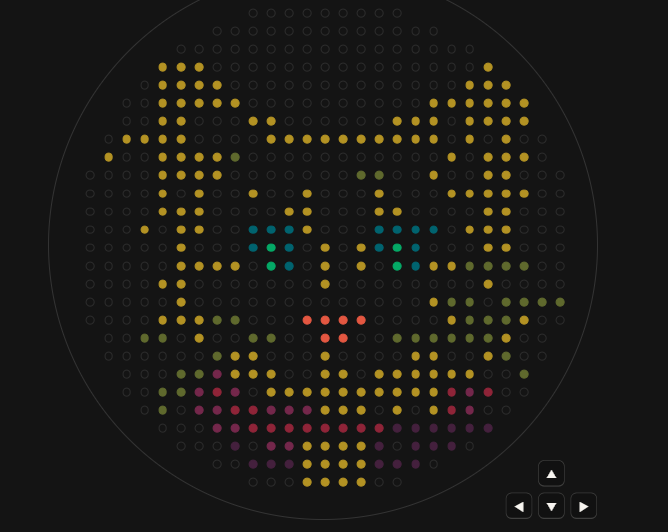
I tried my best to recreate it on my own (no ai) in colab but it didn’t work quite well:

I will most likely have fun with the python code later aswell! Maybe I’ll design an even better looking cat.
Part 2:
I found a very interesting article related to protein crystallization that uses Opentrons-2 liquid handling (you can find the whole article here: https://www.sciencedirect.com/science/article/pii/S2472630325000263)
This paper looks at how a research team used the Opentrons OT-2—an affordable liquid-handling robot—to take over one of the most tedious parts of protein research: setting up crystallization experiments. Growing protein crystals is famously slow, delicate work, and when scientists need lots of crystals that all behave the same way—for studying molecular structures or making biomaterials—the manual effort quickly becomes exhausting. The researchers wanted to know if a general-purpose robot like the OT-2 could handle this large-scale setup reliably.
A difficult part about protein crystalization automation comes from the preparation of the samples. To speed up the process, they programmed the robot in Python and modified it to work with larger 24-well crystallization plates. This wasn’t plug-and-play—they had to design and 3D-print a custom adapter and create a matching software definition so the robot would know how to handle the plates. They then put the system through three tests: mixing colored liquids to check accuracy, growing crystals of lysozyme, and crystallizing a more complex protein from Campylobacter jejuni that their lab studies as a biomaterial.
The results were better than expected. The robot could mix solutions, fill reservoirs, and set up crystallization drops accurately and consistently. When compared with plates prepared by human researchers, the robot’s plates actually produced crystals more reliably—although the robot worked a bit more slowly. Just as importantly, it spared scientists from hours of repetitive pipetting, reduced experiment-to-experiment variation, and managed most tricky steps with only small tweaks for thicker liquids or mixing needs.
In short, the study shows that a relatively inexpensive, flexible robot can take over a big chunk of protein crystallization work. That makes experiments more consistent and far less labor-intensive. For labs that don’t have the budget for specialized crystallization machines, this approach could be a practical and accessible alternative.
I’m not yet 100% sure what my final project, so for the sake of answering the question regarding lab automation in my project let’s take the fungal-material growth project. The project consists of a small automated setup for growing fungal mycelium in a controlled environment. Lab automation is important because it reduces the ammount of work keeping the conditions (like humidity, temperature, airflow, and moisture) of a certain test ideal, that would be absolute hell to do by hand. Mycellium is very sensitive, automating them should make the growth process more consistent and easier to reproduce.
The setup will include sensors that track humidity and temperature, along with a microcontroller that adjusts a humidifier, heater, and small fans to keep conditions stable. I also want to automate substrate hydration using a simple pump system, since moisture levels strongly influence how the material develops. A camera will record the growth over time, allowing me to monitor progress and analyze how different conditions affect the final material. The camera is very important since it can help me detect contamination and also measure the are covered by the fungi
All data from the sensors and the camera will be logged automatically, giving me a clear picture of how the fungus responds to different environments. By combining these elements, the project becomes a small “smart” fungal farm that can grow mycelium materials in a controlled, repeatable way.