Week 9 — Cell-Free Systems
Homework Part A: General and Lecturer-Specific Questions
General homework questions
Explain the main advantages of cell-free protein synthesis over traditional in vivo methods, specifically in terms of flexibility and control over experimental variables. Name at least two cases where cell-free expression is more beneficial than cell production.
Describe the main components of a cell-free expression system and explain the role of each component.
Why is energy provision regeneration critical in cell-free systems? Describe a method you could use to ensure continuous ATP supply in your cell-free experiment.
Compare prokaryotic versus eukaryotic cell-free expression systems. Choose a protein to produce in each system and explain why.
How would you design a cell-free experiment to optimize the expression of a membrane protein? Discuss the challenges and how you would address them in your setup.
Imagine you observe a low yield of your target protein in a cell-free system. Describe three possible reasons for this and suggest a troubleshooting strategy for each.
Advantages of cell-free protein synthesis over traditional in vivo methods in terms of flexibility and control over experimental variables
Cell-free systems offer superior flexibility because they are open, allowing direct manipulation of variables such as pH, temperature, salt concentration, redox potential, or the addition of specific inhibitors without worrying about cell viability. Furthermore, transcription and translation can be controlled orthogonally; for example, you can add RNA polymerase inhibitors without affecting translation. Two cases where cell-free expression is more beneficial than cell production are the production of membrane proteins, since detergents or nanodiscs can be added directly to the extract to avoid toxicity, and the incorporation of non-natural amino acids, because there is no competition with the endogenous cellular machinery, enabling precise control over labeling stoichiometry.
Main components of a cell-free expression system and the role of each component
A cell-free expression system requires a cell extract, which provides ribosomes, tRNAs, aminoacyl-tRNA synthetases, and translation factors; this extract typically comes from E. coli, wheat germ, or rabbit reticulocytes. The DNA template, either a plasmid or a linear PCR product, encodes the target protein and includes a promoter, ribosome binding site, open reading frame, and terminator. An energy solution containing ATP, GTP, and a regenerating system such as phosphoenolpyruvate or creatine phosphate fuels transcription and translation. Nucleotide triphosphates (ATP, CTP, GTP, UTP) serve as substrates for RNA polymerase, and a mixture of all twenty amino acids provides the building blocks for the nascent polypeptide. Finally, salts and cofactors like magnesium acetate, potassium glutamate, and cyclic AMP optimize the reaction conditions.
Why energy provision regeneration is critical in cell-free systems and a method to ensure continuous ATP supply
Energy regeneration is critical because cell-free systems lack the continuous metabolic pathways of living cells; ATP and GTP are rapidly consumed by transcription and translation, and without regeneration, the reaction halts within minutes. One reliable method to ensure continuous ATP supply is to include a secondary energy source such as creatine phosphate along with creatine kinase. As ATP is hydrolyzed to ADP, creatine kinase transfers a phosphate group from creatine phosphate to ADP, regenerating ATP. Alternatively, a glucose‑hexokinase system or a pyruvate oxidase system can be used, but the creatine phosphate system is simple, efficient, and widely compatible with both prokaryotic and eukaryotic extracts.
Comparison of prokaryotic versus eukaryotic cell-free expression systems with an example protein for each
Prokaryotic systems, typically derived from E. coli, are inexpensive, fast (2‑4 hours), and give high yields, but they lack post‑translational modifications and often fail to fold complex eukaryotic proteins. Eukaryotic systems from rabbit reticulocytes, wheat germ, or insect cells are slower and more expensive but enable disulfide bond formation, glycosylation, and proper folding of large mammalian proteins. For a prokaryotic system, a good choice is green fluorescent protein because it requires no modifications and can be monitored in real time by fluorescence. For a eukaryotic system, a better choice is a human kinase such as AKT1, which requires proper folding and phosphorylation for activity; a wheat germ or insect cell system would produce functional, phosphorylated kinase.
Design of a cell-free experiment to optimize expression of a membrane protein, including challenges and solutions
To express a membrane protein, I would use an E. coli cell‑free system supplemented with pre‑formed liposomes or nanodiscs at the start of the reaction, allowing co‑translational insertion into a lipid environment. The main challenge is aggregation and insolubility, which I would address by reducing the temperature to 20‑25°C and adding mild detergents like digitonin or DDM at their critical micelle concentration. A second challenge is the hydrophobicity of transmembrane domains causing premature termination; I would solve this by using a modified DNA template that fuses the target to a solubility tag such as MBP or GST, followed by a protease cleavage site. A third challenge is low yield due to inefficient translation of hydrophobic sequences; I would optimize the reaction by titrating magnesium and potassium concentrations and adding synthetic tRNA pools enriched for rare codons. Finally, I would measure expression by incorporating fluorescently labeled lysine or using a C‑terminal GFP fusion to monitor insertion into nanodiscs via size‑exclusion chromatography.
Three possible reasons for low yield in a cell‑free system and troubleshooting strategies for each
One reason for low yield is degradation of the DNA template by nucleases present in the extract. The troubleshooting strategy is to use a circular plasmid instead of linear DNA, or to add a nuclease inhibitor such as aurintricarboxylic acid to the reaction. A second reason is rapid consumption of energy substrates due to high ATPase activity in the extract. The solution is to increase the concentration of the energy regenerating system, for example doubling the creatine phosphate from 25 mM to 50 mM, or to pre‑incubate the extract with an ATP regenerating mixture for 15 minutes before adding the DNA template. A third reason is premature termination of translation caused by secondary structures in the mRNA or by rare codons. To fix this, you can optimize the DNA sequence by codon harmonization for the host extract, or add a pool of tRNAs corresponding to rare codons to the reaction.
Homework question from Kate Adamala
Design an example of a useful synthetic minimal cell as follows:
Pick a function and describe it.
What would your synthetic cell do? What is the input and what is the output?
Could this function be realized by cell-free Tx/Tl alone, without encapsulation?
Could this function be realized by genetically modified natural cell?
Describe the desired outcome of your synthetic cell operation.
Design all components that would need to be part of your synthetic cell.
What would be the membrane made of?
What would you encapsulate inside? Enzymes, small molecules.
Which organism your Tx/Tl system will come from? Is bacterial OK, or do you need a mammalian system for some reason? (hint: for example, if you want to use small molecule modulated promotors, like Tet-ON, you need mammalian)
How will your synthetic cell communicate with the environment? (hint: are substrates permeable? or do you need to express the membrane channel?)
Experimental details
List all lipids and genes. (bonus: find the specific genes; for example, instead of just saying “small molecule membrane channel” pick the actual gene.)
How will you measure the function of your system?
Pick a function and describe it. What would your synthetic cell do? What is the input and what is the output?
My synthetic minimal cell functions as a lactate biosensor for medical diagnostics. The input is lactate, a metabolite that rises during sepsis, hemorrhage, or intense exercise. The output is a green fluorescent protein signal that is proportional to lactate concentration. The synthetic cell detects external lactate, processes this signal through a genetic circuit, and produces GFP only when lactate exceeds a pathological threshold.
Could this function be realized by cell-free Tx/Tl alone, without encapsulation?
No, without encapsulation the entire transcription-translation system and the reporter GFP would diffuse away, and there would be no compartment to concentrate the signal or to maintain a gradient between input and output. More importantly, without encapsulation the genetic circuit cannot be isolated from environmental contamination or from degrading enzymes. The sensing specificity relies on the encapsulated system’s components being protected and confined.
Could this function be realized by genetically modified natural cell?
Yes, a genetically modified E. coli or Lactococcus strain could express a lactate-responsive promoter driving GFP. However, a natural cell would require growth conditions, would be slower to respond, and could not be easily freeze-dried or stored on a test strip. More critically, a living cell could replicate and potentially contaminate the diagnostic device, whereas a synthetic minimal cell is non-living and biosafe.
Describe the desired outcome of your synthetic cell operation
The desired outcome is a rapid, low-cost, point-of-care diagnostic where a drop of blood or sweat is added to a tube containing synthetic cells, and after one hour at room temperature, green fluorescence indicates pathological lactate levels above 2 mM, while no fluorescence indicates normal levels below 2 mM.
Design all components that would need to be part of your synthetic cell
The synthetic cell consists of a lipid membrane encapsulating a bacterial cell-free transcription-translation system, a linear DNA template encoding the lactate-responsive genetic circuit, a small molecule fluorogenic substrate if needed, and buffer components including magnesium, potassium, and an energy regeneration system.
What would be the membrane made of?
The membrane is made of a 7:3 molar ratio of DOPC (1,2-dioleoyl-sn-glycero-3-phosphocholine) and DOPG (1,2-dioleoyl-sn-glycero-3-phospho-(1’-rac-glycerol)), with 5% cholesterol to reduce membrane permeability to large molecules while allowing small molecules like lactate to diffuse freely. This composition mimics bacterial membrane fluidity while providing mechanical stability.
What would you encapsulate inside? Enzymes, small molecules
Inside I encapsulate the E. coli S30 extract containing all ribosomes, tRNAs, and translation factors; a DNA plasmid encoding the lactate sensor circuit; an ATP regeneration system consisting of creatine phosphate and creatine kinase; all 20 amino acids; NTPs; magnesium glutamate; potassium glutamate; and a small amount of the fluorogenic molecule calcein as a viability control.
Which organism your Tx/Tl system will come from? Is bacterial OK, or do you need a mammalian system for some reason?
Bacterial from E. coli is perfectly adequate here because the lactate-responsive promoter LldR from E. coli is well characterized and functions in a prokaryotic transcription system. No mammalian system is needed because we are not using eukaryotic post-translational modifications or mammalian-specific promoters. A bacterial system is also cheaper and gives higher yields.
How will your synthetic cell communicate with the environment?
The membrane is passively permeable to the input molecule lactate, which is small and uncharged, so it diffuses freely across the lipid bilayer without requiring any channel. The output molecule, GFP, is too large to diffuse out, so the signal remains inside the synthetic cell. This is actually beneficial because it concentrates the fluorescence and prevents signal dilution. Communication is one-way: lactate enters, GFP accumulates inside.
Experimental details
List all lipids and genes
Lipids: DOPC (1,2-dioleoyl-sn-glycero-3-phosphocholine) and DOPG (1,2-dioleoyl-sn-glycero-3-phospho-(1’-rac-glycerol)) in a 7:3 ratio, plus 5% cholesterol.
Genes: The genetic circuit uses the lldP promoter from E. coli, which is repressed by the LldR protein in the absence of lactate. When lactate binds to LldR, the repressor dissociates and allows transcription. Downstream of the promoter is the superfolder GFP gene (sfGFP) with a strong ribosome binding site and a T7 terminator. The LldR repressor is constitutively expressed from a second promoter on the same plasmid. Alternatively, for a simpler system, the lldPRD operon regulatory region can be used directly.
How will you measure the function of your system?
I will measure function by encapsulating the synthetic cells in water-in-oil droplets or in giant unilamellar vesicles, then adding lactate at concentrations ranging from 0 mM to 10 mM. After one hour of incubation at 30°C, I will disrupt the vesicles and measure bulk GFP fluorescence using a plate reader. For single-vesicle analysis, I will use fluorescence microscopy to count the percentage of vesicles that become GFP-positive. A negative control without lactate and a positive control with IPTG-inducible GFP will confirm circuit functionality.
This synthetic cell acts as a non-living, disposable lactate sensor that could be integrated into a bandage or a paper-based test strip without biosafety concerns. Unlike the theophylline example, this system does not require a membrane channel because lactate is naturally permeable, and it does not need a secondary bacterial reporter because GFP is directly produced inside the synthetic cell.
Homework question from Peter Nguyen
Freeze-dried cell-free systems can be incorporated into all kinds of materials as biological sensors or as inducible enzymes to modify the material itself or the surrounding environment. Choose one application field — Architecture, Textiles/Fashion, or Robotics — and propose an application using cell-free systems that are functionally integrated into the material. Answer each of these key questions for your proposal pitch:
Write a one-sentence summary pitch sentence describing your concept.
How will the idea work, in more detail? Write 3-4 sentences or more.
What societal challenge or market need will this address?
How do you envision addressing the limitation of cell-free reactions (e.g., activation with water, stability, one-time use)?
One-sentence summary pitch sentence describing your concept
We propose self-healing architectural coatings infused with freeze-dried cell-free systems that produce concrete-repairing proteins when activated by water ingress through cracks.
How will the idea work, in more detail?
The coating consists of a porous, latex-based paint embedded with freeze-dried BioBits particles containing a cell-free system programmed to produce the hydrophobic protein Mms6 from magnetotactic bacteria, which nucleates calcium carbonate precipitation. When a crack forms in the building facade, rainwater enters the crack and rehydrates the freeze-dried particles, activating transcription and translation of Mms6. The produced Mms6 then catalyzes the formation of calcite crystals that fill the crack over 24 to 48 hours, sealing it against further water entry. The coating also includes a second cell-free particle that produces a green fluorescent protein as a visual indicator, so building inspectors can shine a UV light on the facade and see which cracks have already been repaired.
What societal challenge or market need will this address?
Building maintenance is expensive and labor-intensive, with concrete cracks leading to water damage, mold, steel reinforcement corrosion, and eventual structural failure. Current repair methods require manual inspection and patching, which is impractical for skyscrapers, bridges, or remote infrastructure. This self-healing coating addresses the need for autonomous, low-maintenance building materials that extend structure lifetimes while reducing repair costs and the carbon footprint of replacement concrete. It is particularly valuable in developing regions where routine structural inspections are not feasible.
How do you envision addressing the limitation of cell-free reactions (e.g., activation with water, stability, one-time use)?
Water activation is actually an advantage here because water ingress through a crack is exactly the trigger we want. Stability is addressed by using trehalose as a lyoprotectant during freeze-drying, which keeps the cell-free particles stable at room temperature for over one year as demonstrated by the BioBits platform. The one-time use limitation is addressed by distributing millions of independent freeze-dried particles throughout the coating thickness; when a crack forms, only the particles along that crack path are activated, while deeper, unactivated particles remain dormant for future cracks. For large cracks that consume all available particles in that region, the coating can be reapplied as a maintenance spray every five years. Additionally, we incorporate a second layer of particles with a different promoter that activates only at higher water flow rates, creating a tiered response for small versus large cracks.
Homework question from Ally Huang
Freeze-dried cell-free reactions have great potential in space, where resources are constrained. As described in my talk, the Genes in Space competition challenges students to consider how biotechnology, including cell-free reactions, can be used to solve biological problems encountered in space. While the competition is limited to only high school students, your assignment will be to develop your own mock Genes in Space proposal to practice thinking about biotech applications in space!
For this particular assignment, your proposal is required to incorporate the BioBits® cell-free protein expression system, but you may also use the other tools in the Genes in Space toolkit (the miniPCR® thermal cycler and the P51 Molecular Fluorescence Viewer). For more inspiration, check out genesinspace.
Provide background information that describes the space biology question or challenge you propose to address. Explain why this topic is significant for humanity, relevant for space exploration, and scientifically interesting. (Maximum 100 words)
Name the molecular or genetic target that you propose to study. Examples of molecular targets include individual genes and proteins, DNA and RNA sequences, or broader -omics approaches. (Maximum 30 words)
Describe how your molecular or genetic target relates to the space biology question or challenge your proposal addresses. (Maximum 100 words) Clearly state your hypothesis or research goal and explain the reasoning behind it. (Maximum 150 words)
Outline your experimental plan - identify the sample(s) you will test in your experiment, including any necessary controls, the type of data or measurements that will be collected, etc. (Maximum 100 words)
Background information (maximum 100 words)
During long-duration space missions, astronauts suffer from immune dysregulation, making them vulnerable to reactivation of latent viruses like Epstein-Barr virus (EBV) and herpes simplex. Current detection methods require sample return to Earth or bulky PCR equipment with cold-chain reagents. A rapid, low-resource method to detect viral reactivation from saliva or blood would enable early intervention. This is significant for crew health on Mars missions where resupply is impossible. Scientifically, it tests whether freeze-dried cell-free sensors can function in microgravity and high-radiation environments, a prerequisite for distributed space diagnostics.
Molecular or genetic target (maximum 30 words)
Viral DNA sequences: EBV Balf5 gene and HSV-1 UL30 gene. Also, human housekeeping gene GAPDH as a sample quality control.
How the molecular target relates to the space biology challenge (maximum 100 words)
During viral reactivation, viral DNA copies appear in saliva before symptoms manifest. The Balf5 and UL30 genes are highly conserved, early-expressed viral polymerase genes, making them sensitive detection targets. By designing sequence-specific toehold switches in the BioBits system, viral DNA triggers cell-free protein synthesis of a fluorescent reporter. The GAPDH target confirms that human sample material is present and intact, ruling out false negatives from poor sample collection. This approach directly measures the molecular event of reactivation rather than downstream antibodies or symptoms.
Hypothesis or research goal with reasoning (maximum 150 words)
Hypothesis: Freeze-dried BioBits reactions containing RNA toehold switches specific to EBV Balf5 and HSV-1 UL30 can detect as few as 100 copies of viral DNA per microliter in astronaut saliva samples within 60 minutes, with no false positives from human genomic DNA or common oral microbes.
Goal: To validate this cell-free viral detection system under space-relevant conditions using a thermal cycler for isothermal amplification and a fluorescence viewer for readout.
Reasoning: Traditional PCR in space requires complex sample preparation and cold storage. Toehold switch sensors in freeze-dried cell-free systems eliminate cold chain and work at body temperature. By coupling recombinase polymerase amplification (RPA) on the miniPCR to amplify viral DNA, followed by addition to BioBits sensors, sensitivity reaches single-copy levels. This two-step system converts genetic information into a visual fluorescence signal without living cells, making it safe and storable for years. If successful, astronauts could self-test weekly for viral reactivation using a finger-prick of blood or a saliva swab.
Experimental plan (maximum 100 words)
Samples: Saliva from healthy donors spiked with synthetic EBV and HSV-1 DNA fragments at 0, 10, 100, and 1000 copies per microliter. Controls: no-DNA blank, human genomic DNA only, and bacterial DNA (S. salivarius). All samples will undergo RPA at 39°C for 20 minutes on the miniPCR, then 5 microliters of amplified product will be added to freeze-dried BioBits toehold switch reactions. Fluorescence will be measured at 60 minutes using the P51 Molecular Fluorescence Viewer with blue light excitation and a green emission filter. Each condition will be run in triplicate.
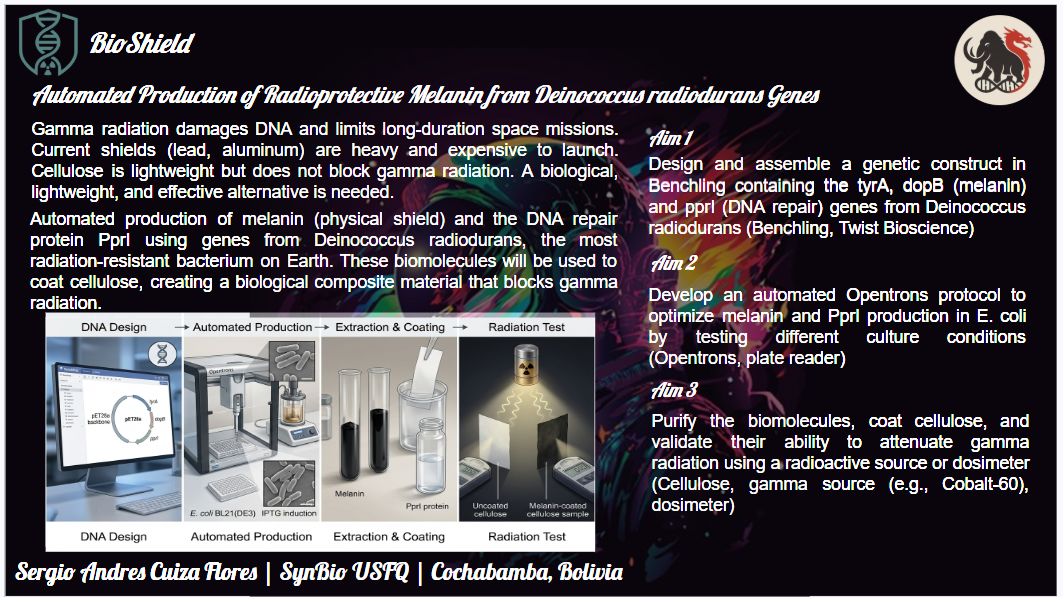
Homework Part B: Individual Final Project
My final project idea is called BioShield. BioShield is a bioengineering project that develops a lightweight, biological radiation shield using microbial melanin and the PprI protein from Deinococcus radiodurans. The shield is made by coating cellulose paper with purified melanin (absorbs gamma rays) and PprI (scavenges free radicals). The genetic construct has been designed in Benchling, and the final project slide has been submitted as required.